
At first glance, the Snapdragon 7+ Gen 3 might seem like a generation behind the Snapdragon 8 Gen 1, but in reality, the story is completely different. The former boasts stronger CPU and GPU performance, whereas the latter gets advantage in terms of a higher peak download speed and higher resolution video recording.
Here, we’ll compare the Snapdragon 7+ Gen 3 and Snapdragon 8 Gen 1, diving into their benchmark details to see how the two chips stack up against each other.
Let’s begin with the spec sheet:
| Snapdragon 7+ Gen 3 | Snapdragon 8 Gen 1 | |
|---|---|---|
| Announced | March 2024 | December 2021 |
| Process node | 4nm | 4nm |
| Manufacturer | TSMC | Samsung |
| Cores | 8 | 8 |
| CPU architecture | 1 x Cortex-X4 @ 2.8 GHz 4 x Cortex-A720 @ 2.6 GHz 3 x Cortex-A520 @ 1.9 GHz | 1 x Cortex-X2 @ 3 GHz 3 x Cortex-A710 @ 2.5 GHz 4 x Cortex-A510 @ 1.8 GHz |
| GPU | Adreno 732 Snapdragon Elite Gaming | Adreno 730 Snapdragon Elite Gaming |
| NPU | Hexagon NPU | Hexagon NPU |
| Camera | Spectra 18-bit triple ISPs Up to 200MP single camera Up to 4K/60FPS recording | Spectra 18-bit triple ISPs Up to 200MP single camera Up to 8K/30FPS video recording |
| RAM Storage | LPDDR5X — 4200 MHz UFS 4.0 | LPDDR5 RAM — 3200 MHz UFS 3.1 |
| Connectivity | Snapdragon X63 5G modem Downlink: 5 Gbps Uplink: 3.5 Gbps Qualcomm FastConnect 7800 Wi-Fi 7 (peak speed: 5.8 Gbps) Bluetooth 5.3 | Snapdragon X65 5G modem Downlink: 10 Gbps Qualcomm FastConnect 6900 Wi-Fi 6E (peak speed: 3.6 Gbps) Bluetooth 5.3 |
Snapdragon 7+ Gen 3 vs 8 Gen 1: Benchmark comparison
[Note: We’ve tested Realme GT 6T (powered by Snapdragon 7+ Gen 3) and Realme GT 2 Pro (powered by Snapdragon 8 Gen 1) for benchmark results.]AnTuTu comparison
AnTuTu is a popular benchmarking tool for measuring different aspects of a device, such as CPU, GPU, memory, and UX performance. The total AnTuTu score represents the overall strength of a device.
Here’s how the Snapdragon 7+ Gen 3 and 8 Gen 1 have performed:
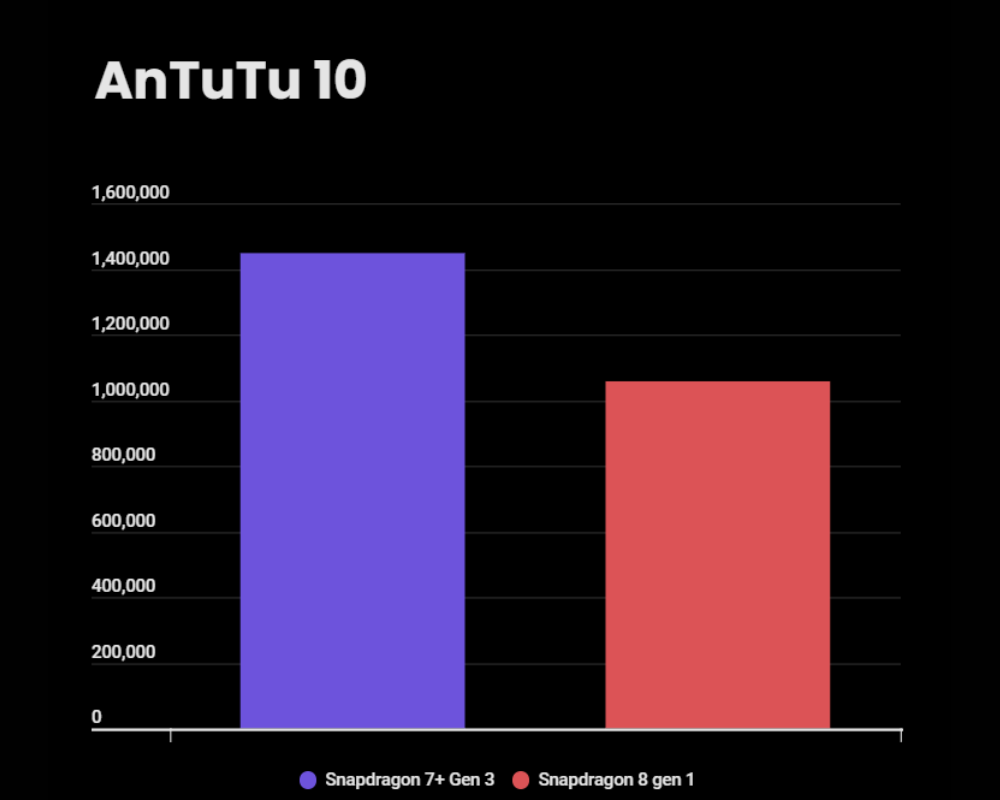
The Snapdragon 8 Gen 1 is nowhere close to 7+ Gen 3 on AnTuTu. It has scored just over a million AuTuTu points, whereas the Snapdragon 7+ Gen 3 has an AnTuTu score close to 1.5 million.
Here’s the breakdown of AnTuTu score:
| SD 7+ Gen 3 | SD 8 Gen 1 | |
|---|---|---|
| AnTuTu score | 1,448,293 | 1,057,645 |
| CPU | 376,122 | 291,119 |
| GPU | 488,799 | 370,425 |
| Memory | 334,990 | 169,641 |
| UX | 248,382 | 226,460 |
Geekbench comparison
Geekbench is a popular benchmarking tool for measuring the CPU capabilities of devices. The single-core score tells the CPU performance when a single core is at work, and the multi core score shows the performance when all cores are at work.
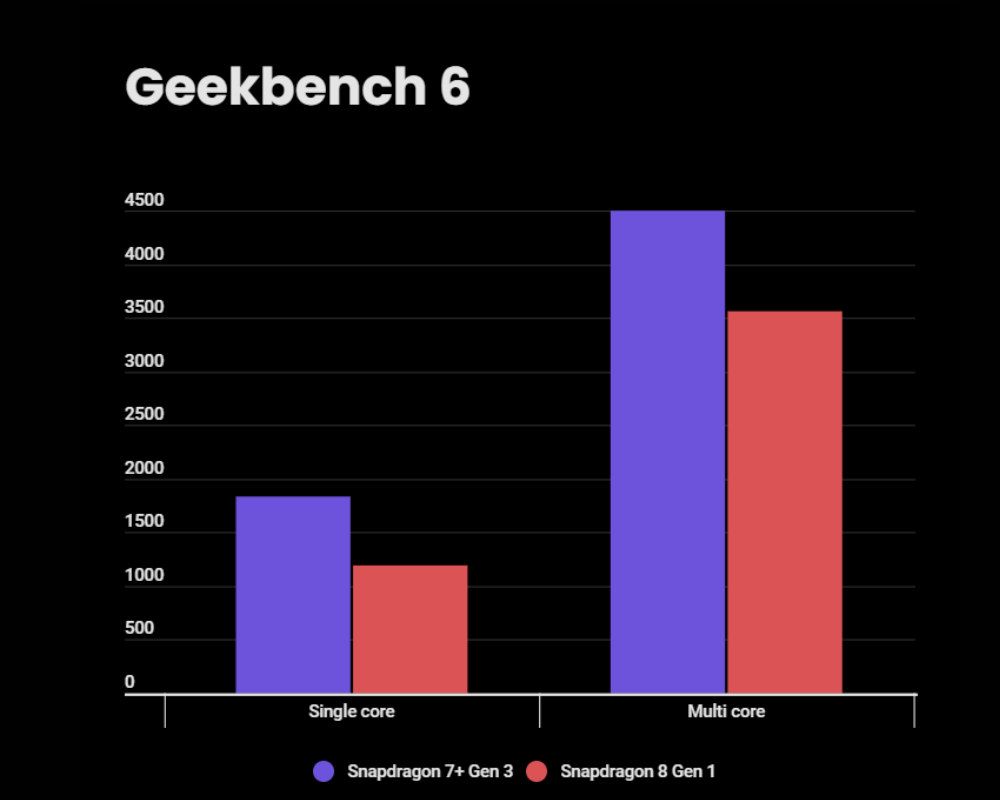
The Snapdragon 7+ Gen 3 crushes the Snapdragon 8 Gen 1 on Geekbench as well, thanks to powerful and efficient CPU cores.
| SD 7+ Gen 3 | SD 8 Gen 1 | |
|---|---|---|
| Single core | 1,834 | 1,192 |
| Multi core | 4,498 | 3,561 |
Snapdragon 7+ Gen 3 vs 8 Gen 1: Key differences
Both chips are fabricated on a 4nm process node, but there’s a key difference in manufacturing. The Snapdragon 7+ Gen 3 is built by TSMC, while the Snapdragon 8 Gen 1 is produced by Samsung, leading to significant variations in performance.
Many 8 Gen 1 phones have heating issues, which leads to poor sustained performance. This problem is largely attributed to Samsung’s 4nm process node. The 7+ Gen 3 doesn’t struggle with heating issues and performance drops, thanks to TSMC’s highly-efficient and advanced manufacturing technology.
The two chips also have different CPU configurations. The 7+ Gen 3 brings one Cortex-X4 prime core clocked at 2.8GHz, four Cortex-A720 performance cores at 2.6GHz, and three Cortex-A520 efficiency cores at 1.9GHz. The 8 Gen 1 has one Cortex-X2 core at 3GHz, three Cortex-A710 cores at 2.5GHz, and four Cortex-A510 cores at 1.8GHz.
Another factor that contributes to better performance on 7+ Gen 3 is faster UFS 4.0 storage and LPDDR5X RAM at 4200MHz, while the 8 Gen 1 supports UFS 3.1 and LPDDR5 RAM at 3200MHz.
While the Snapdragon 7+ Gen 3 has a lower peak CPU frequency, it has highly-efficient and powerful cores than 8 Gen 1, which also reflects on benchmarks. The graphics performance is also better on the 7+ Gen 3, thanks to Adreno 732 (vs. Adreno 730 on 8 Gen 1).
Both chips have similar imaging capabilities, except for video recording. The 8 Gen 1 lets you record up to 8K/30fps, while the 7+ Gen 3 limits at 4K/60fps.
There isn’t a clear winner on the connectivity front, though. The 7+ Gen 3 has a Snapdragon X63 5G modem with up to 5Gbps peak download speed, whereas the X65 5G modem on the 8 Gen 1 offers 10Gbps peak download speed. The coin flips when you switch to Wi-Fi connection, as 7+ Gen 3 with Wi-Fi 7 offers up to 5.8Gbps speed, while the 8 Gen 1 with Wi-Fi 6E peaks at 3.6 Gbps.
Snapdragon 7+ Gen 3 vs 8 Gen 1: Conclusion
The Snapdragon 7+ Gen 3 has faster and more efficient CPU cores than those in Snapdragon 8 Gen 1. It also has a faster GPU. So, whether you do everyday stuff like surfing the internet or scrolling through social media feeds, or playing your favorite games, the Snapdragon 7+ Gen 3 will smoothly handle your processing needs.
The Snapdragon 7+ Gen 3 also supports faster RAM and storage, which adds to better performance. Other aspects such as camera capabilities and connectivity features are excellent on both chips.
It’s pretty clear that the Snapdragon 7+ Gen 3 is much better than the Snapdragon 8 Gen 1.
Snapdragon 7+ Gen 3 phones:
Snapdragon 8 Gen 1 phones:





Comments