Add GIZMOCHINA as Preferred Source on Google
The 2025 Lenovo Yoga 9i 2-in-1 Aura Edition is one of those laptops that quietly wins you over the longer you use it. I’ve been testing it for well over a month now, and during that time, it accompanied me through launch events, flights, hotel stays, editing sessions, and long workdays. I haven’t personally used many competing premium 2-in-1 laptops recently, so I can’t directly compare them against every rival out there. But after spending this much time with it, I genuinely feel this is one of the best premium convertibles currently available.
The unit I tested comes with Intel’s Lunar Lake platform, a 14-inch 2.8K OLED touchscreen, and rotating hinge speakers. On Lenovo India’s website, this configuration is priced at Rs 1,74,005, firmly placing it in premium territory.
5Windows touch still needs refinement
Lenovo has added a feature called Circle-to-Do, which I actually found useful over time.
If you swipe inward from the left side of the screen, you can activate the feature and quickly circle or select on-screen content to perform contextual actions. It feels somewhat like an AI-powered shortcut layer built directly into the system. It’s one of those small additions you may initially ignore but gradually start using more often.
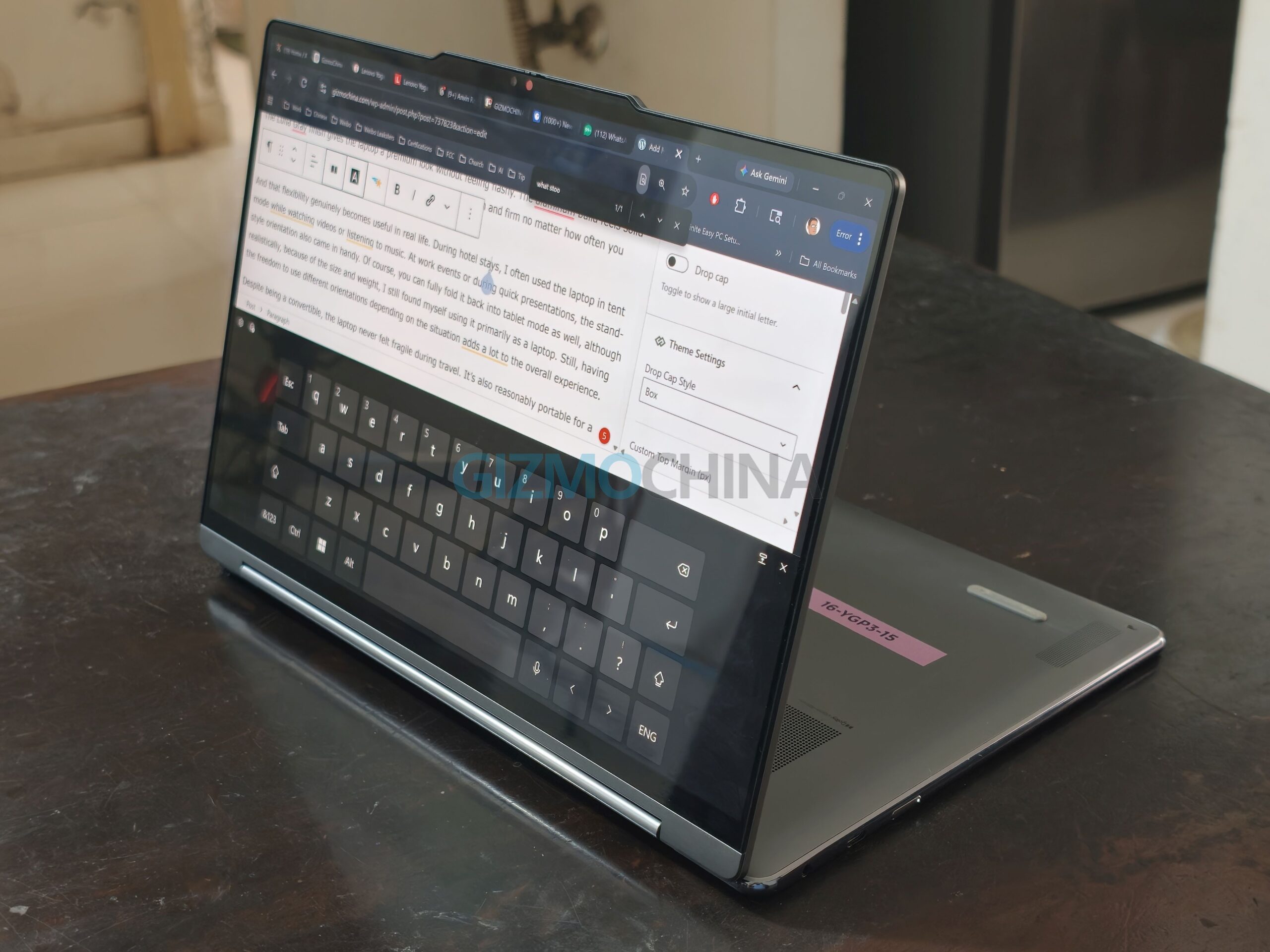
That said, while the touchscreen hardware itself is excellent, I still feel Windows 11 is not fully optimized for touch-first usage.
Technically, you can use this laptop entirely without a mouse thanks to the touchscreen. But in real-world use, there are still moments where touch interactions simply don’t behave the way you expect. Certain menus don’t appear properly, some apps still feel designed primarily for mouse input, and occasionally you end up reaching for the touchpad anyway.
Touch support in Windows has definitely improved over the years, but if you plan to use this machine entirely as a tablet replacement, there will still be frustrating moments.


Honestly, I feel Microsoft should focus more on refining and streamlining the Windows touch experience instead of pushing Copilot features left, right, and center. Hardware like the Yoga 9i already proves how good premium touchscreen laptops have become. The software experience now needs to consistently catch up across the operating system and third-party apps.
Interestingly, I also feel the industry itself may slowly move in this direction. I wouldn’t be surprised if Apple eventually launches an OLED touchscreen MacBook as early as next year, before gradually expanding touchscreen support across future MacBook models while perhaps keeping non-touch panels limited to entry-level variants. Premium laptop hardware is clearly evolving toward more interactive touch-first experiences, and Windows already has a major head start there — it just needs better optimization to fully capitalize on it.