
Add GIZMOCHINA as Preferred Source on Google
MediaTek’s first 2nm chip is finally here. The company today unveiled the Dimensity 9600 Pro built on TSMC’s 2nm process and ARM’s new C-cores. The mobile silicon uses the 2+3+3 CPU layout and is home to more than 33 billion transistors.
Moving from 3nm to 2nm gives a 14% performance bump and a 23% cut in power consumption at the chip level. That’s before you even get into the CPU architecture changes.
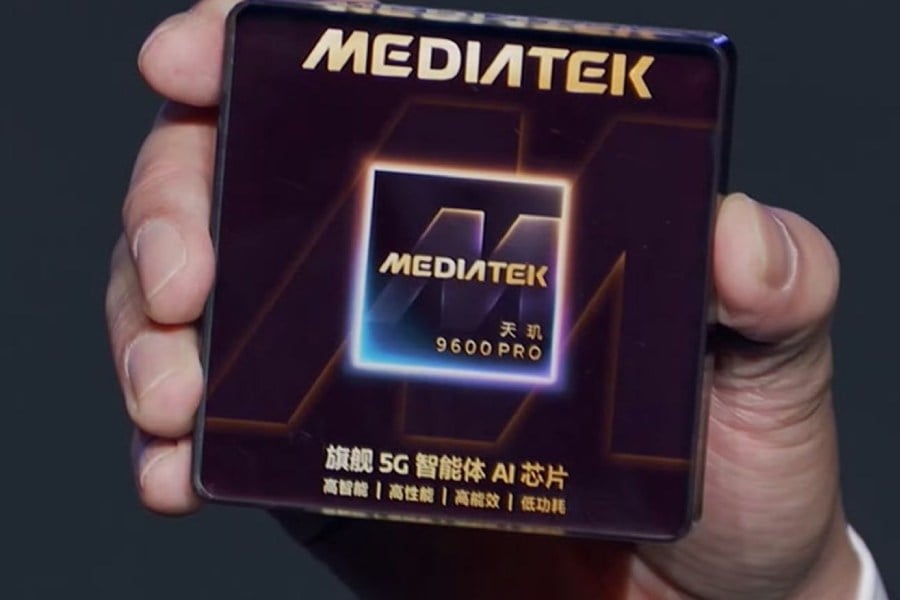
The Dimensity 9600 Pro uses a fourth-generation all-big-core setup of two C2-Ultra super-big cores clocked at 4.55GHz with 2MB of L2 cache each, three C2 Pro big cores at 4.35GHz with 1MB of L2, and three more C2 Pro cores at 3.10GHz with 512KB of L2. Add in 16MB of L3 cache, and you get 34.5MB of total cache across the chip — MediaTek says that’s 21% more L2 cache than the Dimensity 9500, which should help cut down on memory access delays when the chip is under heavy load.
The performance numbers back up the architecture change. MediaTek claims single-core CPU performance improvement by 17% and multi-core by 15% over the Dimensity 9500. As for power consumption, the ultra-large cores use 37% less power, and multi-core power consumption is reduced by 61% at matching peak performance.
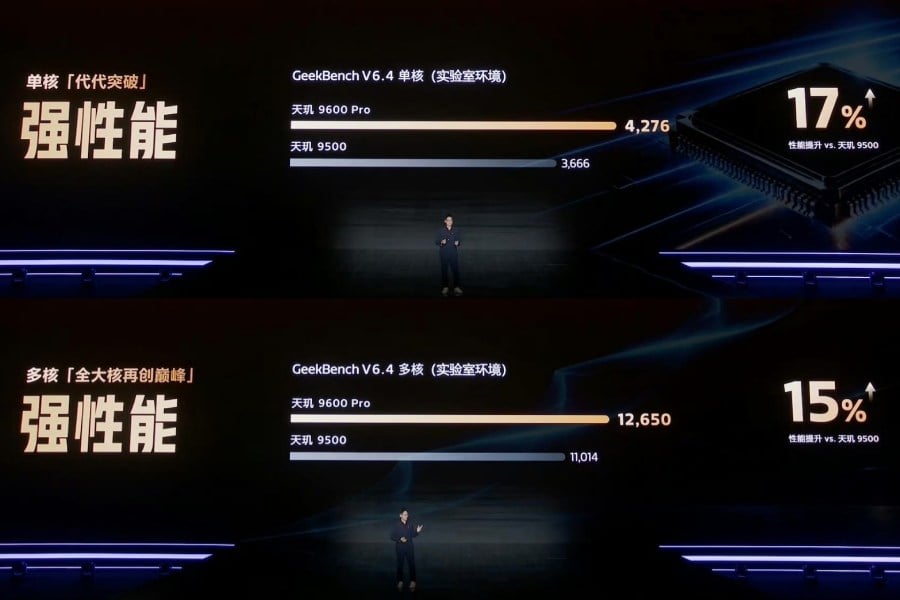
In figures, that translates to the Dimensity 9600 Pro scoring 4,276 points in single-core and 12,650 in multi-core tests at Geekbench 6.4. For reference, the Dimensity 9500 scored 3,666 and 11,014 in the same tests, so the generational jump tracks with MediaTek’s own 17%/15% claims.
Storage and memory move to the next generation
The Dimensity 9600 Pro is the first mobile chip to support LPDDR6 memory and UFS 5.0 storage. LPDDR6 delivers 33% higher performance than LPDDR5X, and UFS 5.0 doubles the sequential read and write speeds you’d get from dual-channel UFS 4.0.
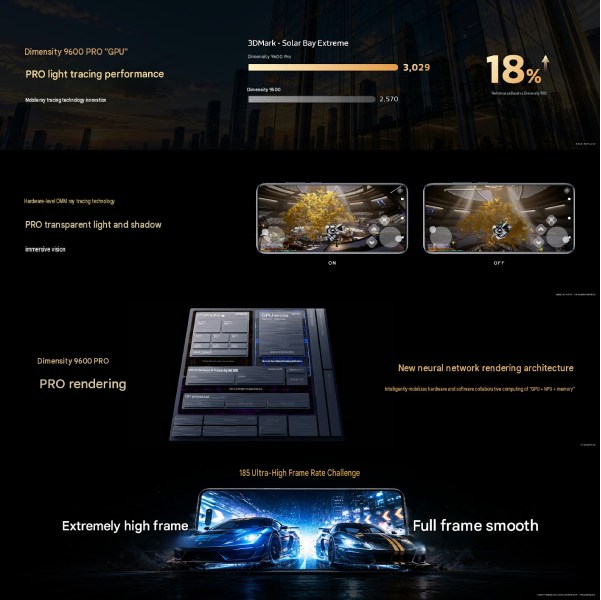
MediaTek paired the CPU upgrades with a new GPU, the G2-Ultra NX, which the company says delivers 27% higher peak performance than the previous generation while cutting power draw by 24% at matching peak output. Ray tracing performance has climbed by 18%, and the chip can now push game frame rates as high as 185fps.
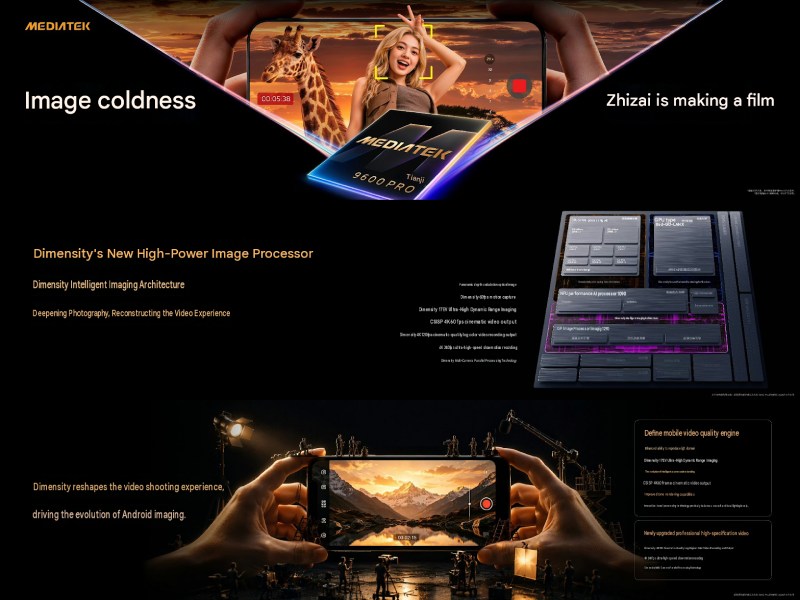
On the imaging side is the Imagiq 1290 ISP that can handle 4K recording at 240fps for slow-motion capture, and built-in H.266 hardware decoding cuts power consumption by 23% compared to relying on software decoding alone.
AI performance is the centerpiece
MediaTek built the Dimensity 9600 Pro around what it calls an AI-native architecture, and the numbers reflect that focus. The chip runs a dual NPU setup: a 10th-generation high-performance NPU 1090 alongside a second-generation low-power NPU for always-on sensing tasks. The high-performance NPU’s prefill performance rises 51% over the previous generation, while the low-power NPU cuts its own power consumption by 40%.

The Generative AI Engine 3.0 doubles INT4 computing power compared to its predecessor, which lets the chip run mixture-of-experts models with up to 30 billion parameters entirely on-device, without leaning on cloud processing.
Tying it together is what MediaTek calls the Tianji Intelligent Computing Fusion Architecture. It manages scheduling across the CPU, NPU, and memory as one system, so large AI models and regular apps can run at the same time without one starving the other of resources. MediaTek claims this keeps power draw down even as output speed holds steady.
Don’t miss a thing! Join our Telegram community for instant updates and grab our free daily newsletter for the best tech stories!
For more daily updates, please visit our News Section.


Comments