
Add GIZMOCHINA as Preferred Source on Google
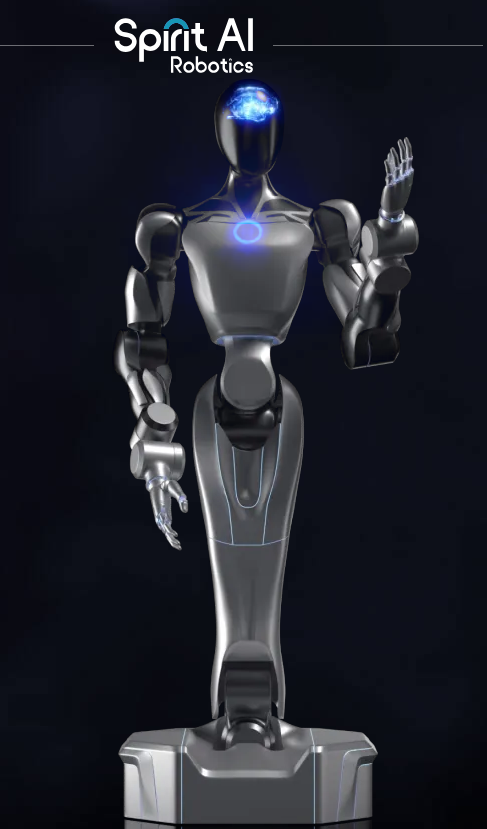
The battle for AI leadership is rapidly moving from chatbots to robots, and China has just scored a major victory. Chinese startup Spirit AI announced that its Spirit v1.6 model ranked No.1 on the RoboArena benchmark, outperforming NVIDIA and other leading competitors.
Spirit v1.6 achieved a score of 1,924, outperforming NVIDIA’s Cosmos3-Nano-Policy, which scored 1,881, and DreamZero, another NVIDIA-backed model, which scored 1,763. The achievement marks the first time a Chinese embodied AI model has reached the No.1 spot on the benchmark.
Why RoboArena Matters
RoboArena is designed to measure how effectively AI systems can translate decisions into real-world robotic actions. Unlike traditional AI benchmarks that focus on language or reasoning, RoboArena evaluates physical task execution, including object manipulation, navigation, tool usage, perception, planning, and adaptability in unfamiliar environments.
The benchmark is widely respected because it uses randomized environments, adversarial testing scenarios, and strict anti-overfitting measures, making it difficult for companies to optimize specifically for the test.
The Growing Physical AI Race
The result highlights how competition in artificial intelligence is increasingly shifting beyond chatbots and large language models toward physical AI. These systems serve as the “brains” behind humanoid robots, robotic arms, autonomous vehicles, and industrial automation platforms.
Spirit AI’s success is being viewed as evidence that efficient model design and high-quality training data can be just as important as massive computing power. The company’s model reportedly demonstrated strong performance in object handling, autonomous navigation, complex tool use, and adapting to new situations with minimal fine-tuning.
China’s Expanding Advantage
China has also been gaining ground across several other embodied AI benchmarks. Companies including Manifold AI, AgiBot, and DexForce currently lead categories related to world modeling, robotic perception, and robotics data generation.
At the same time, investment in the sector continues to surge. Spirit AI recently raised 1.5 billion yuan (about $222 million), while other Chinese robotics startups have secured large funding rounds over the past year. China’s growing strength in robotics data, funding, and benchmark performance suggests the global race is becoming more competitive than ever.
Read More:
- ASUS Launches ROG Harpe II Extreme Edition 20 Gaming Mouse With 24K Gold-Plated Design
- Why Nvidia’s H2+ Humanoid Robot Has the Tech World Talking
- US Expands AI Chip Restrictions Worldwide: What It Means for China
(via)



Comments