Add GIZMOCHINA as Preferred Source on Google
After the global debut last month, Xiaomi has now announced its Xiaomi 17T series in China. The lineup includes both the standard 17T and the more powerful 17T Pro, marking the first time in years that Xiaomi’s T-series phones are launching in China. Xiaomi is also giving the mainland market some special treatment.
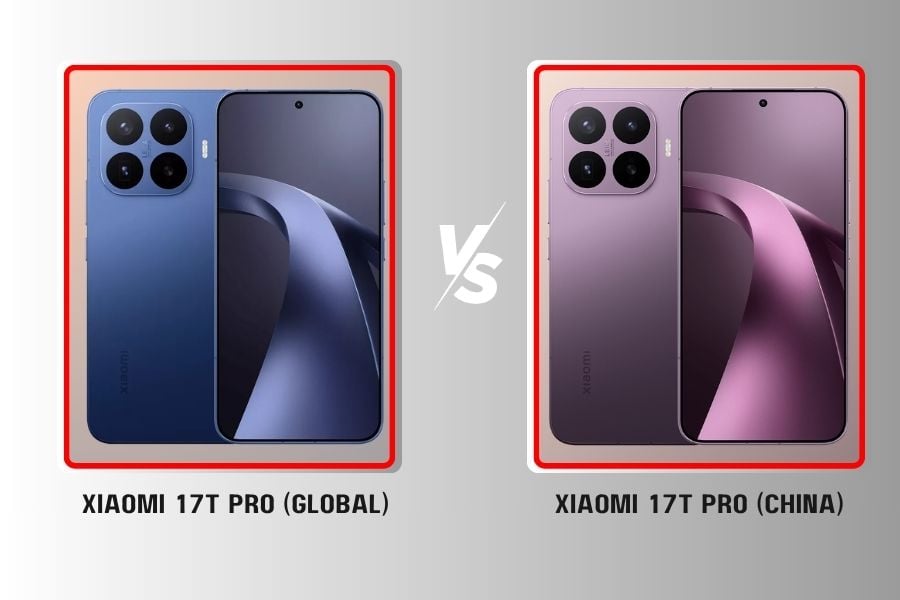
While the two versions look almost identical on the outside, a closer look at the specs reveals some notable differences, especially if battery life and storage matter to you.
1. The main difference is the battery
The most notable difference between the global and Chinese versions is the battery. The global Xiaomi 17T Pro comes with a 7,000mAh battery, while the regular model gets a 6,500mAh cell. However, both the 17T and 17T Pro in China come with a 7,000mAh capacity.
Xiaomi says its new battery uses the highest silicon content in the company’s history, which helps pack more energy into a lighter, more compact cell. The company also claims the battery can maintain 80% of its original capacity even after 1,600 charge cycles.
However, the charging speeds are the same across both regions. Both the global and Chinese versions of the 17T Pro support 100W wired charging, 50W wireless charging, and 50W PPS fast charging. The standard 17T in both markets supports 67W wired charging.
2. Storage and RAM
Here is where things get a little more interesting, and perhaps counterintuitive. In China, the top configuration of the Xiaomi 17T Pro comes with 16GB of RAM and 512GB of storage. That is the highest memory option available for the Chinese market.
But for buyers outside China, Xiaomi is focusing on storage. The top global configuration comes with 12GB of RAM and 1 TB of storage, twice the capacity of the Chinese top model, but with 4GB less RAM.
So which is better? It depends on what you need. If you store a lot of photos, videos, and files locally and rarely max out memory-heavy apps, the 1TB global model may suit you better. But if you are a heavy multitasker who keeps many apps open at once, the extra RAM in the Chinese version could give you a smoother experience. Neither is strictly superior, though.
3. Same Powerful Processor on Both Sides
Where both versions fully agree is in the core performance department. The Xiaomi 17T Pro is powered by the MediaTek Dimensity 9500 chip on both the global and Chinese versions. This is a top-tier processor built on a 3nm process, and it is the same chip used in several competing flagship phones this year.
The standard 17T, meanwhile, uses the Dimensity 8500 Ultra in both markets
4. Display, Camera, and Design
Beyond battery and storage, the two versions share the same display, camera system, and overall design.
The 17T Pro features a large 6.83-inch AMOLED display with a smooth 144Hz refresh rate, offering bright visuals whether you are scrolling social media or watching a video. The standard 17T uses a slightly smaller 6.59-inch screen running at 120Hz.
For cameras, both versions of the 17T Pro carry a triple rear setup including a 50MP main sensor (the Light Fusion 950), a 50MP telephoto camera with 5x optical zoom, and a 12MP ultrawide lens. All cameras are Leica-branded, bringing the company’s well-known colour science and optics tuning to the T series for the first time at this price point.
Both versions also run Android 16 with Xiaomi’s HyperOS 3 software on top. However, it is worth noting that the Chinese version runs a China-specific build of HyperOS that does not include Google services by default. International buyers who purchase a Chinese unit would need to manually install Google apps, and some features may not work correctly. The global version, by contrast, comes with full Google support right out of the box.
5. Affordable in China, Premium Globally
Xiaomi is positioning the 17T Pro as a flagship device globally, and the price reflects that. In Europe, the 17T Pro starts at €999 (roughly $1,170) for the 12GB/512GB model. The standard 17T starts at €749 (roughly $878) in the 12GB/256GB configuration.
In China, the 17T series launched at a special summer price starting from just 2,999 yuan (approximately $415). It’s significantly more affordable for local buyers.
That said, this is a common pattern with Xiaomi phones. Prices in China are almost always lower than what international buyers pay, partly due to different market strategies and import taxes.
6. Should You Import the Chinese Version?
It might be tempting to import the Chinese version for the extra RAM or the larger battery on the standard model. But there are real downsides.
The Chinese version of HyperOS does not include Google services, which are essential for most users outside China. While it is technically possible to sideload the Play Store, it does not always work smoothly.
Additionally, the Chinese version could also have network compatibility issues. Chinese Xiaomi phones are not always optimised for the mobile frequency bands used in Europe, South Asia, or South America. In some rural or regional areas, this could mean weaker signal reception.
And more importantly, from 2025 onwards, unlocking the bootloader on a Chinese Xiaomi phone requires a Chinese Mi account, which is another hurdle for international users.
For more daily updates, please visit our News Section.
Stay ahead in tech! Join our Telegram community and sign up for our daily newsletter of top stories! 💡