
Add GIZMOCHINA on Google:
The Oppo Find X10 series is set to put a strong emphasis on smartphone photography, with the company teasing several camera-focused upgrades. The upcoming lineup will introduce a new Hasselblad Super Clear Camera system designed around more natural-looking images. Oppo has also shared an early look at the phone’s rear camera design, giving us more clues about what to expect.
Oppo Find X10 series focuses on natural photography

The Find X10 will feature a dual 200-megapixel camera setup jointly developed with Hasselblad, while the Find X10 Pro Max is positioned as the more aggressive option with three 200-megapixel cameras. Oppo says the approach is intended to preserve fine details without relying heavily on artificial processing that can introduce unnatural textures and skin.
The second-generation Danxia Color Restoration Lens is another key part of the system. It uses 24 sampling channels and a 15-stop dynamic range to capture ambient light and colors more accurately.
Oppo is also introducing its LUMO native light and shadow engine, which is designed to maintain more natural brightness and contrast, including better facial detail in backlit scenes.
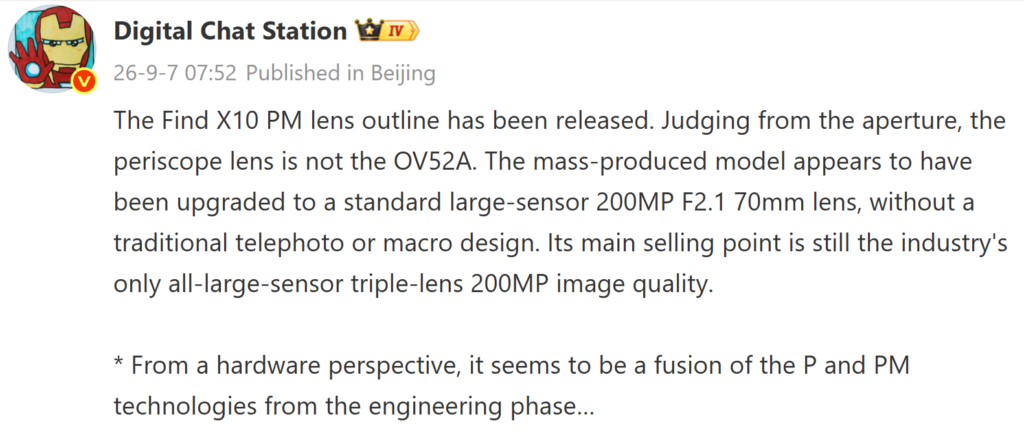
Digital Chat Station has also shared details about the Find X10 Pro Max camera configuration. According to the tipster, the periscope camera’s aperture suggests that the phone may not use the previously rumored OV52A sensor. The production version could instead feature a conventional large-sensor 200-megapixel telephoto camera with a 70mm focal length and an f/2.1 aperture. The setup is also expected to support telephoto macro photography, while retaining the headline feature of three large-sensor 200-megapixel cameras.
The official poster shows a large, horizontal rear camera island with rounded corners and a stepped rectangular layout. Three visible camera openings are arranged within the main section, while a fourth circular area sits separately on the right.
The Find X10 series is set to launch this month (September) in China. Both devices have already appeared on the Geekbench benchmarking platform, revealing that they are powered by different Dimensity 9-series chipsets.
For daily updates, please visit our News Section.
Stay ahead in tech! Join our Telegram community and sign up for our daily newsletter of top stories!




Comments