
Add GIZMOCHINA as Preferred Source on Google
Early performance numbers for Samsung’s upcoming Exynos 2700 are starting to leak, and they give a decent first look at what the company might bring to the Galaxy S27 series next year.
The chip scored 4,328 in single-core and 14,700 in multi-core on Geekbench version 6.7.1. These results come from an internal benchmark list. An earlier public listing from April (on Geekbench 6.6.0) showed much lower numbers, 2,603 single-core and 10,350 multi-core, but the two can’t really be compared directly. Different software versions and a more mature sample make a clean apples-to-apples comparison impossible.
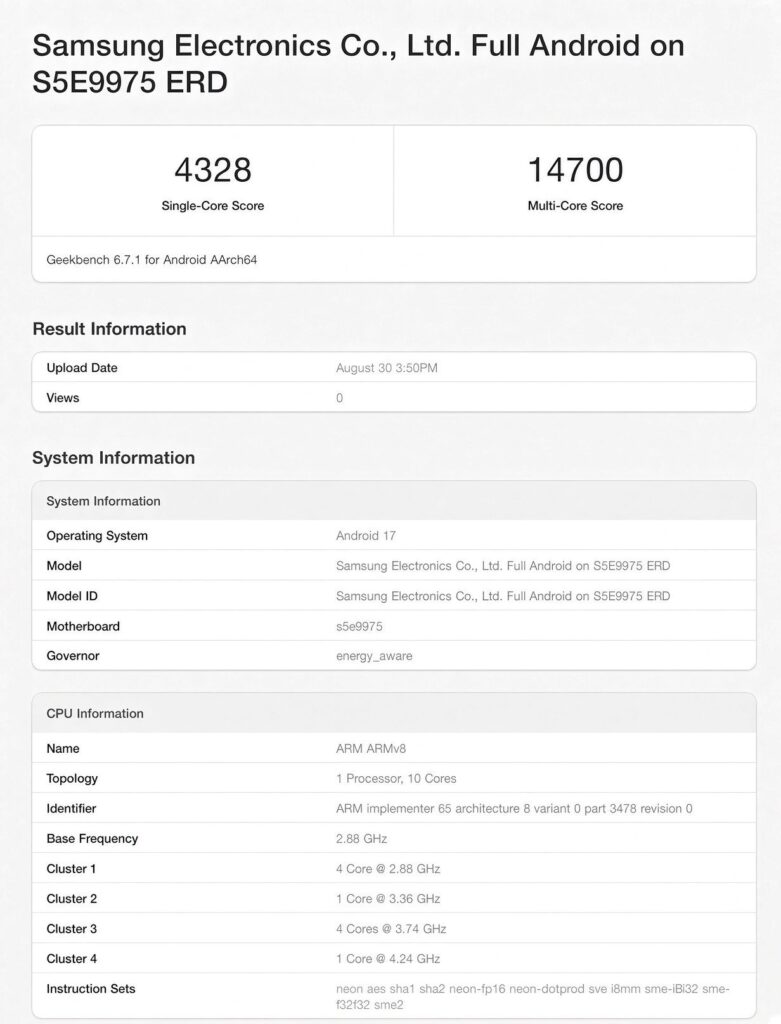
The newer results line up with previously leaked die-shot details. The chip uses a 10-core setup arranged as 1+4+1+4. One cluster has a single Arm C1-Ultra core and four C1-Pro cores. The other has a C2-Ultra core paired with four C2-Pro cores. Mixing older and newer Arm designs like this seems to be Samsung’s way of chasing both strong peak performance and better sustained efficiency than past Exynos chips.
On the graphics side, it’s expected to use an Xclipse 970 GPU. There’s also talk of a dedicated NPU for on-device AI tasks, plus support for LPDDR6 memory, which should give it the bandwidth needed for heavier next-gen workloads.
Samsung is widely expected to put the Exynos 2700 in the Galaxy S27, S27+, and the S27 Pro. It’s reportedly being built on Samsung Foundry’s improved SF2P 2 nm process.
These are still early test numbers, not final production results. But the more complex core layout and modern memory support suggest Samsung is making a real push to close the gap with competing flagship processors. We’ll need real-device benchmarks before we know how competitive the Exynos 2700 actually ends up being when the Galaxy S27 series launches early next year.
Don’t miss a thing! Join our Telegram community for instant updates and grab our free daily newsletter for the best tech stories!
For more daily updates, please visit our News Section.
(Source)




Comments