Add GIZMOCHINA on Google:
As an Amazon Associate, Gizmochina earns from qualifying purchases. Links on this page may earn us a commission at no extra cost to you.
Lenovo has put its new IdeaPad Vibe in a very interesting spot. It starts at $699.99, exactly the same price Apple now charges for the MacBook Neo after raising its price from the original $599. With both laptops targeting buyers who want a relatively affordable machine, the similar pricing makes the comparison hard to ignore.
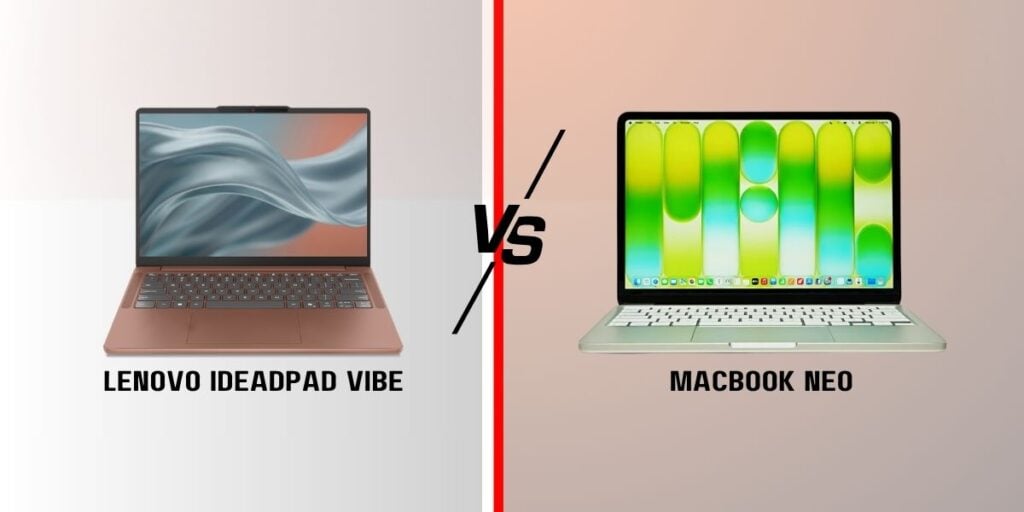
Of course, a spec sheet can’t tell you everything. Keyboard feel, trackpad quality, display tuning, and overall software experience still need to be tested in person. But the specifications already show that Lenovo and Apple are taking very different approaches to the budget laptop market.
1. Same price, different approach
Apple’s pitch with the MacBook Neo was always about restraint. You get a 13-inch Liquid Retina display, an A18 Pro chip borrowed from the iPhone 16 Pro, 8GB of unified memory, and a fanless body that starts at 256GB of storage. No upgrades once you buy it, no configuring your way to more RAM later. What you order is what you live with.
Lenovo’s IdeaPad is more flexible. It comes in 14- and 15-inch sizes, with a choice of AMD Ryzen AI 400 or Snapdragon X chips, and RAM that tops out at 32GB on the AMD side versus the Neo’s fixed 8GB. Storage runs up to 1TB, and Lenovo’s sticking dual SSD slots in there so you can add capacity down the line instead of committing upfront. If you’re the type who keeps a laptop for five years and wants room to grow into it, that alone tips things in Lenovo’s favor.
2. More colors, more customization
Apple gave the MacBook Neo a more colorful look than its usual Mac lineup. It comes in Blush, Citrus, Indigo, and Silver, unlike the classic silver and gray finishes on pricer Macs.
Lenovo, meanwhile, offers even more options. It comes in seven Pantone-developed colors including Dreamy Violet and Radiant Coral, and Lenovo also sells interchangeable keycaps separately. It’s a small thing, but it gives the IdeaPad Vibe a more personal look. I
There is one important catch, though. If you want an OLED display, your color choices are limited to Moody Blue and Lowkey Grey. The other finishes come with a 120Hz IPS panel instead.
3. Lenovo wins on ports
The difference in connectivity is much easier to see. The MacBook Neo has two USB-C ports and a 3.5mm headphone jack. And that’s fine if most of your accessories are wireless or USB-C, but if you have peripherals like monitors, SD cards, and other devices, you’ll definitely need a separate adapter.
The IdeaPad Vibe is much more practical here. It has two USB-A ports, two USB-C ports, HDMI, and a microSD card reader, along with Wi-Fi 7 support. The USB ports are limited to 5Gbps, so this isn’t a laptop designed around extremely fast external storage. But for everyday use, having more built-in ports means fewer dongles to carry around.
4. The Neo is lighter, but Lenovo has a bigger battery
Apple still has an advantage when it comes to weight. The MacBook Neo weighs 1.23kg, while the 14-inch IdeaPad Vibe starts at 1.3kg. The Neo also has a 36.5Wh battery, which Apple claims delivers up to 16 hours of video playback.
Lenovo hasn’t published an official battery-life rating yet, but the AMD version can be equipped with a battery as large as 65Wh. That doesn’t automatically mean it will last longer than the Neo, since battery life also depends heavily on the processor and software, but the larger capacity gives Lenovo some room to work with.
The webcams also favor Lenovo. The Neo uses a 1080p FaceTime HD camera without a physical privacy shutter. The IdeaPad Vibe has a 5MP IR camera with a privacy cover and Windows Hello support.
5. Performance is still the big unknown
This is the one area where it’s difficult to conclude without actually testing the laptops. Apple’s A18 Pro is already a known quantity, and the company’s close control over its hardware and software means the Neo’s 8GB of memory doesn’t necessarily tell the whole story. For browsing, writing, streaming, and other everyday tasks, it should be more than capable.
Lenovo’s Ryzen AI 400 and Snapdragon X options are also promising, particularly for users who want more RAM and on-device AI capabilities. With up to 32GB of memory, the IdeaPad Vibe also has a clear advantage for heavier multitasking.
Still, processor performance isn’t something you can judge from core counts and memory numbers alone. Cooling, software optimization, battery settings, and the difference between Windows and macOS all matter.
Apple is also reportedly working on a MacBook Neo successor with an A19 Pro chip and more RAM for next year, so the current Neo is unlikely to remain the company’s entry-level MacBook for long.
6. Which one makes more sense?
The MacBook Neo is still the simpler option. If you’re already using an iPhone and other Apple devices, want a lightweight laptop, and mainly need something for browsing, writing, streaming, and everyday work, the Neo is a no-brainer.
On the other hand, the IdeaPad Vibe is more flexible with more ports, more RAM, more storage options, two SSD slots, larger screen choices, and far more customization. Those things become more useful if you plan to keep the laptop for several years.
The biggest catch is the display and color trade-off. If OLED matters to you, you’ll have to choose between just two IdeaPad Vibe colors. Lenovo’s AMD models are expected to arrive in October, while Snapdragon versions are scheduled for November.
Until both laptops have been properly tested, it’s too early to say which one is faster or better overall. But at the same $699.99 starting price, the IdeaPad Vibe clearly offers more flexibility on paper, while the MacBook Neo keeps things simple. Which approach makes more sense will mostly depend on whether you value Apple’s simpler experience or Lenovo’s upgradeability and wider range of hardware options.
For more daily updates, please visit our News Section.
Stay ahead in tech! Join our Telegram community and sign up for our daily newsletter of top stories!