Advertisement

Add GIZMOCHINA as Preferred Source on Google

As an Amazon Associate, Gizmochina earns from qualifying purchases. Links on this page may earn us a commission at no extra cost to you.

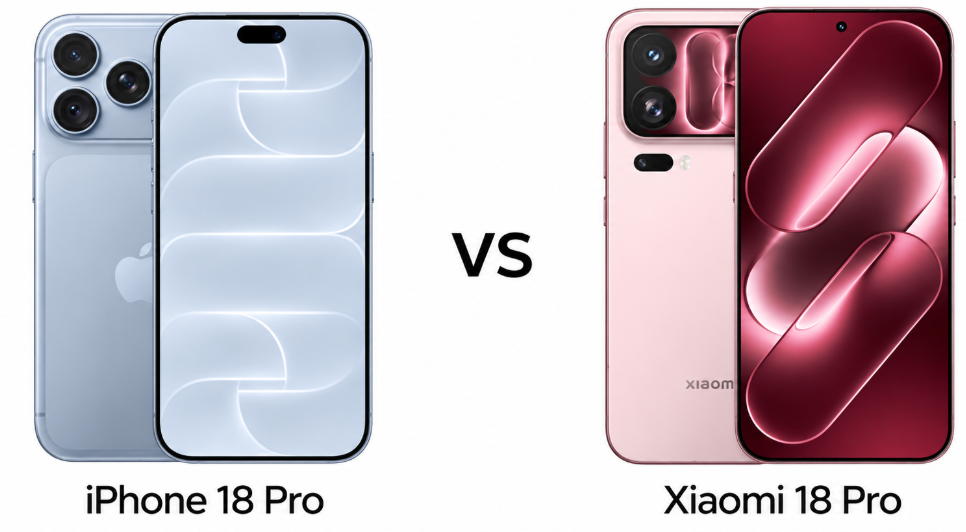
iPhone 18 Pro and Xiaomi 18 Pro take very different approaches to the premium smartphone market. Apple focuses on polished software, video capabilities, and a mature camera system, while Xiaomi pushes hardware with a 200MP Leica camera, 7000mAh battery, and a secondary rear display. The comparison therefore goes beyond specifications to reveal which flagship delivers the more complete experience.
Major Features:

CategoryiPhone 18 ProXiaomi 18 ProWinner
Design & BuildCeramic Shield 2, aluminum frame, glass back, IP68Dragon Crystal Glass 3, aluminum frame, IP68Xiaomi — More distinctive design with rear display
Display6.3-inch LTPO Super Retina XDR OLED, 120Hz, Dolby Vision, 3,000 nits6.4-inch LTPO AMOLED, 120Hz, Dolby Vision, HDR10+, 4,000 nits, rear 120Hz AMOLEDXiaomi — Brighter and more versatile display setup
ProcessorApple A20 Pro, 2nmSnapdragon 8 Elite Gen 6, 2nmApple — Stronger software-hardware optimization
RAM & Storage12GB RAM, up to 2TB, NVMeUp to 16GB RAM, up to 1TB, UFS 4.1Apple — Offers higher maximum storage
Main Camera48MP wide, 48MP periscope, 48MP ultrawide, LiDAR200MP wide, 200MP periscope, 50MP ultrawide, LeicaXiaomi — More aggressive camera hardware
Selfie Camera18MP ultrawide with PDAF50MP wide with PDAFXiaomi — Higher-resolution autofocus selfie camera
Video RecordingUp to 4K 120fps, ProRes RAW, Apple Log 2, Dolby VisionUp to 8K 30fps, 4K 120fps, Dolby Vision, 10-bit LOGApple — More advanced professional video tools
Battery4,056/4,288mAh depending on variant7,000mAhXiaomi — Much larger battery capacity
Wired ChargingFast charging, 50% in 15 minutes100W wiredXiaomi — Significantly faster charging
Wireless Charging25W MagSafe/Qi250W wirelessXiaomi — Higher wireless charging speed
Reverse Charging4.5W wired27W wirelessXiaomi — More practical reverse charging
ConnectivityWi-Fi 7, Bluetooth 6.0, NFC, USB-C 3.2 Gen 2Wi-Fi 7, Bluetooth 6.0, NFC, IR, USB-C 3.2Xiaomi — Adds an IR blaster and broader audio support
BiometricsFace IDUltrasonic under-display fingerprintApple — Face ID offers seamless biometric authentication
SoftwareiOS 27Android 17, HyperOS 4Apple — Stronger ecosystem integration
PricePriced around $1,200 / ₹164,900Priced around $1,000 / ₹120,000Xiaomi — More hardware at a lower price
OverallPremium ecosystem, video and software experienceFeature-rich hardware, cameras, battery and chargingXiaomi — Better overall hardware value
Disclaimer: Specs are based on available data. Actual performance may vary. Verify details from official sources before buying.

1. Design and Display

Build and Feel

The iPhone 18 Pro combines Ceramic Shield 2 with an aluminum frame and IP68 protection, giving it a familiar premium construction with strong durability credentials. Face ID and satellite-based emergency features add practical advantages, while the design remains focused on a conventional flagship experience. Xiaomi counters with Dragon Crystal Glass 3, an aluminum frame and IP68 protection, plus a secondary rear display that makes the phone considerably more distinctive.

Display Quality

Apple’s 6.3-inch LTPO Super Retina XDR OLED supports 120Hz, Dolby Vision, HDR10 and an anti-reflective coating, with up to 3,000 nits peak brightness. Xiaomi offers a larger 6.4-inch LTPO AMOLED with 120Hz, Dolby Vision, HDR10+ and an impressive 4,000-nit peak. Its rear 120Hz AMOLED display is another major differentiator. Xiaomi therefore offers the more feature-rich display package, while Apple’s tuning feels more polished.

Verdict

Xiaomi wins on display versatility and brightness, while Apple delivers a refined viewing experience with excellent HDR support and anti-reflective treatment. Xiaomi is the stronger overall display package.

2. Specifications Including Battery

Performance

The iPhone 18 Pro uses Apple’s A20 Pro chip built on a 2nm process, paired with 12GB RAM and NVMe storage. Xiaomi employs the 2nm Snapdragon 8 Elite Gen 6 with up to 16GB RAM and UFS 4.1 storage. Both are positioned at the top of the performance hierarchy, but Apple’s tightly integrated hardware and software should appeal more to users prioritizing sustained app optimization.

Battery and Charging

Xiaomi has a substantial advantage with its 7,000mAh silicon-carbon battery, 100W wired charging, 50W wireless charging and 27W reverse wireless charging. Apple’s battery is significantly smaller, although its 25W MagSafe/Qi2 support and fast wired charging remain convenient. For heavy users, travelers and gamers, Xiaomi’s capacity and charging speeds are simply more practical. Apple’s advantage is a more mature power-management ecosystem.

Verdict

Xiaomi wins decisively on battery capacity, charging speed and charging flexibility. Apple remains highly efficient, but Xiaomi is better equipped for demanding all-day use.

3. Camera

Main and Secondary Lenses

The iPhone 18 Pro uses three 48MP cameras covering wide, 4x optical telephoto and ultrawide photography, supported by sensor-shift stabilization and LiDAR. Its video system is particularly advanced, with ProRes RAW, Apple Log 2, Dolby Vision and 4K recording up to 120fps. Xiaomi counters with a 200MP Leica main camera, 200MP periscope telephoto and 50MP ultrawide. The hardware is more ambitious and offers greater photographic flexibility.

Selfie Camera

Apple’s 18MP ultrawide selfie camera includes PDAF, Face ID depth hardware and advanced video features such as Dolby Vision and Apple Log 2. Xiaomi steps up with a 50MP autofocus selfie camera capable of 4K video and HDR10+. On paper, Xiaomi offers greater resolution and stronger hardware, but Apple’s processing and video ecosystem remain major strengths. For creators, Apple’s front and rear video pipeline feels more mature.

Verdict

Apple wins for professional video capabilities and consistency, while Xiaomi offers more aggressive camera hardware. For photography experimentation, Xiaomi is compelling; for reliable video, Apple leads.

4. Pricing

The iPhone 18 Pro is priced around $1,200 or ₹164,900, placing it firmly in the ultra-premium category. The Xiaomi 18 Pro is priced around $1,000 or ₹120,000, undercutting Apple’s flagship by a substantial margin. Despite the lower price, Xiaomi delivers a 200MP dual-telephoto camera system, larger battery, faster charging and a secondary display.

Is the price justified? 

Apple’s premium is easier to justify for buyers who prioritize long-term software integration, advanced video recording, Face ID, satellite capabilities and the broader iOS ecosystem. Xiaomi provides considerably more hardware for the money, particularly with its 7,000mAh battery, 100W charging and 16GB RAM option. From a pure specification-to-price perspective, Xiaomi is clearly the stronger proposition.

Verdict

Xiaomi offers substantially better value, delivering more aggressive hardware at a lower price. Apple justifies its premium through software integration, ecosystem features and advanced video capabilities.

Disclaimer:
Prices are approximate and may vary based on country, region, launch timing, and applicable taxes. Always check whether the listed price is for a China unit or a global/international variant when purchasing.

5. Conclusion

iPhone 18 Pro stands out with A20 Pro performance, LiDAR, Face ID, satellite communication and an exceptionally capable professional video system. Xiaomi answers with a 200MP Leica camera setup, 7,000mAh battery, 100W charging, 50W wireless charging and a secondary rear AMOLED display. 

The two phones target different definitions of a Pro flagship. Apple’s strengths lie in refinement, ecosystem integration and content creation, while Xiaomi emphasizes hardware innovation and maximum specifications. For buyers who want the most features and stronger everyday hardware value, Xiaomi makes the more convincing case.

Verdict

Xiaomi 18 Pro is the overall winner, thanks to its stronger camera hardware, much larger battery, faster charging, secondary display and significantly lower price. The iPhone 18 Pro remains the better choice for video creators and Apple ecosystem users.


FAQs

1. Which phone has the better camera for photography?
The Xiaomi 18 Pro offers more versatile camera hardware, including dual 200MP sensors and Leica tuning.

Where to buyiPhone 18 ProLatest price on AmazonCheck price →

2. Which smartphone is faster for gaming?
Both deliver flagship performance, but the A20 Pro and iOS optimization give the iPhone 18 Pro an edge.

3. Which phone has better battery life?
The Xiaomi 18 Pro should last longer, thanks to its much larger 7,000mAh battery.

4. Which phone offers better value for money?
The Xiaomi 18 Pro offers more hardware features and faster charging at a considerably lower starting price.

5. Should you buy the iPhone 18 Pro or Xiaomi 18 Pro?
Choose iPhone for video and ecosystem integration; choose Xiaomi for battery, charging, cameras and hardware value.

Disclaimer: Prices, specifications, and availability may vary by region and retailer. Recommendations in this article are based on editorial opinion, feature-based value, and market positioning at the time of writing. Readers are advised to do their own research before making a purchase.

Read More:

Comments