
Add GIZMOCHINA as Preferred Source on Google
As an Amazon Associate, Gizmochina earns from qualifying purchases. Links on this page may earn us a commission at no extra cost to you.
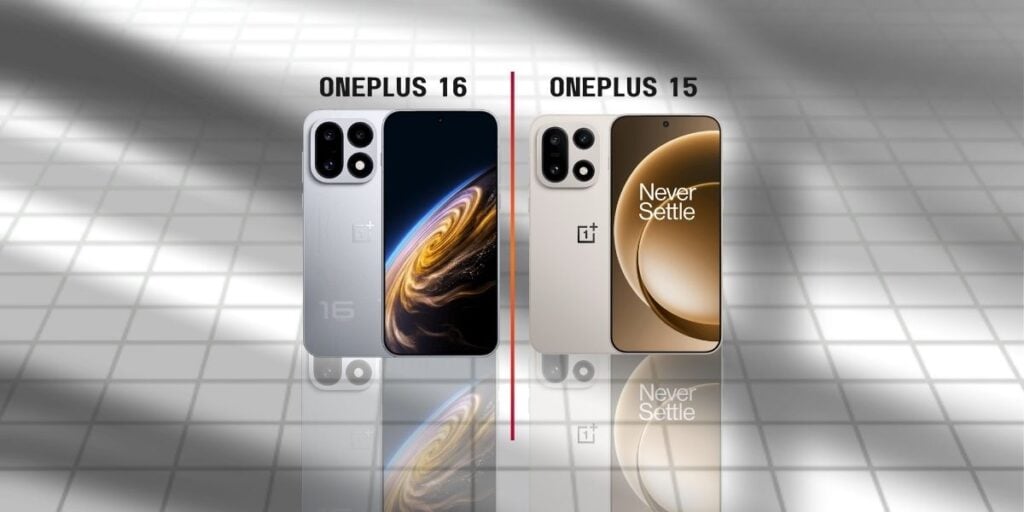
The OnePlus 16 brings several major hardware changes over the OnePlus 15, including a new 2nm Snapdragon chipset, a 9,000mAh battery, a 200MP main camera, and a display that supports a 165Hz refresh rate across the system. OnePlus has also updated the phone’s gaming hardware, cooling system, and software, although some features remain unchanged from the previous generation.
The two phones share a similar design, with a 6.78-inch flat display, narrow bezels, and a flat-sided frame. However, the OnePlus 16 makes a few trade-offs alongside its upgrades. Wired charging drops from 120W to 100W, while the periscope telephoto camera moves from 3.5x to 3x optical zoom.
For OnePlus 15 owners, the question is whether the larger battery, newer processor, and camera changes justify an upgrade. Here’s a detailed look at how the OnePlus 16 compares with the OnePlus 15 and what has changed between the two generations.
1. Performance
The processor is one of the biggest differences between the two phones. The OnePlus 15 uses Qualcomm’s Snapdragon 8 Elite Gen 5, a 3nm chipset with two prime cores clocked at up to 4.6GHz. The OnePlus 16 moves to the Snapdragon 8 Elite Extreme Gen 6, built on a 2nm process, with two prime cores reaching 5.0GHz and six performance cores running at up to 4.0GHz.
The new chip also uses an all-big-core CPU design and introduces Adreno Matrix Cores for graphics features such as upscaling and frame generation. Moving to a smaller manufacturing process can improve power efficiency, although the actual gains depend on how the chip performs under different workloads.
OnePlus has also updated its Wind Chaser Game Core. The first-generation system on the OnePlus 15 supports up to 165fps in compatible titles, while the newer version on the OnePlus 16 is rated for 185fps. OnePlus says the phone averaged 185fps in Delta Force during a three-hour test at high graphics settings. Actual results will depend on the game, settings, and operating temperature.
2. Cooling upgrades
Higher frame rates and sustained performance put more pressure on a phone’s cooling system, so OnePlus has revised the thermal hardware alongside the new processor.
The OnePlus 15 uses the Glacier cooling system, which combines a vapor chamber with an aerogel insulation layer. The OnePlus 16 gets an updated setup with a zoned vapor chamber, revised thermal gel, and a graphite layer rated at 2,100 W/m·K.
OnePlus claims the new vapor chamber is 40% more effective and the thermal gel is 50% better than before. The updated layout also directs heat away from areas where users typically hold the phone during landscape gaming. The company has retained the general approach of insulating the frame while improving heat dissipation around the processor.
3. 165Hz is no longer limited to games
The OnePlus 15 already has a high-refresh-rate display, but its 165Hz mode is primarily available in supported games and select applications. During normal use, the phone’s 6.78-inch LTPO OLED panel adjusts its refresh rate between 1Hz and 120Hz.
The OnePlus 16 changes this by extending 165Hz support across the system. Scrolling through menus, moving between apps, and navigating supported interfaces can now take advantage of the higher refresh rate rather than relying on it mainly for gaming. Meanwhile, compatible games can reach 185Hz.
Both phones retain a 1.5K resolution and a pixel density of 450ppi. They also support 1.07 billion colors, 100% DCI-P3 color gamut coverage, and peak brightness of 2,000 nits. The OnePlus 16, however, uses BOE’s new X4 luminescent material instead of the X3 in the OnePlus 15.
Another addition is the P4 display chip, which OnePlus says improves clarity during fast motion. The minimum brightness remains 1 nit, while PWM dimming runs at 3,840Hz. The newer phone also receives TÜV Rheinland Eye Comfort 6.0 certification, replacing version 5.0 on the OnePlus 15.
The higher refresh rate is the most visible change on paper, but it comes with a few qualifications. Not every app or game will run at 165Hz or 185Hz, and the difference will depend on the content being displayed. A higher refresh rate can make supported animations and scrolling look smoother, but it does not automatically improve image quality or resolution.
Both phones stick with a 1.5K panel rather than moving to QHD+. That means the OnePlus 16 prioritizes refresh rate and motion handling over a higher pixel count.
4. A larger 9,000mAh cell
There’s an upgrade in terms of battery as well. The OnePlus 15 has a 7,300mAh battery, while the OnePlus 16 now packs a 9,000mAh cell, roughly a 23% increase. Also worth noting is that the new battery uses two cells, each with a typical capacity of 4,500mAh.
OnePlus has paired the larger battery with OPPO’s energy management chip, which handles power draw. The company says the system helps maintain stable performance at low charge levels and allows the battery to retain at least 80% of its capacity after five years of use.
Here are the official estimates for several activities on the new phone:
- Up to 23.8 hours of video playback.
- Up to 20.6 hours of short-video browsing.
- Up to 13.6 hours of navigation.
- Up to 8.1 hours of gaming.
5. Charging is slower
The larger battery comes with a change that may disappoint some users. The OnePlus 15 supports 120W wired charging, while the OnePlus 16 reduces the maximum charging speed to 100W.
OnePlus claims the OnePlus 15 can charge to full in around 40 minutes. Meanwhile, the OnePlus 16 charges from 1% to 100% in 52 minutes.
Both phones support 50W wireless charging, although the compatible charger is sold separately. The OnePlus 16 also adds 27W wired reverse charging, allowing it to supply power to accessories such as earbuds and smartwatches.
Both phones also support bypass charging. It allows the phone to draw power directly from the charger during supported gaming sessions instead of routing all that power through the battery, helping reduce heat.
6. The main sensor jumps to 200MP
The OnePlus 16 makes a substantial change to its main camera, moving from the OnePlus 15’s 50MP Sony sensor to a 200MP sensor measuring 1/1.4 inches. And of course, you get OIS stabilization.
The higher resolution gives the phone more pixels to work with when cropping photos, although megapixel count alone does not determine image quality. Sensor size, image processing, exposure, and lens performance all contribute to the final result.
The telephoto camera sees a different kind of change. Both phones use a stabilized 50MP periscope camera, but the OnePlus 15 offers 3.5x optical zoom at an 85mm equivalent focal length. The OnePlus 16 moves to 3x optical zoom, using a 1/1.95-inch sensor, and it also supports 6x lossless zoom.
The 50MP ultra-wide camera remains unchanged, with a 116-degree field of view. The front camera, however, moves from 32MP on the OnePlus 15 to 50MP on the OnePlus 16.
OnePlus has also introduced a shooting option called “one shot, three crop.” It lets users capture a single 200MP photo and create wide, medium, and close compositions from the same image. Other additions include a wide-format shooting mode, a text-prompt AI retouching tool limited to 100 uses per month, and Master Mode for film-style tones.
Both phones use Oppo’s LUMO imaging system and support 4K video recording at 120fps with Dolby Vision. The hardware changes give the OnePlus 16 more flexibility for still photography, but its overall camera performance will need to be assessed through actual photos and videos.
7. Faster touch response and network handling
The OnePlus 16 also gets three updated custom chips for gaming: one for network performance, one for touch input, and another for motion sensing.
The new G3 network chip replaces the G2 in the OnePlus 15. OnePlus claims it reduces cellular gaming latency by 42.1%, improves Wi-Fi stability by 18.5%, and increases Wi-Fi network pickup by 11.5%. The phone also has 14 high-performance antennas and six anti-interference antennas.
For touch input, the company is using the Lingxi T3 chip. It supports multi-finger touch sampling at up to 520Hz in select games. OnePlus claims 43.27% better touch accuracy, 54% lower click latency in a MOBA game, and 36% lower swipe latency in a shooter.
The gyroscope sampling rate also increases from 200Hz on the OnePlus 15 to 800Hz on the OnePlus 16. OnePlus says six-axis calibration and temperature compensation help reduce drift, while start-stop latency is 13% lower.
The newer phone also introduces a one-tap Gun God Mode for games including Peacekeeper Elite, Delta Force, CrossFire, Dark Zone, Valorant Mobile, and Call of Duty. The mode adjusts frame rate, touch response, network priority, and cooling settings together. Pairing the phone with a clip-on cooler unlocks an additional X mode, which OnePlus says can further improve graphics quality and frame rates.
8. Design and software
The OnePlus 16 retains the general appearance of the OnePlus 15, including its flat-sided frame, squared corners, 6.78-inch display, and narrow 1.15mm bezels. Both phones have a shortcut key on the side and IP66, IP68, IP69, and IP69K ratings for dust and water resistance.
The color options change with the new generation. The OnePlus 15 comes in Sand Dune, Absolute Black, and Misty Purple, while the OnePlus 16 is available in Tomorrow Starlight, Mars Red, and Deep Black.
Tomorrow Starlight gets an interstellar lighting effect that illuminates for incoming calls, messages, and red envelope notifications in China. It can also respond to certain in-game actions and music, provided the necessary app permissions are enabled.
As for software, the OnePlus 15 shipped with ColorOS 16, while the OnePlus 16 ships with ColorOS 17 based on Android 17. OnePlus has retired OxygenOS for its newer phones, with ColorOS now serving as the software experience across the brand’s lineup.
ColorOS 17 introduces a refreshed interface and a memory management engine called Tide Engine. Other additions include AI Notes, which can combine information from multiple sources into one note, and an updated AI Tap feature.
The cross-device features carry over from the previous generation. Users can mirror their phone’s screen to a Mac or Windows PC through the OPPO Connect client. The phone can also handle iPhone calls and sync messages and notifications from an iPhone. Apple Watch users can manage calls, messages, and notifications on the watch, with fitness and health data syncing back to the phone.
Both phones also carry OnePlus’s claim of maintaining smooth performance in a 72-month aging test. The company has not provided independent results to verify how the two models compare after extended use.
9. OnePlus 15 vs OnePlus 16: Specs compared
| Specification | OnePlus 15 | OnePlus 16 |
| Processor | Snapdragon 8 Elite Gen 5, 3nm | Snapdragon 8 Elite Extreme Gen 6, 2nm |
| Display | 6.78-inch, 1.5K, 165Hz in supported games | 6.78-inch, 1.5K, 165Hz system-wide |
| Maximum gaming refresh rate | 165Hz | 185Hz in supported games |
| Battery | 7,300mAh | 9,000mAh |
| Wired charging | 120W | 100W |
| Wireless charging | 50W | 50W |
| Main camera | 50MP | 200MP |
| Periscope telephoto | 50MP, 3.5x optical zoom | 50MP, 3x optical zoom |
| Ultra-wide camera | 50MP | 50MP |
| Front camera | 32MP | 50MP with autofocus |
| Gyroscope sampling | 200Hz | 800Hz |
| Software | ColorOS 16 | ColorOS 17 based on Android 17 |
10. Should you upgrade from the OnePlus 15 to the OnePlus 16?
The OnePlus 16 brings meaningful changes to performance, battery capacity, display refresh rate, and the main camera. Its 2nm processor has higher performance and efficiency claims, the battery grows by roughly 23%, and 165Hz support extends beyond gaming. The upgraded touch and network chips also give the newer model several advantages for competitive gaming.
However, the OnePlus 15 still has a few advantages of its own. Its 120W wired charging is faster than the 100W charging on the newer phone, and its telephoto camera offers higher optical magnification at 3.5x. The design and several other features also remain largely unchanged.
For existing OnePlus 15 owners, the upgrade makes the most sense if battery life, gaming performance, or the higher-resolution main camera are priorities. If your current phone already handles everyday tasks and gaming well, the changes may not be enough to justify replacing it immediately.
For anyone choosing between the two models for the first time, the OnePlus 16 has the newer hardware and larger battery, while the OnePlus 15 could be the better value if its price drops significantly.
For more daily updates, please visit our News Section.
Stay ahead in tech! Join our Telegram community and sign up for our daily newsletter of top stories!