
Add GIZMOCHINA on Google:
As an Amazon Associate, Gizmochina earns from qualifying purchases. Links on this page may earn us a commission at no extra cost to you.
Bose Ultra Open Earbuds (2nd Gen) and Samsung Galaxy Buds On bring two different approaches to open-ear audio. While Bose focuses on its distinctive cuff-style design and immersive sound technology, Samsung offers clip-on comfort, advanced call features and longer battery life. With a noticeable price difference, which open-ear earbuds deliver the better overall package?
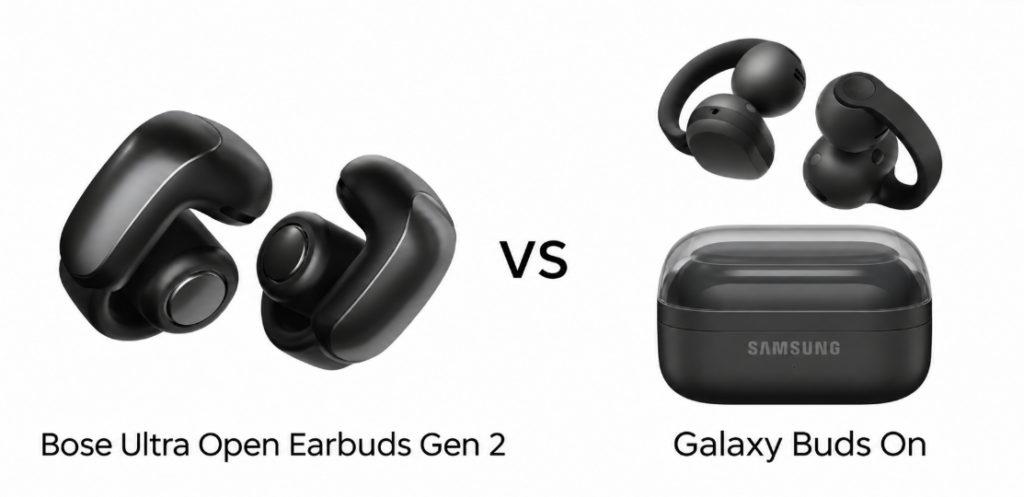
1. Major Features:
| Category | Bose Ultra Open Earbuds (2nd Gen) | Samsung Galaxy Buds On | Winner |
|---|---|---|---|
| Product Type | Open-Ear Wireless Earbuds | Open-Ear Clip-On Wireless Earbuds | Samsung – Clip-on design with flexible bands |
| Design | Cuff-Style Open-Ear | Clip-On Open-Ear | Depends on fit preference |
| Fit | Light Flex Grip | Flexible Clip-On Bands | Depends on fit preference |
| Joint Design | Adjustable Flex Joint | Flexible Clip-On Structure | Bose – Adjustable flex joint |
| Driver | Newly Engineered Driver | 11.3mm TwinBoost, Dual Dynamic Drivers | Samsung – Larger specified driver system |
| Audio Technology | Bose OpenAudio | Sound Leakage Cancellation | Depends on audio preference |
| Spatial Audio | TrueSpatial Technology | 360 Audio | Tie – Both support spatial audio |
| Immersive Audio | Bose Immersive Audio | 360 Audio | Bose – Dedicated Immersive Audio modes |
| Listening Modes | Stereo, Immersion, Cinema | 360 Audio | Bose – More dedicated listening modes |
| Hi-Fi Audio | Not specified | 24-bit/96kHz | Samsung – High-resolution audio support |
| Sound Leakage Control | OpenAudio Technology | Sound Leakage Cancellation | Samsung – Dedicated leakage cancellation feature |
| Adaptive Volume | Not specified | Yes | Samsung – Adaptive Volume |
| Active Noise Cancellation | No | No | Tie – Neither supports ANC |
| Microphones | 2 Microphones | 3 Microphones | Samsung – Additional microphone |
| Call Technology | Bose SpeechClarity | HD Voice, DNN Noise Reduction | Samsung – More extensive call processing |
| Voice Pickup Unit | Not specified | Jaw-Sensing VPU | Samsung – Dedicated voice pickup hardware |
| Bluetooth | 5.4 | 6.2 | Samsung – Newer Bluetooth version |
| Bluetooth Multipoint | Yes | Auto Switch | Bose – Supports two simultaneous device connections |
| LE Audio | Not specified | Ready | Samsung – LE Audio readiness |
| AI Assistants | Voice Assistant Support | Gemini and Bixby | Samsung – Integrated AI assistants |
| Voice Commands | Not specified | Yes | Samsung – Voice command support |
| Head Gestures | Not specified | Yes | Samsung – Hands-free gesture controls |
| Controls | Physical Buttons | Tap and Hold, Head Gestures, Voice Commands | Samsung – More control options |
| Quick Voice Memo | Not specified | Yes | Samsung – Built-in voice memo feature |
| Battery Life (Earbuds) | Up to 9 Hours | Up to 9.5 Hours | Samsung – 30 minutes longer |
| Total Battery Life | Up to 28.5 Hours | Up to 38 Hours | Samsung – 9.5 hours more |
| Talk Time | Not specified | Up to 5.5 Hours | Samsung – Specified talk time |
| Fast Charging | 10-Minute Charge for 2 Hours Playback | Not specified | Bose – Specified quick charging |
| Wireless Charging | Yes | Yes | Tie – Both support wireless charging |
| Water Resistance | IPX4 | IP54 | Samsung – Higher dust and water protection |
| Single Earbud Usage | Yes | Not specified | Bose – Independent earbud usage |
| Companion App | Bose App | Galaxy Wearable | Depends on ecosystem |
| Compatibility | Bluetooth Devices | Android 11+, iOS Bluetooth Audio, Windows 10 PCs | Samsung – Broader specified compatibility |
| Earbud Weight | Approximately 5.9g | Not specified | Bose – Lighter specified weight |
| Price | Approx. $300 / ₹28,000 | Approx. $230 / ₹20,000 | Samsung – Lower price |
2. Design and Comfort
Build & Fit
The Bose Ultra Open Earbuds (2nd Gen) and Samsung Galaxy Buds On take different approaches to open-ear comfort. Bose uses a cuff-style design with a Light Flex Grip and adjustable flex joint, allowing each earbud to wrap around the ear without entering the ear canal. Its polycarbonate and silicone construction supports this distinctive form factor while maintaining an open-ear listening experience.
Samsung opts for a clip-on design with flexible bands that secure the earbuds around the ears. Rather than using Bose’s adjustable joint, the Galaxy Buds On rely on their flexible clip-on structure. Both designs keep the ear canals unobstructed, making them suitable for listeners who prefer not to use conventional in-ear earbuds.
Controls & Usability
Bose provides physical buttons on each earbud for playback, volume and call controls. Samsung offers a more extensive control system combining touch interactions, voice commands and head gestures. Its automatic left/right detection also removes the need to manually identify which earbud goes on which side.
Verdict
Samsung takes the lead in control flexibility and hands-free interactions, while Bose offers a distinctive adjustable cuff-style fit. The better design ultimately comes down to personal comfort preferences.
3. Sound Quality
Driver Performance, Bass, Mids and Highs
The Bose Ultra Open Earbuds (2nd Gen) feature a newly engineered driver paired with Bose OpenAudio technology. Their sound presentation is designed around an open-ear listening experience, with Bose Immersive Audio adding a more spatial approach to playback. TrueSpatial technology further supports its immersive listening modes, including Stereo, Immersion and Cinema.
Samsung takes a more explicitly specified hardware approach with its Galaxy Buds On. They feature an 11.3mm TwinBoost speaker system with dual dynamic drivers and support 24-bit/96kHz Hi-Fi audio. This gives Samsung a stronger specification sheet for high-resolution audio playback, although actual sound quality also depends on tuning and the source device.
Codec Support & Audio Features
Bose brings Immersive Audio and dedicated Cinema and Immersion modes to the experience. Samsung counters with 360 Audio, Adaptive Volume and Sound Leakage Cancellation, alongside its high-resolution audio support.
Verdict
Samsung has the advantage on driver specifications and high-resolution audio support. Bose, however, offers a more clearly defined immersive listening feature set through TrueSpatial and its dedicated audio modes. Both target listeners who want spatial audio without traditional in-ear designs.
4. ANC and Transparency Modes
Noise Cancellation Quality
Neither the Bose Ultra Open Earbuds (2nd Gen) nor the Samsung Galaxy Buds On offers conventional Active Noise Cancellation. Both use open-ear designs that leave the ear canals unobstructed, prioritising awareness of surrounding sounds rather than isolating listeners from their environment.
However, Samsung introduces Sound Leakage Cancellation and Adaptive Volume. These features address different aspects of open-ear listening: limiting sound leakage and adjusting playback volume. They should not be confused with ANC, which actively reduces external noise reaching the listener.
Bose takes a different approach with its OpenAudio technology, designed around delivering sound through an open-ear format. It does not include an ANC system or a dedicated noise-cancelling mode.
Ambient & Call Performance
Neither model needs a conventional transparency mode because the open-ear construction already allows environmental sounds to remain audible. For calls, Bose uses two microphones alongside SpeechClarity technology. Samsung goes further with three microphones, a jaw-sensing Voice Pickup Unit, personalised beamforming and Deep Neural Network noise reduction. Its Super Wideband Calling also supports 16kHz call audio.
Verdict
Samsung wins on call-related hardware and noise-processing features. Bose keeps things simpler with SpeechClarity and its two-microphone arrangement. Neither is suitable for listeners specifically seeking ANC.
5. Battery and Connectivity
Battery Life & Fast Charging
The Bose Ultra Open Earbuds (2nd Gen) deliver up to 9 hours of playback on a single charge, with the charging case extending total listening time to 28.5 hours. Enabling Immersive Audio or Auto Volume reduces earbud playback to 5 hours, while using both features brings it down to 4 hours. Its 10-minute quick charge provides up to 2 hours of playback, and the case supports wireless charging.
Samsung offers a longer rated battery life, with up to 9.5 hours from the earbuds and up to 38 hours when combined with the charging case. It also supports wireless charging, although a fast-charging figure is not included in the specifications provided.
Bluetooth Stability and Multipoint
Bose uses Bluetooth 5.4 and supports multipoint connectivity, allowing two devices to remain connected simultaneously. Samsung moves ahead with Bluetooth 6.2 and LE Audio readiness. Its Auto Switch feature enables automatic device switching across compatible Galaxy devices, including smartphones, tablets, Galaxy Book PCs and Samsung TVs.
Verdict
Samsung takes the battery advantage with 9.5 hours of earbud playback and 38 hours overall. Bose counters with a specified quick-charging feature and traditional multipoint connectivity. For longer listening between charges, Samsung has the stronger specifications.
6. Pricing
The Bose Ultra Open Earbuds (2nd Gen) are positioned at approximately $300 (₹28,000), placing them firmly in the premium open-ear segment. The Samsung Galaxy Buds On are comparatively more affordable at around $230 (₹20,000).
That creates a noticeable difference of approximately $70 (₹8,000), with Samsung offering the lower entry price while bringing several additional hardware and software features. These include dual dynamic drivers, 24-bit/96kHz audio support, three microphones, a jaw-sensing Voice Pickup Unit, head gestures and a longer rated total battery life.
Bose justifies its higher positioning through its distinctive cuff-style design, Immersive Audio, TrueSpatial technology, Cinema mode and established multipoint support. Its quick-charging capability also adds convenience.
Verdict
Samsung offers better overall value on paper, particularly with its longer battery life, advanced call features, newer Bluetooth version and lower price. Bose remains an interesting alternative for listeners who specifically prefer its cuff-style design and immersive audio features. Unless those Bose-specific features are a priority, the Galaxy Buds On make a stronger case at their lower asking price.
7. 6. Conclusion
The Bose Ultra Open Earbuds (2nd Gen) stand out with their cuff-style construction, adjustable flex joint, Bose Immersive Audio, TrueSpatial technology and dedicated Cinema mode. They also offer Bluetooth multipoint and quick charging, making them a feature-rich option for listeners who prefer Bose’s approach to open-ear audio.
The Samsung Galaxy Buds On bring a different set of strengths. Their 11.3mm TwinBoost speaker system, dual dynamic drivers, 24-bit/96kHz Hi-Fi support, 360 Audio and Sound Leakage Cancellation create a comprehensive audio feature set. Samsung also adds a jaw-sensing VPU, head gestures, voice commands, Gemini and Bixby integration, and Quick Voice Memo functionality. Its 38-hour total battery rating further strengthens its appeal.
Verdict
The Samsung Galaxy Buds On emerge as the more versatile overall package. They offer longer rated battery life, more advanced call hardware, additional smart controls and a lower price. Bose still has a compelling alternative for listeners who prioritise its distinctive cuff-style design and immersive audio experience.
Ultimately, Samsung is the stronger all-round choice, while Bose is better suited to those specifically drawn to its design and audio ecosystem.
Disclaimer: Prices, specifications, and availability may vary by region and retailer. Recommendations in this article are based on editorial opinion, feature-based value, and market positioning at the time of writing. Readers are advised to do their own research before making a purchase.
FREE NEWSLETTER
Get Gizmochina Daily
Every morning: the phone and gadget news that matters, with our take. 4 minutes.

Comments