
Add GIZMOCHINA on Google:
As an Amazon Associate, Gizmochina earns from qualifying purchases. Links on this page may earn us a commission at no extra cost to you.
Qualcomm’s newest flagship chip is called the Snapdragon 8 Elite Extreme Gen 6. You need a breath to say it out loud. It is also the one thing the Motorola Signature 27 and the OnePlus 16 have in common.
Everything else is different. The Motorola Signature 27 is set to reach the US in November. The OnePlus 16 is only on sale in China. OnePlus has stopped launching new phones in Europe and North America. You can read all you like about the OnePlus 16. Most of you will not be able to buy one.
The spec sheets point in different directions too. OnePlus fitted the OnePlus 16 with a 9,000mAh-equivalent battery and a screen that runs at 185Hz in games. Motorola gave the Signature 27 a smaller 7,000mAh battery. It also has a 200MP periscope camera and a promise of seven years of OS updates.
Both phones are on the list of devices confirmed for Qualcomm’s new chip. That means speed will not decide this one. The battery, the cameras, the software support, and where you live will. Here is how the two phones compare.
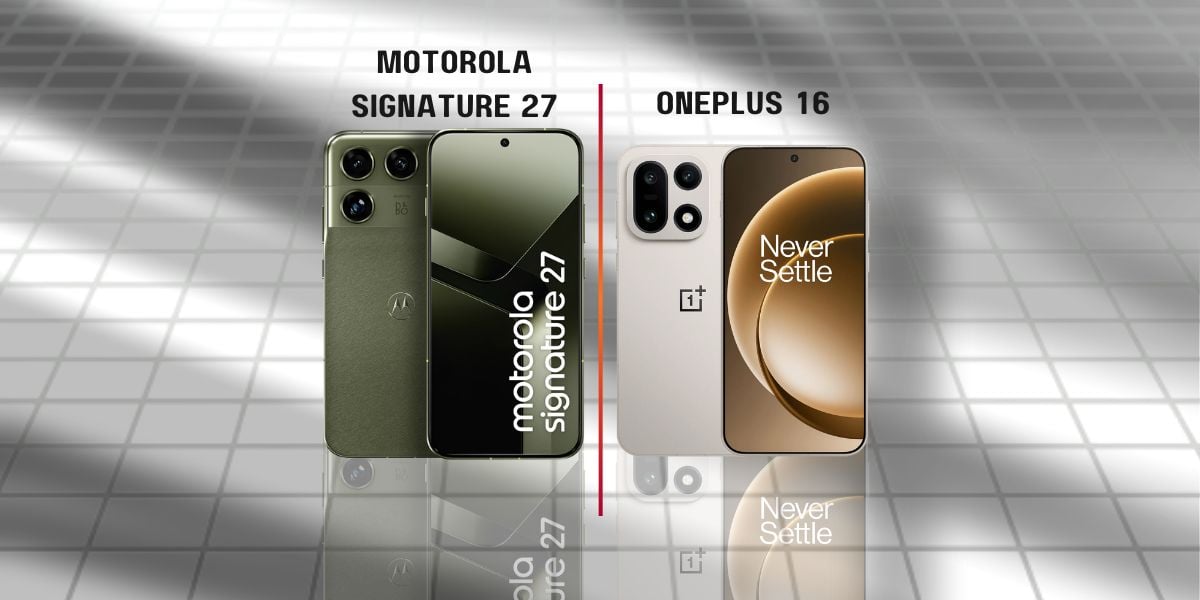
1. Performance and cooling
On the chip itself, there is nothing to split them. Qualcomm says the Snapdragon 8 Elite Extreme Gen 6 is built on a 2nm process. It claims a 13% CPU gain and a 44% GPU gain over the Snapdragon 8 Elite Gen 5. Both phones get the same silicon.
OnePlus has built more around it. The OnePlus 16 has a G3 gaming network chip, a P4 display chip, and a T3 touch chip. As a result, multi-finger touch sampling can reach 520Hz, and the gyroscope samples at 800Hz. OnePlus also says the phone held an average of 185fps in Delta Force for three hours in its own testing.
Motorola is not selling the Motorola Signature 27 as a gaming phone. It pairs diamond-infused thermal gel with a new 3D vapor chamber to keep the chip cool. You can get up to 16GB of RAM. RAM Boost can stretch that to 24GB.
If you play competitive shooters, the OnePlus 16 makes the better case. For everything else, the Motorola Signature 27 should feel just as fast.
2. Display
The OnePlus 16 has a flat 6.78-inch BOE X4 OLED panel. It runs at up to 165Hz across the whole system and can reach 185Hz in supported games. We covered the BOE partnership and what it brings earlier. Also, the panel has 450ppi with 100% DCI-P3 coverage, can dim down to 1 nit of brightness, and uses 3,840Hz PWM dimming.
The Motorola Signature 27 has a 6.8-inch Extreme AMOLED Duo, or tandem OLED, display. Thus, Motorola claims the screen can reach up to 12,000 nits of peak brightness. We, however, cannot compare it directly with the 2,000 nits of brightness OnePlus quotes for the whole screen. The screen also supports Dolby Vision, and Audio by Bang & Olufsen handles sound.
3. Cameras
Both phones have a 200-megapixel camera, but they use it for different purposes. Motorola is using the sensor for a periscope telephoto camera, while OnePlus is using it for the main rear camera.
The Motorola Signature 27 pairs its 200MP periscope camera with a 50MP Sony LYTIA L910 main sensor featuring LOFIC technology. Motorola says this helps preserve details in both bright and dark areas of the same image. There is also a dedicated EVS Action Sensor for capturing fast-moving subjects in low light.
The OnePlus 16 has a 200MP main camera with a 1/1.4-inch sensor and optical image stabilization. It also gets a 50MP periscope camera with 3x optical and 6x lossless zoom, alongside a 50-megapixel ultrawide camera with a 116-degree field of view. The front camera is another 50MP unit with autofocus. For video, the phone supports 4K recording at 120fps with Dolby Vision.
On paper, the Motorola has an advantage for long-range photography, while the OnePlus has the higher-resolution main camera. Since the main camera is likely to be the one most people use regularly, this is an important difference. However, independent camera testing for both phones is still limited, so it is too early to draw firm conclusions about overall image quality.
4. Battery and charging
The OnePlus 16 wins in terms of battery. It packs a 9,000mAh dual-cell battery, with each cell rated at a typical capacity of 4,500mAh. Charging supports 100W wired and 50W wireless speeds, with OnePlus claiming a full charge from 1% takes just 52 minutes. The phone also supports 27W wired reverse charging.
OnePlus says the battery will retain at least 80% of its original capacity after five years, which is a useful promise given its large size.
The Motorola Signature 27 has a smaller 7,000mAh battery, with a rated capacity of 6,790mAh. It supports 90W wired and 50W wireless charging. Motorola claims just 12 minutes of wired charging can provide enough power for a full day of use, while a complete wireless charge takes up to 80 minutes. You will need to buy the chargers separately.
Motorola also quotes up to 77 hours of mixed-use battery life. OnePlus, meanwhile, provides individual test figures, including up to 23.8 hours of video playback. These measurements use different testing methods, so they do not tell us which phone will last longer in everyday use. Real-world battery tests will give us a better idea.
5. Design and durability
The Motorola Signature 27 comes in a Pantone Coal Smoke finish, with a warm gray color and a Tactical Weave texture on the back. The front has Gorilla Glass protection, while the phone carries IP68 and IP69 ratings for water and dust resistance. Motorola also says it passed 14 MIL-STD-810H procedures across 16 categories.
The OnePlus 16 comes in three colors: Tomorrow’s Starlight, Mars Red, and Deep Black. The Tomorrow’s Starlight version has an additional interstellar light effect on the back, which can glow for incoming calls, messages, and in-game events. The phone is built with a metal frame and carries IP66, IP68, IP69, and IP69K ratings.
Other hardware features include an ultrasonic fingerprint sensor, a dedicated shortcut key, and stereo speakers.
6. Software and updates
Motorola has the advantage in software support. The company promises seven major Android OS updates and up to seven years of security updates for the Signature 27. Meanwhile, OnePlus promises five years of software updates and six years of security updates
Motorola’s software also includes Gemini Intelligence and Motorola Qira. The latter can help users find and recall information across different apps, although it requires a Motorola or Lenovo account and at least 12GB of RAM.
The OnePlus 16 runs ColorOS 17 with OPPO AI features. It can connect to Mac and Windows computers, answer calls from an iPhone, and pair with an Apple Watch.
Price and availability
Availability is probably the biggest difference between the two phones, particularly for buyers outside China.
The Motorola Signature 27 is priced at $1,599 in the US and €1,899 in Europe. However, select retailers and partners in some countries will offer it for a lower price of € 1,399. Sales begin on November 16 across Europe, the Middle East, and Africa.
The OnePlus 16, meanwhile, went on sale in China on October 31, with prices starting at CNY 5,999 (around $900). OnePlus has not announced international pricing or an overseas release date. For buyers outside China, importing the phone is currently the only realistic option.
7. Which one should you buy?
The Motorola Signature 27 makes more sense if you want longer software support, a 200-megapixel periscope camera, and a phone with a confirmed US release. Its tandem OLED display and durability ratings are also worth considering.
The OnePlus 16 is the better option on paper if battery capacity, charging speeds, and gaming performance matter more to you. Its 9,000mAh battery and 165Hz display give it some clear hardware advantages. The bigger problem is availability, as buyers outside China still have no confirmed international release to look forward to.
8. Motorola Signature 27 vs OnePlus 16: key specs
| Motorola Signature 27 | OnePlus 16 | |
|---|---|---|
| Chipset | Snapdragon 8 Elite Extreme Gen 6 | Snapdragon 8 Elite Extreme Gen 6 |
| Display | 6.8-inch Extreme AMOLED Duo | 6.78-inch flat BOE X4 OLED, 1–165Hz |
| Brightness claim | Up to 12,000 nits | 2,000 nits global |
| Main camera | 50MP Sony LYTIA L910 | 200MP, 1/1.4-inch, OIS |
| Telephoto | 200MP periscope | 50MP periscope, 3x optical |
| Ultrawide | 50MP | 50MP, 116° |
| Battery | 7,000mAh | 9,000mAh equivalent (dual-cell) |
| Wired charging | 90W | 100W |
| Wireless charging | 50W | 50W |
| Water and dust rating | IP68 and IP69 | IP66, IP68, IP69 and IP69K |
| Software | Android with Gemini Intelligence and Motorola Qira | ColorOS 17 |
| Storage | 256GB or 512GB | Up to 1TB |
FREE NEWSLETTER
Get Gizmochina Daily
Every morning: the phone and gadget news that matters, with our take. 4 minutes.