
Add GIZMOCHINA on Google:
Xiaomi’s Redmi Band 4 and Redmi Band 3 share several fundamental features, including a 1.47-inch display, 60Hz refresh rate, 5ATM water resistance and 50 sports modes. However, the newer Redmi Band 4 introduces changes to its exterior design, health-monitoring capabilities and claimed battery endurance.
While both devices target users looking for an affordable fitness tracker with everyday smart features, their differences are worth examining before choosing between them. Here is how the two Redmi bands compare across design, display, battery, health tracking and everyday functionality.
Design & Build
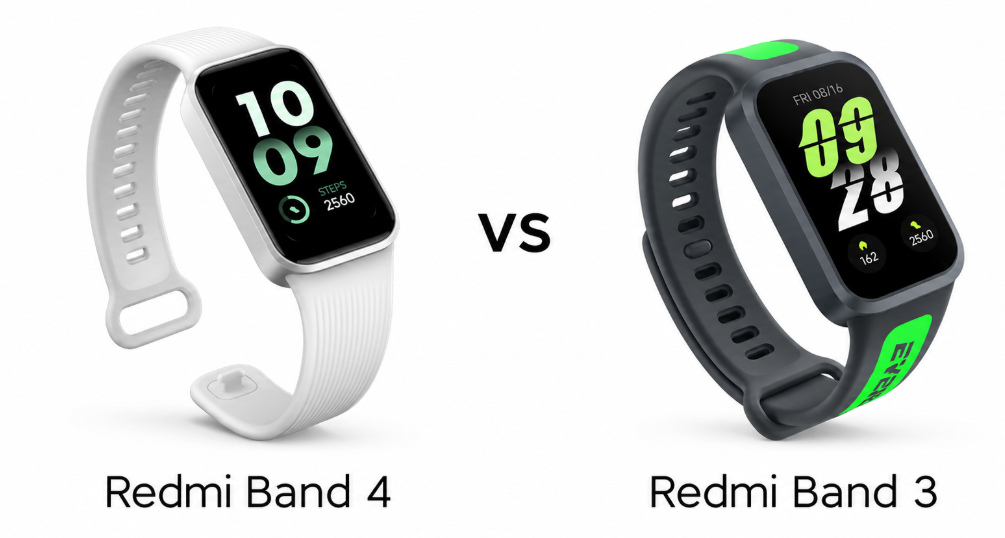
The Redmi Band 4 introduces a refreshed exterior with a metal-textured unibody design, replacing the Redmi Band 3’s high-strength fiber-polymer construction. Its 2.5D curved cover glass also gives the newer model a different front appearance compared with the reinforced glass on its predecessor. Xiaomi has updated the strap design as well, moving from the Redmi Band 3’s conventional TPU strap to a vertically textured design on the Redmi Band 4.
These changes give the newer model a more refined appearance, although both retain a lightweight fitness-band design intended for everyday use. The Redmi Band 3’s TPU strap provides a straightforward and practical approach to daily wear.
Winner: Redmi Band 4 – Refreshed exterior with a curved-glass finish and updated strap design.
Display
Both fitness bands feature a 1.47-inch display with a 60Hz refresh rate, keeping their screen sizes and refresh performance on equal footing. This means users upgrading from the Redmi Band 3 should not expect a larger viewing area or a higher refresh rate with the Redmi Band 4.
The main distinction lies in the display’s protective glass and overall presentation. The Redmi Band 4 uses 2.5D curved glass, while the Redmi Band 3 features reinforced glass. The curved-glass treatment gives the newer model a different appearance, complementing its redesigned exterior. However, neither model establishes a clear advantage in screen size or refresh rate.
Winner: Redmi Band 4 – Curved-glass design gives it a refreshed display appearance.
Battery Life & Charging
Battery endurance is one of the more meaningful improvements in the Redmi Band 4. Xiaomi claims up to 21 days of battery life, compared with up to 18 days for the Redmi Band 3. This represents three additional days of claimed usage, potentially reducing how frequently users need to recharge the newer fitness band.
The Redmi Band 4 also offers approximately eight days of battery life with regular monitoring enabled. This provides a more practical indication of endurance when health-monitoring features are being used more frequently. The Redmi Band 3 features a 300mAh lithium-ion polymer battery and supports charging in less than two hours.
Winner: Redmi Band 4 – Three additional days of claimed maximum battery life.
Health Tracking
Both models cover essential health-monitoring requirements, including heart rate monitoring, blood oxygen tracking and sleep monitoring. These features make them suitable for users who want basic health insights throughout the day without investing in a more expensive smartwatch.
The Redmi Band 4 expands this functionality with all-day stress monitoring and women’s health tracking. These additions give the newer model a broader health-monitoring package, particularly for users interested in tracking stress levels and menstrual health alongside their regular fitness data.
The Redmi Band 3 already provides optical heart rate and blood oxygen sensors, making it a capable starting point for everyday health tracking. However, the additional monitoring features give its successor an advantage.
Winner: Redmi Band 4 – Adds all-day stress monitoring and women’s health tracking.
GPS & Navigation
Neither model establishes a dedicated built-in GPS advantage. The Redmi Band 3 does not include built-in GPS, and the Redmi Band 4’s feature set does not establish a standalone GPS capability either.
Consequently, users looking for independent outdoor route tracking should consider a fitness band with dedicated satellite positioning instead. Both Redmi models are better suited to everyday activity monitoring, step tracking and general fitness use than advanced navigation.
For users who primarily exercise indoors, walk around their neighbourhood or track general daily activity, the absence of a dedicated GPS system may not be a significant limitation.
Winner: Tie – Neither model offers a confirmed built-in GPS advantage.
Sports & Training Features
The Redmi Band 4 and Redmi Band 3 both support 50 sports modes, giving them similar coverage for everyday workouts and recreational fitness activities. Whether users prefer indoor exercise, walking or other supported activities, neither model offers a numerical advantage in the number of available sports modes.
The Redmi Band 4 benefits from its additional stress-monitoring capabilities, which complement its fitness features with broader health insights. However, the core sports-mode selection remains unchanged between the two generations.
For users primarily interested in workout variety, the Redmi Band 3 remains competitive. Those wanting a more comprehensive combination of fitness and health monitoring will find the Redmi Band 4 more appealing.
Winner: Tie – Both offer the same 50 sports modes.
Smart Features & Connectivity
The Redmi Band 3 supports Bluetooth 5.3 BLE and Xiaomi HyperOS, alongside compatibility with Android 8.0 or later and iOS 12.0 or later. Its smart functionality includes notifications and other everyday fitness-band features.
The Redmi Band 4 focuses on practical everyday conveniences, including notifications, alarms, watch faces and WeChat and Alipay QR payments. These payment integrations make it particularly useful for users who regularly use Xiaomi’s supported payment ecosystem.
The two devices approach everyday functionality differently, with the Redmi Band 4 highlighting convenient payment-related features while the Redmi Band 3 provides a clearly defined connectivity specification.
Winner: Redmi Band 4 – Offers integrated WeChat and Alipay QR payment functionality.
Outdoor Features & Water Resistance
Both fitness bands feature 5ATM water resistance, making them suitable for water-related activities within the limits of their respective water-resistance ratings. This gives the Redmi Band 4 no particular advantage over its predecessor for everyday exposure to water or swimming-related use.
Neither model offers a confirmed built-in GPS advantage, so users who regularly participate in outdoor running or cycling and require independent route tracking may need a more advanced wearable.
For general outdoor activity tracking, however, both bands provide a similar foundation through their sports modes, health-monitoring capabilities and water-resistant construction.
Winner: Tie – Both feature 5ATM water resistance and similar outdoor-tracking capabilities.
Which One Should You Buy?
The Redmi Band 4 is the more appealing choice for users who want the newer design, additional health-monitoring features and longer claimed battery endurance. Its all-day stress monitoring, women’s health tracking and updated exterior give it meaningful improvements over the Redmi Band 3.
However, the Redmi Band 3 remains a practical option for users who primarily need heart rate monitoring, blood oxygen tracking, sleep monitoring and 50 sports modes. Its 1.47-inch display and 5ATM water resistance also remain competitive against the newer model.
Final Verdict
If you are planning to buy a new fitness band, the Redmi Band 4 is the better choice thanks to its refreshed design, additional health-monitoring features and longer battery life. However, if you already own the Redmi Band 3, there is little reason to upgrade, as the core experience remains largely unchanged and the improvements are relatively incremental.
Disclaimer: Prices, specifications, and availability may vary by region and retailer. Recommendations in this article are based on editorial opinion, feature-based value, and market positioning at the time of writing. Readers are advised to do their own research before making a purchase.
Redmi Band 4 vs Redmi Band 3
| Category | Redmi Band 4 | Redmi Band 3 | Winner |
| Cover Glass | 2.5D Curved Glass | Reinforced Glass | Redmi Band 4 – Curved-glass design |
| Frame Design | Metal-textured Unibody | High-Strength Fiber Polymer | Redmi Band 4 – Refreshed exterior |
| Strap Design | Vertically Textured | TPU | Redmi Band 4 – Updated design |
| Display Size | 1.47-inch | 1.47-inch | Tie – Same size |
| Refresh Rate | 60Hz | 60Hz | Tie – Same refresh rate |
| Battery Life | Up to 21 days | Up to 18 days | Redmi Band 4 – Longer endurance |
| Regular Monitoring | Approximately 8 days | — | Redmi Band 4 – Additional usage information |
| Heart Rate Monitoring | Supported | Optical Sensor | Tie – Both supported |
| Blood Oxygen Monitoring | Supported | Optical Sensor | Tie – Both supported |
| Stress Monitoring | All-day | — | Redmi Band 4 – Additional tracking |
| Sleep Tracking | Supported | Supported | Tie – Both supported |
| Women’s Health Tracking | Supported | — | Redmi Band 4 – Additional feature |
| Sports Modes | 50 | 50 | Tie – Same number |
| Water Resistance | 5ATM | 5ATM | Tie – Same rating |
| Wireless Connectivity | — | Bluetooth 5.3 BLE | Redmi Band 3 – Defined Bluetooth specification |
| NFC | Not supported | Supported | Redmi Band 3 – NFC support |
| Smart Features | Notifications, alarms, watch faces, WeChat and Alipay QR payments | Notifications and smart-band functions | Redmi Band 4 – QR payment features |
| Built-in GPS | — | No | Tie – No established advantage |
Read More:
- Samsung Galaxy W27 vs Samsung Galaxy Z Fold8 Ultra: What’s Actually Different?
- RedMagic 12 Pro+ vs OnePlus Ace 7 Pro: Which Flagship Gaming Phone Is Better?
- OnePlus Turbo 6V vs Nord 5: Is a 9000mAh Battery Better Than Flagship Performance?
FREE NEWSLETTER
Get Gizmochina Daily
Every morning: the phone and gadget news that matters, with our take. 4 minutes.

Comments