
Add GIZMOCHINA on Google:
As an Amazon Associate, Gizmochina earns from qualifying purchases. Links on this page may earn us a commission at no extra cost to you.
Anker Soundcore AeroClip 2 and Samsung Galaxy Buds On take different approaches to open-ear listening. Both use a clip-on design that keeps the ear canal open, making them suitable for people who dislike traditional in-ear earbuds. However, their priorities are quite different. Anker focuses on Hi-Res audio, LDAC support, durability and AI-powered features, while Samsung puts more emphasis on smart controls, voice assistance, call clarity and its Galaxy ecosystem.
There is also an interesting trade-off in battery life: Samsung promises longer playback, while Anker offers a higher water-resistance rating and a different set of audio features. Neither is designed to provide traditional active noise cancellation, so the comparison comes down to comfort, sound, convenience, and everyday usability.
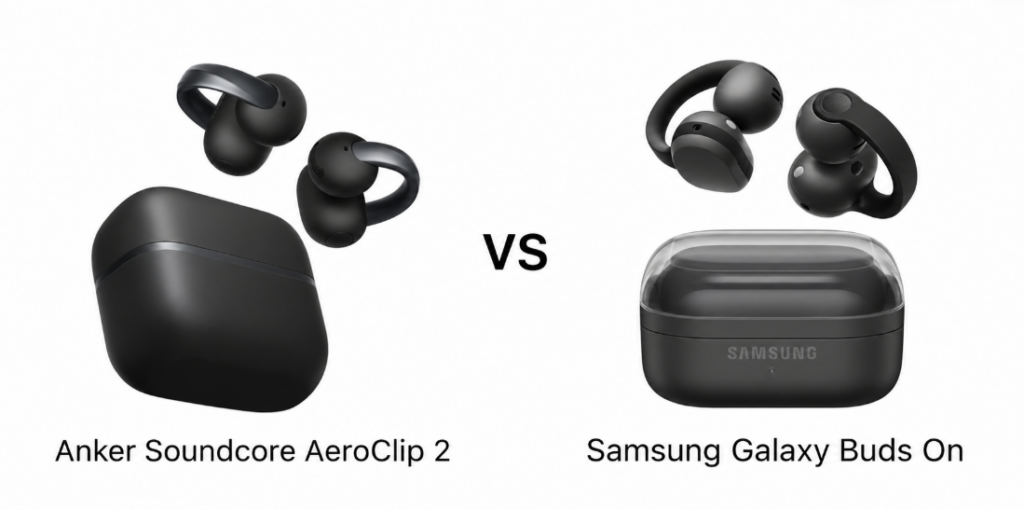
1. Major Features:
| Category | Anker Soundcore AeroClip 2 | Samsung Galaxy Buds On |
|---|---|---|
| Product Type | Open-Ear Wireless Clip-On Earbuds | Open-Ear Clip-On Wireless Earbuds |
| Design | GoldenFit C-Bridge Design | Clip-On Open-Ear |
| Fit | GoldenFit C-Bridge | Flexible Clip-On Bands |
| Joint Design | Flexible C-Bridge | Flexible Clip-On Structure |
| Driver Unit | 12mm Dual-Magnet Drivers | 11.3mm TwinBoost Dual Dynamic Drivers |
| Audio Technology | Hi-Res Audio | Hi-Fi Audio |
| Audio Codec | LDAC | Not specified |
| Spatial Audio | 3D Spatial Audio | 360 Audio |
| High-Resolution Audio | Hi-Res Audio | 24-bit/96kHz |
| Bluetooth Version | 6.0 | 6.2 |
| Battery Life (Earbuds) | Up to 8 hours | Up to 9.5 hours |
| Total Battery Life | Up to 32 hours | Up to 38 hours |
| Fast Charging | 10 minutes for up to 4 hours of playback | – |
| Wireless Charging | Yes | Yes |
| Active Noise Cancellation | No | No |
| Sound Leakage Technology | Minimal Sound Leakage | Sound Leakage Cancellation |
| Microphones | 4 MEMS Microphones | 3 Microphones |
| Voice Sensors | 2 Bone-Conduction Sensors (VPUs) | Jaw-Sensing VPU |
| Call Technology | Anker Thus AI | HD Voice, DNN Noise Reduction |
| Multipoint Connection | Yes, Dual-Device Connection | Auto Switch |
| LE Audio | – | Ready |
| AI Assistants | AI Translation (100+ Languages) | Gemini and Bixby |
| Voice Commands | – | Yes |
| Head Gestures | – | Yes |
| Controls | Physical Button Controls | Tap and Hold, Head Gestures, Voice Commands |
| Equalizer | HearID 5.0 | Galaxy Wearable Audio Settings |
| Water Resistance | IP57 | IP54 |
| Companion App | soundcore App | Galaxy Wearable |
| Compatibility | Bluetooth-Compatible Devices | Android 11+, iOS Bluetooth Audio, Windows 10 PCs |
| Additional Features | Built-in White Noise, Nap Mode | Quick Voice Memo |
| Weight | 6.2g per earbud | – |
| Price (US) | Approx. $170 | Approx. $230 |
| Price (India) | Approx. ₹21,000 | Approx. ₹20,000 |
2. Design and Comfort
Build and Fit
Both earbuds feature an open-ear clip-on construction, avoiding the pressure associated with silicone ear tips. However, their fitting mechanisms differ. The AeroClip 2 uses Anker’s GoldenFit C-Bridge design, with each earbud weighing approximately 6.2g. Its flexible structure is designed to maintain a secure fit without sealing the ear canal.
The Galaxy Buds On takes a similar approach with flexible clip-on bands and a joint-based structure. This design aims to keep the earbuds comfortably positioned while allowing users to remain aware of their surroundings.
For everyday use, both designs have an advantage over conventional in-ear earbuds, particularly for people who dislike having something inserted into their ears. Actual comfort will still depend on ear shape and individual fit.
Controls and Usability
Anker provides physical button controls, which can help prevent accidental inputs during movement. Samsung offers more interaction options, including touch-and-hold controls, voice commands and head gestures.
Verdict
Samsung offers greater control flexibility, but Anker’s physical buttons may appeal to users who prefer straightforward operation. Neither has an obvious universal comfort advantage, although the AeroClip 2’s IP57 rating provides better protection against dust and water than Samsung’s IP54 rating.
3. Sound Quality
Driver Performance, Bass, Mids and Highs
The AeroClip 2 features 12mm dual-magnet drivers, while the Galaxy Buds On uses 11.3mm TwinBoost dual dynamic drivers. Both configurations are designed to deliver a fuller listening experience despite the absence of a traditional in-ear seal.
Anker has a particularly interesting advantage on paper with its larger drivers and Hi-Res Audio support. Its LDAC compatibility also gives it an advantage for users with compatible Android devices and high-quality audio sources. This makes the AeroClip 2 an appealing option for listeners who prioritise audio specifications.
Samsung counters with 24-bit/96kHz Hi-Fi audio support and 360 Audio, providing a more feature-rich listening experience within its ecosystem. However, driver size alone does not determine sound quality, and neither product’s specifications establish which has better bass response, vocal separation or treble clarity.
Codec Support and Audio Features
Anker supports LDAC and 3D Spatial Audio, while Samsung offers 360 Audio and its own Galaxy-focused audio features.
Verdict
Anker has the more straightforward advantage for codec flexibility, particularly for LDAC-compatible Android users. Samsung makes a stronger case for people already invested in Galaxy devices. Actual sound quality will ultimately depend on tuning and fit.
4. Noise Cancellation and Ambient Listening
Noise Cancellation Quality
Neither the AeroClip 2 nor the Galaxy Buds On offers conventional active noise cancellation (ANC). This is an important distinction because both products are designed around open-ear listening rather than isolating the listener from surrounding noise.
Anker’s minimal sound leakage technology is intended to reduce how much audio escapes from the earbuds. Samsung also features Sound Leakage Cancellation, which addresses sound escaping from the open-ear design. These technologies should not be confused with ANC, which actively reduces external noise reaching the listener.
Ambient and Call Performance
The open-ear construction naturally allows users to hear surrounding sounds without switching to a dedicated transparency mode. This can be useful while walking, working or listening to audio at home.
For calls, Anker combines four MEMS microphones with two bone-conduction sensors and its AI-powered call technology. Samsung uses three microphones, HD Voice, DNN noise reduction and a jaw-sensing VPU. Both manufacturers are targeting clearer voice pickup, although real-world call quality will depend on background noise and microphone processing.
Verdict
Anker has the more extensive microphone hardware on paper, while Samsung offers a dedicated combination of voice-processing technologies. Neither should be purchased for noise isolation. For people who want environmental awareness, both designs make sense.
5. Battery and Connectivity
Battery Life and Fast Charging
Samsung takes the lead in battery endurance. The Galaxy Buds On delivers up to 9.5 hours of playback from the earbuds and up to 38 hours with its charging case. The AeroClip 2 offers up to 8 hours independently and 32 hours with the case.
That gives Samsung an additional 1.5 hours of standalone playback and six hours of combined battery life. Anker, however, has a useful fast-charging feature: a 10-minute charge provides up to four hours of playback. Samsung also supports wireless charging, which adds convenience when using a compatible charging pad.
Bluetooth Stability and Multipoint
Both earbuds support modern Bluetooth connectivity, with Anker using Bluetooth 6.0 and Samsung featuring Bluetooth 6.2. Anker supports dual-device multipoint connections, allowing users to connect two devices simultaneously. Samsung offers Auto Switch, which is particularly convenient when moving between compatible Galaxy devices.
Samsung also supports LE Audio readiness, Gemini and Bixby integration, voice commands and head gestures.
Verdict
Samsung wins on overall battery endurance and wireless charging, while Anker offers more clearly defined conventional multipoint functionality and faster quick charging. Samsung is particularly attractive for Galaxy users, but Anker is more flexible for people switching between different devices.
6. Pricing
Which Offers Better Value?
The AeroClip 2 has an approximate price of $170, compared with around $230 for the Galaxy Buds On. At these dollar prices, Anker is considerably cheaper, with a $60 difference that makes its LDAC support, IP57 protection, four microphones and fast charging particularly attractive.
However, the Indian price estimates tell a different story. The AeroClip 2 is approximately ₹21,000, while the Galaxy Buds On is around ₹20,000. At these prices, Samsung is marginally cheaper, despite being the more expensive option in the US comparison.
This regional difference changes the buying decision considerably. Anker looks like the better deal at the quoted US prices, but Samsung becomes more competitive in India.
Verdict
Anker offers better value at $170, while Samsung is the more affordable choice at the quoted Indian prices. Actual retail prices, discounts and regional availability should be checked before making a purchase.
7. Which Open-Ear Earbuds Should You Choose?
The Anker Soundcore AeroClip 2 and Samsung Galaxy Buds On are aimed at similar users, but their strengths make them suitable for different priorities.
Choose the Anker Soundcore AeroClip 2 if audio codec flexibility, water resistance, fast charging and broader device compatibility matter more than ecosystem-specific features. It is also the more attractive purchase at the quoted US price.
Choose the Samsung Galaxy Buds On if longer battery life, Galaxy integration, smart controls, wireless charging and voice assistant features are your priorities. Its lower quoted Indian price also makes it worth considering.
Overall, neither is an outright winner. Anker is the more audio-focused and durability-oriented option, while Samsung is the more connected and convenience-focused alternative. The better purchase depends on which features will actually make a difference in everyday listening.
One important buying consideration is that neither model replaces a conventional ANC-equipped pair of earbuds. Their open-ear designs prioritise comfort and environmental awareness over isolation. That makes them better suited to commuting in quieter environments, office use, walking and casual listening than noisy flights or crowded public transport.
At the same time, the price difference should be judged against regional availability rather than global pricing alone. A substantial discount on either model could easily change which one offers the better overall package.
Disclaimer: Prices, specifications, and availability may vary by region and retailer. Recommendations in this article are based on editorial opinion, feature-based value, and market positioning at the time of writing. Readers are advised to do their own research before making a purchase.
Read More:
- Redmi Band 4 vs Redmi Band 3: What Has Changed Between the Two Smart Bands?
- Samsung Galaxy W27 vs Samsung Galaxy Z Fold8 Ultra: What’s Actually Different?
- OnePlus Turbo 6V vs Nord 5: Is a 9000mAh Battery Better Than Flagship Performance?
FREE NEWSLETTER
Get Gizmochina Daily
Every morning: the phone and gadget news that matters, with our take. 4 minutes.

Comments