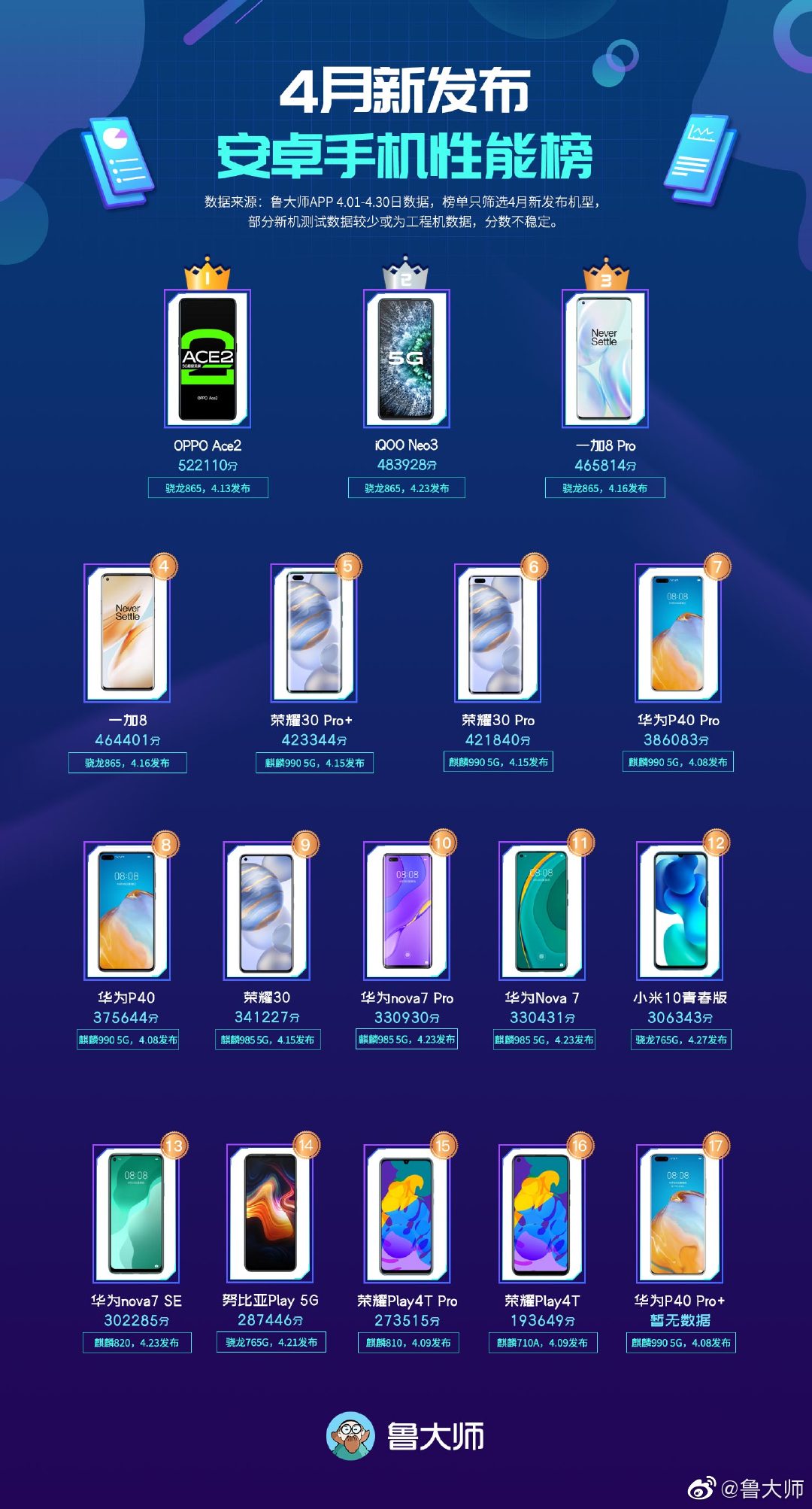
In April, the Chinese benchmarking platform – Master Lu shared a report on the market share of smartphone brands in the first quarter of 2020 in China. Huawei ranked first followed by Honor, OPPO, Xiaomi and Vivo. Today, the company released the list of best performing smartphones for the month of April. The list is led by the OPPO Ace2 flagship that was announced earlier in the same month.
The OPPO Ace2 scored 522,110 in Maser Lu benchmarks. Second came the iQOO Neo3 phone that recorded a score of 483,920. The OnePlus 8 Prov acquired the third spot with a scored of 465,814. Fourth came the OnePlus 8 with a score of 464,401. The top four are Snapdragon 865 mobile platform powered devices.
The Honor 30 Pro+ Kirin 990 5G powered surpassed Huawei P40 series with a scored of 424,344. The Honor 30 is placed sixth with a score of 421,840. The Huawei P40 Pro recorded a score of 386,083 to gain the seventh position. The Huawei P40 is on the eighth spot with 375,644 score.
The Honor 30 which is the first Kirin 985 5G chipset powered smartphone reached the ninth position with a score of 341,227. Powered the same Kirin 985 SoC, Nova 7 Pro and Nova 7 gained the tenth and eleventh places in the list with respective scores of 330,930 and 330,431.
The other phones that are included in the top 17 best performing phones in April in China include Snapdragon 765G powered Xiaomi Mi 10 Youth Edition, the Kirin 820 5G powered Huawei Nova 7 SE, Nubia Play 5G that features SD765G, Honor Play 4T Pro driven by Kirin 810, Honor Play 4T fueled by Kirin 710A and Kirin 990 5G powered Huawei P40 Pro+.
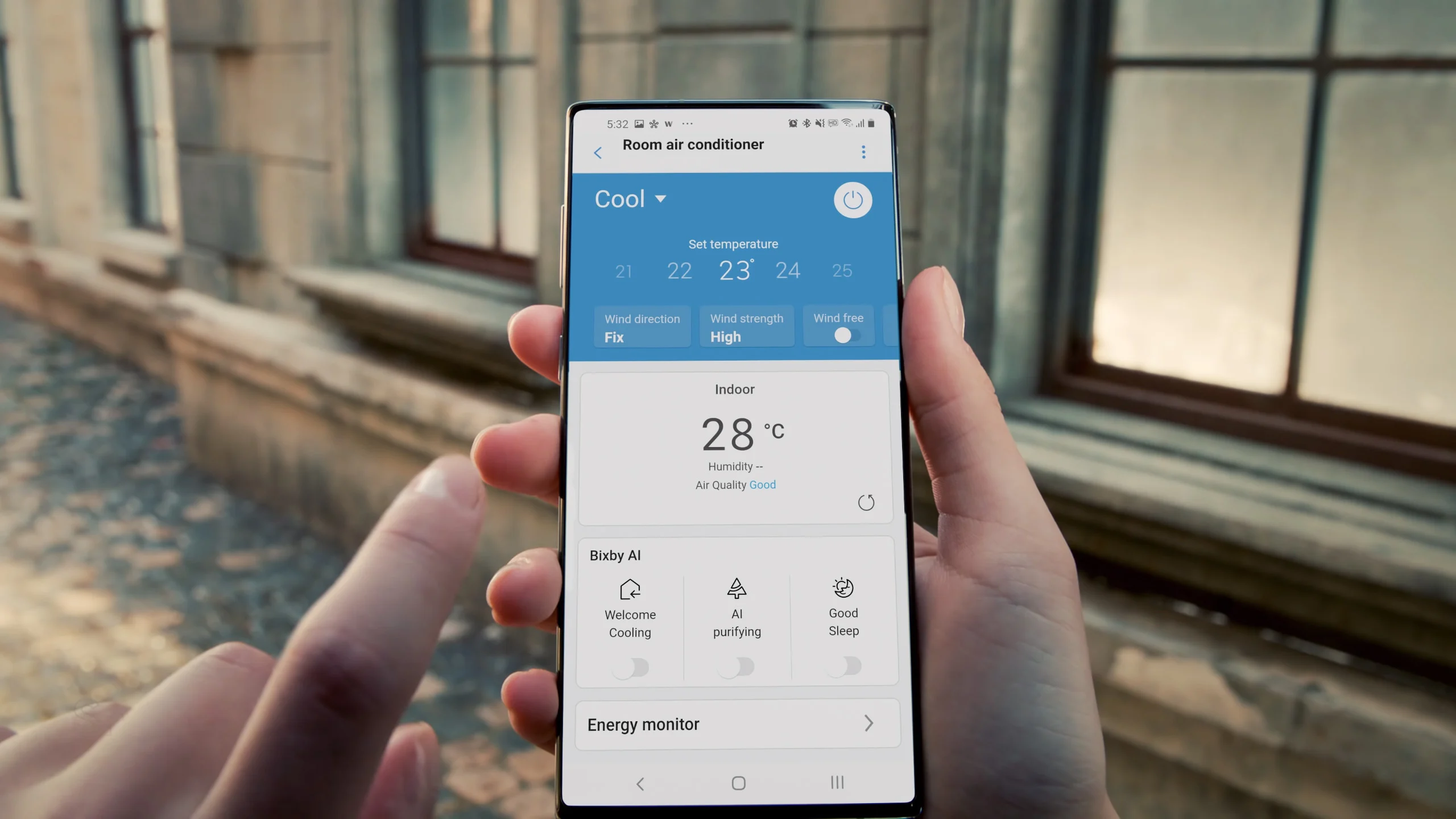
South Korean giant Samsung recently released an advertisement for its new wind-free air conditioners and in that ad, the company’s unannounced full-screen smartphone is showcased, running SmartThings app.
It shows that the smartphone has full-screen display without ant type of notch or punch-hole cutout for the front-facing camera setup. This could mean that the phone has an under-display camera technology, which the company has been working for a while.
Recently, renders of Samsung’s first smartphone featuring a pop-up camera setup as a part of its premium mid-range Galaxy A-lineup were leaked online. So, the phone showcased in the ad could be the upcoming Galaxy A-series device having pop-up front-facing camera.
However, it makes more sensor for the company to showcase a flagship-grade smartphone in an advertisement. Thus, there’s a possibility that the phone in question is a part of the upcoming Galaxy Note 20 series.
While the Samsung Galaxy Note 20 flagship was rumoured to feature the under-display camera technology, new reports claim that the company has ditched the plan because of issues with the supply chain with the on-going COVID-19 pandemic.
So, as said, the phone could either be the upcoming Galaxy A-series device with a pop-up front-facing camera or the upcoming flagship under the Galaxy Note 20 lineup. Or there’s a possibility that the phone in question is a totally different one. Another possibility is that there’s no such device from Samsung coming anytime soon and it was just a dummy device for the advertisement.
Samsung is expected to launch its flagship Galaxy Note 20 series as well as the second-generation Galaxy Fold smartphone this summer. Both the devices could get launched together at the same event. To know for sure, we’ll have to wait for some kind of confirmation from the company.
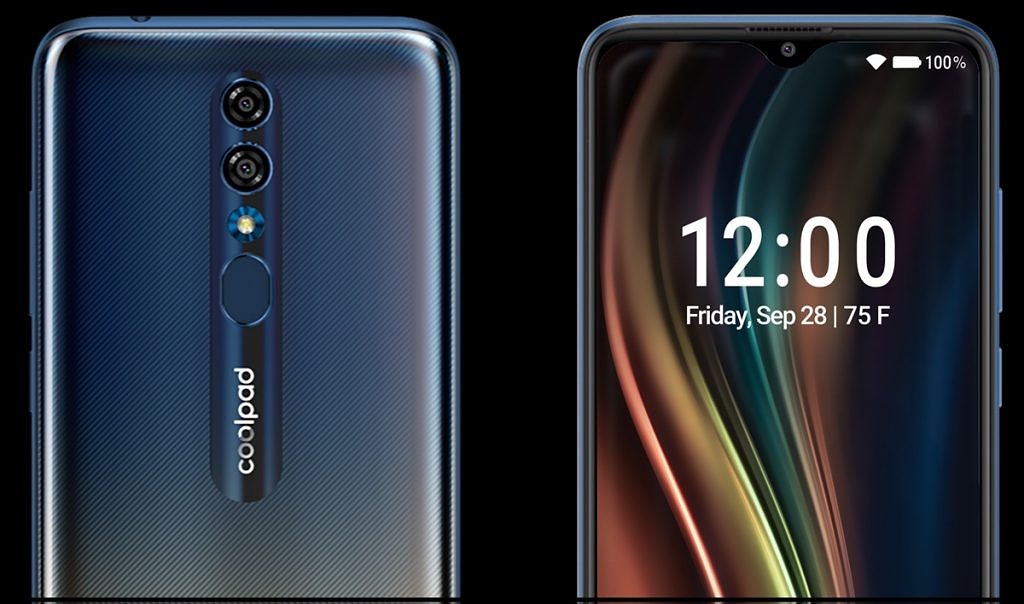
According to Chinese media, Coolpad has silently revealed a new smartphone called the Coolpad N11. The smartphone found listed on the official website (Chinese version) of the company with some of its key specs. The handset is expected to go on sale soon in China.
The images available on the Coolpad’s website reveals that the display has a punch-hole at the top-left corner. Except for the chin, the other three bezels appear quite slim. Hence, it appears that the phone will offer users with a high screen space.
Coolpad N11
The Coolpad N11 draws power from a 4,000Ah battery. It is unclear whether the phone supports rapid charging. The Snapdragon 660 chipset is present under the hood of the device. The top-left corner of the rear shell of the phone has a triple camera setup and an LED flash.
A fingerprint scanner is also available on the backside of the Coolpad N11. The phone can be seen in black color. It may also come in other color editions. The other specs of the Coolpad N11 are not known yet. Also, the company is yet to confirm on the pricing and availability of the N11 smartphone.
Coolpad Legacy 5GIn related news, earlier this year, Coolpad unveiled the Coolpad Legacy 5G at the Consumer Electronics Show (CES) 2020 tech exhibition that was held in January. The Snapdragon 765 powered phone has a 6.53-inch full HD+ display with waterdrop notch. It has 4 GB of RAM and 64 GB of storage. There is a 48-megapixel + 8-megapixel dual camera setup on its rear and it has a front camera of 16-megapixel. The Android 10 OS runs on the device. It has a 4,000mAh battery that supports Quick Charge 3.0 through USB-C. The handset that is priced around $400 is yet to go on sale.
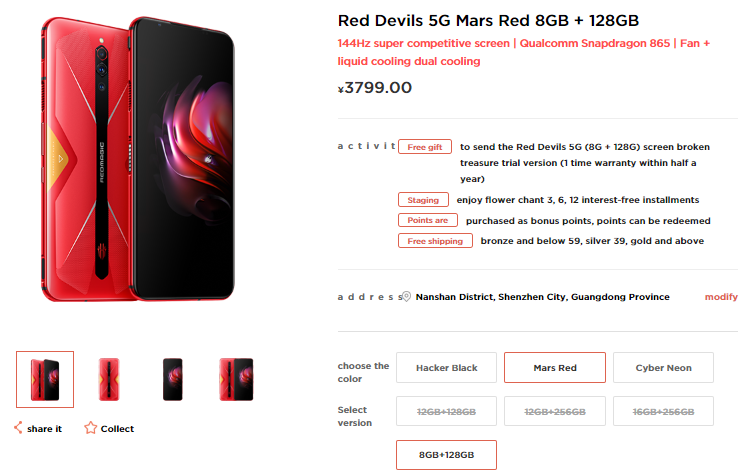
At the unveil event of the Red Magic 5G phone in March, Nubia had confirmed that it will be available in three colors like Hacker Black, Cyber Neon (red-blue) and Mars Red (red-orange) in China. However, the first 5G-ready gaming phone has been available in Hacker Black and Cyber Neon editions since the time it was made available for purchase in the home market. Starting from today, buyers can also avail the Mars Red version of Red Magic 5G.
The Nubia Red Magic 5G Mars Red edition comes in 8 GB RAM + 128 GB storage version only. It carries a price tag of 3,799 Yuan ($537).
In the international markets, the Hacker Black, Cyber Neon and Mars Red color editions are called Eclipse Black, Pulse and Hot Rod Red, respectively. Currently, the handset is available in Eclipse Black color in the global market in 8 GB RAM + 128 GB storage for $579. The Hot Red Red color edition with 8 GB RAM + 128 GB storage version will soon go on in international markets also for $579. The Pulse model with 12 GB RAM + 256 GB storage is currently sold out. Its pricing is $649.
The Red Magic 5G has a 6.65-inch notch-less screen that supports full HD+ resolution of 1080 x 2340 pixels. The Android 10 OS along with Red Magic 3.0 runs on the device. The Snapdragon 865 mobile platform powers the device and it comes with up to 16 GB of LPDDR5 RAM. The phone offers users with UFS 3.0 storage and it lacks an external storage slot.
A 4,500mAh battery is at the helm of Red Magic 5G. The handset comes with support for 55W fast charging. It has a front camera of 8-megapixel. The back panel has a Sony IMX686 64-megapixel lens, an 8-megapixel ultrawide sensor and a 2-megapixel macro sensor placed inside its triple camera system. It is equipped with 5G support, stereo speakers, 3.5mm audio jack and NFC.
The Samsung Galaxy S20 Ultra 5G has been available in China in Cosmic Grey and Cosmic Black colors. Earlier this week, the South Korean company revealed that the Galaxy S20 Ultra 5G will soon arrive in a new color variant Cosmic White. Today, the company began with the sales of the Cosmic White edition of the smartphone.
In terms of appearance, the Galaxy S20 Ultra Cosmic White edition appear similar to the Galaxy S20’s Cloud White model that is only available in South Korea, the US (Verizon) and Spain. The new Cosmic White does not have the gradient appearance like the Cloud White model.
The Galaxy S20 Ultra 5G Cosmic White that has 12 GB of RAM and 256 GB of storage is available for purchase from today with a pricing of 9,999 Yuan (~$1,416). The Cosmic White is currently exclusive to the Chinese markets. The specs of the S20 Ultra Cosmic White are same as its other color variants.
The Galaxy S20 Ultra 5G comes with a massive 6.9-inch Dynamic AMOLED display with top-center positioned punch-hole. It supports quad HD+ resolution and 120Hz refresh rate. The display is integrated with an ultrasonic fingerprint sensor.
The Snapdragon 865 mobile platform drives the phone with LPDDR5 RAM. The phone comes with UFS 3.0 storage and it has a shared SIM slot for adding a microSD card. The One UI 2.0 based Android 10 OS runs on the device. The 4,500mAh battery of the device supports 45W fast charging, 15W wireless charging and 9W reverse wireless charging.
The Galaxy S20 Ultra’s rear camera setup includes a 108-mgaepixel main lens, a 48-megapixel periscope telephoto lens with 10x hybrid zoom support, a 12-megapixel ultrawide lens and a 3D ToF sensor. It has a selfie camera of 40-megapixel.
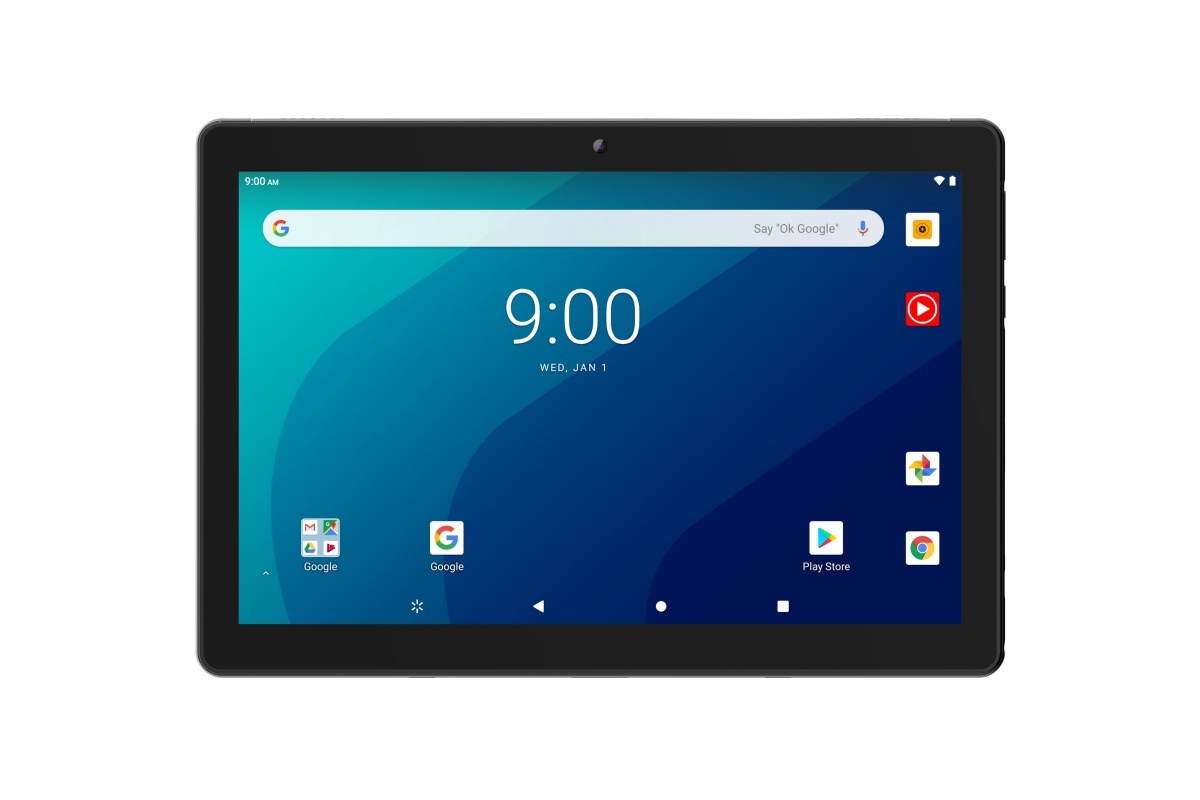
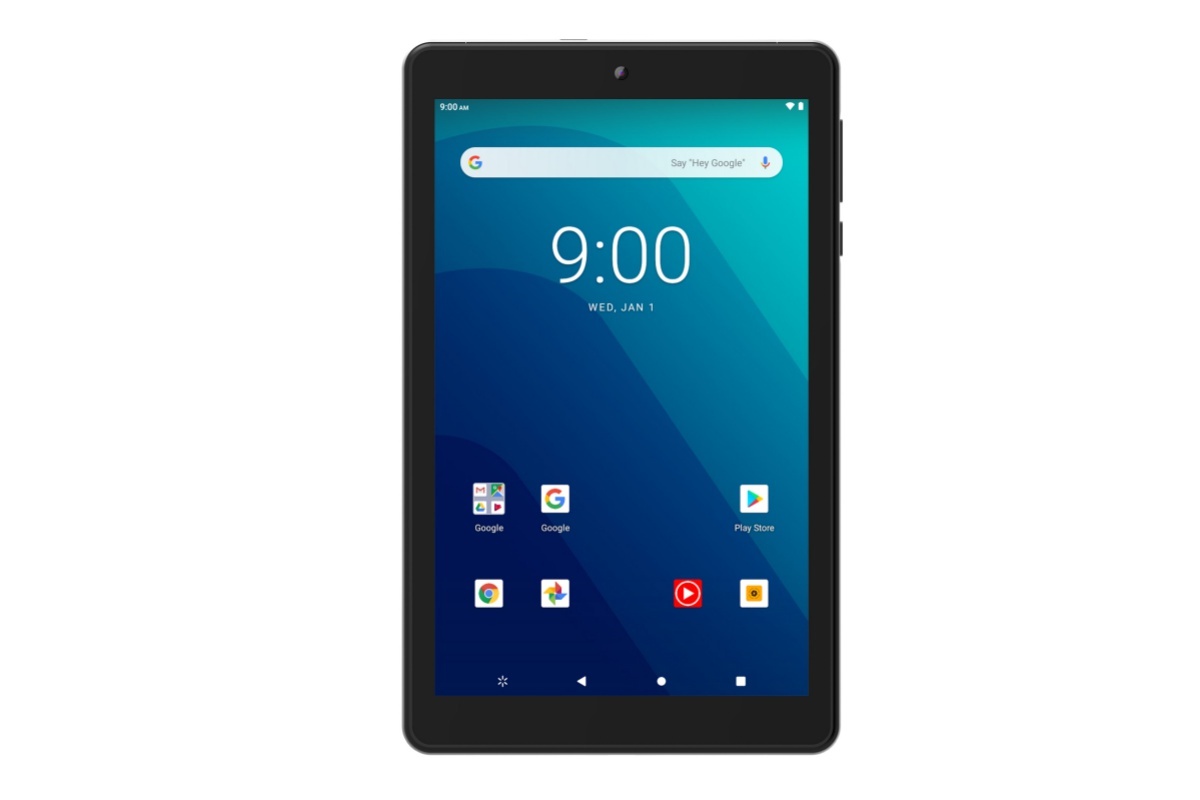
Walmart’s Onn brand has been around for a while, making home theatre accessories and the like. The brand last year ventured into the tablet market with the launch of the Onn 7, Onn8 and Onn 10 tablets in the U.S. The e-commerce giant seems to have recorded some success with the product as the Onn 8 Pro and Onn 10 Pro have now been introduced as upgraded versions.
Walmart Onn 8 Pro and Onn 10 Pro are still entry-level slates perhaps targeted at taking on the Amazon Fire lineup. As the names imply, the Onn 8 Pro features an 8-inch LCD display with HD resolution while the Onn 10 Pro packs a 10.1-inch LCD FHD display panel. Both tablets run on Google’s latest Android 10 operating system.
Both tablets are powered by an octa-core processor clocked at up to 2.0 GHz, said to be MediaTek MT8768WA processors. The processor is paired with 3GB of RAM on the Onn 10 while the Onn 8 packs 2GB of RAM. You get 32GB of expandable storage on both models. Walmart also touts the tablets’ batteries to last up to 10 hours. For photography, you get a 5MP front and 5MP rear cameras on both tablets.
As for the prices, the Onn 8 comes in at $99 while the Onn 10 is offered for $129.
Walmart Onn 10.1″ Tablet Pro
10.1″ LCD touchscreen
10-hour battery life
5 MP front-facing camera & 5 MP rear-facing camera
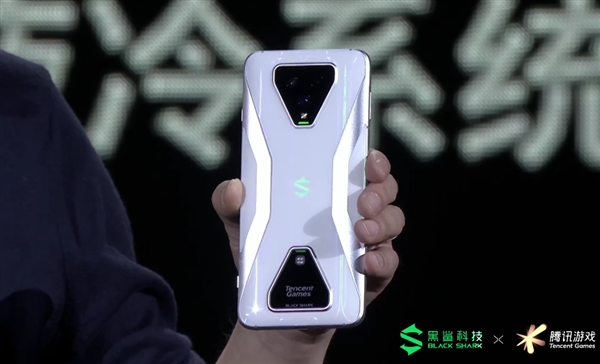
Xiaomi‘s Black Shark gaming phone brand took the wraps off the third-generation Blackshark 3 and 3 Pro in March this year. Since then the smartphones have gone on sale in China. The company has now revealed that both models will be available to buyers in Europe from May 8.
This was revealed on Black Shark’s official website but the poster didn’t contain any detail of the price. The Black Shark 3 starts at 3499 yuan (~$502) in China while the 3 Pro has a starting price of 4699 yuan (~$674). We expect the prices to be slightly higher but still remain attractive to buyers.
Asa reminder, the Black Shark 3 features a 6.67-inch AMOLED panel with the industry’s first 270Hz touch sampling rate. This combined with a 24ms touch response time and a 28ms multi-finger touch response time ensures that you face minimal touch lags during gameplay. The touch panel refreshes at 90Hz, ensuring smooth scrolling and animations.
On the other hand, the Black Shark 3 Pro model takes things to another level. It comes with a tablet-sized 7.1-inch AMOLED panel with a Quad HD+ 3120 x 1440p resolution display. It’s nearly the size of Mate 20 X’s massive screen but with a higher resolution! Clearly, the Black Shark 3 Pro has one of the best displays for mobile gaming.
Both phones are powered by a Snapdragon 865 processor. But the biggest difference between the two models in terms of design is the presence of two tactile physical buttons on the right side of the Pro variant which the standard variant lacks.
Xiaomi just launched the Lite version of the Mi Note 10 in the global market. It came just two months after the Lite version of the Mi 10 and it is impossible for us not to compare these two devices due to their similar specifications and prices. We also brought another interesting device in this “Lite” comparison: Oppo Find X2 Lite. In each case, we are talking about upper-midrange handsets coming with advanced specs sheets, but they are not flagships and they are focused on value for money. Which has the highest value and which is worth the money asked? This specs comparison between Mi Note 10 Lite, Mi 10 Lite, and Oppo Find X2 Lite will clear your idea.
Xiaomi Mi Note 10 Lite vs Xiaomi Mi 10 Lite vs Oppo Find X2 Lite
Xiaomi Mi 10 Lite
Xiaomi Mi Note 10 Lite
Oppo Find X2 Lite
DIMENSIONS AND WEIGHT
164 x 74.8 x 7.9 mm, 192 g
157.8 x 74.2 x 9.7 mm, 204 grams
160.3 x 74.3 x 8 mm, 180 grams
DISPLAY
6.57 inches, 1080 x 2400p (Full HD+), Super AMOLED
Quad 64 + 8 MP + 2 + 5 MP f/1.9, f/2.2, f/2.4 and f/2.4
16 MP f/2.5 and f/2.5 front camera
Quad 48 + 8 + 2 + 2 MP f/1.7, f/2.2, f/2.4 and f/2.4
32 MP f/2.0 front camera
BATTERY
4160 mAh, fast charging 20W
5260 mAh
Fast charging 30W
4025 mAh, Fast charging 30W
ADDITIONAL FEATURES
Dual SIM slot, 5G
Dual SIM slot, 5G
Dual SIM slot, 5G
Design
If we consider aesthetics, my favorite handset here is the Oppo Find X2 Lite. It offers a very thin and lighter design, as well as a less invasive camera module on the rear side making it more minimalistic. It is equipped with a glass back and an aluminum frame for a premium look. Definitely a beautiful device, like every handset from the Find X2 series. But with its curved display edges, Xiaomi Mi Note 10 Lite remains a very elegant and futuristic device. Even the Xiaomi Mi 10 Lite has a great design, it features a flat display but a smaller camera module than Xiaomi Mi Note 10 Lite on the back. All of these devices come with an in-display fingerprint reader.
Display
On the paper, Xiaomi Mi Note 10 Lite offers a more interesting display. The panel is HDR10-compliant, so it may provide a richer image quality, even while streaming content. On the other hand, Xiaomi Mi 10 Lite offers a wider diagonal. Thanks to its smaller display, Oppo Find X2 Lite is slightly more compact. Do not underestimate it: unfortunately, we still had no chance to test that display, but Oppo usually equips its handsets with great panels.
Hardware/Software
Xiaomi Mi 10 Lite and Oppo Find X2 Lite offer a stronger hardware thanks to the Snapdragon 765G mobile platform. Unlike the Mi Note 10 Lite, they support 5G networks thanks to a 5G integrated modem. You should get very similar high-end performances with Xiaomi Mi 10 Lite and Oppo Find X2 Lite, but the former has a micro SD slot to expand the internal storage, while the latter does not. Android 10 is installed out of the box on all of these smartphones.
Camera
Xiaomi Mi Note 10 Lite, Xiaomi Mi 10 Lite, and Oppo Find X2 Pro are midrange camera phones. Oppo Find X2 Lite looks more convincing with its bright focal aperture and an amazing selfie camera. But Xiaomi Mi Note 10 Lite and Xiaomi Mi 10 Lite’s quad-cameras are great as well. You should get a similar photo quality, judging by the camera specs.
Battery
Due to its mammoth 5260 mAh battery, Mi Note 10 Lite will most likely offer a way longer battery life than Xiaomi Mi 10 Lite and Oppo Find X2 Lite with all the usage patterns. Also consider that Xiaomi Mi Note 10 Lite does not support 5G, so it is even more efficient. It also comes with a fast 30W charging technology, but the 30W fast charging found on the Oppo Find X2 Lite will charge it faster because the battery is smaller.
Price
The global price of the Xiaomi Mi Note 10 Lite and Xiaomi Mi 10 Lite ranges from €350/$383 to €400/$438, while Oppo Find X2 Lite starts from €499/$546. On the paper, Xiaomi Mi Note 10 Lite looks more gorgeous due to its huge battery, but it lacks 5G support and it has an inferior chipset. Oppo Find X2 Lite offers an amazing and compact design, great cameras, and faster charging and Xiaomi Mi 10 Lite is more or less at the same level (slightly bigger battery, potentially inferior cameras). Which one would you pick?
Earlier this week, we reported that MediaTek will have an event on May 7 where it is expected to announce new processors. One of the expected chipsets is a higher-clocked version of the Dimensity 800.
It turns out that an AnTuTu benchmark result of this higher clocked version already surfaced on the web. And it is compared against that of the standard version. The benchmark results were posted on Weibo by Digital Chat Station and he said they are from prototype devices.
[envira-gallery id=”320400″]
As you can see in the images above, the device powered by the overclocked Dimensity 800 (right) scored higher than the device powered by the standard Dimensity 800 in all areas, most especially in the CPU, UX, and GPU categories.
According to a tweet by Russian tech blog @Xiaomishka, the Dimensity 800 and Dimensity 800+ (overclocked version) will power two upcoming Redmi phones in China. The phones have model numbers M2004J7AC and M2004J7BC and are believed to be the Redmi Note 10 (Dimensity 800) and Redmi Note 10 Pro (Dimensity 800+).
After the presentation of #MediaTek on May 7th, now I am more than sure that the following #Redmi smartphones are: 1⃣ M2004J7AC = #RedmiNote10 with Dimensity 800 SoC 2⃣ M2004J7BC = #RedmiNote10Pro with Dimensity 800+ SoC (the speed of the large core is increased to 2.6GHz) 😉👍 https://t.co/Nny8PDu7Vf
The tweet reveals the Dimensity 800+ has its “large core” pushed to 2.6GHz which is a significant bump from the 2.0GHz clockspeed of the performance cores of the Dimensity 800.
We advise you to take the above with a grain of salt until more details surface. Nevertheless, there is no gainsaying that the overclocked Dimensity 800 will offer a significant improvement in performance over the Dimensity 800.
In recent years, the smoking habit has changed a lot due to the invention of e-cigarettes. According to a report from the World Health Organisation, the consumption of cigarette smoking is decreasing rapidly as the e-cigarette has started picking the pace. Moreover, the number of vapers are consistently increasing, and it reached 7 million in 2011 to 41 million in 2018. It is expected to increase further to 55 million in 2021.
The E-cigarette is a new technology invention of the last decade, and it has become popular among the youth. Researchers are citing various reasons behind the popularity of e-cigarettes. Reportedly, the e-cigarette is less harmful than conventional cigarettes. Moreover, easy availability, along with the option to choose among different flavours are some significant advantages of the product. It does not need any ashtray, are odourless and never smell bad.
It poses fewer health risks than traditional cigarettes, and it tends to attract vapers than the standard smokers. E-cigarettes offers varied choices among the users as they can choose between different sizes, design, and flavours. Due to such improvements, the users get attracted to the E-cigarettes.
These E-cigarettes is more of vaping than smoking as it does not burn tobacco; it creates vapers making it safe and healthy. Furthermore, in some countries, smoking a traditional cigarette is termed as an offence, but vaping is allowed throughout the globe. An E-cigarette is 85% less harmful than the conventional cigarette.
More affordable
The E-cigarette is more affordable than the traditional form of smoking, reducing the expenses of vapers. There are different liquids available in the market with varying strengths of nicotine. The users can choose between 5 different nicotine levels. It’s up to the vapour when to choose between different strengths. The user can start decreasing the nicotine levels to zero, which helps the heavy users to quit smoking. It is more vapour friendly, more economical and even reduces the carbon footprint up to some extent.
Options to choose
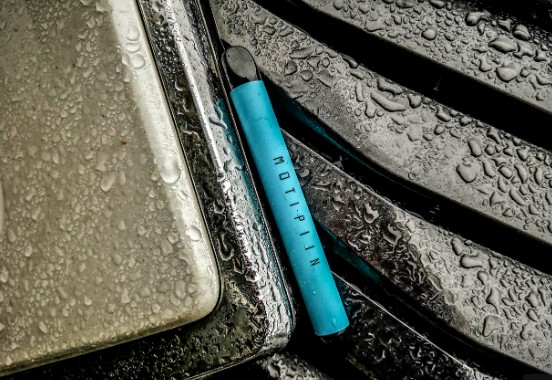
There are many significant e-cigarettes making brands, including MOTI. The company’s MOTI PIIN e-cigarette offers various flavours, beautiful designs, more eco-friendly approach towards smoking. E-Cigarettes have helped major celebrities like Johnny Depp and Katherine Heigl to quit smoking easily by reducing the nicotine levels.
More eco-friendly
Always ensure to properly dispose of cigarette filters as it adversely impacts the environment and takes a massive amount of investments to clear the litter. However, the e-cigarette does not need any cellulose acetate filter, which usually takes over 12 years to break down. The new cigarettes have potentially reduced a lot of air and soil pollution and can be ultimately tagged as eco-friendly.
There are many other advantages of E-cigarettes. The vapers are free to choose between different sizes, flavours and ultimately can control the level of nicotine which helps to quit smoking.
An e-cigarette is a future as it offers customizability in terms of design, flavours and nicotine controller. Multiple benefits of e-cigarettes have seriously impacted the traditional cigarettes.
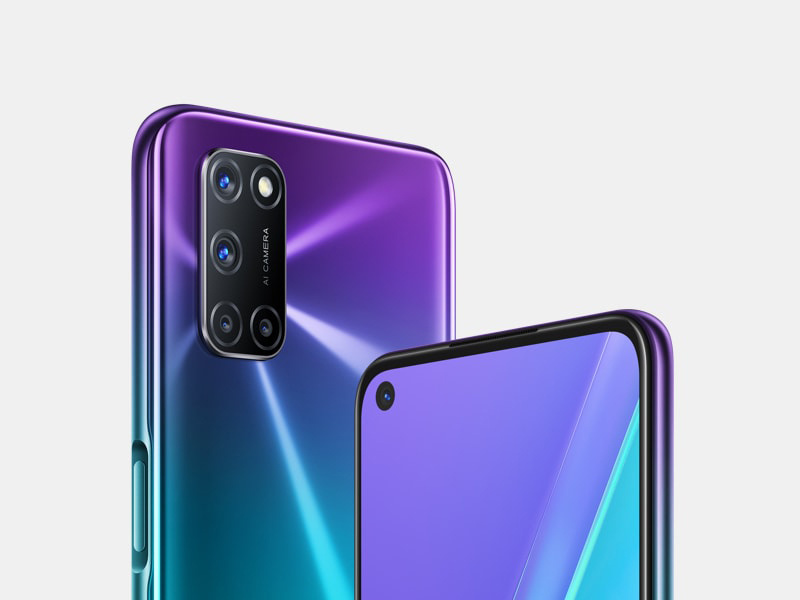
Earlier this month OPPO quietly launched the OPPO A92s powered by the 5G MediaTek Dimensity 800 chipset. Later on, a leaked render of the OPPO A92 appeared showing the design. While OPPO is yet to disclose the details and pricing of the A92, a new leaked render of the A92 in Aurora Purple has leaked from Twitter tipster Evan Blass.
The leaked render shows the device from all sides, confirming the presence of a punch-hole located at the upper left corner of its display. The punch-hole is said to house a 16MP sensor. The display which is a 6.5-inch LCD panel with FHD+ resolution is a flat-screen. The phone packs a quad-camera setup at the rear which is housed in a rectangular module. There is no rear-mounted fingerprint sensor but the A92 has a side fingerprint sensor located at the right side of the display. The power button and volume rockers are located on the left side.
The OPPO A92 will reportedly be powered by a Qualcomm Snapdragon 665 processor paired with 8 GB of RAM and there is 128 GB of built-in storage. The ColorOS 7.1 based Android 10 OS will come preloaded on the device and it will cram a 5,000mAh battery.
Apart from the Aurora Purple hue, the OPPO A92 will also be available in Shining White and Twilight Black colours.e phone, it can be said that it is a rebranded version of the OPPO A52.
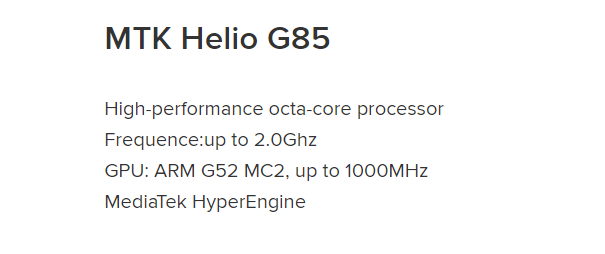
Update: MediaTek has released the official spec sheet and it confirms our original story that the difference between the Helio G80 and Helio G85 is a higher clocked GPU.
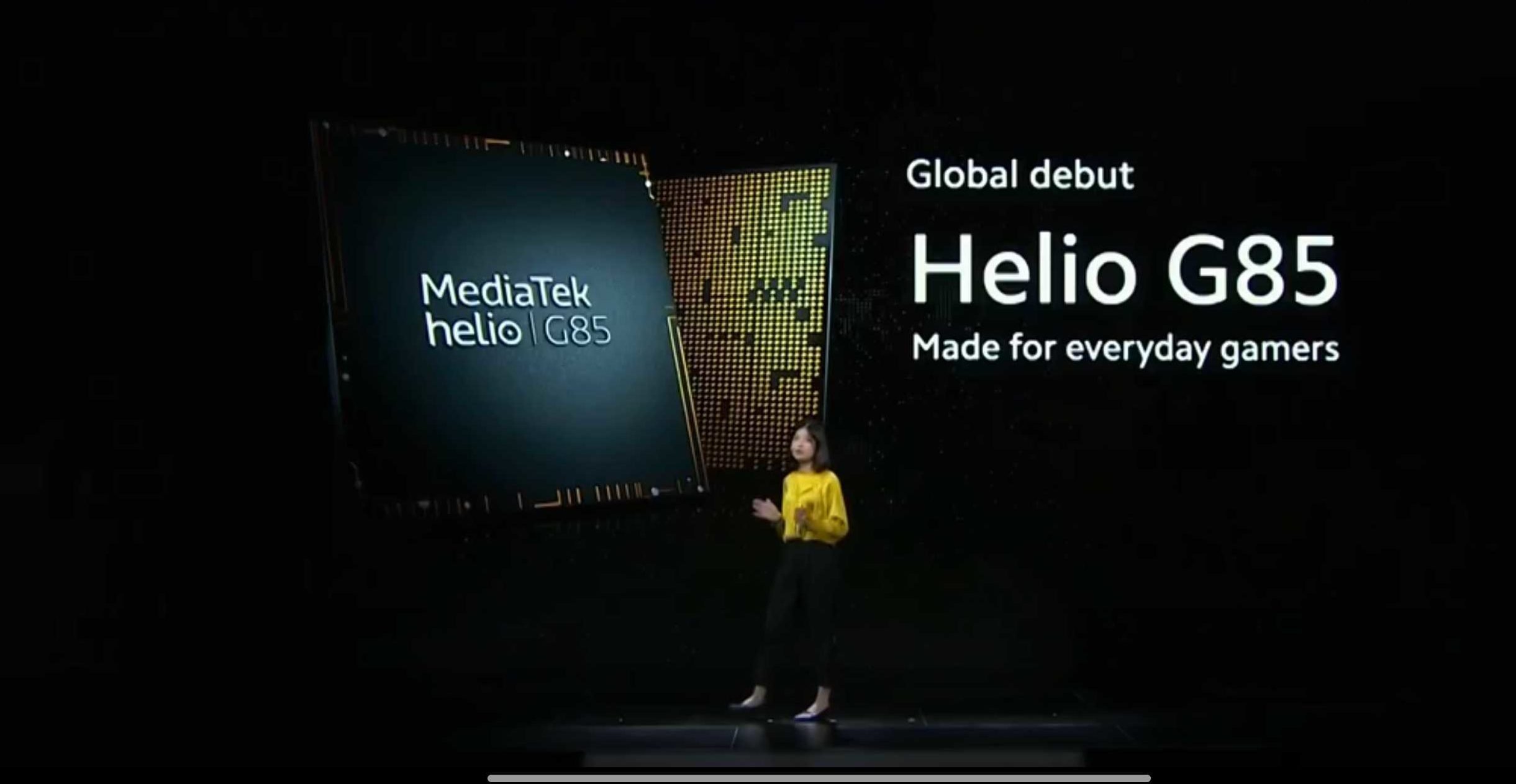
MediaTek’s Helio G-series line of smartphone chipsets has gotten a new member today. The new processor which is called the Helio G85 made its debut in the Redmi Note 9. So what features does this new gaming chipset bring?
The Helio G85 processor arrives nearly three months after the Helio G80 was announced. The latter processor made its global debut in the Realme 6i smartphone.
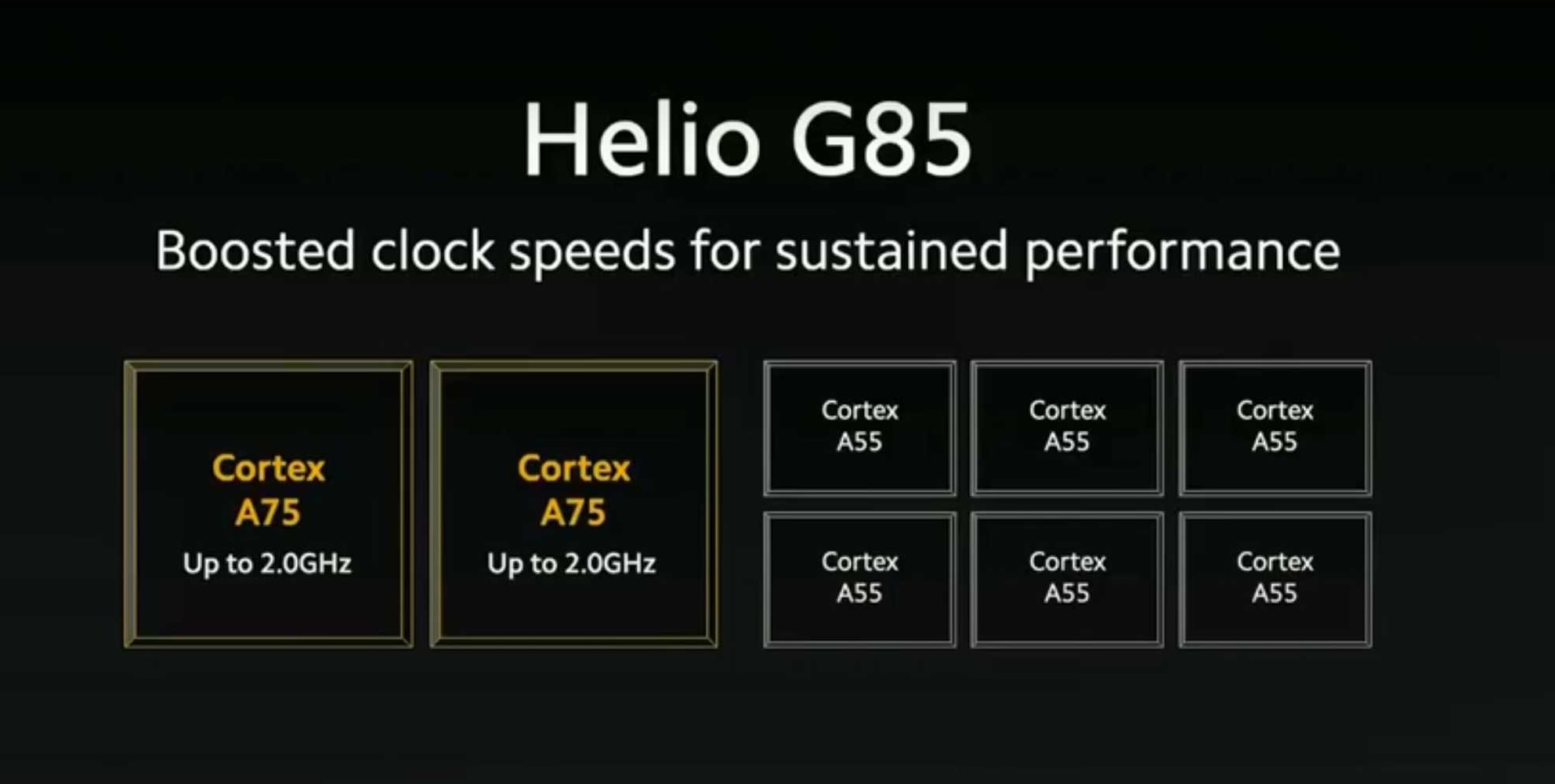
For the 12nm Helio G85, MediaTek is sticking to a 2+6 core arrangement. So you have 2x Cortex-A75 cores clocked at 2.0GHz and 6x Cortex-A55 cores whose clockspeed is unknown. This is the same core arrangement and clockspeed as the Helio G80. So what is actually different?
The clockspeed of the GPU seems to be the only difference. Based on the official spec sheet of the Redmi Note 9, the Mali G52 MC2 of the Helio G85 is clocked at 1000MHz while the spec page for the Helio G80 says its GPU is clocked at 950MHz. So we have just an increase of 50MHz over that of the Helio G80. Pretty disappointing, right?
We reached out to MediaTek for a full spec sheet of the new chipset to see if there are more details but we haven’t gotten any response yet. If and when they do publicize a full spec sheet and we find more differences, we will let you know.
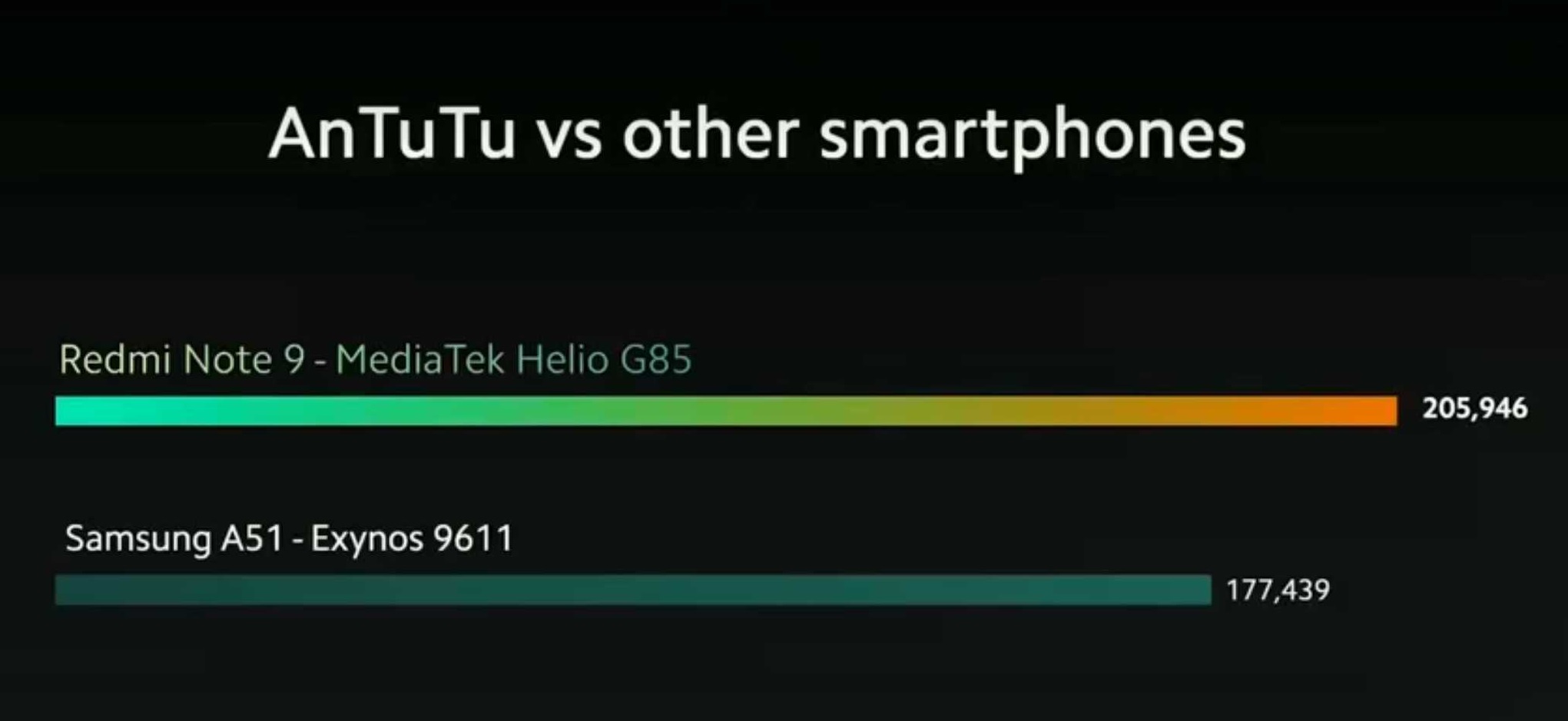
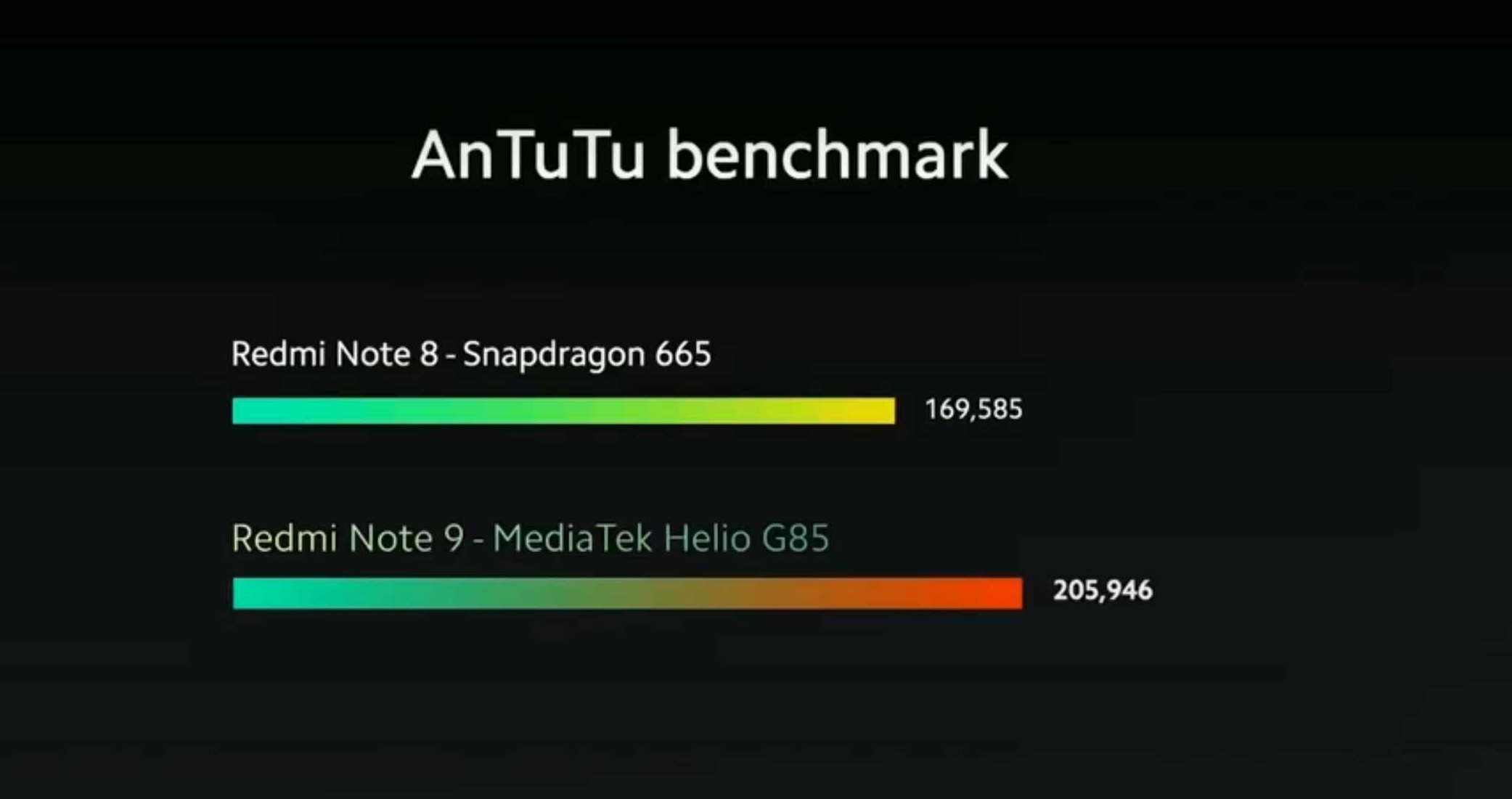
According to benchmark results displayed by Xiaomi during its product launch, the Helio G85 beats the Exynos 9611 and the Snapdragon 665 processor by no small margin.
Based on the above, the Helio G85 does bring a bump in performance compared to the Snapdragon 665 that powers the Redmi Note 8. However, there is no justification for why it exists when there is the Helio G80.
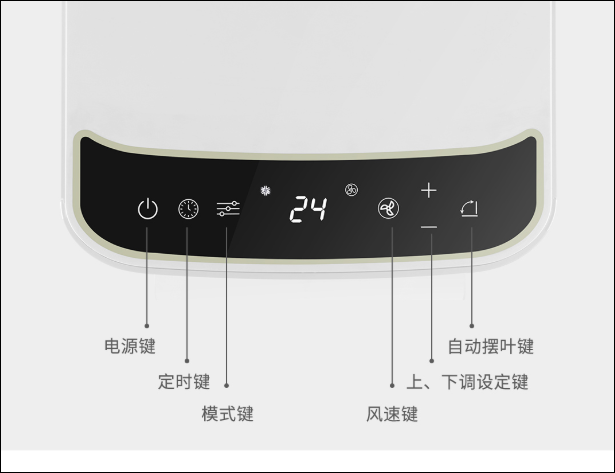
In most homes, it is rare to find an air conditioning system in the kitchen. In winter, this may not pose any challenge but cooking during the summer will definitely be associated with sweating due to the ambient temperature. In this regard, Xiaomi Youpin has launched a third-party mobile air-conditioner. The product is manufactured by NEW WIDETECH, a Chinese start-up and adopts a 1,599 yuan (~$226) price tag.
The new mobile air-conditioner is the same size as the Mi Air Purifier but has a universal caster at the bottom. Thus, it can easily be moved to the kitchen when cooking or any other part of the house. It is suitable for any place, such as apartments, office spaces, kitchens, security kiosks, and even outdoor activities.
The NEW WIDETECH Smart Mobile Air-conditioner features an applicable area of 11-17 square meters. The air-con doesn’t utilise a split unit design and as such, no outdoor unit is required. It supports three functions of air supply (adjustable double-speed wind speed), cooling and dehumidification, which not only meets the summer heat but also realizes the dehumidification during the rainy season.
The mobile air conditioner adopts a waterless tank design. It uses a DC water pumping motor to force the evaporation of condensed water without draining at all times, which solves the trouble of draining the machine. The machine also has some air purification functions. The built-in silver ion filter can remove the bacteria in the air including E. coli. It also effectively filters dust and other particles in the air, and make the blown wind more fresh and comfortable.
In addition, it has a built-in Wi-Fi function and can be paired to a smartphone via the MIJIA app. With the app, the settings of the air-conditioner can be adjusted from a smartphone. The machine can also be linked to the XiaoAI-enabled device to achieve voice control. It also has a dedicated remote control.
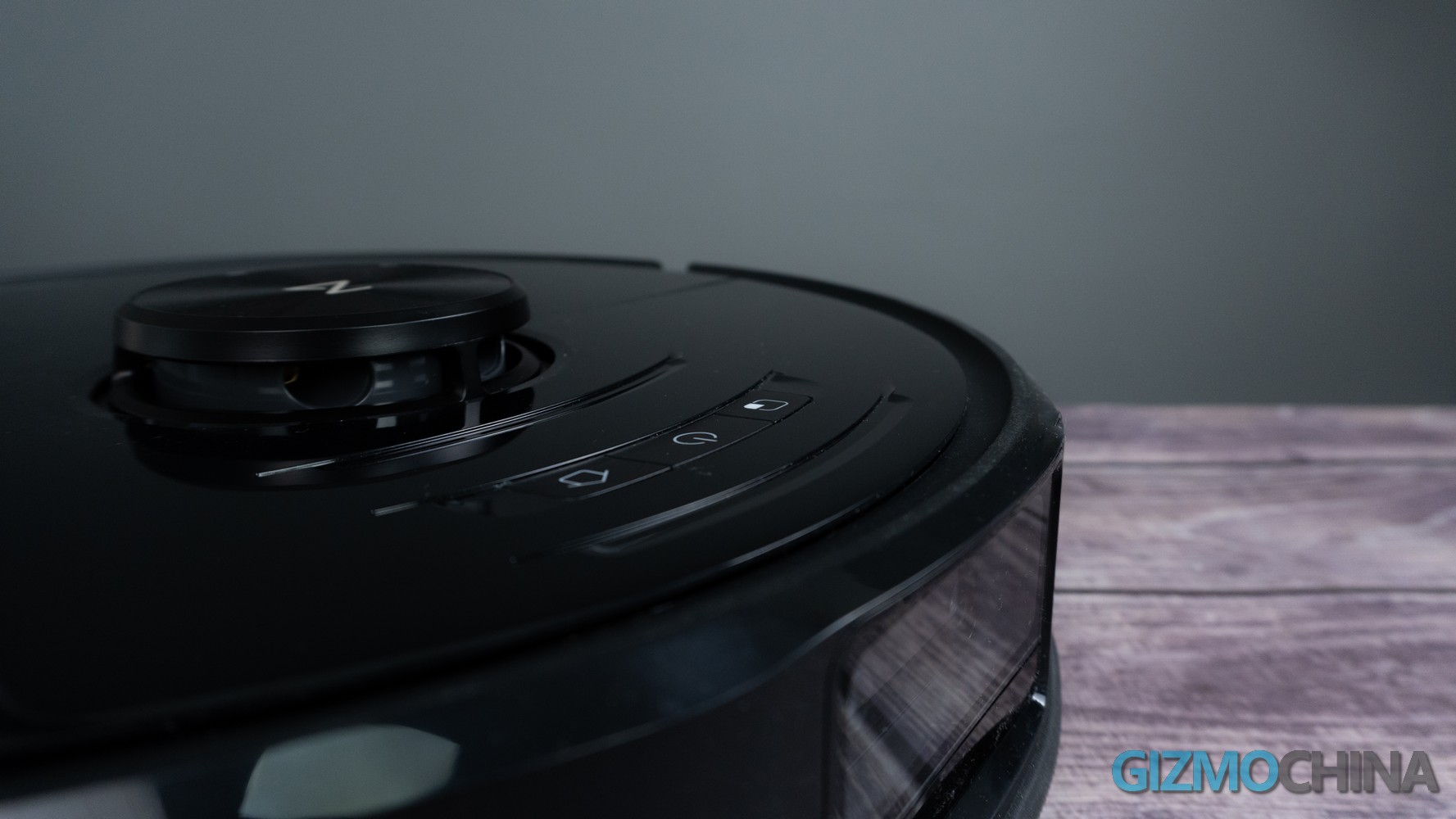
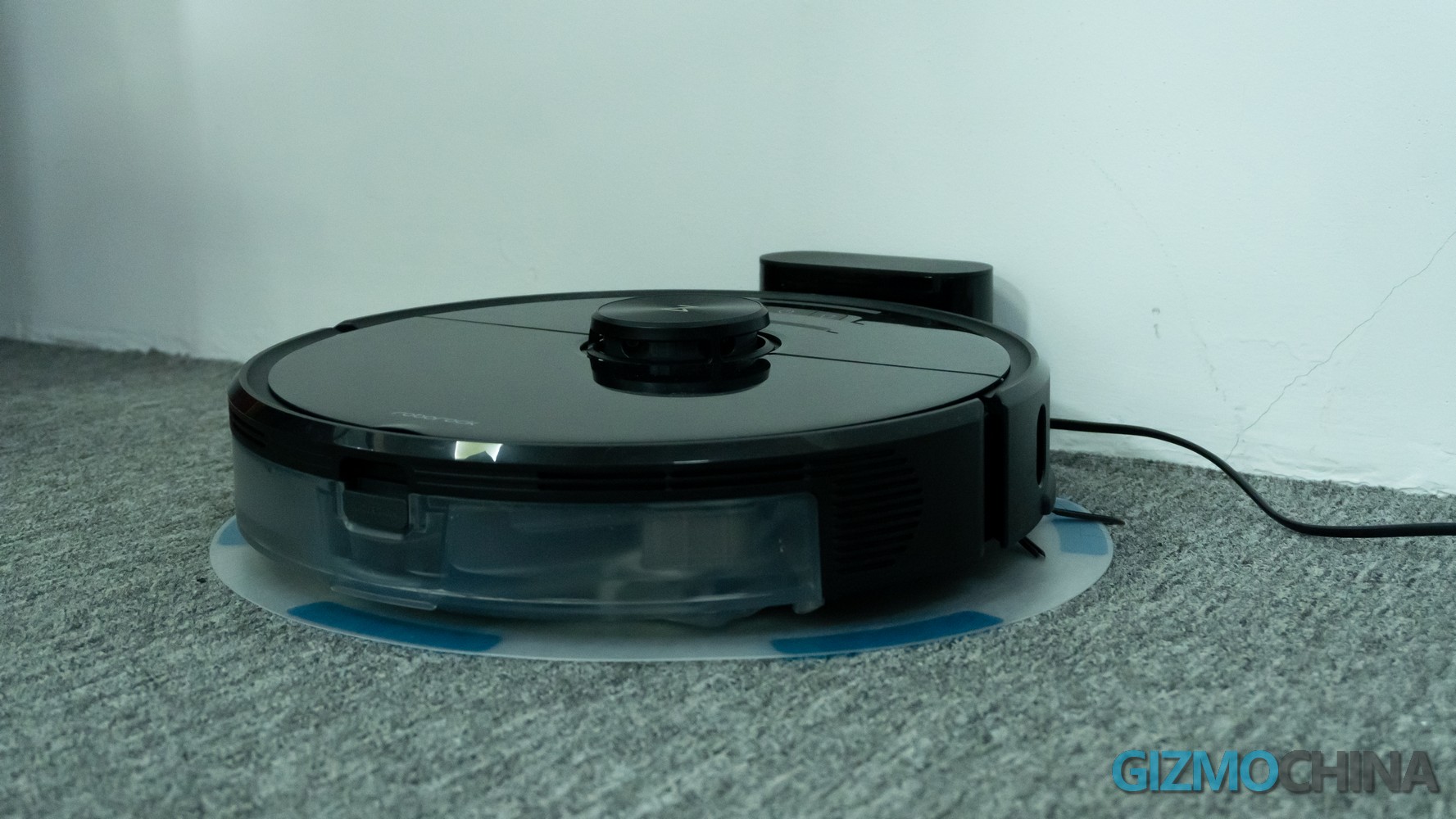
The Roborock S6 MaxV vacuum cleaner recently became one of the most useful members of my smart home system. Actually, my point is that most intelligent household appliances are not as smart as companies claim. But in the case of a Robot vacuum cleaner, you will see tangible benefits in your life, you no longer have to mop or vacuum, which is why I am willing to pay a premium for a powerful vacuum cleaner. So, I have been keeping an eye on this segment. And the Roborock S6 MaxV turned out to be a great option for my need.
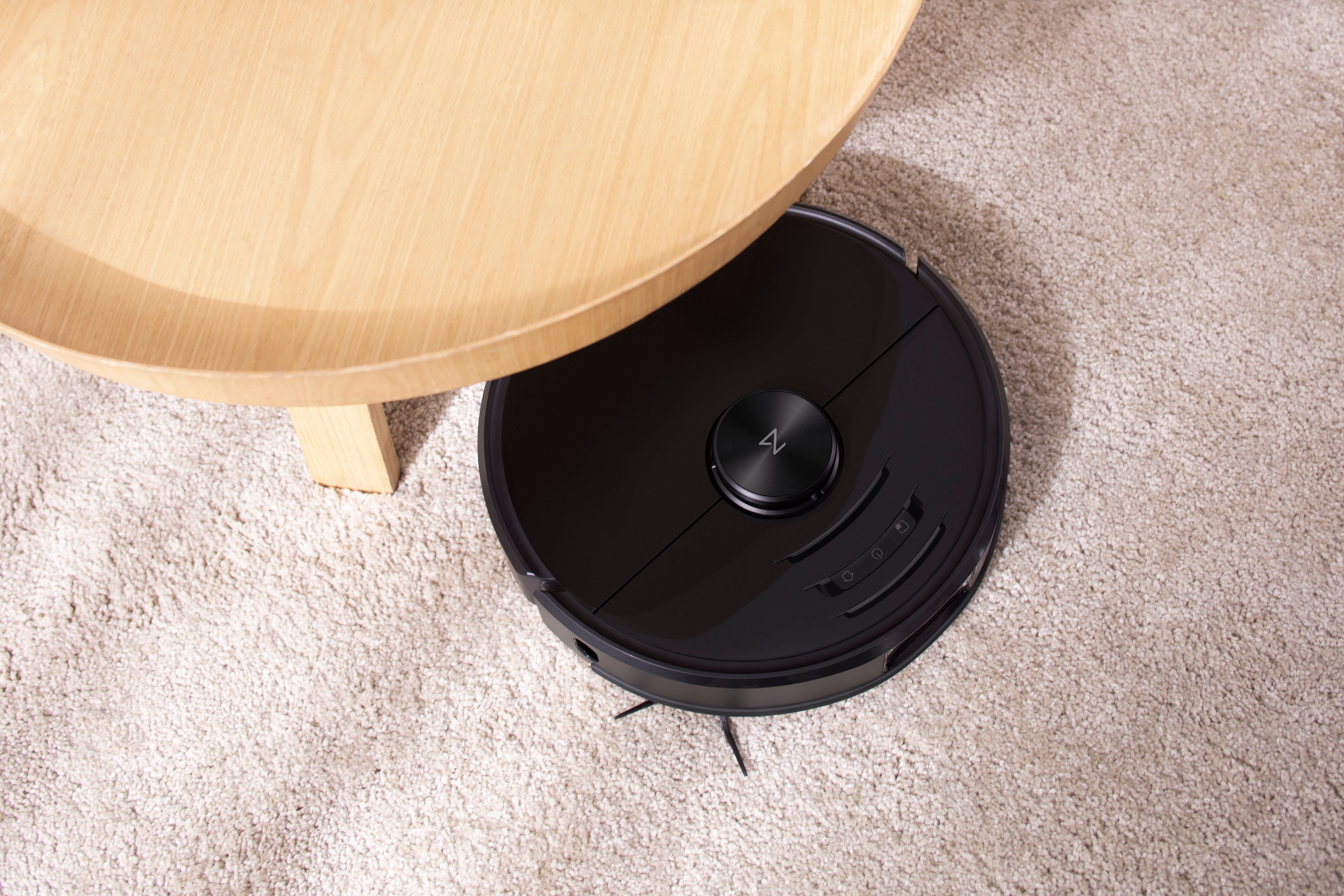
Roborock, specializing in the design and production of cutting-edge intelligent vacuum cleaner, introduced its latest cleaner product, the Roborock S6 MaxV this week. The Roborock S series is the most innovative lineup of Roborock products. And the S6 MaxV is Roborock’s most powerful robot vacuum as it comes with plenty of new technologies and hardware upgrades. Compared to the previous S-series models, it has stereo cameras and a LIDAR Sensor together for better obstacle avoidance and room detection; a better power motor but longer battery life; a larger 300ML water container providing maximum mopping area up to 250㎡.
Hardware
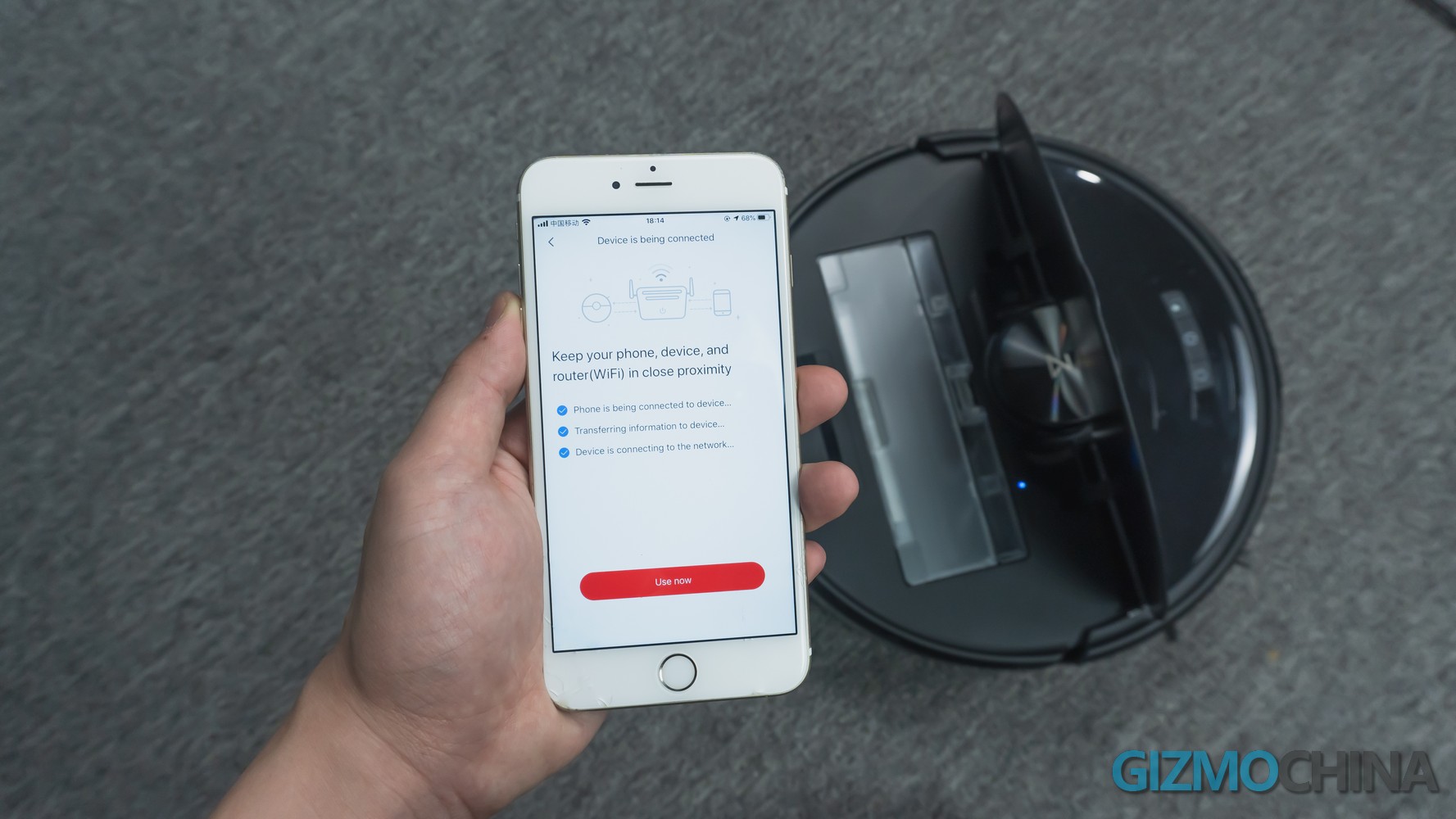
Inside of the Roborock S6 MaxV, a Qualcomm APQ8053 processor provides better AI calculation and processing power. Combined with the dual-camera system, the better chip is able to have more accurately & faster obstacle recognition and avoidance than a single camera. Working with the LIDAR sensor, the Roborock S6 MaxV is more capable of building an accurate map of an interior. In actual running, the map information could be scanned and uploaded to the phone App in half a minute. Thanks to the Qualcomm chip and the simplified App, interaction with the S6 MaxV was easier and far more fluent.
The Roborock has added an App guidebook inside the box. Users can find all details about the App in this book.
Stereo cameras
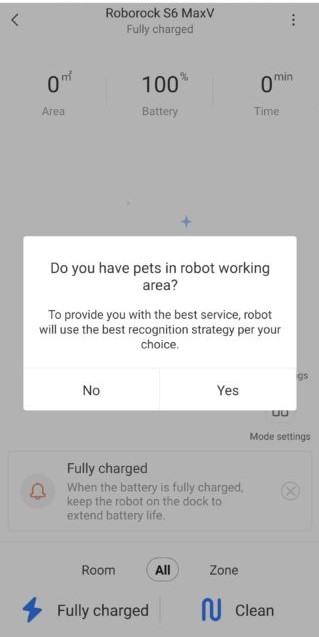
The most important upgrade in the new model is the stereo cameras. Thanks to the stereo cameras, users don’t have to stay with the cleaner, to monitor its work, and prevent it from bumping into obstacles. The stereo camera on the front captures detailed images at a max-speed of 30fps. It can spot obstacles as small as 2-inches wide and 1.1 inches tall, not to mention shoes or small toys. Another wonderful detail is that when you first launch the S6 MaxV, it would ask you on the App if you’re keeping pets. If yes, the S6 MaxV will turn on the Pet mode to avoid pet droppings.
The Roborock S6 MaxV is equipped with a 5200mAh battery, the same as the previous S6 model. But it is able to provide up to 180 minutes of cleaning, which is 30 minutes longer than the cleaning time of the S6 model. It’s enough to cover a cleaning area of 300㎡or a mopping area of 250㎡. However, I’m sure some of you have larger houses and the battery life might not be enough to finish the whole cleaning work on one charge.
According to past experience, most robot vacuum cleaners would automatically go back to the dock when 20% of low battery warning, then charge up to 80% and resume the cleaning. But on the S6 MaxV, the process has become smarter. It calculates how much power it needs to finish cleaning, and then charges up to the required power level. So compared to the most vacuum cleaners, the S6 MaxV is definitely one of the most efficient cleaners for a big house.
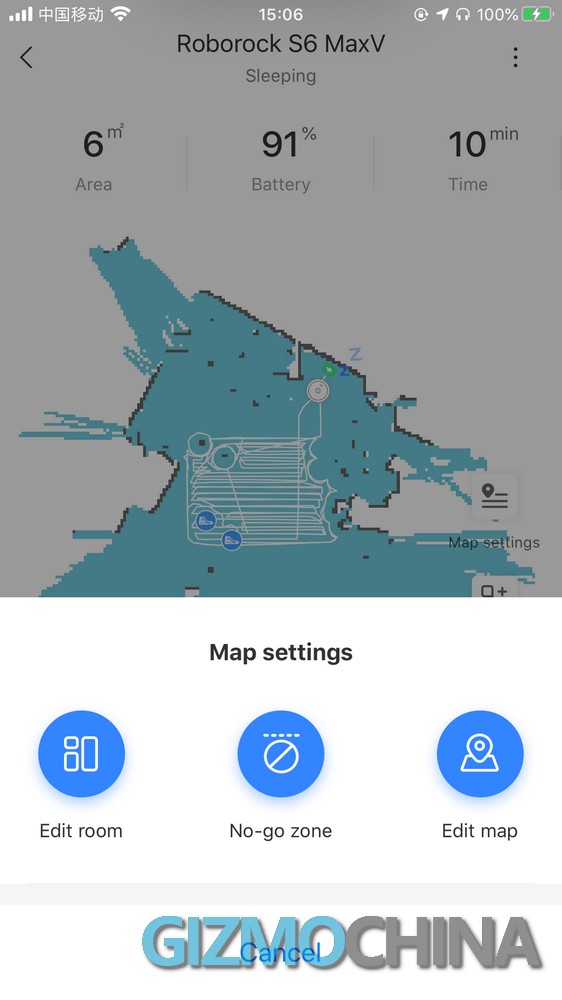
Other hardware upgrades like 25% better suction power (2500Pa) and larger water tank capacity (300ml) enable sweeping and mopping at the same time. You can also set it to just sweeping or just mopping mode. Using the official Roborock APP, users are able to customize schedules and various zones settings for the S6 MaxV. For example, users can schedule multi-tasks of mopping mode or just sweeping mode (suction power) for every room.
Roborock App
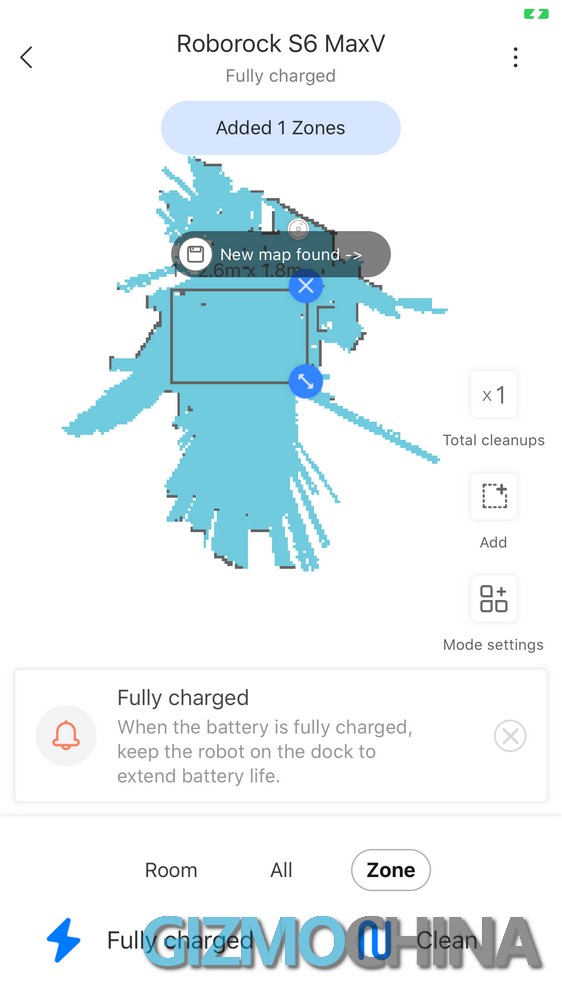
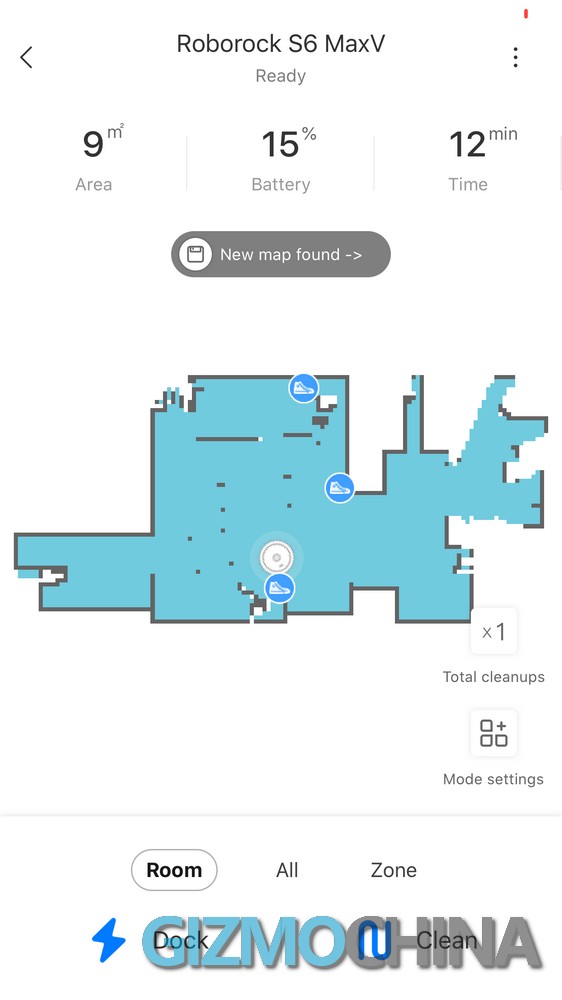
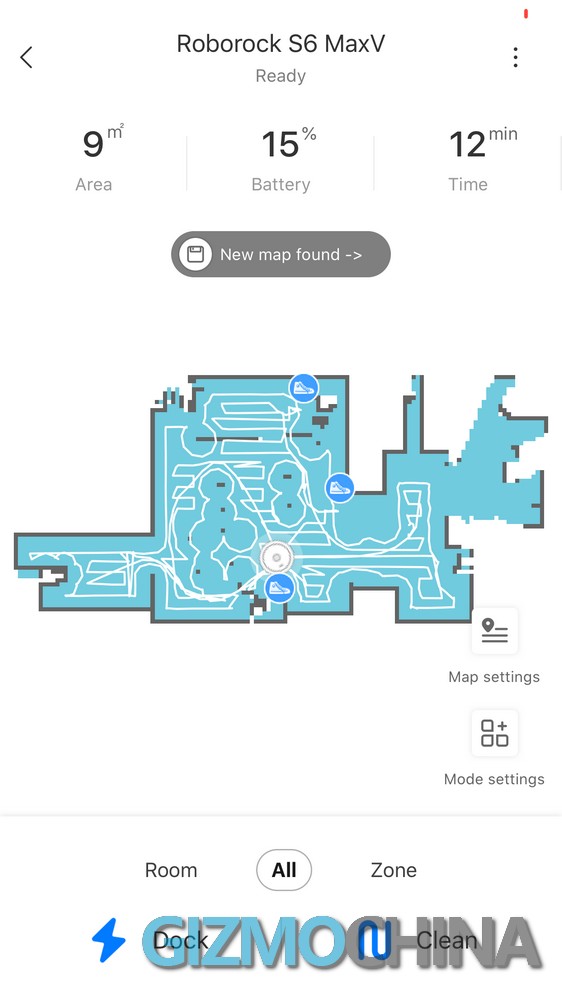
The App can display the multi-level maps scanned and stored by the S6 MaxV. It supports up to 4-floor plans and recognizes automatically which map the robot is on. So you can track all the cleaning routes of the robot and complete all the latest features provided:
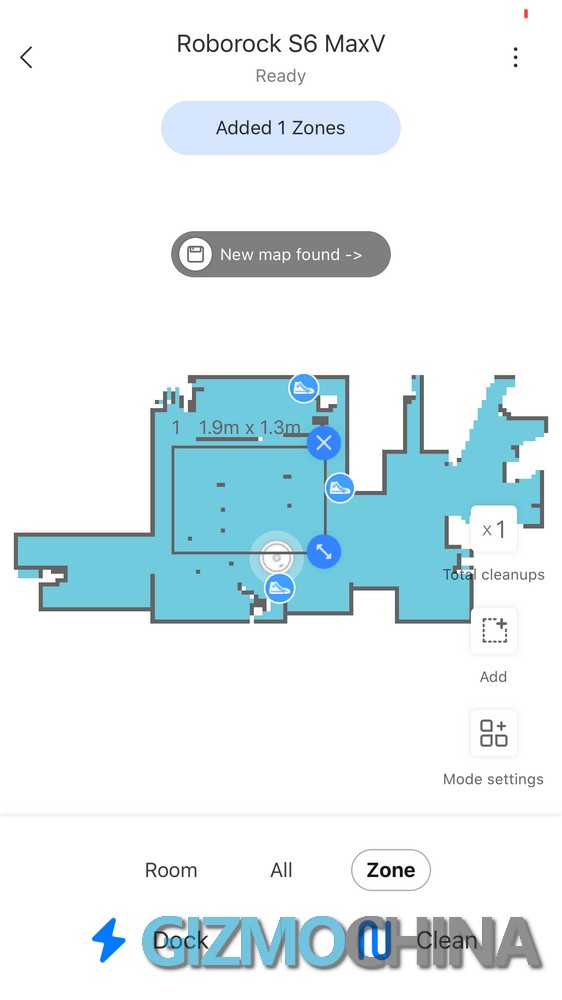
No-Go Zones: Allow users to create a rectangle shape of the area or a barrier tape for keeping the robot off. No-Mop Zones: Let the robot avoid mopping in a carpeted area or a customized area.
Room Cleaning: Order the robot to clean a specific room or two instead of the whole house. Zoned Cleaning: Clean within a specific zone of an interior. Pin n Go: Users can select a specific point on the map and send the robot to clean there.
Noise
Another problem that users complained about a robot cleaner is noise. But on the S6 MaxV, it provided 5 suction power modes for users to use it appropriately under different scenarios. In the silent mode, all of my family members were happy with its cleaning efforts and were able to accept the noise as well.
Carpet cleaning
Roborock S6 MaxV is also appropriate for carpet cleaning. Thanks to its 25% power improvement and the feature to identifies carpets, the Robot provided much better cleaning than most other robots on my carpet. When the S6 MaxV identified carpet, it boosts suction power to the MAX level to provide the most powerful cleaning.
Conclusion
We are glad to see that Roborock was able to combine the advanced hardware and the functional software on the new Roborock S6 MaxV.
The smart tech doesn’t come cheap as the price tag of $749 is quite steep. However, when you figure out how much time you lose during mopping and sweeping, you would agree with me. It’s definitely worth the money. It’s not necessary to buy the S6 MaxV, but if you are willing to embrace the smart life, the S6 MaxV won’t disappoint you.
Chuwi is popularly known for its hybrid laptops, tablets, and notebooks across the globe. The company recently introduced Chuwi Hi10X featuring high-end specification encasing under its hybrid design. However, CHUWI Hi10X got support for 4096 Pressure Level Stylus that improves the writing experience on par with iPad. There are many other advantages of the new pressure-sensitive stylus.
Chuwi Hipen H6 Stylus is capable of working between 1024 to 4096 pressure levels which improve the writing experience as it matches the Apple Pencil specs. The new stylus with more pressure sensitivity allows the user to make complex designs and workflows more precisely. The overall accuracy in making delicate drawing improves a lot with a stylus having better sensitivity. The tablet is now giving direct competition to Apple iPad in terms of writing experience.
The new stylus’s low writing delay improves the pencil edge accuracy with the ability to record courseware notes and for other purposes. Moreover, it offers a longer battery backup due to a massive Li-ion battery encased.
Chuwi HiPen H6 can be recharged via a USB cable at a convenient time.
Powerful Chuwi Hi10X Tablet
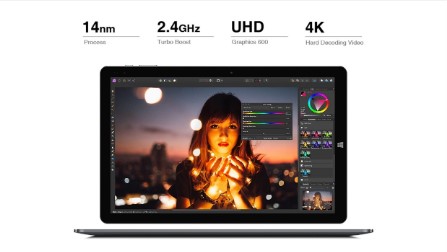
Chuwi Hi 10X houses an Intel Gemini Lake N4100 processor with a built-in UHD 600 Graphics card. The notebook can easily render 4K videos on its high-end display. The tablet is coupled with 6GB LPDDR4 RAM and 128GB internal storage. It can easily handle multitasking, and CPU intensive tasks. The hybrid nature of the tablet allows us to dock the keyboard and use the device as a laptop for better productivity.
Chuwi Hi 10X tablet high-end specifications
Apart from the powerful chipset and fast RAM, the tablet features a 10.1-inch Full HD+ display offering a brilliant visual experience. Its entire full-metal body gives the tablet a premium look and fine texture and keeps body lightweight.
Cost-effective tablet
Offering such powerful specifications including 110.1-inch IPS display, Intel N4100 processor, 6GB RAM, 128GB ROM, and full metal body is really a cost-effective deal. The new HiPen H6 stylus offers to improve writing experience and make it more competitive against Apple iPad.
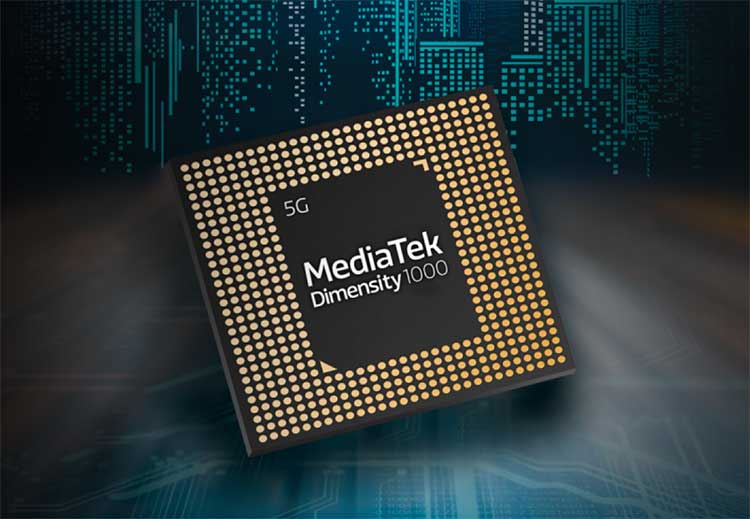
MediaTek has announced it will enable YouTube video streams using the cutting-edge AV1 video codec on the MediaTek Dimensity 1000 5G SoC. The MediaTek Dimensity 1000 is the world’s first smartphone SoC to integrate an AV1 hardware video decoder, enabling it to playback AV1 video streams up to 4K resolution at 60 fps. With its improved compression efficiency, AV1 gives users incredible visual quality and smoother video experiences, while using fewer data.
MediaTek Dimensity 1000
Video streaming is the number one activity in smartphone use, so by using the Dimensity 1000’s more power-efficient hardware-based AV1 video decoder, users can enjoy longer battery life while still streaming at the best quality settings. Combined with its ultra-fast 5G connectivity in a single chip, the Dimensity 1000 leads the industry in design and capability.
“MediaTek is engaged in consistently upgrading its offerings to enhance user experience, and AV1 technology is a prime example. Video is now the most used form of communication, with 70% of Millennials and Gen Z reportedly using streaming services,” said Dr. Yenchi Lee, Assistant General Manager of MediaTek’s Wireless Business Unit. “Industry reports state that the video streaming market is likely to expand at a CAGR of 19.6% and touch $124.57 billion by 2025, and it is one of the principal drivers of 5G services. MediaTek is leading the way in enabling effective video streaming with AV1.”
The AV1 video codec is creating a landmark change in the video streaming industry. First released in 2018 by the Alliance for Open Media (AOMedia), AV1 is royalty-free, crafted to replace the VP9 codec and become the Internet Video Codec (NETVC) standard. AV1 is an ultra-high-performance video codec technology that delivers 30% more compression efficiency over existing VP9.
“AV1 has become an increasingly important format to allow high-resolution playback on handheld devices, and we’re excited that MediaTek has implemented dedicated AV1 hardware to advance its adoption, such as what’s included in their Dimensity 1000 5G SoC,” said Matt Frost, Director of Product Management of Google Chrome. “As mobile video streaming becomes more prevalent, new use cases like MediaTek’s emphasize the important work of developing next-generation codecs.”
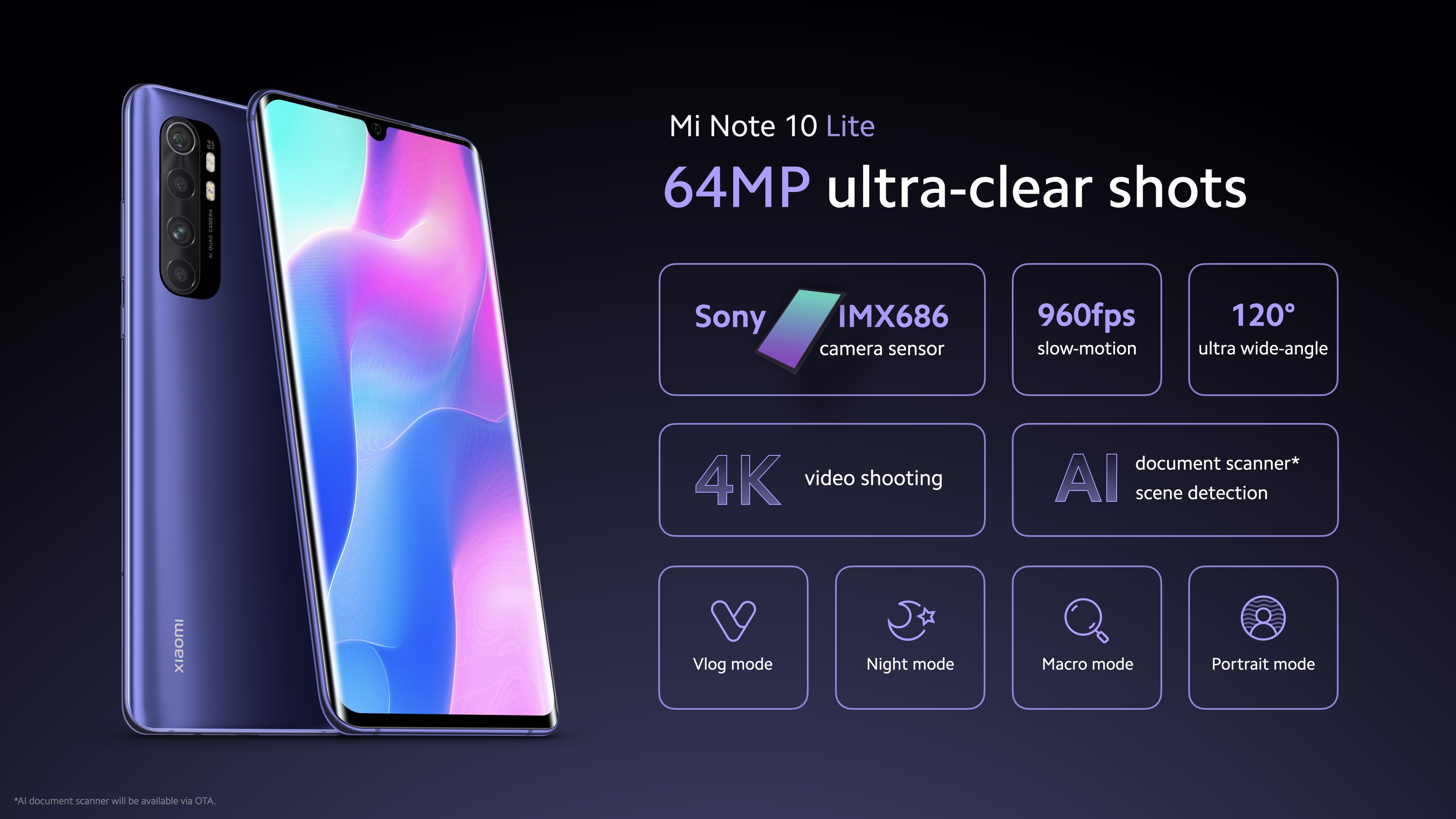
Alongside the Redmi Note 9, Xiaomi also announced the Mi Note 10 Lite. As the name says, this is a lite variant of the Mi Note 10 that launched last year.
Mi Note 10 Lite Design
With respect to design, the Mi Note 10 Lite has a curved AMOLED display with a waterdrop notch. The back is also covered in glass and curves at the sides. Xiaomi has redesigned the camera housing to appear different from that of its siblings but all the sensors are arranged vertically. Finally, Xiaomi ditches the Aurora Green color for a new and pretty cool Nebula Purple. You still get Glacier White and Midnight Black colorways.
Mi Note 10 Lite Specifications
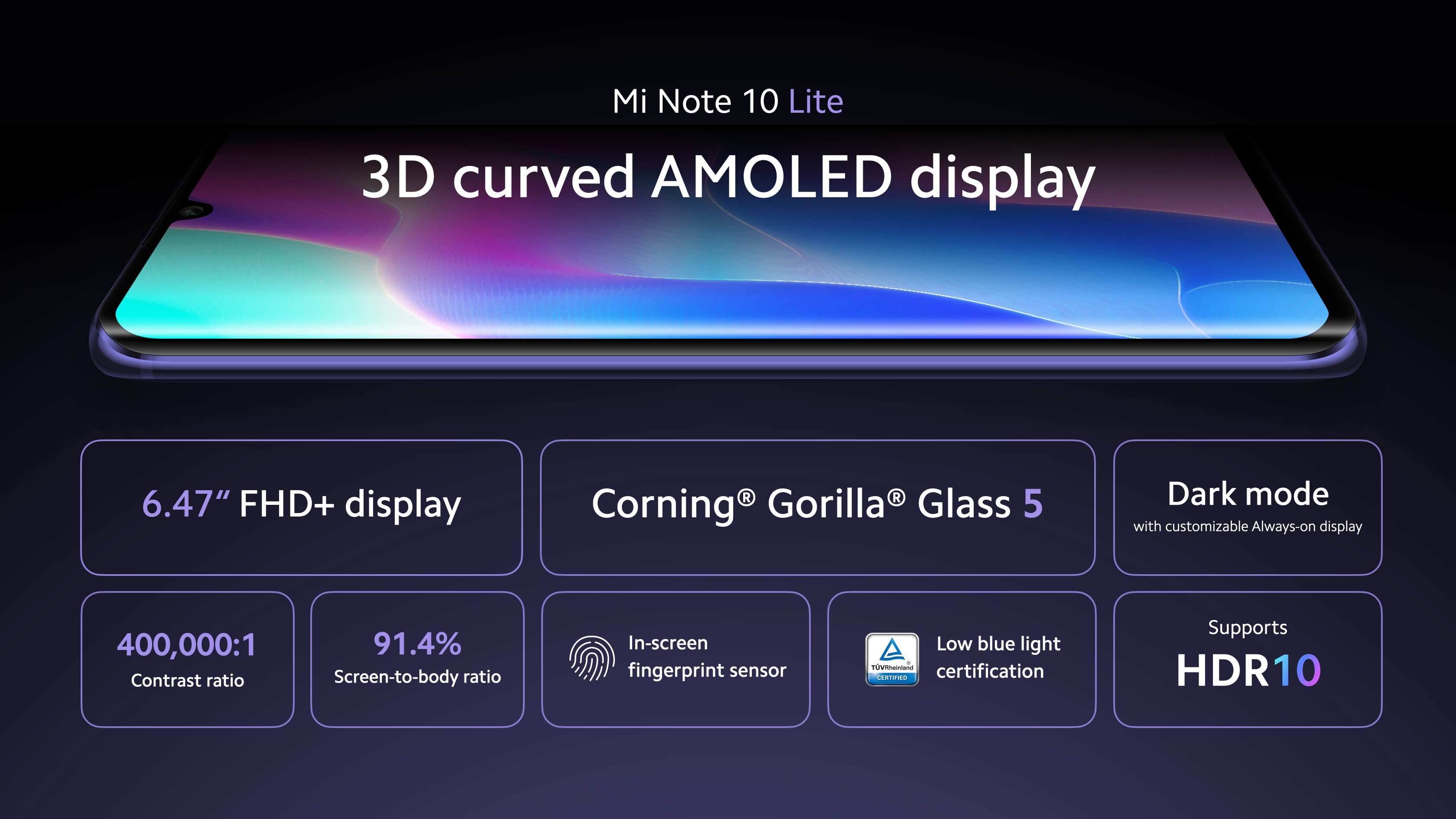
The Mi Note 10 Lite has a 6.47-inch 3D curved AMOLED display with TUV Rehiland low blue-light certification, Gorilla Glass 5 protection, and support for HDR10. There is a Snapdragon 730G processor under the hood and buyers will be able to choose from between a 6GB RAM + 64GB version and a 6GB RAM + 128GB version.
The Mi Note 10 Lite lives up to its “Lite” moniker with its camera configuration. It has a total of four rear cameras, unlike the Mi Note 10 and Mi Note 10 Pro that have five rear cameras.
The primary rear camera is a 64MP 1.6μm Sony IMX686 sensor. There is also an 8MP 120° ultra wide-angle camera, a 5MP depth sensor, and a 2MP macro camera. Xiaomi has paired the sensors with double LED flash.
The Mi Note 10 Lite can record in 4K and also in slow-motion at 960fps. Other camera features are a vlog mode, night mode, macro mode, portrait mode, and an AI document scanner.
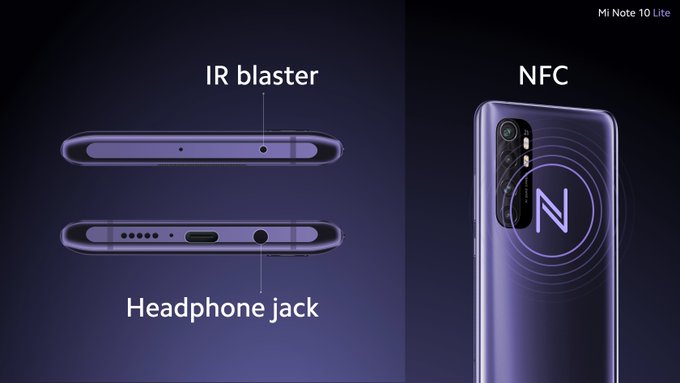
There is a 5260mAh battery inside with support for 30W fast charge (30W fast charger included). The Mi Note 10 Lite also has an in-display fingerprint scanner, an audio jack, NFC, and an IR blaster. The phone ships with MIUI 11 based on Android 10.
Mi Note 10 Lite Price and Availability
The Mi Note 10 Lite has a price tag of €349 for the base model and €399 for the 6GB+128GB version.
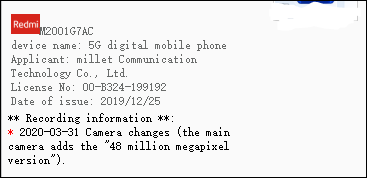
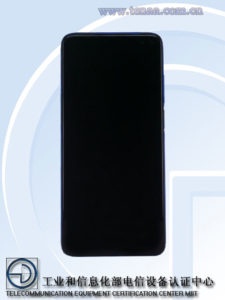
Chinese telecoms regulatory agency TENAA has updated the product information for the Redmi K30 5G. The listing shows the addition of a new version with a 48-megapixel main camera.
The Redmi K30 5G was launched in December 2019 as the brand’s first 5G phone. The device features a quad-camera setup with a 64-megapixel Sony IMX686 sensor as the main camera. The new version only houses a less powerful but efficient 48MP sensor which we believe is a Sony camera sensor. Apart from that, all other features remain the same.
As a recap, the device is powered by a Qualcomm Snapdragon 765G processor which uses a 7nm EUV process. The processor integrates a Snapdragon X52 modem with support for SA/NSA dual-mode 5G. The Redmi K30 5G is equipped with a 6.67-inch dual-punch hole display with a 20:9 aspect ratio and a screen ratio of 91%. Corning Gorilla Glass 5 on all sides.
The other sensor of the Redmi K30 5G’s rear-facing camera setup includes an 8-megapixel ultrawide lens with 120-degree field-of-view, a 5-megapixel macro lens and a 2-megapixel depth assist lens. While at the front, the device features an AI-powered dual-camera setup that includes a 20-megapixel main lens and a 2-megapixel depth sensor. The front camera supports 30fps full HD video shooting.
The Redmi Note 9 is finally here. At an online event today, Xiaomi announced a successor to the Redmi Note 8. The new phone comes with a new design, a new processor and more.
The Redmi Note 9 has a 6.53-inch FHD+ DotDisplay. It actually has a punch hole at the top left corner of the screen for the selfie camera. Xiaomi says the display is covered with Gorilla Glass 5 and the device has a splash-proof nano-coating.
Inside the phone is the new Helio G85 – an octa-core processor clocked at 2.0GHz. It is paired with 3GB or 4GB of RAM and 64GB or 128GB of storage respectively.
The phone has quad rear cameras – a 48MP f/1.79 with 4-in-1 Super Pixel, an 8MP f/2.2 ultrawide angle with a 118° viewing angle, a 2MP f/2.4 depth sensor, and a 2MP Macro Camera. Up in front is a 13MP sensor with support for Face Unlock. Xiaomi ships the Redmi Note 9 with a bunch of cool camera features including a kaleidoscope effect, document scanner, night mode, and portrait mode (on both sides).
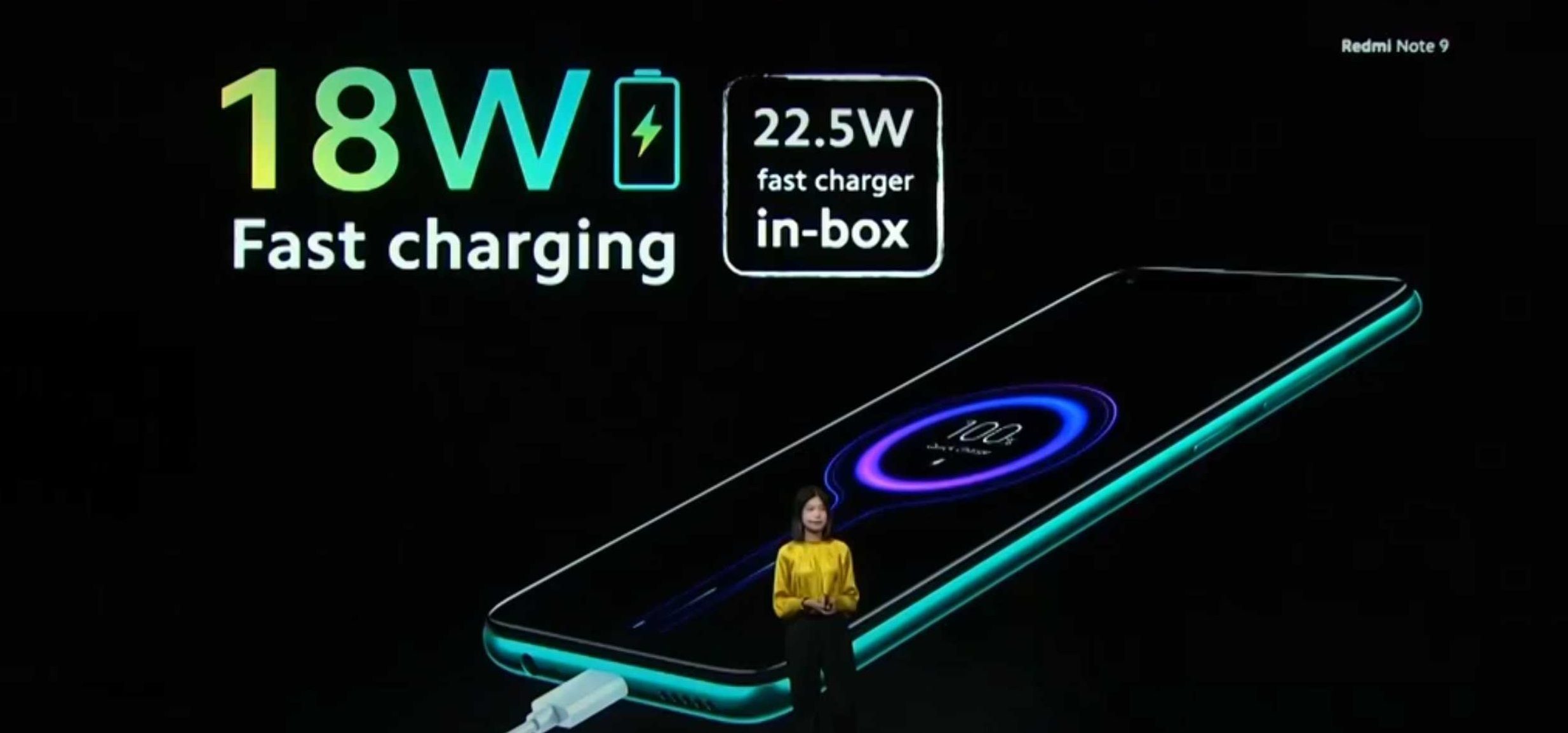
There is a massive 5020mAh battery inside the Redmi Note 9 and it supports 18W fast charging but Xiaomi ships it with a 22.5W fast charger. The phone also has an audio jack, NFC, IR blaster, and a rear-mounted fingerprint scanner.
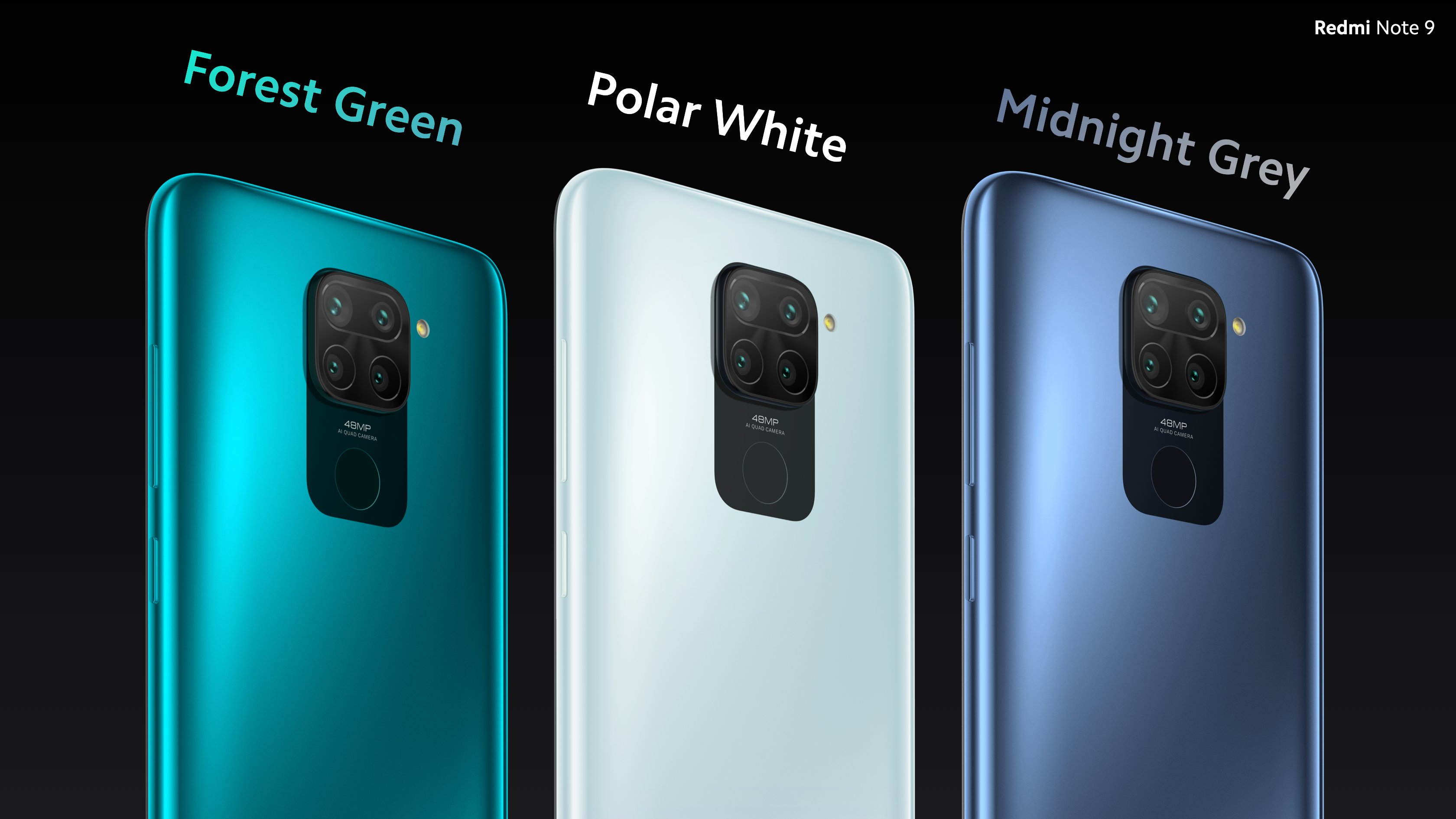
The Redmi Note 9 is priced at $199 for the 3GB RAM + 64GB version and $249 for the 4GB RAM + 128GB version. The phone comes in Forest Green, Polar White, and Midnight Gray (blue) and will go on sale in Mid-May.
Ulefone Armor 7E is the latest addition to the company’s popular Armor series lineup. The new mid-range device offers exceptional durability with the ability to stand against all the odds. It has already gone through screen rigidity test, drop test, waterproof design, and many others to prove the sturdiness and resilience. In a new video, the smartphone is once again proving itself against drop, and car crashing.
As we can see in the video above, the phone is dropped from varying heights, crushed under a car, and even rammed against the wall, but it came out with flying colors without any damage. It even survives fall from bicycle holder and a set of stairs. The Ulefone Armor 7E keeps working without a single crack and any other damage.
The smartphone carries IP68, IP69K, and MIL-STD 810G military standard certifications for protection against dust, water, and drop. However, the smartphone offers much more than just the durability part.
Ulefone Armor 7E comes powered with MediaTek Helio P90 AI octa-core processor with 2.2GHz maximum clocking speed. It’s PowerVR GM9446 GPU can handle any graphics-intensive task. There’s a huge 48-megapixel triple camera module for high-quality photos. The module also features a 2-megapixel depth and a macro sensor for capturing small objects. A 16-megapixel front camera is present on the front for selfies.
There’s a big 6.3-inch capacitive touch display with a Full HD+ resolution of 2340 x 1080 pixels. It capable enough to provide outstanding movie watching and gaming experience. In connectivity, the users will get support for Bluetooth 5.0, GPS, WiFi, VoLTE, and FM Radio. Moreover, there are Acceleration Sensor, Gravity Sensor, P-Sensor, L-Sensor, E-compass, Gyroscope, Heart Rate Sensor, Coulombmeter, NFC, OTG, Fingerprint, and Face recognition.
A huge 5500 mAh battery with 15W fast charging and 10W wireless charging. It measures 165.85*81*13.55mm and weighs 290 grams.
Ulefone Armor is available on Pre-Order for $219 from Banggood. You can know more details by heading to the product page.
We use cookies on our website to give you the most relevant experience by remembering your preferences and repeat visits. By clicking “Accept”, you consent to the use of ALL the cookies.
This website uses cookies to improve your experience while you navigate through the website. Out of these, the cookies that are categorized as necessary are stored on your browser as they are essential for the working of basic functionalities of the website. We also use third-party cookies that help us analyze and understand how you use this website. These cookies will be stored in your browser only with your consent. You also have the option to opt-out of these cookies. But opting out of some of these cookies may affect your browsing experience.
Necessary cookies are absolutely essential for the website to function properly. This category only includes cookies that ensures basic functionalities and security features of the website. These cookies do not store any personal information.
Any cookies that may not be particularly necessary for the website to function and is used specifically to collect user personal data via analytics, ads, other embedded contents are termed as non-necessary cookies. It is mandatory to procure user consent prior to running these cookies on your website.