Advertisement

Coronavirus: China deploys robots to prevent cross-infection

China is yet to curb the Coronavirus epidemic but the country has been able to deploy technology to fight the disease, in order to prevent the spread. Aside from the quarantine efforts, China recognises the need to cater to the needs of patients who have been infected by the virus and have deployed robots to do what humans would ordinarily have to do.

In several hospitals, a large number of robots are now being used, to a certain extent, to perform tasks such as disinfection, food delivery, dispensing drug, and remote diagnosis, reducing the workload of frontline medical staff and reducing cross-infection.

Recently, the first batch of 140 disinfection robots developed by Shanghai Dongfulong Technology Co., Ltd. have been delivered to Wuhan Jinyintan Hospital and other hospitals on the front line of epidemic resistance. The robots are said to use programmable logic controller (PLC) modules provided by German industrial giant Siemens, which are mainly divided into two categories: vaporized hydrogen peroxide disinfection machines and intelligent sterilization robots. They are all sterilized with hydrogen peroxide steam.

The medical personnel remotely control the disinfection robot through the tablet WIFI, set the room sterilization sequence according to the sterilization needs, independently plan the path and avoid obstacles. This device uses a lithium battery for cyclic charging, and the continuous working time after charging can reach 5 hours.

According to an engineer from Dongfulong, these two artificial intelligence disinfection machines can achieve a 6-log killing effect on microorganisms. 6-log refers to a 99.9999% reduction in bacteria.

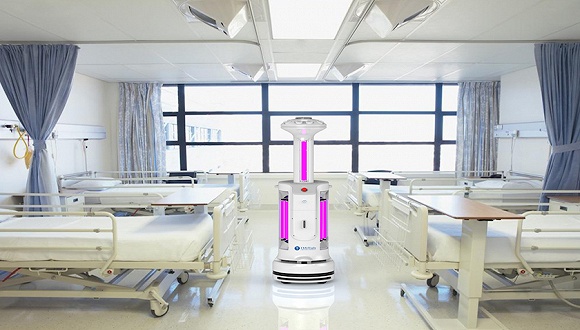
Further, more than 30 smart disinfection robots manufactured by Shanghai Titanium Robot Technology Co., Ltd. are also in the isolation ward, ICU, operating room, and fever clinic of six hospitals including Wuhan Xiehe Hospital and Wuhan Central Hospital. Titanium’s disinfection robot uses Chloric acid + plasma disinfection method. In the environment of human and machine coexistence, it performs autonomous mobile multi-point disinfection for the environmental surface and air, and the disinfection level reaches 6-log level.
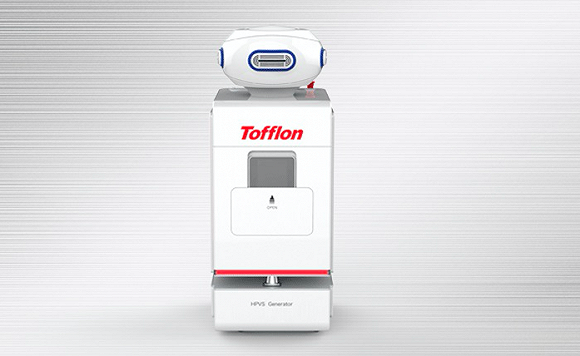
In addition to disinfection robots, a large number of robots such as nursing robots, consultation robots, and transport robots have also been deployed to the front lines of epidemic prevention.  There are also robots that can deliver materials including food to specific wards.

Qinglang, a robot company that focuses on unmanned delivery also sent dozens of food delivery robots to the quarantine areas in Hangzhou, Shanghai and other places. The robots can also deliver mineral water, fruits, medicines, etc. According to Qinglang’s WeChat official account, the food delivery robot is called Peanut. The staff can place meals on the robot’s three-layer tray during mealtimes and enter the room number of the quarantine area on the touch screen. Track the room number to serve the meal.
The company says the food delivery robot is fully autonomous and the contact-free distribution method can block the “human-to-human” new Coronavirus infection chain, reduce the possibility of infection within the quarantine zone, and improve the efficiency of food delivery and save the use of disposable protection.

Outside the hospital setting, JD Logistics stated on its official Weibo that it has basically completed map collection and robot testing of robot distribution in Wuhan. The firm is deploying distribution robots from various places to assist Wuhan. It intends to provide Wuhan with supplies and user orders required for the epidemic.

In rural areas such as Hebei, Shaanxi, and Jiangsu, JD Logistics’ drones have begun preparations for drone distribution and plan to provide logistics services to already closed areas.


(source)

Xiaomi Youpin launched a Disposable Raincoat for 29.9 Yuan ($4.3)

The Xiaomi Youpin platform has launched a new Disposable Raincoat earlier today (7th February 2020) that carries a price tag of 29.9 Yuan, which roughly translates to about 4.3 US Dollars.

As the name suggests, the product is a disposable raincoat that is made for protecting one from unexpected rains. It is being sold and distributed by the Xiaomi Youpin platform while the Zhongke Hongrun Technology Co. Ltd will be providing the after sales services for the same.

Xiaomi

The disposable raincoat arrives with a few useful functionalities as well apart from just protecting the user from the rain. It is very convenient to use with its opening and closing being very easy, percent for quickly gettings in to avoid rain drops. This is made possible through its open button design with four snap buttons being present on the front row.

It is also available in two color variants, including yellow and blue and arrives with a widened hem, making it easier to use during walking and even cycling as well. The disposable raincoat can also be used to protect one from other elements like snow and dust and can act as a simple and effective backup in case of surprising weather elements, like a cloud burst.

Xiaomi

The materials used in the disposable raincoat is made of 0.05mm thick PE material, making it durable regardless of its thin layer. This also makes it a better alternative over conventional affordable raincoats. Despite its intended purpose of use and name, the raincoat can be used multiple times and can easily be dried up and folded for storage, which is inevitably better for the environment by reducing unnecessary wastage.


(Via)

Xiaomi to Launch a flagship Wi-Fi 6 Router alongside the Mi 10 series

New information has just surfaced that reveals that Xiaomi is planning on releasing a flagship Router that features Wi-Fi 6 alongside its flagship smartphone series, the Xiaomi Mi 10. The information was shared on Weibo, which is a Chinese microblogging website, earlier today (7th February 2020).

For those unaware, Wi-Fi 6 is the latest standard in WiFi technology (Wireless Fidelity). It is also known as AX WiFi or 802.11ax WiFi and is the next generation succeeding the current 802.11ac WiFi standard. The latter which is commonly used in most routers suffers from a series of issues, including network congestion, lacking coverage area and the constant need to switch SSIDs. However, Wi-Fi 6 seems to improve in all of the above mentioned areas.

Xiaomi

Compared to its predecessor, Wi-Fi 6 optimizes power consumption and coverage capabilities of a router, supporting multi high speed concurrent connections. In other words, the connection is stronger with a wider range and can better support multiple connections at the same time. Other benefits include lower latency overall, high rate of data transmission and more.

Xiaomi’s upcoming flagship Wi-Fi router offering is expected to support this new WiFi technology standard. Furthermore, the Xiaomi Mi 10 series, the Mi 10 and Mi 10 Pro are also expected to support Wi-Fi 6, making the router compatible with the smartphones as well. Currently, the new standard has yet to be highly adopted and become more active in commercial circulation.

Xiaomi
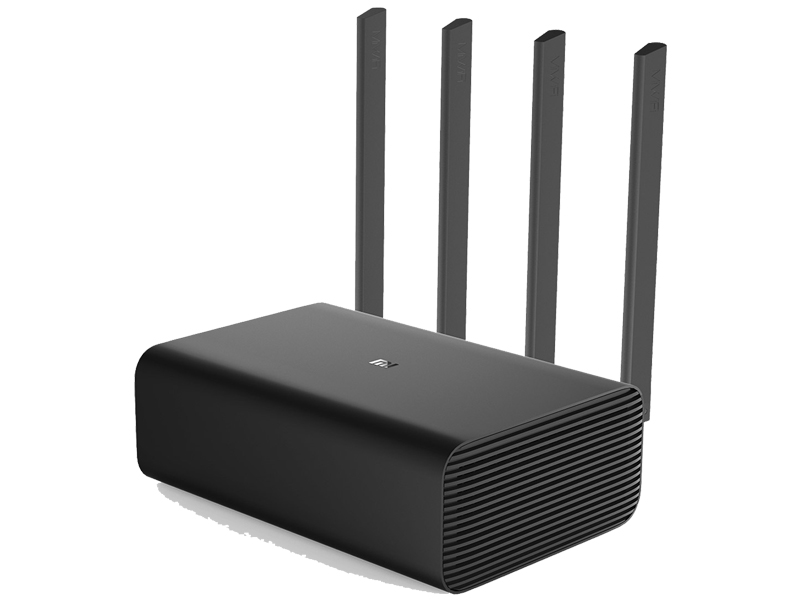
Xiaomi Mi Smart Router Pro

Unfortunately, information is still scarce regarding the launch and finer details are unavailable, for now. The new Xiaomi router could share the stage with the Mi 10 series but is also likely to be launched separately as well. So stay tuned for more developments regarding upcoming Xiaomi launches.


(Via)

Researcher discovers active backdoor mechanism in many IoT products

Security researcher Vladislav Yarmak has published details about a backdoor mechanism he discovered in Xiongmai firmware, used by millions of smart devices across the globe, such as security cameras, DVRs, NVRs, and others. A firmware fix is not currently available as Yarmak did not report the issue to the company, citing a lack of trust in the vendor to properly fix the issue.70Mai Smart Car DVR 2

In a detailed technical rundown that Yarmak published on Habr, the security researcher says the backdoor mechanism is a mash-up of four older security bugs/backdoors that were initially discovered and made public in March 2013, March 2017, July 2017, and September 2017 — and which the vendor failed to adequately fix.

According to Yarmak, the backdoor can be exploited by sending a series of commands over TCP port 9530 to devices that use HiSilicon chips and Xiongmai firmware. The commands which are the equivalent of a secret knock will enable the Telnet service on a vulnerable device.

Yarmak says that once the Telnet service is up and running, the attacker can log in with one of six Telnet credentials listed below, and gain access to a root account that grants them complete control over a vulnerable device.

These Telnet logins have been found in previous years as being hardcoded in the firmware, but despite public disclosures and their abuse by Mirai botnets, Yarmak says the hardcoded credentials were left in place, while the vendor chose to disable the Telnet daemon instead.

Because Yarmak did not intend to report the vulnerability, firmware patches are not available. Instead, the security researcher has created proof-of-concept (PoC) code that can be used to test if a “smart” device runs on the vulnerable firmware.

If a device is found to be vulnerable, the Russian researcher advises that device owners should ditch and replace the equipment. The proof-of-concept code is available on GitHub. Build and usage instructions for the PoC are available in the Habr post.

This backdoor is said to likely be on a countless number of devices, as the Hangzhou Xiongmai Technology Co which manufactures the Xiongmai firmware is a known seller of white-label products, sold under tens of other brands. The researcher cited the work of another researcher who in September 2017 tracked down the same backdoor mechanism in the firmware that was being used by DVRs sold by tens of vendors.


(source)

World’s largest 3D printed building opened in Dubai, part of a plan to have 25% of all constructions being 3D Printed by 2030

The World’s biggest 3D printed building has official been opened in Dubai. It is a large two story building encompassing 6,900 foot surface area which has been made for local general administrative functions by the Dubai Municipality; and is a part of a plan to have 25 percent of all new constructions being made in a similar manner by 2030.

Dubai
The 3D printer was positioned by a large crane to build the outer wall before moving upward to reach the final height of the building

The building was originally designed in Boston, US and was a joint effort with Apis Cor, which is a company that specializes in 3D printing and construction of buildings. Intersetingly, the newly completed structure is not the tallest 3D printed building, that title goes to a five story apartment building in China. However, the area in which the 3D printed building in Dubai wins is the total surface area.

Similar to conventional construction, the foundation was laid first with concrete mixtures before the 3D printed walls were erected. The construction utilized a fast drying mix of recycled construction debris, cement, and other construction leftovers which also makes this a less environmentally impactful and economical project. In comparison to a traditional building of this size, the materials used are roughly about 50 percent lighter and are said to be considerably more durable in the longer run.

Dubai
The newly constructed building that will serve administrative functions for Dubai’s Municipality

Initially, the construction process used the 3D printer to line the outer walls, making it a few inches thick before the walls reached full height. After this was completed, construction workers took over and started working on the roof and also worked on cutting out spaces for windows whilst filling in the walls with insulating materials.

Notably, Apis Cor claims that an affordable 500 square foot house can be 3D printed in just about 24 hours, which is indicative of the quick pace of its technology. The company is planning on working on such projects in the states of Louisiana and California as well.


(Via)

Google Pixel 4A is codenamed “Sunfish” and packs Qualcomm Snapdragon 730 SoC

Google recently launched its flagship smartphones — Pixel 4 and Pixel 4 XL. The company is now expected to launch a budget-friendly variant of the same which could be named Pixel 4A and Pixel 4A XL.

While there have been three codenames for the same, it has now been confirmed that the Pixel 4A is codenamed “sunfish”, which will be the successor to Google Pixel 3A. Based on the previous leaks, the device will come powered by the Qualcomm Snapdragon 730 SoC.

Google Pixel 4A

This also confirms that the smartphone won’t have support for 5G connectivity. However, there’s no information available if other devices — redfin, bramble, or both code-names will have Snapdragon 765 SoC.

If those two devices end up having 5G connectivity support, it could mean that the phones will be powered by the Qualcomm Snapdragon 765 SoC. However, there’s not much information available about these phones yet.

So far, it has been revealed that the Pixel 4a could come with a 5.7 or 5.8-inch single hole-punch display. The device is said to have a single rear camera setup and will feature a rear-mounted fingerprint sensor.

It will reportedly have around 3.5mm headphone jack and USB Type-C port. Google’s Pixel 3a series was successful and if the company plays its cards right, the upcoming Pixel 4a series could also be a huge success. Given that the Pixel 4 lineup hasn’t debuted in the Indian market, the budget-friendly 4A has lots of things riding on it.

(Source)

Samsung Galaxy Z Flip spotted in another Leaked Video

Since 2019’s Galaxy Fold, multiple reports have surfaced regarding Samsung working on other smartphones with a foldable display. One such smartphone is the upcoming Galaxy Z Flip which has been spotted again in another video that was leaked.

Samsung
Samsung Galaxy Z Flip

The Samsung Galaxy Z Flip was caught on camera again in an undisclosed location at a retail store. It was spotted by an Instagram user that also filmed and posted a short video on their account. As seen in the video, the upcoming foldable smartphone was covered by a thick case that is designed more for covering the device to prevent leaks rather than protection.

Previously, the South Korean tech giant had utilized a similar tactic to hide its Galaxy Fold smartphone to showcase just the screen, back in November 2018. Unfortunately, the video does not reveal any surprising new detail regarding the Samsung Galaxy Z Flip but does indicate its imminent announcement. We might see it in the Samsung Unpacked event which is going to be held on 11th February 2020, where the Galaxy S20 flagship series will also be announced.

For those unaware, the Galaxy Z Flip was recently spotted earlier this week in a leaked video. The design follows a clamshell display that also resembles the Motorola Razr 2019. Unfortunately, finer details regarding the smartphone are currently unavailable and we will have to wait for an official announcement from Samsung for more details. So stay tuned, as more information is expected to arrive soon and we will be covering the upcoming Samsung Unpacked 2020 event as well.


(Via)

Researchers can track PC Monitor’s brightness to Steal User Data

According to a new report, researchers have found a new method to steal data from computers that are not connected to any external system or other computers. They achieved this by mapping the brightness of the LCD monitor.

A camera equipped device can map the subtle changes in the LCD monitor’s RGB colors to extract user data

The method utilizes a previously compromised computer to relay changes in the LCD’s RBG color values through a camera. The changes are imperceptible, meaning its almost impossible to map it with the naked eye, thus it requires a camera equipped device. Theoretically speaking, one can also trick someone into loading malware on their computer through a USB drive and use nearby security cameras, that have been hacked, to relay the relevant data.

In other words, all of this sounds like a technique out of science fiction or a hacking scene in a movie, but it is now also a method of extracting data out of one’s system. However, don’t worry too soon, as it is not yet possible for hackers to simply gain access to your computer’s important credentials and sensitive data through brightness alone.

A data thief would have to go through many loops like gaining access to a camera that is pointed towards the target computer for it to be possible. As it stands right now, the technique will supposedly more helpful to intelligence agencies and other such organizations rather than a hacker keeping track of your PC monitor. Although the development does give rise to a new avenue of hacking altogether, even between air-gapped computers that are completely isolated.


(Via)

iQOO 3 5G for India benchmarked; Could be arriving as first UFS 3.1 storage phone

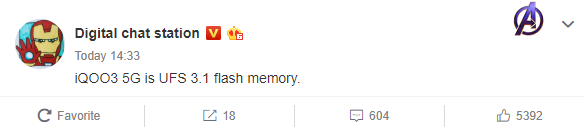
Everything on the specifications of the rumored iQOO 3 smartphone is known since has appeared on China’s TENAA database. While the China launch of the phone appears to be close at hand, some reports have claimed that it may debut first in India. In fact, India which is still not a 5G-ready country will possibly a Snapdragon 865 powered 5G iQOO phone and a 4G phone this month. The Indian variant of the phone has been benchmarked on Geekbench 5 through which it some of its specifications have been revealed. At the same time, a reputed Chinese tipster has revealed that it could be equipped with UFS 3.1 storage. Hence, it could be debuting as the world’s UFS 3.1 supported device.

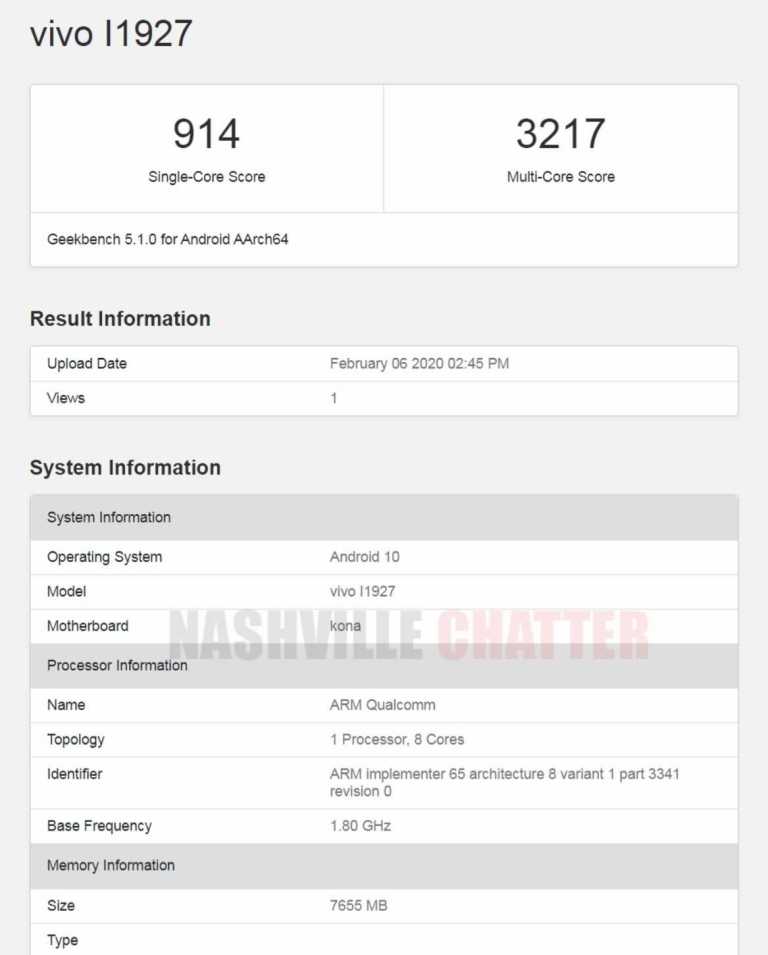
The Bureau of Indian Standards (BIS) had recently approved two iQOO phones with model numbers such as I1927 and I1928. These could be two different phones. The I1927 has seemingly appeared on Geekbench 5 today as “Vivo I1927.” It appears to be the Snapdragon 865 5G phone from iQOO phone that will debut soon in India. It is yet to be confirmed whether it will be debuting as iQOO 3.

According to the Geekbench 5 listing, the Vivo I1927 has scored 914 and 3217 in the single-core and multi-core tests, respectively. The listing reveals that the smartphone is driven by “kona” octa-core processor that offers a base speed of 1.80GHz. Past reports have confirmed that Kona is the codename of the Snapdragon 865 5G mobile platform.

The Geekbench 5 listing of the alleged iQOO 3 phone reveals that it is loaded with Android 10 OS. The SoC of the device is equipped with 8 GB of RAM. The TENAA listing of the phone has revealed that the phone may also come in 6 GB and 12 GB RAM edition in China.

The TENAA appearance of the purported iQOO 3 has also revealed that China will be receiving it in 128 GB and 256 GB storage editions. A Chinese tipster has claimed that iQOO 3 could become the first phone to arrive with UFS 3.1 that was made official earlier this month. In the recent past, iQOO China’s product manager had hinted that the next iQOO phone will be not be not only coming with SD865, but also the latest UFS 3.1 storage technology.

iQOO 3 specifications (Rumored)

The alleged iQOO 3 TENAA listing revealed that it has a 6.44-inch full HD+ AMOLED display with in-screen fingerprint reader. It will be a punch-hole screen with 60Hz refresh rate. The handset will have a 16-megapixel front camera and a 64-megapixel + 13-megapixel + 13-megapixel + 2-megapixel quad cameras setup on its back.

Allegegd iQOO 3
Allegegd iQOO 3 (right) with purported OPPO Find X2 (left)

The SD865 and UFS 3.1 surely is a lethal combination. iQOO will be also using Micron’s LPDDR5 RAM technology. However, there is no confirmation whether the iQOO 3 will be equipped with LPDDR5. The phone may house a 4,410mAh battery that will probably support 55W fast charging.


(via)

Samsung Galaxy Z Flip gets a special cavier Joker & Harley Quinn edition even before launch

Samsung is all set to launch its second flagship smartphone — Samsung Galaxy Z Flip. Even before the phone goes official in next week at the Unpacked event, Russian jeweler Caviar has designed a custom luxury version of the unannounced phone.

The company has launched “The Joker and Harley Quinn Limited Edition” of the Samsung Galaxy Z Flip smartphone. It says that the back panel of the device will be inlaid with 24 carat gold.

Samsung Galaxy Z Flip Harley Quinn Joker Edition

The upper part of the back panel shows the clown as a Joker reference while the lower part of the same is of Harley Quinn. The back of the phone looks like two playing cards — while Harley Quinn is referred as ‘Queen’ while the Joker is a trump card.

Given that its a foldable smartphone, when it is folded in half, the device shows both Harley Quinn and Joker on each side of the device. This new limited edition smartphone is up for pre-order for a price of $5,210 and Caviar says that only 54 units are currently available for order.

Samsung is all set to launch the Galaxy Z Flip smartphone at its Unpacked event on 11th February in San Francisco. As per the reports, the device is expected to be smaller than the Galaxy Fold and will not be as expensive as the first-generation Fold smartphone.

As per the rumors, the Galaxy Z Flip will launch with a 6.7-inch FHD+ flexible screen and a 1.06-inch secondary display. There will be a Snapdragon 855+ processor inside the device along with 8GB of RAM and 256GB of UFS 3.0 storage.

The dual rear cameras are a 13MP f/1.8 primary sensor and a 12MP f/2.2 123° ultrawide-angle camera. The selfie camera is a 10MP f/2.4 sensor. The phone has a 3300mAh battery that is split into two and supports 15W wired charging and also supports wireless and reverse wireless charging. Samsung will ship it with Android 10 with One UI 2 on top.

(Via)

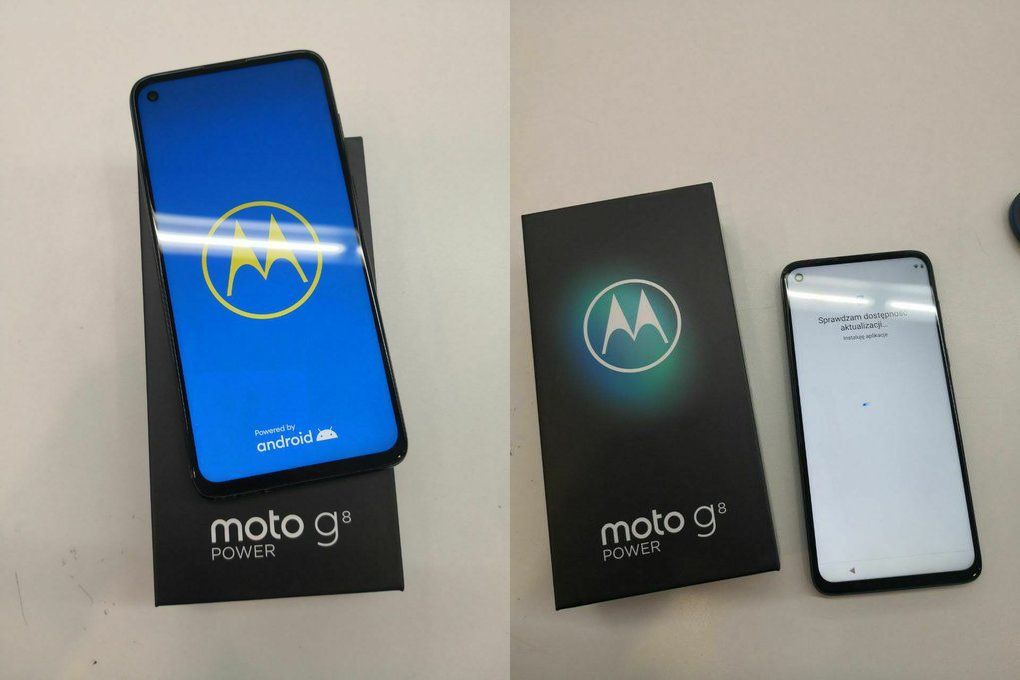
Moto G8 Power live shots, Amazon Listings reveal launch is very near

The upcoming Motorola Moto G8 Power was listed for a short period on Amazon UK earlier today. Although the retailer was quick to take down the listing, the damage was already done as enthusiastic fans captured screenshots of the device and specifications. The Moto G8 Power is expected to launch at the Mobile World Congress (MWC) 2020 scheduled to be held in Barcelona, Spain later this month. A separate leak has revealed the live shots of the smartphone.

The Moto G8 Power is rumored to be unveiled alongside the Moto G8 and the G Stylus. The renders of these phones are already available online. According to the live shots and other images that have appeared on Amazon UK,  the Moto G8 Power sports a punch-hole camera at the front. The smartphone flaunts a quad-camera setup at the rear next to the centrally-placed Motorola logo which is embedded with a fingerprint reader. 

Moto G8 Power live shots

The device is water-resistant and can withstand a few raindrops. But users are advised to avoid drowning it in a pool. The retailer listing revealed that it will be available in Smoke Black and Capri Blue color variants.

Moto G8 Power Specifications and Features

The Moto G8 Power Amazon UK listings revealed that it flaunts a 6.36-inch IPS LCD capacitive touchscreen with a resolution of 2280 x 1080 pixels. The G8 Power runs on a 2.0 GHz octa-core SoC with 4GB of RAM and 64GB of native storage. Past reports have revealed that it will be driven by the Snapdragon 665 chipset. The same SoC is rumored to power the Moto G8 and Moto G Stylus phones.

The quad-camera setup includes a 16-megapixel primary sensor with an 8-megapixel ultrawide lens, an 8-megapixel telephoto sensor and a 2-megapixel macro sensor. The G8 power flaunts a 25-megapixel lens at the front.

Moto G8 Power in Smoke Black and Capri Blue

Powering the Moto G8 Power is a 5,000 mAh battery. It is said to be arriving with support for 18W fast charging. The smartphone runs on Android 10 and boasts dual speakers. Connectivity options include VoLTE, Wi-Fi 802.11ac, Bluetooth v5.0 USB Type-C, USB OTG, GPS and a 3.5 mm audio port. 


(via 1, 2, 3)

Apple patents a Next Gen Apple Watch with Touch ID fingerprint scanner support

Last week, Apple had filed a patent application that was titled “Apple Patent Reveals Apple Watch’s Digital Crown being eliminated and replaced with an Optical based System.” In other words, an upcoming next gen Apple Watch with Touch ID support.

Apple

Earlier today (7th February 2020), the US Patent & Trademark Office published this patent application from Apple. The patent reveals that the Cupertino based giant is working on a new Apple Watch that will make the digital crown of the wearable more useful to the user through the addition of the Touch ID fingerprint scanner support.

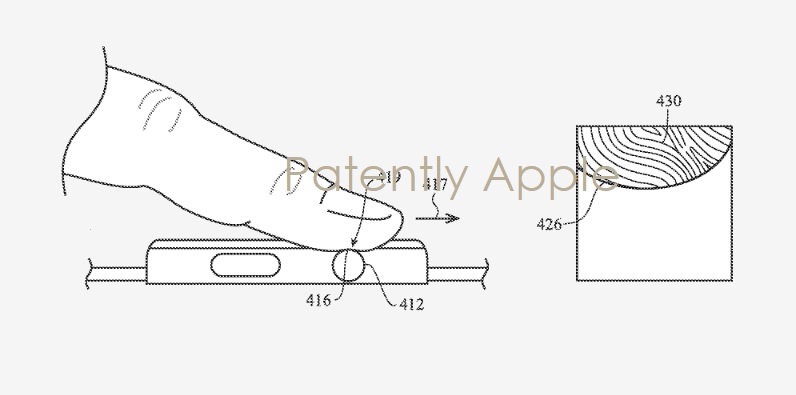
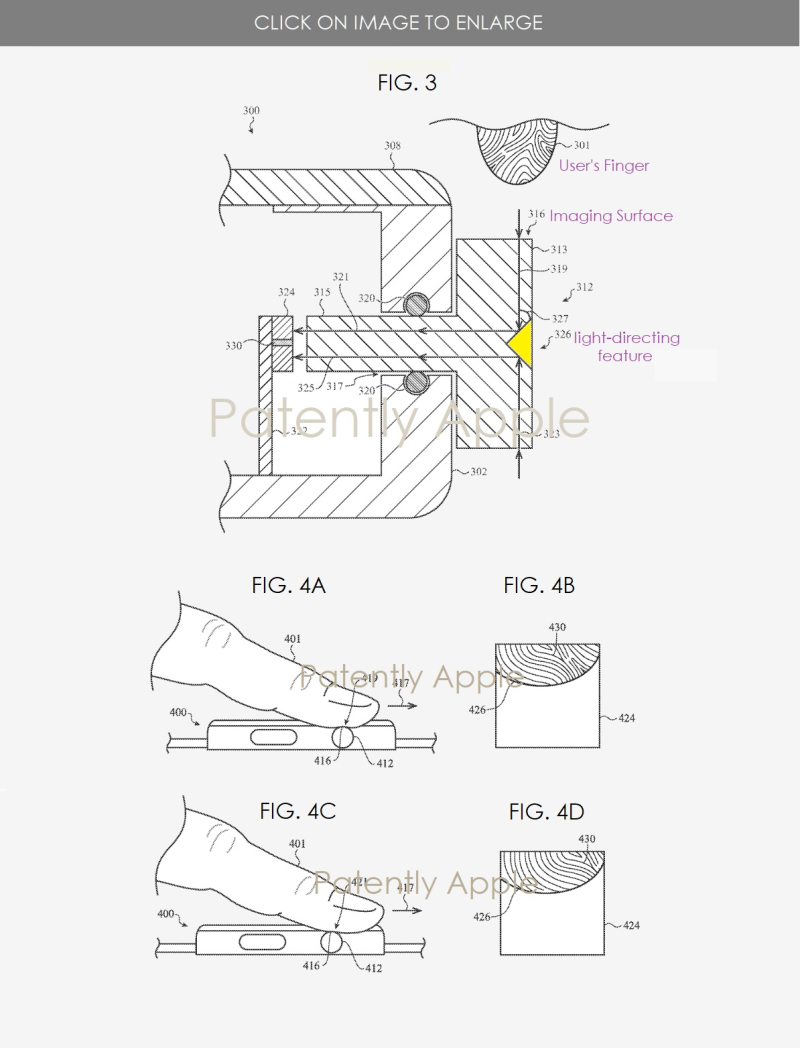
According to the Apple patent, the side surface of the smartwatch will feature a transparent cover alongside image sensors that will be extended via the Watch’s crown. This mechanism will enable biometric security on the wearable product, or in other words, Touch ID security. The mechanism is housed below the primary display of the Apple Watch and also seems to have a light transmitting and an image sensing surface.

Apple

The images reveal that to input the fingerprint from users’ fingers, one must place it on the circular surface of the digital crown and rotate it. Meaning, it is not a simple touch input but a sliding action across the round dial. This is an interesting functionality that the company could add in its future iterations of its Apple Watch which will also make the popular wearables more secure as well.


(Via)

Android 11 R spotted running on Pixel 2XL

Some Android smartphone manufacturers are having a tough time with the Android 10 rollout. Meanwhile, a Pixel 2XL is seen running Android 11 R build, a couple of months before its official announcement. After a Geekbench appearance on Pixel 4 a few weeks ago, Android 11 R was found running on a three-year-old Pixel by folks over at the Piunikaweb.

Android 11

According to a photo posted by a Twitter user Droidivan, Pixel 2 is running on Android R bearing the build number aosp_talmen-user debug R.AOSP.MASTER6165648test-keys with January 2020 security patch. It is quite a surprising situation to see an Android 11 build running on the Pixel 2 XL.

However, it is believed that the device is running a Generic System Image of Android 11/R. These builds are usually sent to OEMs and developers for early access to make the required changes. The Twitter user would have received one of such early build that he managed to flash on Pixel 2XL. These builds are the full stock Android builds without any alterations or modifications.

It’s too early to comment on the features and availability of Android 11. The first developer preview is also a couple of months away. However, the chances of Android 11 availability on Pixel 2XL has gradually improved with this leak.

Some leaks and rumors suggest Android 11 will feature a Dark Mode scheduling,  fully secure Wireless ADB, and video recording support larger than 4GB.


(source, via)


Xiaomi Mi 10, Mi 10 Pro new leak reveals front and rear design

Xiaomi is still silent on the launch date of the Mi 10 series. However, it is being said that the Mi 10 and Mi 10 Pro smartphones will be made official on Feb. 13 at 2 PM (local time) in China. It will go official through an online live conference event. There is no confirmation yet whether the company will be also launching the Xiaomi Mi 10 Explorer Edition with a transparent rear. Last month, several live shots of the Xiaomi Mi 10 had appeared to reveal its design. A snapshot of a promo material of the Xiaomi MI 10 series and a screenshot of what looks like an official image are now doing rounds on Weibo. These new images have revealed the front and rear designs of the Xiaomi Mi 10 and Mi 10 Pro smartphone phones.

Xiaomi MI 10, M10 Pro leaked image

In the new images, there are two Mi 10 handsets with a slightly different camera arrangement. The green variant that has a smaller number of cameras seems to be the Xiaomi Mi 10 whereas the bluish model could be the Xiaomi Mi 10 Pro as it features an additional camera.

The Xiaomi Mi 10’s camera setup includes three lenses that are stacked together and a separately placed fourth sensor and an LED flash. On the other side, the Xiaomi Mi 10 Pro seems to feature an additional sensor between the second and third lenses. As past reports have revealed, the Mi 10 series will be equipped with a 108-megapixel main lens. The Chinese text in the promo image reveals the Snapdragon 865 mobile platform powered Mi 10 series will arrive with camera features like 8K videography and 50x hybrid zoom.

Coming to the display of the Xiaomi Mi 10 series, it appears that the Mi 10 and Mi 10 Pro could be sporting the same kind of screen. The leaked photos show that they are equipped with a curved display that has a punch-hole at the upper-left corner. The display of the phone is surrounded by ultra-slim bezels. An earpiece seems to be present in the thin top bezel of the Mi 10 phone. It is speculated that the display of the Mi 10 series will support a refresh rate of 120Hz. Also, it will feature an in-display fingerprint sensor.

The other specifications of that are expected to be available on the Mi 10 series include LPPDR5 RAM and Wi-Fi 6. The Mi 10 Pro may support 66W fast charging whereas the Mi 10 may arrive with 30W rapid charger. The base model of the MI 10 could be coming with 8 GB of RAM and 128 GB of storage. The Mi 10 series phone could be priced between 3,500 Yuan (~$500) and 5,000 Yuan (~$716).

(via)

Confirmed: Samsung will also supply LPDDR5 memory to Xiaomi Mi 10

Yesterday, Xiaomi announced that its upcoming Mi 10 series will feature the new-age LPDDR5 memory across the entire lineup. Micron was first to confirm this news and it announced the mass production of the first LPDDR5 RAM chip for Mi 10.

LEi Jun confirms Samsung made LPDDR5 RAMs for Mi 10

However, soon after this announcement, netizens on Weibo wondered whether Xiaomi planned to use Samsung made LPDDR5 memory chips as well. This was a valid question given how the upcoming Samsung Galaxy S20 series, Nubia’s Red Magic 5G flagship are expected to use Samsung’s new memory chip. And yesterday night, Xiaomi’s CEO Lei Jun confirmed that the Mi 10 series will be using Samsung as well as Micron’s LPDDR5 memory chips.

Both Samsung and Micron LPDDR5 memory chips promise speeds of up to 6.4 Gbps, which a significant 50% boost as compared to previous LPDDR4X generation. The new age chips also promise a 20-30% reduction in power consumption. And if Samsung is supplying LPDD5 memory chips for the Xiaomi Mi 10, we can’t entirely rule out the possibility of the top-end variant featuring a Samsung made 16 GB LPDDR5 RAM. After all, Samsung had revealed that it was working on a 16GB RAM module for 2020.

Redmi K20 Pro Exclusive Edition 512GB Storage
Even the Redmi K20 Pro Premium edition features an extreme 12GB +512GB memory configuration

Xiaomi has never been shy to include high RAM modules inside its flagships. For example, its most recent Mi 9 Pro 5G has a 12 GB RAM variant as well. So, it won’t be surprising to see a 16GB LPDDR5 RAM module in the top-end Xiaomi Mi 10 Pro 5G model.


Apple AirPods supply could be in trouble after the Coronavirus Outbreak

Apple is one of the many companies that have been facing production issues after the recent Coronavirus outbreak in China. Previously, we had reported on its iPhone production witnessing an impact through Foxconn, and now even its AirPods supply might be affected as well.

The new breed of virus has been a cause of alarm in the Southeast Asian region and originated from the Wuhan city in China. This had caused the local government to enforce a halt on various factories and production lines in the country. The move was done to curb the infection spreading further in environments with a high number of workers.

Apple
Apple AirPods Pro

Notably, Apple had ordered the production of 45 million units of its popular AirPods series of wireless earbuds before the first incident of Coronavirus occurred. The Cupertino based giant had ordered this massive order after the demand for its hearables crossed expectations.

As of right now, production lines and factories have been shut down, in accordance with the Government’s ruling, till the 10th of February 2020. Reportedly, this will affect the production of AirPods since the supply of certain crucial components has fallen short due to the factory shutdown. Apple supplied AirPods through three key manufacturers, all of which had to halt a major part of their production recently.

Apple

According to a report, these three companies only have two weeks worth of materials and components to make AirPods. Thus, Apple might face a crunch for AirPod shipments till the time they can find another supplier for the different components. Currently, Apple is focusing its supply of AirPods on its online stores and various retail locations. Older AirPod models are still in supply but the Pro variants buyers are seeing a month long wait before shipping.


(Via)

Vivo Y91C 2020 launched; Specifications, featured and price

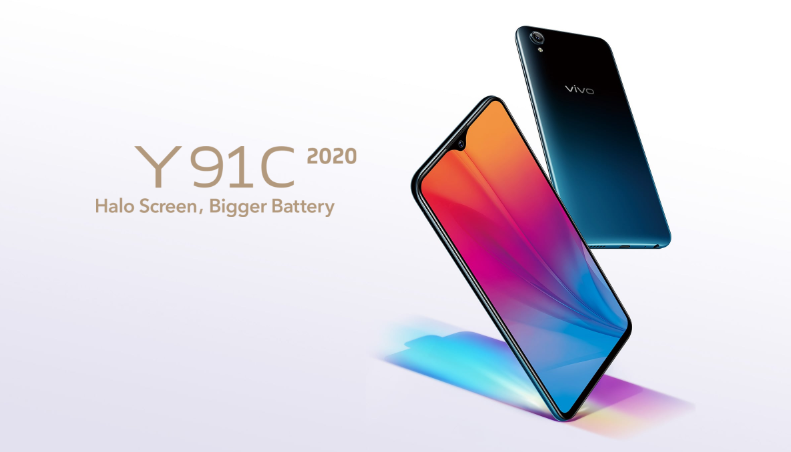
Vivo has discreetly announced a new smartphone dubbed as Vivo Y91C 2020 in Bangladesh. Last year, some countries like Malaysia and Thailand had received the Vivo V91C smartphone. The newly unveiled Vivo Y91C 2020 is nothing but a rebranded version of the same phone for Bangladesh.

Vivo Y91C 2020 specifications

The Vivo Y91C 2020 measures 155.11 x 75.09 x 8.28mm and weighs 163.5 grams. The phone flaunts a Halo FullView 6.22-inch IPS LCD display with waterdrop notch. The screen offers HD+ resolution of 720 x 1520 pixels. The company claims that the Vivo Y91C offers a screen space of 88.6 percent. The rear shell of the phone is made out of polycarbonate material and has a curvy appeal.

The MediaTek Helio P22 (MT6762R) octa-core processor powers the smartphone along with 2 GB of RAM. The entry-level Vivo phone offers users with a 32 GB of built-in storage. Users can expand its storage by a microSD card. It is quite a bummer to see the phone ship with older Android 8.1 Oreo OS that is skinned with the FunTouch OS 4.5 UI.

Vivo Y91C 2020
Vivo Y91C 2020

The rear side of the phone features a 13-megapixel single camera with f/2.2 aperture and LED flash. A 5-megapixel camera with f/1.8 aperture rating is available on the display notch. The device lacks a fingerprint reader which means users will be provided with only face unlock biometric security feature.

The Vivo Y91C 2020 comes with a 4,030mAh battery. It does not support fast charging. The connectivity features that are added on the phone are dual SIM support, 4G VoLTE, 2.4GHz Wi-Fi, Bluetooth 5.0, GPS, microUSB 2.0 and 3.5mm audio jack.

Vivo Y91C price and availability

In Bangladesh, the Vivo Y91C phone carries a price tag of 9,990 BDT (~$117). It can be bought in two colors like Fusion Black and Ocean Blue. In Thailand, the Blue option is not available for Vivo Y91C. Instead, the country has received the phone in Fusion Black and Sunset Red color variants.


(source|via)

Moto Razr teardown shows that the phone is difficult to repair

Motorola recently announced its first foldable smartphone — Motorola RAZR and after the initial delay, the device is now up for purchase. While the shipping was set to start on 25th February, some unit of the phone seems to have already shipped out.

With this, a teardown of the smartphone revealed the internals. As per the dismantle video by PBKreviews, the Motorola Razr comes with two batteries, a thin display panel. With number of screws to hold everything, the phone seems quite difficult to repair.

To get to the 6.2-inch paper-thin display panel also seems to be a major task as one needs to navigate through numerous wires, screws and components. It is also reportedly difficult to take off the front cover that houses the display.

Along with careful prying, it also needs quite a good amount of heat to make sure that the glue holding it together loses the grip. The video also shows the two batteries of the phone placed on two sides of the hinge.

While the repairability score of the Motorola Razr may not be good, it seems that the cost to get the device repaired isn’t very high. The company has revealed that it will be charging $299 for replacing the display which Motorola itself says is prone to bumps and lumps.

This is quite good for a device that costs $1,500. In comparison, South Korean-giant Samsung is charging $599 to fix the foldable screen of the Galaxy Fold, which retails for around $2,000.

(Source)

Samsung Galaxy A11 leak reveals punch-hole display and triple cameras

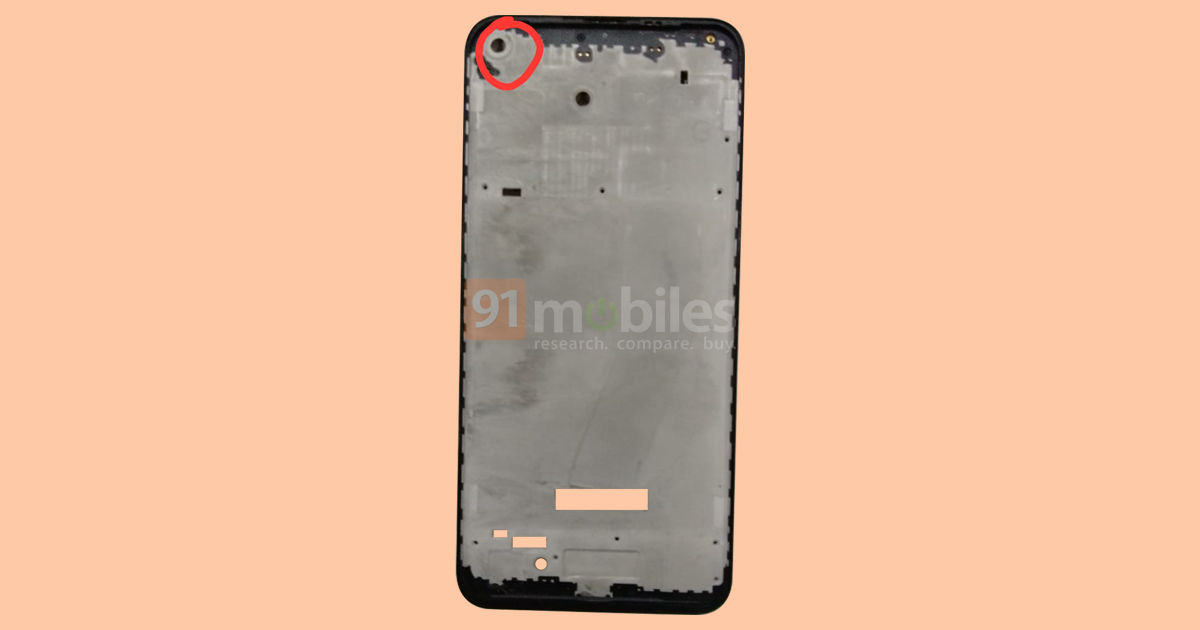
The Samsung Galaxy A11 that has a model number  of SM-A115F was recently spotted receiving clearance from the United States Federal Communications Commission (FCC) and the Wi-Fi Alliance certification, fueling rumors of an imminent release. 91mobiles has just received exclusive images of the upcoming Galaxy A11’s underlying frame, revealing a few major hardware components. The images show that it will be sporting a punch-hole screen and triple cameras. 

Among the list of interesting updates, the Galaxy A11 seems to sport a single punch-hole at the upper-left corner of the screen. The handset is rumored to flaunt a triple-camera rear setup, although, the post on the publication could not confirm its presence due to a lack of physical sensors. If true, this would be a major update for the Galaxy A11, which hopes to compete with feature-rich smartphones from Realme and Xiaomi in the segment.

samsung-galaxy-a11-feature-image
Leaked image of Samsung Galaxy A11

The report also states that Galaxy A11 will be housing a mammoth 5,000 to 6,000 mAh battery, which contradicts the FCC listing that mentions the presence of a 4,000 mAh unit. Previous reports also mentioned that the Galaxy A11 could sport up to 128GB of internal memory, further expandable via a microSD card. The smartphone will likely run on Android 10 with the One UI 2.0 skin on top and sport 2.4 GHz Wi-Fi connectivity. The Galaxy A11 is rumored to be available in four color options, namely red, blue, black and white.

A benchmark listing of the alleged Samsung Galaxy A11 could be powered by the Snapdragon 625/626, which is a older but more potent CPU than the Exynos 7884 found on the Galaxy A10. The FCC documents also confirm the presence of a rear-mounted fingerprint scanner. The smartphone is expected to feature at least 2 GB of RAM and 32GB of native storage. Additional features include an HD+ display and a rectangular module for the rear camera, complete with an LED flash unit.

In related news, Samsung also plans to unveil the Galaxy M31 soon. The smartphone will likely retain the specifications of the predecessor Galaxy M30s albeit a few changes. This means that the device would flaunt the same 6.4-inch Infinity-U Super AMOLED display found on the M30s. The device is likely to draw power from an Exynos 9611 SoC with 6GB of RAM and 128GB of internal storage. The primary camera flaunts a 64-megapixel GW1 sensor with an ultra-wide lens, a macro lens, and a depth sensor. The device reportedly draws power from a 6,000 mAh battery and runs on Android 10 out of the box with the overlying One UI 2.0 skin. The Galaxy M31 may debut as early as this month in India.


(source)

Attorney general suggests US should buy Nokia & Ericsson to take on Huawei

The US seems to be extremely worried about Huawei’s dominance in the 5G market. So much so that the US attorney general suggested that American investors should buy a controlling stake in Nokia and/ or Ericsson in order to transform them into formidable competitors to the Chinese telecommunications giant.

Nokia Logo

“There are only two companies that can compete with Huawei right now: Nokia and Ericsson,” Barr said in his speech at a conference on China’s security threat at the Center for Strategic and International Studies in Washington. “Putting our large market and financial muscle behind one or both of these firms would make it a far more formidable competitor and eliminate concerns over its staying power.”

He raised concerns about Nokia and Ericsson’s ability to take on Huawei. Barr said that neither of these companies had Huawei’s scale or backing from a powerful country which put them at a disadvantage when compared to the Chinese telecommunications giant.

And given how 5G is expected to power a range of emerging technologies in the coming years, Barr is worried that China will be able to influence and control these technologies if Huawei dominates this new-age communications market. In his speech, he added, “From a national security standpoint, if the industrial internet becomes dependent upon Chinese technology, China would have the ability to shut countries off from technology and equipment upon which their consumers and industries depend.”

5G
5G will be at the forefront of new technologies

In order to avoid such a situation, he said the US is considering a few proposals that align itself “with Nokia and/or Ericsson through either American ownership of a controlling stake or through a “consortium or private American and allied companies.”

Barr’s comments reveal how important 5G is for the US. And if Nokia and Ericsson are bought by American investors, the race for 5G will essentially be a fight between two superpowers: China and the US.

Meanwhile, Huawei has sued Verizon in the US for infringing 12 patents in the field of computer networking, download security and video services.


(Source)