
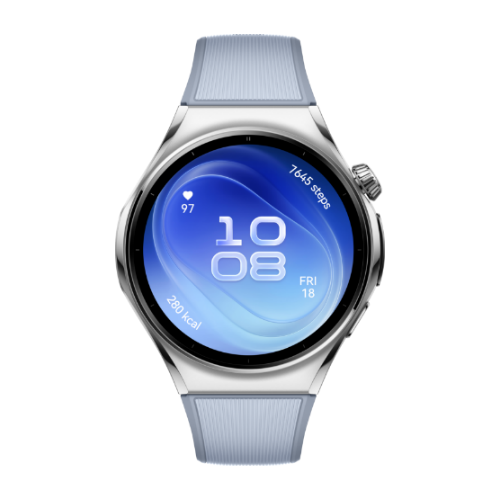
Huawei Watch 6
-
Processor:
-
RAM:
-
Storage:
-
Display: 1.5 inches
-
Camera: No
-
Operating System: HarmonyOS
Huawei Watch 6 was officially released on September 23, 2026.
Product Main Features:
The Huawei Watch 6 measures 46.4 × 46.4 × 10.9 mm and weighs either 38 or 60 grams, depending on the variant. It features a sapphire crystal front and plastic back, with an aluminium case for the 42mm version or a stainless steel case for the 46mm version. The cellular variant also supports eSIM connectivity.
It comes with a 1.5-inch LTPO 2.0 AMOLED display featuring a resolution of 466 × 466 pixels and approximately 310 ppi density. The screen offers a peak brightness of 3500 nits and is protected by sapphire crystal. Running on HarmonyOS, the watch includes a loudspeaker and supports dual-band Wi-Fi, Bluetooth 5.2, NFC and multi-band satellite positioning through GPS, BDS, Galileo, QZSS and GLONASS.
There is no camera, USB port, FM radio or 3.5mm headphone jack. Health and fitness features include heart rate monitoring, SpO2 tracking, body temperature measurement, ECG, heart rate variability monitoring and arterial stiffness detection. It also includes an accelerometer, gyroscope, barometer, compass and X-TAP sensor.
The watch offers 5 ATM water resistance, IP68/IP69 protection and EN13319 certification for swimming and diving up to 40 metres. It supports 10W wireless charging and is available in Silver, Gold and Black.
Huawei Watch 6 - SPECIFICATIONS
General
-
ModelHuawei Watch 6
-
ReleasedSeptember 2026
-
StatusAvailable
Design
-
Type Design Type called form factor refers to a mobile phone's size, shape, and style as well as the layout and position of major components of phone. There are three major form factors seen in mobile phones => bar phones, folding phones and sliding phones.Bar
-
Dimensions46.4 x 46.4 x 10.9 mm
-
Weight38 grams
-
WaterproofIP68/IP69 dust tight and water resistant (high pressure water jets)
Display
-
Display Type Display Technology => A number of display technologies and types used in mobile phones => TFT (Thin Film Transistor), IPS (In-Place Switching), OLED (Organic Light Emitting Diode), AMOLED (Active-Matrix Organic Light-Emitting Diode), Super AMOLED (an even advanced version of AMOLED), Resistive Touchscreen (Resistive touchscreens contain two layer of conductive material with a very small gap between them which acts as a resistance), Capacitive Touchsceen (Capacitive touchscreen technology consists of a layer of glass coated with a transparent conductor)LTPO 2.0 AMOLED
-
Size1.5 inches
-
Resolution466 x 466 pixels
-
Display Colors Display Colors is refers to the number of different shades of colors that the screen is capable of displaying => 64K colors, 256K colors and 16 million colors, Obviously 16M is highest available range of colors and better than others.16M colors
-
Pixel Density Pixel Density (PPI) is refers to the concentration of pixels on a particular display, measured in pixels per inch (ppi). Pixel density is calculated by dividing the diagonal pixel resolution of a display by its diagonal size, higher pixel density better display quality.310 PPI (pixels per inch)
-
Touch ScreenYes
-
Display Protection Display Protection => Gorilla Glass is a special alkali-aluminosilicate glass shield with exceptional damage resistance that helps protect mobile displays from scratches, drops, and bumps of everyday use, It is always better to go for a smartphone with Gorilla Glass for that added protection and peace of mind.Sapphire crystal
-
Features3500 nits (peak)
Hardware
-
Memory Card Slot Memory Card Slot is a special slot for inserting a memory card. Memory cards allow you to expand the phone's built-in memory, A memory card (sometimes called a flash memory card or a storage card) is a small storage medium used to store data such as text, pictures, audio, and video, for use on small, portable or remote computing devices such as mobile phones, mp3 players, digital cameras.No
-
Sensors Sensors are electronic components that detects and responds to some type of input from the physical environment. The specific input could be light, heat, motion, moisture, pressure and location, The output is generally a signal that is converted to use in computing systems, a location sensor, such as a GPS receiver is able to detect current location of your electronic device.Accelerometer, gyro, heart rate, barometer, compass, SpO2, thermometer (body temperature), X-TAP
Heart Rate Variability (HRV)
Arterial Stiffness Detection
Software
-
Operating System OS => Every computer system run on a base software called Operating System (OS). Operating System controls all basic operations of the computer (such as smartphone, PDAs, tablet computers and other handheld devices). The Operating System allows the user to install and run third party applications (apps), apps are used to add new functionality to the device.HarmonyOS
Camera
-
Rear Camera Camera is able to capture photographs and usually videos, The most important characteristics of a camera are the resolution (measured in megapixels), lens focus type (fixed or automatic), higher megapixel cameras are known to capture higher quality photos, but not always a good measurement of the photos quality.No
-
ImageNo
-
VideoNo
-
Flash Flash Light => There is commonly two types of flash lights are used in camera mobile phones, LED Flash (LED flash offers lower power consumption with drive circuitry that takes up very little room, LEDs can be strobed faster than any other light source), Xenon Flash (xenon flash produces an extremely intense full-spectrum white light for a very short duration)No
-
Front CameraNo
Network
-
SIM SIM (Subscriber Identity Module) is a small card that contains mobile network subscriber's account information. This allows the phone using the card to attach to a mobile network. The SIM card is most commonly associated with GSM and UMTS mobile networks. Moving a SIM card from one phone to another allows a subscriber to switch mobile phones without having to contact their mobile network carrier. SIM cards can also be used by a phone to store limited amounts of data, such as phone numbers and text messages.Standard SIM
-
Dual SIMeSIM - cellular model only
Connectivity
-
Wi-fi Wi-Fi is a popular wireless networking technology using radio waves to provide high-speed network connections that allows devices to communicate without cords or cables, Wi-Fi is increasingly becoming the preferred mode of internet connectivity all over the world.Yes, dual-band
-
USBNo
-
GPS GPS The Global Positioning System is a satellite-based radio navigation system, GPS permits users to determine their position, velocity and the time 24 hours a day, in all weather, anywhere in the world, In order to locate your position, your device or GPS receiver must have a clear view of the sky.GPS (L1+L5), BDS (B1I+B1C+B1a), GALILEO (E1+E5a), QZSS (L1+L5), GLONASS
-
NFC NFC (Near field communication) is a set of standards for smartphones and similar devices to establish peer-to-peer radio communications with each other by touching them together or bringing them into proximity, usually no more than a few inches.Yes
-
Wireless Charging Wireless Charging (Inductive Charging) uses an electromagnetic field to transfer energy between two objects. This is usually done with a charging station. Energy is sent through an inductive coupling to an electrical device, which can then use that energy to charge batteries or run the device.No
-
Headphone JackNo
Battery
-
Placement10W wireless
Media
-
Video PlaybackNo
-
Video OutNo
-
FM RadioNo
-
Ring TonesNo
-
LoudspeakerNo
-
HandsfreeNo
Data
-
4G LTE 4G LTE bandsLTE - cellular model only
-
5G NR BandsNo
-
SpeedHSPA, LTE - cellular model only
Messaging
-
SMS SMS (Short Messaging Service) is a text messaging service component of phone, Web, or mobile communication systems. It uses standardized communications protocols to allow mobile phone devices to exchange short text messages over the networks.No
-
MMS MMS (Multimedia Messaging Service) is a standard way to send messages that include multimedia content (audio clips, video clips and images) to and from mobile phones over wireless networks using the WAP protocol.
More Products from Huawei


Advertise

Comments