
Add GIZMOCHINA as Preferred Source on Google
Xiaomi Mi Play inaugurated a brand new series of devices from the Chinese giant, which is located in the mid/low-end segment. That is why this device is a perfect rival for the newly-announced Huawei Enjoy 9 and Asus Zenfone Max (M2), two other impressive alternatives available with a price tag inferior to €200 in Asia. These handsets are perfect for you if you are looking for a device which is never great, but never gives disappointments despite having an incredibly low price tag. If you belong to this range of users, go ahead and check out this specs comparison.
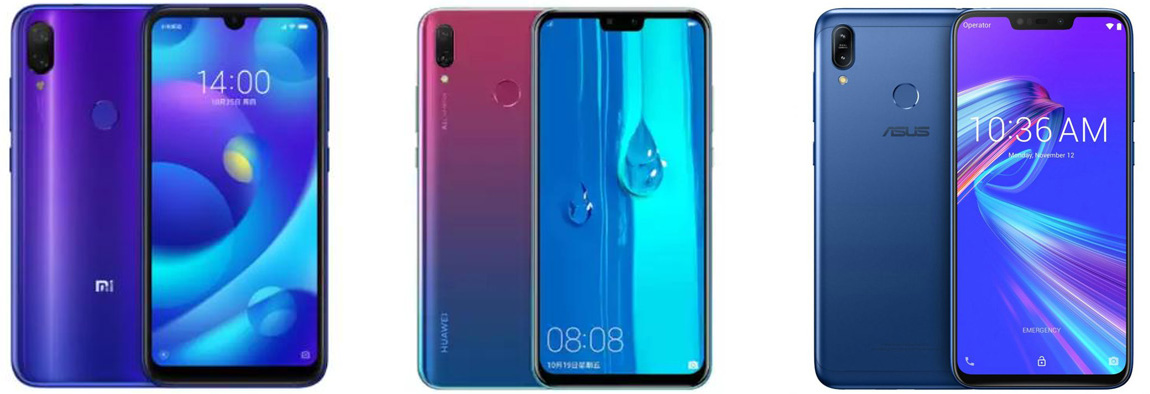
Xiaomi Mi Play vs Huawei Enjoy 9 vs Asus Zenfone Max (M2)
| Xiaomi Mi Play | Huawei Enjoy 9 | Asus Zenfone Max M2 | |
|---|---|---|---|
| DIMENSIONS AND WEIGHT | 147.76 x 71.89 x 7.8 mm, 150 grams | 158.9 x 76.9 x 8.1 mm, 168 grams | 158.4 x 76.3 x 7.7 mm, 160 grams |
| DISPLAY | 5.84 inches, 1080 x 2280p (HD+), 432 ppi, IPS LCD | 6.26 inches, 720 x 1520p (HD+), 269 ppi, IPS LCD | 6.3 inches, 720 x 1520p (HD+), 267 ppi, IPS LCD |
| PROCESSOR | MediaTek Helio P35, octa-core 2.3 GHz | Qualcomm Snapdragon 450, octa-core 1.8 GHz | Qualcomm Snapdragon 632, octa-core 1.8 GHz |
| MEMORY | 4 GB RAM, 64 GB – micro SD slot | 3 GB RAM, 32 GB – 4 GB RAM, 64 GB – micro SD dedicated slot | 3 GB RAM, 32 GB – micro SD dedicated slot |
| SOFTWARE | Android 8.1 Oreo, MIUI | Android 8.1 Oreo, EMUI | Android 8.1 Oreo |
| CONNECTIVITY | Wi-Fi 802.11 a/b/g/n/ac, Bluetooth 4.2, GPS | Wi-Fi 802.11 b/g/n, Bluetooth 4.2, GPS | Wi-Fi 802.11 b/g/n, Bluetooth 4.2, GPS |
| CAMERA | Dual 12 +2 MP 8 MP front camera |
Dual 13 + 2 MP f/1.8 and f/2.4 8 MP f/2.0 front camera |
Dual 13 +2 MP 8 MP front camera |
| BATTERY | 3000 mAh | 4000 mAh | 4000 mAh |
| ADDITIONAL FEATURES | Hybrid Dual SIM slot | Dual SIM slot | Dual SIM slot |
Design
The design is the key point of Xiaomi Mi Play. It is one of the most elegant and beautiful handsets sold for less than €200. Unlike Huawei Enjoy 9 and Asus Zenfone Max M2 which are full metal unibody phones, Xiaomi Mi Play has a glass back and you can get it in two gradient color variants or in black. Further, it comes with a waterdrop notch and very thin bezels, and it is more compact and lightweight than its opponents thanks to its smaller display. That is why I like it more aesthetically. Between Asus Zenfone Max M2 and Huawei Enjoy 9, I would choose the latter because it has a smaller notch and a more attractive rear design.
Display
Xiaomi Mi Play has the best display because it provides a higher level of detail. Indeed, it is the only device to sport the Full HD+ resolution, while Asus Zenfone Max M2 and Huawei Enjoy 2 have below-average HD+ displays. This plays an important role when it comes to energy consumption given that low-resolution displays are more efficient, but it decreases the viewing quality. Xiaomi Mi Play also has the smallest display and thanks to the higher pixel density it will look more detailed than other Full HD+ displays.
Specs & Software
Xiaomi Mi Play and Asus Zenfone Max M2 are superior devices when it comes to hardware and performance. The MediaTek Helio P35 found on the Mi Play is a valid rival for the Snapdragon 632 by Qualcomm inside the Asus Zenfone Max M2. I personally like the Snapdragon 632 more because of its GPU. Further, Asus Zenfone Max M2 has a micro SD dedicated slot allowing to use both the dual SIM slot and the expansion slot at the same time. Android 8.1 Oreo is installed out of the box on each of these handsets, and it is customized by a proprietary user interface. Basing on the current software support from the companies, we believe Xiaomi Mi Play will most likely be the first, if not the only one, to get Android Pie in the coming year.
Camera
Do not expect high-end cameras from these handsets, but all of them can provide a decent photo quality, at least when light conditions are good because when it gets dark they start becoming disappointing. The one I like more is Asus Zenfone Max M2 because it features a LED flash on the front side for a better selfie quality in the dark. Anyways, note that there are just marginal differences in photo quality between these devices.
Battery
The longest-lasting phone is definitely the Asus Zenfone Max M2 because of its 4000 mAh battery paired with very efficient components, such as the Snapdragon 632 chipset. Right after, there is Huawei Enjoy 9 which can achieve almost the same battery life in most of the scenarios. Xiaomi Mi Play is much inferior and it is not a battery champion like its opponents. It can just reach a sufficient battery life: one day with a moderate use, while the other twos can last more than one day with a stressed use.
Price
While specs are definitely not the strongest points of these devices, the price is the most important thing. Xiaomi Mi Play debuted in China with a starting price tag of just $160/€140 + 10 GB of free data traffic for 12 months, Huawei Enjoy 9 costs just $145/€127 in its base variant and Asus Zenfone Max M2 was launched with a starting price of $195/€170 in India. I would personally go for the Asus Zenfone Max (M2) because of its big battery and good performance. I would not choose Xiaomi Mi Play because, even though it has a better design and a better display, its 3000 mAh battery is not enough for my use. On the other hand, Huawei Enjoy 9 has a lower-end SoC than Asus Zenfone Max M2 and this would make me spend those $50 more to get a faster and smoother user experience thanks to the Snapdragon 632. Last but not least, the front-facing LED flash and the micro SD dedicated slot are always useful things.
- Read More: ASUS ZenFone Max Pro M2, Max M2 now official in Russia; Pricing and Specifications Revealed
Asus Zenfone Max (M2) vs Xiaomi Redmi Note 6 Pro vs Motorola One Power: PROs and CONS
Asus Zenfone Max M2
PROs
- Great battery life
- Micro SD dedicated slot
- Thin design
- Front-facing flash
- Nice performance
CONS
- HD display
Xiaomi Mi Play
PROs
- Compact and lightweight
- Better display
- Good design
- Good performance
CONS
- Smaller battery
Huawei Enjoy 9
PROs
- Good design
- Affordable price
- Big battery
CONS
- HD display
- Lower-end SoC


Comments