
Add GIZMOCHINA as Preferred Source on Google
Despite its above-average price, the newly-announced Nokia X71 had a big echo in the smartphones world during the initial period. But the concurrency released a lot of midrange phones like that in the last period: will the Nokia X71 be at their level and win the sales competition? In this article, we compared the new HMD Global affordable device with two of the most interesting upper-midrange phones of the moment. One is the Redmi Note 7 Pro, a powered-up version of the Redmi Note 7 with a better SoC and more internal storage. The second is the less famous Hisense U30 that is the world’s first phone with Snapdragon 675 on board. After reading the comparison, let us know which one do you prefer by using the comment box below.
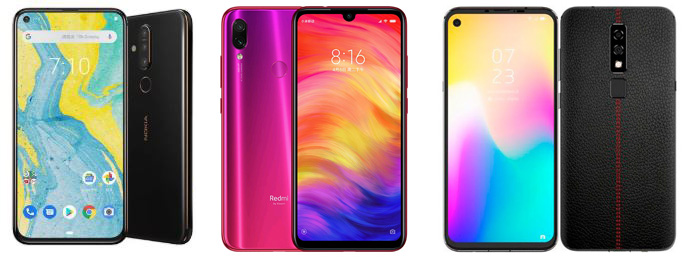
Nokia X71 vs Xiaomi Redmi Note 7 Pro vs HiSense U30
| Nokia X71 | Xiaomi Redmi Note 7 Pro | Xiaomi Mi 9 SE | |
|---|---|---|---|
| DIMENSIONS AND WEIGHT | 157.2 x 76.5 x 8 mm, 180 grams | 159.2 x 75.2 x 8.1 mm, 186 grams | 73.6 x 156.5 x 9.16 mm, 186 grams |
| DISPLAY | 6.39 inches, 1080 x 2316p (Full HD+), 400 ppi, IPS LCD | 6.3 inches, 1080 x 2340p (Full HD+), 409 ppi, IPS LCD | 6.3 inches, 1080 x 2340 pixels, 409 ppi, IPS LCD |
| PROCESSOR | Qualcomm Snapdragon 660, octa-core 2.2 GHz | Qualcomm Snapdragon 675, octa-core 2 GHz | Qualcomm Snapdragon 675, octa-core 2 GHz |
| MEMORY | 6 GB RAM, 128 GB – micro SD slot | 4 GB RAM, 64 GB – 6 GB RAM, 128 GB – micro SD slot | 6 GB RAM, 128 GB |
| SOFTWARE | Android 9 Pie | Android 9 Pie, MIUI | Android 9 Pie |
| CONNECTIVITY | Wi-Fi 802.11 a/b/g/n/ac, Bluetooth 5.0, GPS | Wi-Fi 802.11 a/b/g/n/ac, Bluetooth 5.0, GPS | Wi-Fi 802.11 a/b/g/n/ac, Bluetooth 5.0, GPS |
| CAMERA | Triple 48 + 8 + 5 MP f/1.8 and f/2.4 16 MP f/2.0 front camera |
Dual 48 + 5 MP f/1.8 and f/2.4 13 MP front camera |
Dual 48 + 5 MP 20 MP front camera |
| BATTERY | 3500 mAh, fast charging 18W | 4000 mAh, fast charging 18W | 4500 mAh, Fast Charging with Quick Charge 4.0 |
| ADDITIONAL FEATURES | Hybrid Dual SIM slot | Hybrid Dual SIM slot | Dual SIM slot |
Design
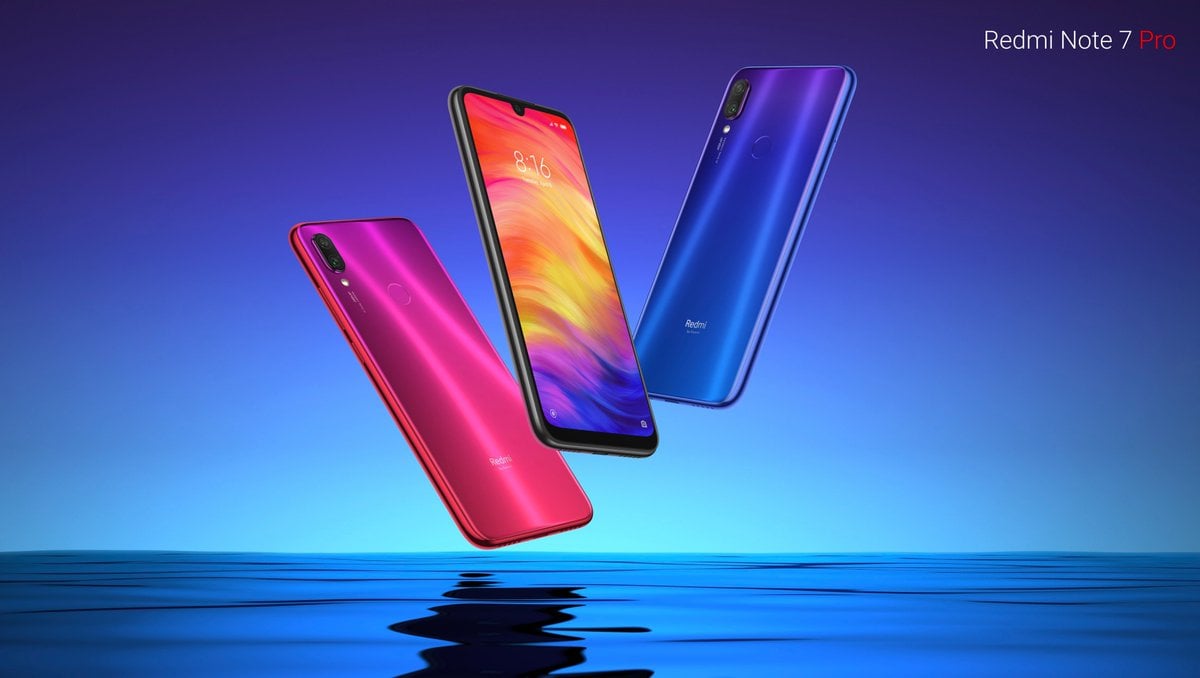
In a world in which all the upper-midrange phones come with a glass body, HiSense U30 differentiates from the concurrency thanks to a leather back. And it is also one of the first phones to sport a punch-hole display with minimal bezels. Announced at CES 2019, this device is one of the most original ones in terms of aesthetics. But if you are not an anti-conformist user and you prefer a traditional but elegant design, as well as great build quality, then you should choose the Nokia X71 which comes with a glass back, an aluminum frame and a punch-hole display. With its standard waterdrop notch and its plastic frame, Xiaomi Redmi Note 7 Pro represents the cheapest choice when it comes to materials, so it does not deserve attention under this point of view.
Display
We suggest you skip this section if you are seriously considering to get one of these phones. The reason is simple: there are just minimal differences between the display quality of these handsets. Each of them comes with a classic IPS LCD panel and a Full HD+ resolution, so the level of detail is not so different, as well as the viewing angles and the color reproduction. The only important difference is the position of the cameras and the bezels thickness: as said above, while Redmi Note 7 Pro has a waterdrop notch, Nokia X71 and HiSense U30 come with in-display cameras which make them look more “borderless”.
Specs & Software
Due to its lower-end Snapdragon 660 chipset, Nokia X71 is the inferior guy when it comes to hardware and performance. But note that it comes with the stock Android One, so it will get faster updates and direct support by Google. Xiaomi Redmi Note 7 Pro and HiSense U30 are more powerful as they both feature a Snapdragon 675 SoC paired with 6 GB of RAM and 128 GB of internal storage. Speed and reactivity are not that different, but Redmi Note 7 Pro has expandable internal storage, while the HiSense U30 has no expansion slot.
Camera
On the paper, Nokia X71 has the most advanced camera department which is also its strongest point. It is equipped with a triple camera including a 48 MP main sensor, an 8 MP ultrawide lens and a 5 MP depth sensor. Xiaomi Redmi Note 7 Pro and HiSense U30 have a 48 + 5 MP dual camera and they lack the ultrawide sensor and the Carl Zeiss optics found on the Nokia X71.
Battery
With a 4500 mAh battery, HiSense U30 wins the battery comparison on the paper, but we still have to see how its software optimization performs and how much it is able to last on a single charge. Xiaomi Redmi Note 7 Pro comes right after with a 4000 mAh unit, while Nokia X71 takes the last place with a 3500 mAh battery. All come with a fast charging technology.
Price
For a unit of the Nokia X71, you are willing to pay about €290/$326, HiSense U30 costs about €356/$402, while the Redmi Note 7 Pro comes with a price tag of €200/$225, but in a lower-end memory configuration (4/64 GB instead of 6/128 GB). In conclusion, due to its bigger battery, its punch-hole display, and its amazing hardware department, HiSense U30 looks the most impressive device on the paper. But if you prefer cameras, then you would better go for the Nokia X71.
Nokia X71 vs Xiaomi Redmi Note 7 Pro vs HiSense U30: PROs and CONS
Nokia X71
PROs
- Great design
- Nice build quality
- Nice cameras
CONS
- Costlier
Xiaomi Redmi Note 7 Pro
PROs
- Good performance
- Great price
- Big battery
- Water resistant
CONS
- Less impressive cameras
Hisense U30
PROs
- High performance
- Original design
- Huge battery
CONS
- Price


Comments