
Huawei’s Mate series has become one of the best flagship lines of smartphones. Every year, Huawei sets a new standard with its phones and the Mate 30 and Mate 30 Pro are no different. The theme for this year is Rethink Possibilities and Huawei does just that.
Design
Just like last year’s Mate 20 series, the Mate 30 and Mate 30 Pro also look different with respect to design, mainly on the front.
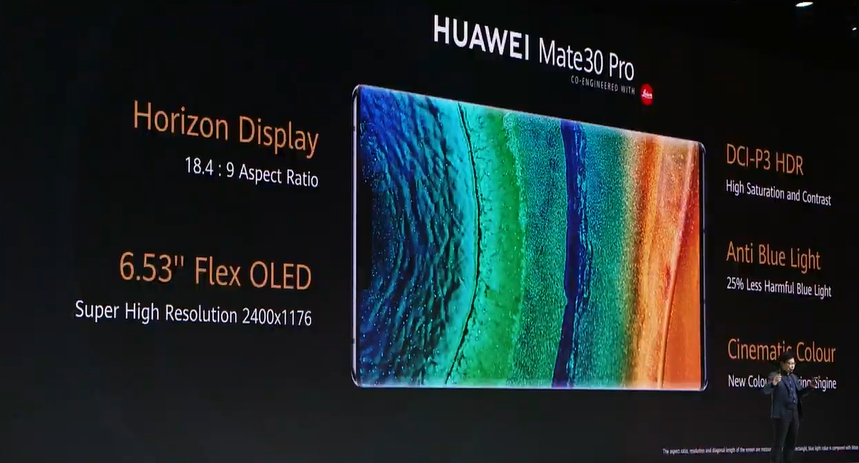
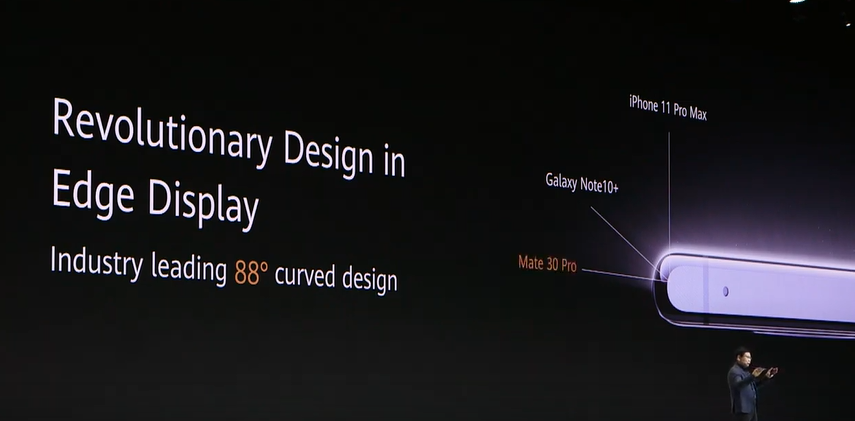
The Mate 30 Pro features what is called a Horizon Display which is its name for what is generally referred to as a waterfall display. The screen curves at an angle of 88°, just shy of a right-angle. Theses curves mean there are no side buttons on the Mate 30 Pro. So Huawei uses what is called Side-touch Interaction which is invisible virtual keys. Because these are virtual keys, they are customizable, so if you like the buttons on the left, you can have them on the left instead of the right. Side-touch interaction also adds a virtual camera shutter key and like the volume keys, you can also change its position.
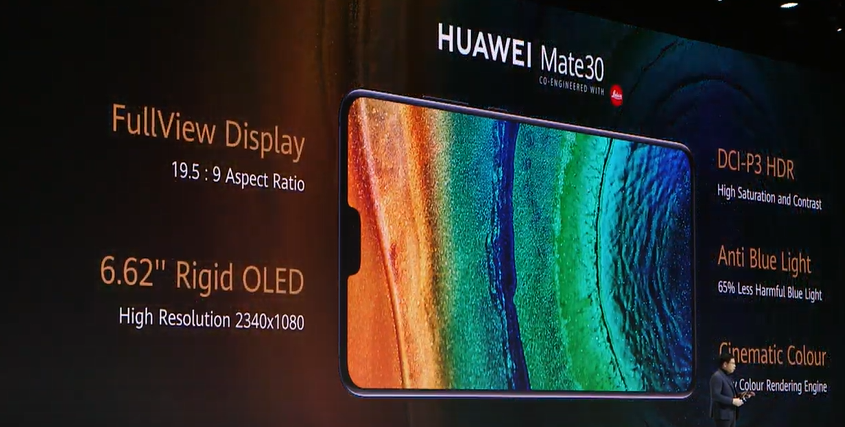
The Mate 30, on the other hand, has what Huawei calls a Rigid OLED display which is actually just a flat display.
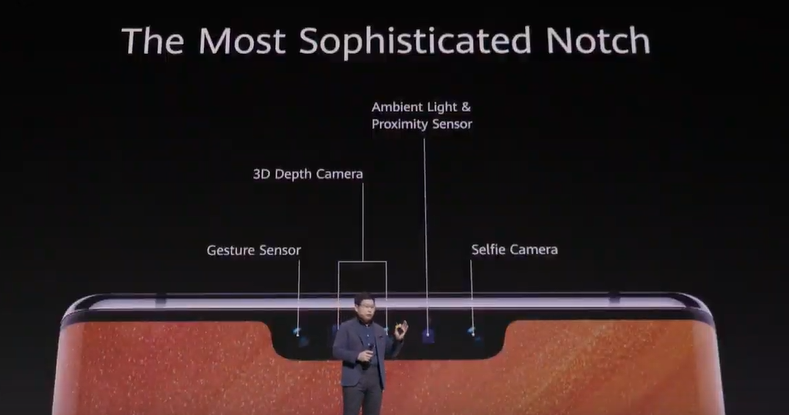
Both phones have a notch at the top while, while that of the Mate 30 Pro is smaller than its predecessor’s, the Mate 30 has a bigger notch.
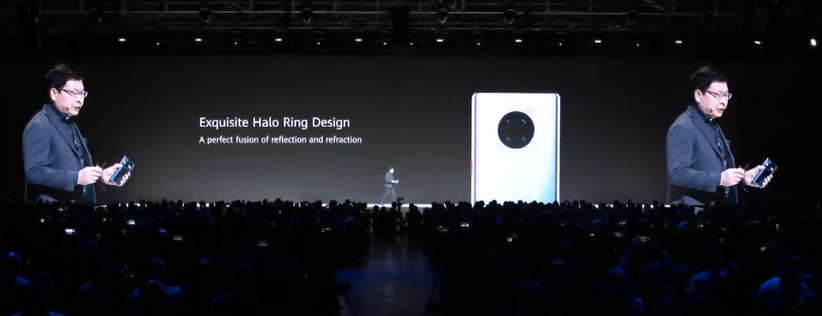
On the back of the Mate 30 series is a new camera design called Halo Ring. Huawei says the design was inspired by that of a DSLR camera. The Mate 30’s camera housing holds three sensors while the Pro model has a quad-camera setup.
Huawei also revealed that its Mate 30 series 5G phones boast a total of 21 antennas, 14 of which are 5G antennas which trump the 6-antenna design we have seen in other 5G phones like the Vivo NEX 3 5G.
Huawei Mate 30 Pro and Mate 30 Pro 5G
The Huawei Mate 30 Pro comes in two versions – a 5G and a 4G model. Both have a 6.53-inch Flex OLED display with a 2400 x 1176 resolution and an 18.4:9 aspect ratio.
The notch at the top of the display is home to a Gesture Sensor which allows users to wave to scroll and make a hand grab gesture to screenshot without touching the screen. There is also a pair of 3D depth cameras, ambient light and proximity sensor, and a selfie camera inside the notch. The Mate 30 Pro also has 3D Face Unlock.
Two other pretty tricks the Mate 30 Pro can do are AI Auto-Rotate and AI Private View. AI Rotate switches the screen’s orientation when you move from portrait to landscape even if the phone is not in your palms. AI Private View will automatically hide sensitive information when it senses someone is looking over your shoulder.
The Mate 30 Pro is powered by the Kirin 990 while the Mate 30 Pro 5G is powered by the Kirin 990 5G. The Kirin 5G chip doesn’t just have a 5G modem. It also differs from the non-5G model in other ways. For example, its NPU chip has 2 big cores and 1 small core while the regular Kirin 990 has 1 big core and 1 small core. The Kirin 990 5G also has its 4x Cortex A55 cores clocked higher at 1.95GHz and its 2x Cortex A76 cores clocked at 2.36GHz against the non-5G’s 1.86GHz and 2.09GHz.
Both versions of the Mate 30 Pro has 8GB of RAM and 256GB of storage. There is dual SIM support and the 5G version supports dual SIM 5G which means either of the two SIM slots can be set to 5G. The tray is a hybrid SIM tray which allows for two nano-SIM cards or 1 nano-SIM and an NM Card (SIM 2 slot).
The Mate 30 5G supports 5G bands n79, n78, n77, n38, n28, n3, and n1 which makes it usable around the globe.
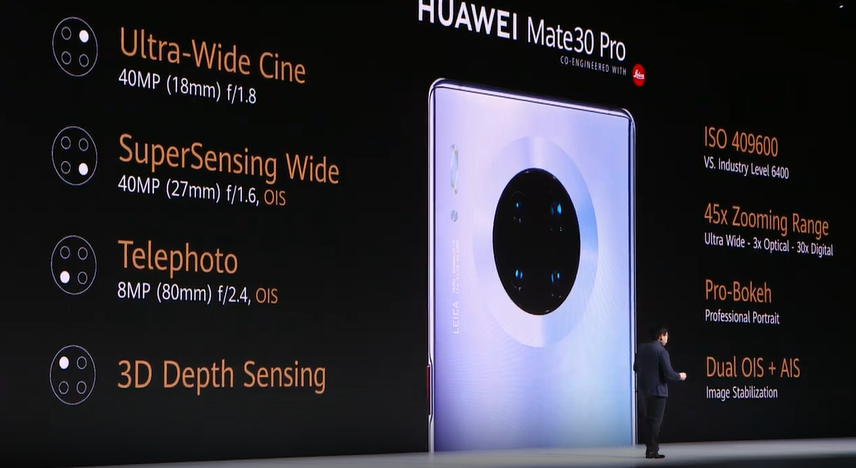
The Mate 30 Pro series boasts an impressive camera setup. The quad cameras o the back are a SuperSensing 40MP f/1.6 camera with OIS, a 40MP Cine f/1.8 camera, an 8MP f/2.4 telephoto camera with OIS, and a 3D depth-sensing camera. The phones also have a dual-LED flash, a laser focus sensor, and a color temperature sensor. The selfie camera is a 32MP f/2.0 sensor and with the 3D sensor.
The Mate 30 Pro duo pack a 4500mAh battery with support for 40W wired charging and 27W wireless charging. Owners will have to purchase the wireless charger separately. Reverse wireless charging is back and this time it is 3 times faster than that of the Mate 20 Pro. There is no audio jack but there is an IR sensor.
The Mate 30 Pro runs EMUI 10 based on Android 10. It has an IP68 rating and weighs 198 grams. Its dimensions are 158.1 x 73.1 x 8.8 millimeters.
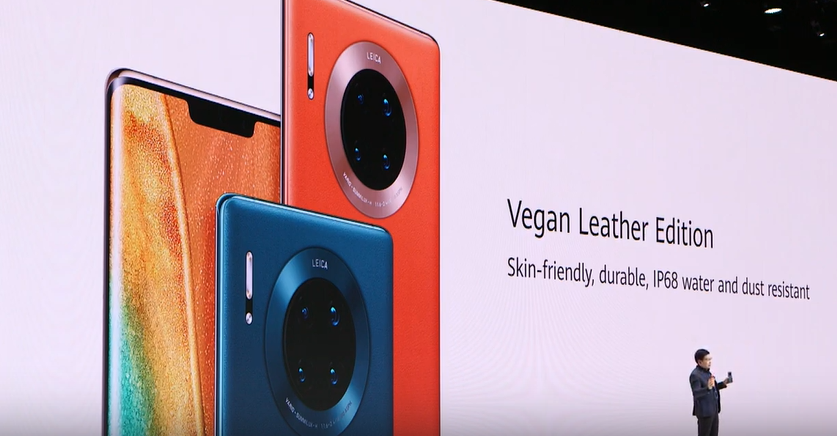
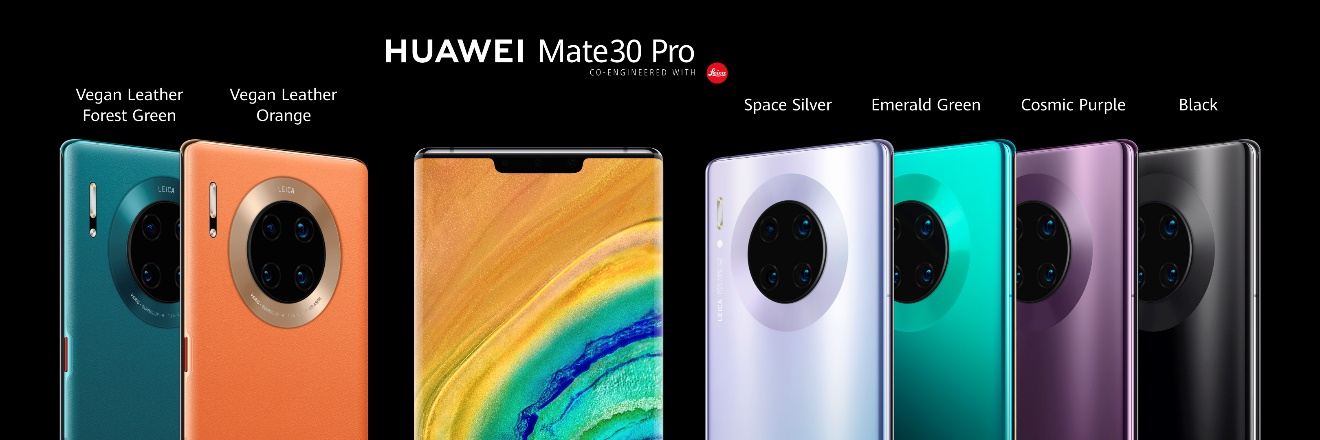
The Mate 30 Pro is available in Black, Space Silver, Cosmic Purple, and Emerald Green. The Mate 30 Pro 5G comes in the aforementioned colors and adds a Vegan Leather version that is available in Orange and Forest Green. The Vegan Leather version is skin-friendly, durable, and IP68 water and dust resistant.
Mate 30 and Mate 30 5G
The Mate 30 and Mate 30 5G both have a 6.62-inch FullView Rigid OLED display with a 2340 x 1080 resolution and a 19.5:9 aspect ratio.
Just like the Mate 30 Pro differs from its 5G version when it comes to processors, the same applies to the Mate 30 and its 5G version. The Kirin 990 chipset is paired with 8GB of RAM and 128GB of storage on both versions.
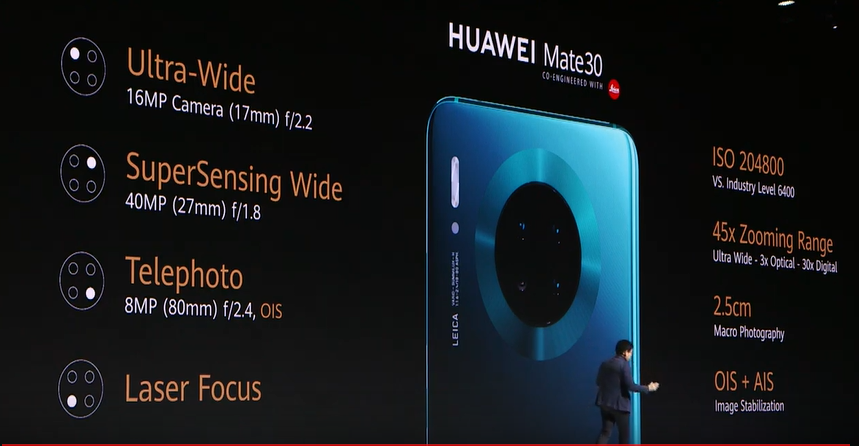
The Mate 30 duo have a 40MP f/1.8 SuperSensing primary rear camera which is paired with a 16MP f/2.2 ultrawide angle camera, and an 8MP f/2.4 telephoto camera with OIS. There is dual-LED flash, a laser focus sensor, and a color temperature sensor too.
The Mate 30 and Mate 30 5G pack a 4200mAh battery and also support 40W wired charging. Thankfully, Huawei has also added wireless charging this year instead of via an add-on case. They also support 27W wired charging and not a slower charging speed but no reverse wireless charging. It keeps the audio jack and also has an IR sensor.
The Mate 30 duo run EMUI 10 based on Android 10. They are available in the same colors as the Mate 30 Pro with the 5G version also having Vegan Leather variants.
Price
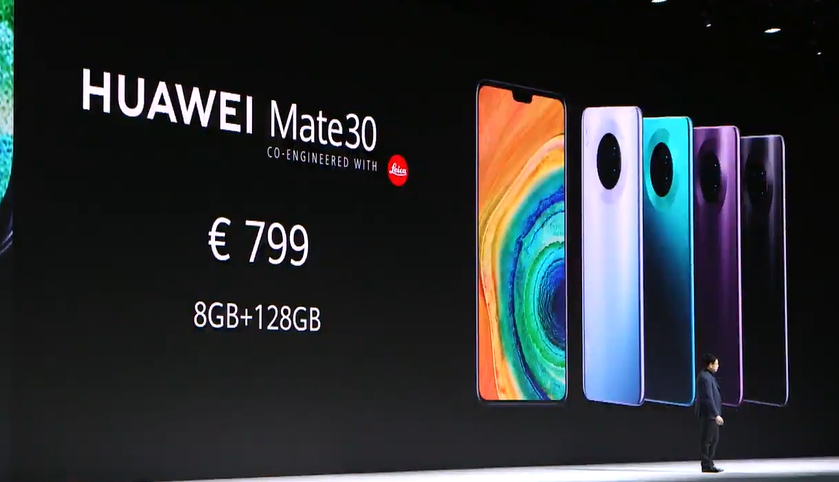
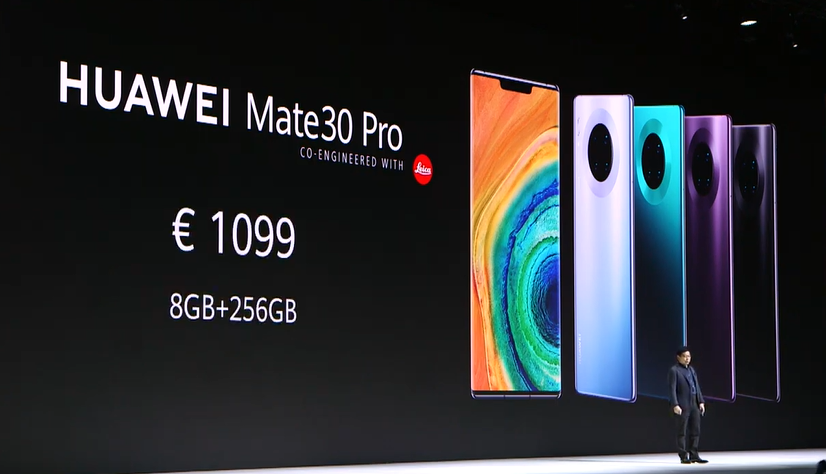
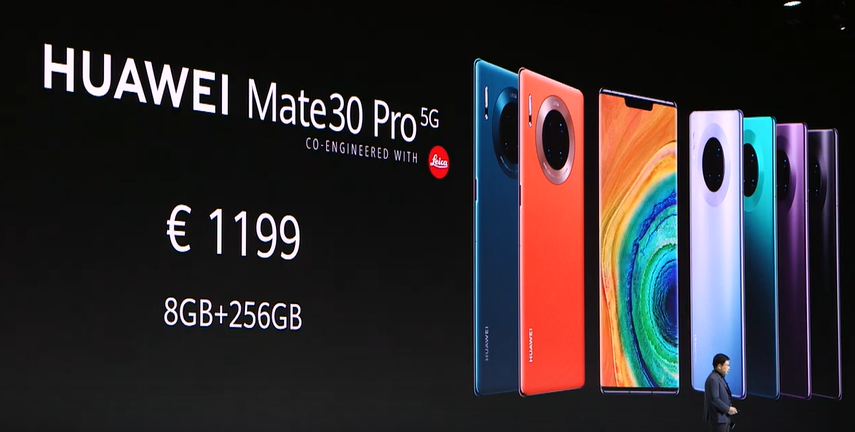
The Mate 30 is priced at €799 while the Mate 30 Pro is priced at €1099. Huawei didn’t reveal the price of the Mate 30 5G but the Mate 30 Pro 5G will sell for €1199.
There is no info on availability.






Comments