
Add GIZMOCHINA as Preferred Source on Google
Earlier today (17th March 2020), Redmi revealed a few details regarding its upcoming premium flagship, the Redmi K30 Pro. In the press conference, the Xiaomi subsidiary revealed that the smartphone will feature a VC liquid cooled heat sink which will improve performance and enable Qualcomm’s Snapdragon 865 SoC to run at full capacity.
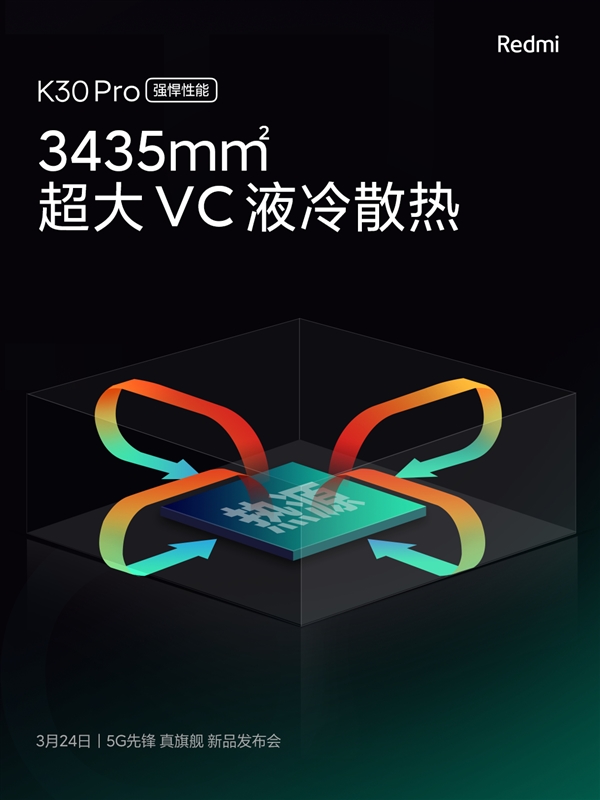
According to the official image poster, the Redmi K30 Pro will be equipped with a 3435 square millimeter of liquid cooled heat sink which is claimed to offer improved thermal performance and allow for greater heat dissipation over traditional cooling methods. Lu Weibing, General Manager of Redmi, stated that the name of the new VC heat sink or vapor chamber is along the line of a vacuum sink heat sink cooling technology.
Editor’s Pick: Oppo product page shares misleading details of the Find X2’s weight, offers refunds to customers
For those unaware, heat sinks are basically copper tubes that run along the length on the device’s internals covering heat generating components such as the processor, memory, and battery. These tubes carry the liquid cooling solution which uses the principle of gas to liquid phase change to conduct heat from one side of the device to another. In simple terms, this allows for better heat dispersion and lowers overall temperatures during extended or intensive periods of smartphone usage.
Technically, the more powerful a processor, the more power it draws and the heat generated rise as well. The Snapdragon 865 SoC is currently one of the fastest most powerful chipsets which is commercially available and is capable of running intense gaming apps and more. This generated heat which can reduce the overall performance of the device, but Redmi K30 Pro’s new liquid heat sink can lower the heat generated, allowing for more performance gains over a given period of use.
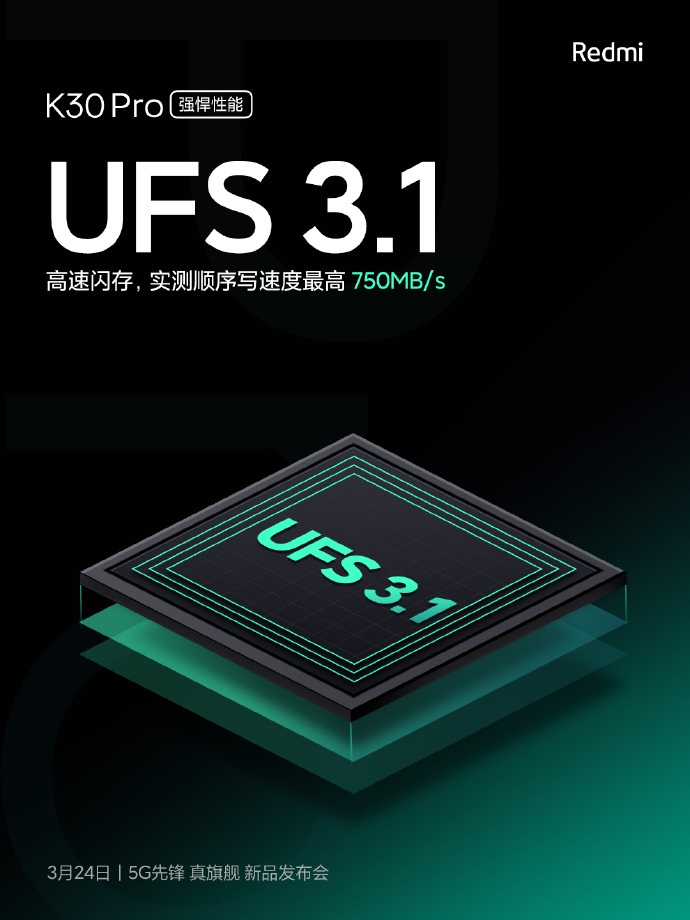
Update: the Redmi K30 Pro has just been confirmed to feature UFS 3.1. The new storage standard is the latest and fastest memory chip currently available commercially in the market and will provide read speeds up to 750MB/s. The image poster shared also states that this may be the “strongest performance combination’ in the 5G era.” By comparison, UFS 3.0 only offered read speeds between 400MB/s or 260MB/s.
UP NEXT: Samsung is rumored to develop a 150MP Nonacell Camera sensor with a Q4 2020 Launch




Comments