
Add GIZMOCHINA on Google:
Last year, Xiaomi replaced the CC series with the new Civi series: a lineup of devices focused on design and selfie cameras. This year we saw two new handsets from this series, with the latest released just a few days ago, at the end of last month: we are talking about the Xiaomi Civi 2. Before this device, earlier this year, the Chinese giant came up with the Xiaomi Civi 1S, an upgrade of the first phone from the series released in 2021. The latest two devices from the series share several things in common and a lot of people are wondering whether it is better to purchase the older one in order to save some money or spend more on the latest device. We will try to let you find out through this comparison between the specifications of the Xiaomi Civi 1S and the Xiaomi Civi 2.
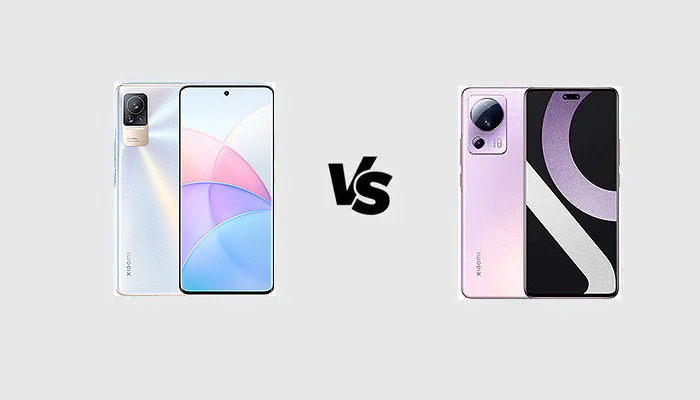
Xiaomi Civi 1S vs Xiaomi Civi 2
| Xiaomi Civi 1S | Xiaomi Civi 2 | |
|---|---|---|
| DIMENSIONS AND WEIGHT | 158.3 x 71.5 x 7 mm, 166 g |
159.2 x 72.7 x 7.2 mm, 172 g |
| DISPLAY | 6.55 inches, 1080 x 2400 pixels (Full HD+), OLED | 6.55 inches, 1080 x 2400 pixels (Full HD+), AMOLED |
| PROCESSOR | Qualcomm Snapdragon 778G+, octa-core 2.5 GHz | Qualcomm Snapdragon 7 Gen 1, octa-core 2.4 GHz |
| MEMORY | 8 GB RAM, 128 GB – 8 GB RAM, 256 GB – 12 GB RAM, 256 GB | 8 GB RAM, 128 GB – 8 GB RAM, 256 GB – 12 GB RAM, 256 GB |
| SOFTWARE | Android 12, MIUI | Android 12, MIUI |
| CONNECTIVITY | Wi-Fi 802.11 a/b/g/n/ac/6, Bluetooth 5.2, GPS | Wi-Fi 802.11 a/b/g/n/ac/6, Bluetooth 5.2, GPS |
| CAMERA | Triple 64 + 8 + 2 MP, f/1.8 + f/2.2 + f/2.4 32 MP front camera |
Triple 50 + 20 + 2 MP, f/1.8 + f/2.2 + f/2.4 Dual 32 + 32 MP f/2.0 front camera |
| BATTERY | 4500 mAh, fast charging 55W | 4500 mAh, Fast Charging 67W |
| ADDITIONAL FEATURES | 5G, dual SIM | 5G, dual SIM |
Design
Both Xiaomi Civi 1S and Xiaomi Civi 2 come with a stunning design: they are among the most beautiful phones ever released. Despite it being an older phone, I personally prefer the Xiaomi Civi 1S for a few reasons. First of all, it is a thinner and lighter phone, so it can fit better in your hands, especially if they are small. Both phones are built with an aluminum frame and a glass back protected by Gorilla Glass 5, but the 1S has a higher screen to body ratio. While the new model has a pill shaped punch hole, the older one has a single punch hole for a more minimalistic look. Further, it also comes with a smaller and less invasive camera module. These are the reasons why I prefer the Xiaomi Civi 1S: do you agree or you would go for the more recent model due to its similarities to the latest iPhones?
Display
From the Xiaomi Civi 1S to the Xiaomi Civi 2, almost nothing changed in terms of display. They are equipped with OLED panels showing vivid colors and deep blacks, and they are able to show up to one billion colors. The diagonal of these panels is 6.55 inches and they sport a Full HD+ resolution of 1080 x 2400 pixels, Dolby Vision support, the HDR10+ certification, and an in-display fingerprint reader. There are only two important differences between these displays: the first is the shape of the punch hole, as we already mentioned above, but this does not affect the image quality. The second is the presence of higher peak brightness on the Xiaomi Civi 2, with up to 1,000 nits. A more important difference regards the audio departments since the Xiaomi Civi 1S has stereo speakers, while its internal rival has just a mono speaker.
Specs & Software
The Xiaomi Civi 2 offers higher performance thanks to the presence of an upgraded chipset. We are talking about the Snapdragon 7 Gen 1 mobile platform by Qualcomm built with a 4 nm production process and sporting an octa-core architecture with a max clock frequency of 2.4 GHz. Alongside this chipset, you can find either 8 or 12 GB of RAM and either 128 or 256 GB of UFS 2.2 native storage. The Xiaomi Civi 1S is not far from its internal rival, but its processor is inferior: we are referring to the Snapdragon 778G+ chipset by Qualcomm built with a 6 nm production process. It has an octa-core architecture composed of a Cortex A78 CPU running at a max frequency of 2.5 GHz, three Cortex A78 CPUs running at 2.4 GHz, four Cortex A55 CPUs running at 1.9 GHz, and an Adreno 642L GPU. Both these Xiaomi devices run Android 12 out of the box, customized by MIUI 13.
Camera
The camera setup of the Xiaomi Civi 2 is definitely more convincing. It is equipped with a triple rear camera including a main 50 MP sensor with an f/1.8 focal aperture, a great 20 MP ultrawide lens with an f/2.2 focal aperture, and a 2 MP macro camera. Further, it has a dual front camera including a 32 MP main sensor and a 32 MP ultrawide shooter, as well as a front-facing LED flash. It is one of the most advanced selfie phones out there. The Xiaomi Civi 1S has a triple rear camera with a 64 MP main sensor, an 8 MP ultrawide lens, and a 2 MP macro camera, while on the front, it comes with a single 32 MP selfie snapper.
Battery
The battery capacities of these two phones are exactly the same: 4500 mAh. But the Xiaomi Civi 2 is able to guarantee a longer battery life because its processor is built with a better 4 nm production process, so it has lower energy consumption. Further, it features a faster charging technology with a power of 67W.
Price
The starting price of the Xiaomi Civi 2 in the Chinese market roughly translates into €350 or $350 at the actual change, while you need at least €330 or $330 to grab a unit of the Xiaomi Civi 1S, but currently, it has better street prices. Which one would you pick?
Xiaomi Civi 1S vs Xiaomi Civi 2: PRO and CONS
Xiaomi Civi 1S
PRO
- Thinner
- Lighter
- Stereo speakers
- More affordable
CONS
- Inferior hardware
Xiaomi Civi 2
PRO
- Better chipset
- Superior front cameras
- Better rear cameras
- Faster charging
CONS
- Higher price
RELATED
- OPPO Find X5 vs Find X5 Pro vs Find X5 Lite: Specs Comparison
- Motorola Edge 30 Ultra vs Edge 30 Neo vs Edge 30 Fusion: Specs Comparison
- OPPO Reno7 vs Reno7 Pro vs Reno7 SE: Specs Comparison
- Black Shark 5 Pro vs POCO F4 GT vs Xiaomi 12: Specs Comparison
Check the latest videos from our YouTube channel and subscribe:




Comments