Add GIZMOCHINA as Preferred Source on Google
Motorola is gearing up to launch the next iteration of its foldable phone, the Razr 50 Ultra (Razr+ 2024 in the US). This successor to the Razr 40 Ultra promises advancements in performance, camera capabilities, and design, making it a compelling option for foldable enthusiasts. Leaks and certifications have provided a glimpse into what we can expect from this upcoming foldable phone. Let’s delve into the expected specifications of the Razr 50 Ultra and how it stacks up against its predecessor.
1. Design
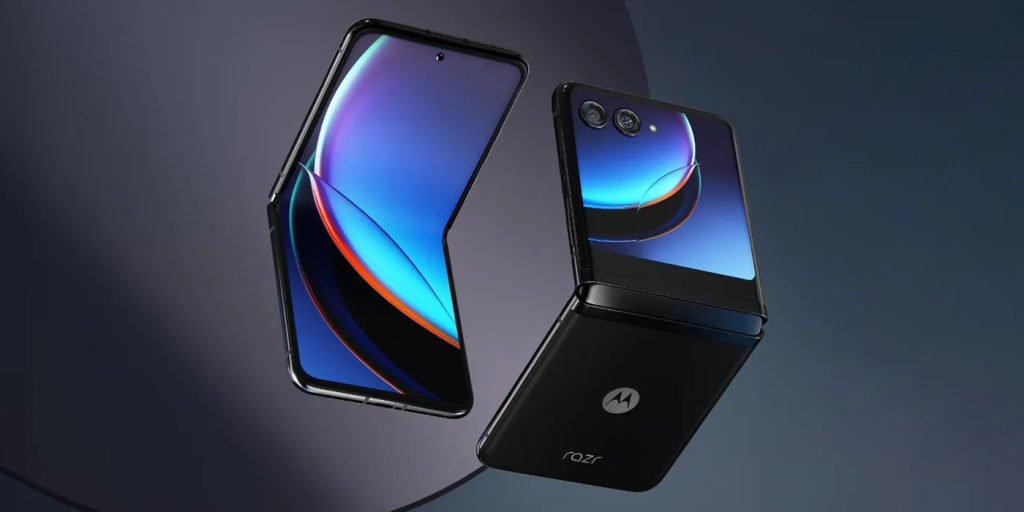
Based on leaked information, the Razr 50 Ultra is expected to retain the familiar clamshell design that has become synonymous with the Razr series. It will likely sport a large foldable display on the inside and a secondary display on the outer shell. While the overall design might not see a drastic change, there could be significant improvements in terms of the hinge and bezels.
Leaks suggest a reduction in the number of components in the hinge. This could potentially lead to a smoother folding experience and a more compact design when the phone is closed. Additionally, slimmer bezels around the main display are expected, enhancing the viewing experience by offering more screen real estate.
Motorola doesn’t shy away from trying new colors every year. As per the leaks, color options for the Razr 50 Ultra might include Midnight Blue, Spring Green, and Hot Pink. The 40 Ultra came in Infinite Black, Glacier Blue, and Viva Magenta colors.
2. Display
As per leaks, the Razr 50 Ultra is likely to inherit the large foldable display from the Razr 40 Ultra. This translates to a possibly 6.9-inch primary display (2640×1080 pixels) with foldable LTPO pOLED technology. This technology offers a balance between refresh rate and power efficiency, allowing for smooth visuals and potentially longer battery life. The refresh rate might remain similar to the Razr 40 Ultra, offering a range between 1Hz and 165Hz for an adaptive experience that adjusts based on content and user interaction.
The secondary display on the outer shell is also expected to be similar in size to the Razr 40 Ultra, which boasts a 3.6-inch display. This display allows for quick access to notifications, music controls, and other functionalities without unfolding the phone. Software improvements might be implemented to enhance the usability of the secondary display for multitasking, potentially allowing for more interaction and app usage.
3. Performance
The most significant upgrade in the Razr 50 Ultra is anticipated to be the processor. While the Razr 40 Ultra relied on the Snapdragon 8 Gen 1+, the Razr 50 Ultra is expected to pack the latest Snapdragon 8s Gen 3. This chip promises significant performance improvements in CPU, GPU, and AI processing, making the Razr 50 Ultra a powerhouse for demanding tasks like gaming and video editing.
The Razr 50 Ultra is also rumored to come with a base RAM configuration of 12GB, compared to the starting 8GB in the Razr 40 Ultra. This signifies a focus on multitasking and future-proofing the device for even more demanding applications. Storage options are also expected to see a bump, with a base variant offering 256GB, with a possible 512GB option available.
4. Camera
While details about the specific camera sensors are yet to be confirmed, leaks suggest a dual-camera system on the Razr 50 Ultra. The rear camera setup is expected to feature a 50MP main sensor paired with a 50MP 2x optical zoom telephoto lens. This would be a significant upgrade from the Razr 40 Ultra’s 12MP main sensor and 13MP ultrawide sensor combination.
The Razr 50 Ultra is expected to retain the Razr 40 Ultra’s 32MP front camera. However, without confirmation on the specific sensor details, it’s difficult to say definitively if there will be a noticeable difference in image quality.
5. Battery Life and Durability
The Razr 40 Ultra packed a 3800mAh battery, and the Razr 50 Ultra is expected to have a 4000mAh battery. This might seem like a minor difference, but the potential improvements in power efficiency from the newer processor and adaptive refresh rate display could potentially translate to longer battery life on the Razr 50 Ultra. The upcoming foldable flagship is expected to support at least 33W wired fast charging.
Durability-wise, the Razr 50 Ultra is expected to maintain an IPX8 water resistance rating, offering protection against submersion. The Razr 40 Ultra only offered dust and splash resistance (IP52). This upgrade could provide peace of mind for users concerned about accidental water damage.
6. Software
The Razr 40 Ultra launched with Android 13, and the Razr 50 Ultra is likely to come with Android 14 out of the box. Motorola will add its custom UI optimizations designed specifically for the foldable form factor, ensuring a smooth user experience.
7. Pricing
The Razr+ 2024 (Razr 50 Ultra) in the US is expected to be priced at $999, which is the same starting price as the Razr 40 Ultra. This could be seen as a value proposition, considering the rumored bump in RAM (12GB vs 8GB) in the base variant of the Razr 50 Ultra. However, the European pricing might differ. Leaks suggest a price tag of around €1200 for the Razr 50 Ultra in the EU, which is the same price as the Razr 40 Ultra at launch.
8. Conclusion
Based on available information, the Motorola Razr 50 Ultra appears to be shaping up as a worthy successor to the Razr 40 Ultra. While the design might not see a radical overhaul, potential upgrades in performance, storage, and camera capabilities are exciting prospects. The phone is likely to cater to users who value the unique foldable form factor and a powerful flagship experience. However, some points to consider include the price tag, which is likely to remain on the premium end, and the battery life, which might not see a significant improvement due to the limitations of foldable technology.
RELATED:
- Moto X50 Ultra launched with a 6.7″ 1.5K pOLED display, Snapdragon 8s Gen 3 CPU
- Motorola Edge 50 Fusion India Launch: 144Hz curved display, 50MP Sony LYTIA camera, & more
- Top 6 HyperOS Features You Absolutely Can’t Miss
- Get $100 OFF on VIVO X100 Ultra at GeekWills
- Get Blackview HERO 10 Premium Foldable Phone for an Early Bird Price of $429