Add GIZMOCHINA as Preferred Source on Google
Asus recently opened pre-bookings for its latest Vivobook S 15 (2024), the first AI-powered PC in India featuring Snapdragon X Elite and innovative Copilot+ AI features. This launch has sparked significant interest, positioning the Vivobook S 15 as a potential rival to Apple’s popular MacBook Air M3. But does it truly measure up? Let’s delve into its features, performance, and pricing to assess its worthiness.
1. Basic Specifications
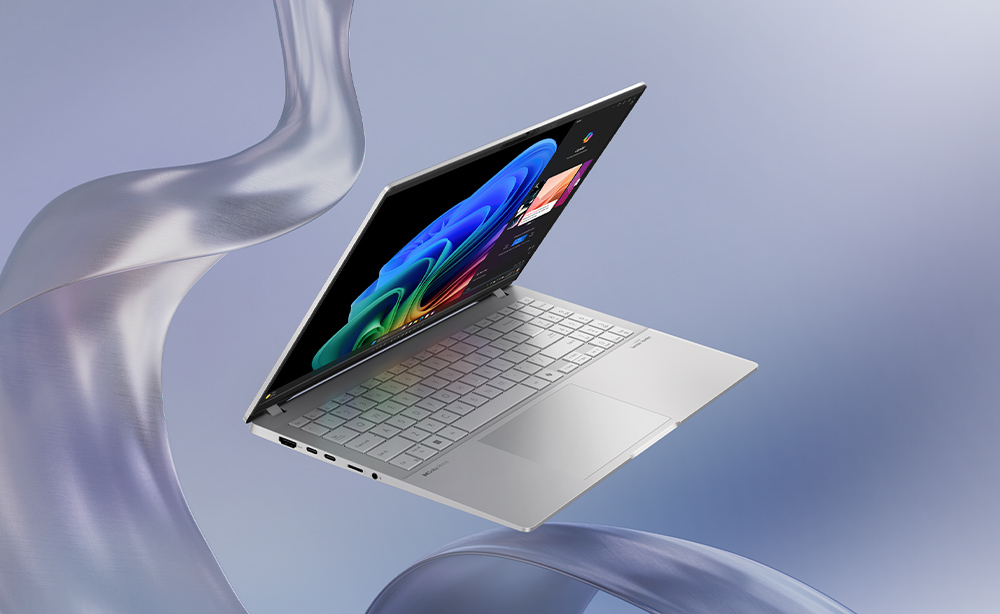
The Vivobook S 15 OLED features a Snapdragon X Elite X1E 78 100 processor along with an Adreno GPU, Qualcomm Hexagon NPU 45TOPS, and 16GB LPDDR5X RAM. It has a 15.6″ 3K OLED display with a 120Hz refresh rate, and 1TB M.2 NVMe PCIe 4.0 SSD.
It’s impressively thin and light at just 1.42kg and 1.47cm. It offers a single-zone RGB keyboard and a dedicated Copilot key. In terms of connectivity, the laptop includes two USB4 ports, two USB 3.2 Type-A, HDMI 2.1, a MicroSD card reader, and an audio jack. It comes with a 70Wh battery providing up to 18 hours of use and runs on Windows 11 Home.
2. Copilot+ AI Features
One of the standout features of the Vivobook S 15 is its integration of Copilot+ PC, a set of AI-powered tools designed to enhance productivity and user experience. While the headline feature, Recall, has been delayed due to security concerns, the laptop still boasts several other AI capabilities. These include presence monitoring, which dims the display when the user isn’t looking to conserve battery life, and improved Windows Studio effects for video calls. The dedicated AI chip also offloads intensive processes from the CPU, contributing to the laptop’s impressive battery life.
3. Comparison with MacBook Air M3
While the Vivobook S 15 aims to compete with the MacBook Air M3, there are key differences to consider. The Vivobook S 15 offers a larger 15.6-inch display compared to the MacBook Air M3’s 15-inch display. In terms of processing power, initial reviews suggest that the Vivobook S 15’s Snapdragon X Elite processor performs well in multi-core tasks and rendering processes, even outperforming the M3 MacBook Air in certain scenarios.
Battery life is another area where the Vivobook S 15 shines. Tests have shown impressive battery longevity, surpassing many competitors. However, it falls slightly short of the larger 15-inch M3 MacBook Air, which boasts an even longer battery life.
4. Drawbacks and App Compatibility Concerns
One of the main concerns with the Vivobook S 15 lies in app compatibility. The number of native ARM Windows apps is currently limited, leading to reliance on emulation for many applications. While some apps perform well under emulation, others may encounter issues. Furthermore, certain app developers have blocked emulation, resulting in the unavailability of some popular apps on this PC, although they are expected to be released later.
While Microsoft’s Prism translation layer aims to improve compatibility, it doesn’t solve all issues. The lack of a touchscreen makes using features like Cocreator in Microsoft Paint less intuitive, according to Wired. Additionally, the Live Captions feature struggles to keep up with fast-paced audio. Overall, the Vivobook might not be suitable for those seeking high graphics performance or needing specific apps that are not widely used.
According to reviews, the gaming performance of this laptop is also inconsistent. Emulation and overall performance are less than ideal, primarily due to Qualcomm’s weaker GPU, which lags behind competitors. This may be disappointing for users who prioritize gaming on their laptops.
5. Pricing and Value Proposition
The Asus Vivobook S 15 (2024) starts at ₹124,990 for the 16GB + 1TB model. This makes it slightly more affordable than the 13″ MacBook Air M3, which starts at ₹134,900 in India.
The Vivobook S 15 (2024) offers a compelling value compared to the MacBook Air M3, especially when considering storage options. The base model of the MacBook Air M3 starts with 8GB RAM and 512GB storage, which may not be sufficient for power users. The same 16GB + 1TB variant of the MacBook Air M3 comes at a significantly higher price point.
Asus is also offering attractive pre-order benefits, including a 2-year warranty extension, 3 years of damage protection, and branded earbuds, all for just ₹1. This adds significant value to the package and makes the Vivobook S 15 an even more tempting option.
Therefore, if you prioritize a powerful Windows laptop with innovative AI features, competitive performance, and a vivid display, the ASUS Vivobook S 15 (2024) presents an attractive option. However, if you rely on specific apps that are not yet optimized for ARM or are a hardcore gamer, you might want to consider alternatives or wait for further app compatibility improvements.