
Add GIZMOCHINA as Preferred Source on Google
Various PC makers have recently unveiled their latest notebook offerings that feature Qualcomm’s new Snapdragon X Elite and X Plus processors. These chips were touted to offer impressive battery life, and now, we can see the Snapdragon X series powered Surface Laptops pitted against newer MacBooks with some impressive results.
Is Snapdragon X Plus better than M3 in efficiency?
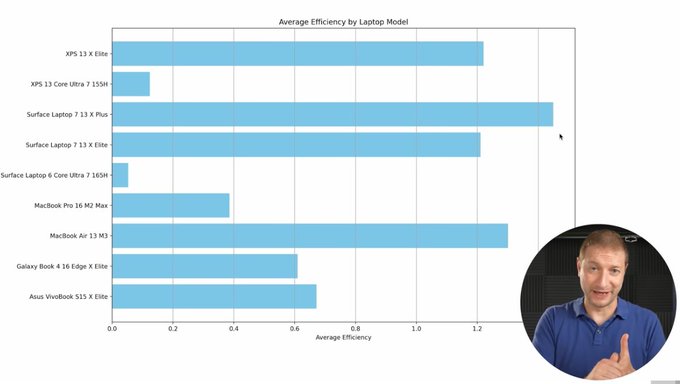
In a battery life and efficiency test from Alex Ziskind on YouTube, we get a fair idea of how the new Snapdragon chips perform in the real world. He approached the test with realism in mind to get a more accurate representation of what we can expect from these laptops. This test included coding, listening to music, and even certain intensive tasks. Alex took into account the different battery sizes of the laptops.
In the initial efficiency test measuring “Battery Drain vs Work Done”, the M2 MacBook Air was the most efficient, while the M3 MacBook Pro and M2 Max variants also saw impressive performance. On the other hand, the Surface Laptop 7th Edition outperformed other Snapdragon X Elite and X Plus powered laptops like the ASUS Vivobook S 15, Dell XPS 13, and Galaxy Book 4 16 Edge. It is worth noting that this efficiency test was more focused on intensive tasks that pushed the CPU cores.
In the automated workflow test to recreate a more realistic scenario, Ziskind reran the test playing YouTube videos occasionally, between writing and running the codes. This was a prolonged test with all laptops set to high performance. Surface Laptop 7 13 (X Plus) led the pack with the highest average efficiency, with the M3 MacBook Air 13 being the runner up.
The Snapdragon X Elite variant of the Surface Laptop 7 13 came in third, and performance much better than the Galaxy Book 4 Edge 16 and VivoBook S 15. Keep in mind that this is still just a test from a person who codes, so expect different results depending on casual use and other tasks. You can click here to check out our previous coverage of the Snapdragon X Plus, where it outperforms the M2 and M3 chips in Cinebench.



Comments