
Add GIZMOCHINA as Preferred Source on Google
As an Amazon Associate, Gizmochina earns from qualifying purchases. Links on this page may earn us a commission at no extra cost to you.
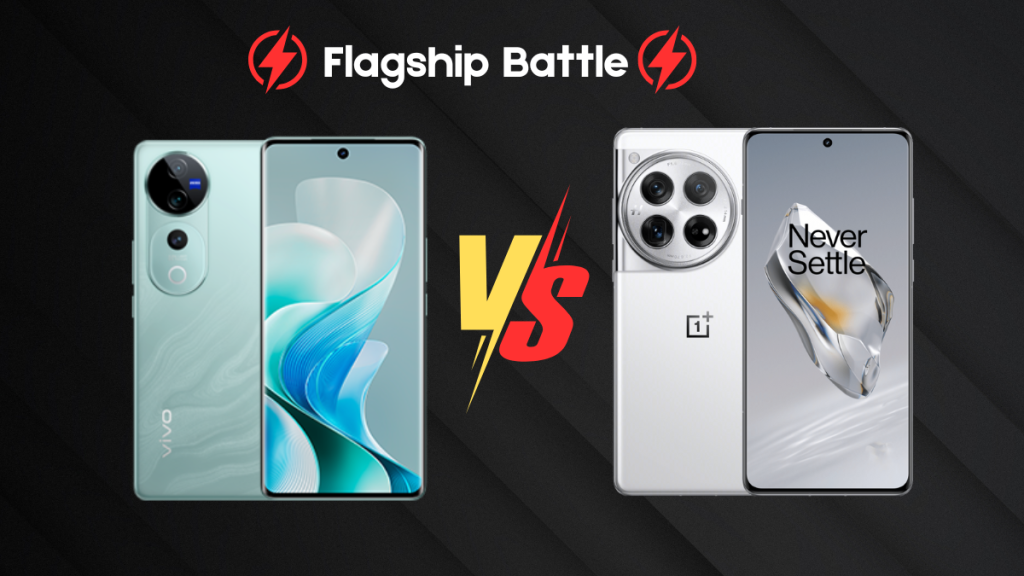
Vivo V40 Pro and OnePlus 12 are popular premium smartphones from Chinese brands. Both devices look solid on the spec sheet, featuring impressive cameras, a high-resolution display, and a powerful octa-core chipset for superior performance. They also come with super-fast charging support that refills the battery in minutes.
Vivo V40 Pro and OnePlus 12 are good high-end phones, but some key differences set them apart. In this post, we’ll compare them to see how the two flagship phones stack up against each other and which offers more value for money.
Let’s begin with the spec sheet:
| Vivo V40 Pro | OnePlus 12 | |
|---|---|---|
| Release Date | August 2024 | January 2024 |
| Body | Domension: 164.3 x 75.1 x 7.5 mm Weight: 192 g | Dimension: 164.3 x 75.8 x 9.2 mm Weight: 220 g |
| Display | 6.78″ AMOLED 1260 x 2800 px resolution 120Hz refresh rate 4500 nits peak brightness Schott Xensation Alpha protection | 6.82″ LTPO AMOLED ProXDR 1440 x 3168 px resolution 120Hz refresh rate 4500 nits peak brightness Gorilla Glass Victus 2 protection |
| Chipset | Dimensity 9200+ (4nm) Immortalis-G715 MC11 GPU | Snapdragon 8 Gen 3 (4 nm) Adreno 750 GPU |
| RAM/Storage | 8GB/12GB LPDDR4X RAM 256GB/512GB UFS 3.1 storage | 12GB/16GB LPDDR5X RAM 256GB/512GB UFS 4.0 storage |
| Rear Camera | 50MP (Primary) – OIS, f/1.9, 1/1.56″ 50MP (Telephoto) – OIS, f/1.9, 1/2.51″, 2x optical zoom 50MP (Ultrawide) – f/2.0, 1/2.76″, 119˚ FOV Video: 4K/1080p @ 30fps | 50MP (Primary) – OIS, f/1.6, 1/1.4″, 85˚ FOV 64MP (Periscope Telephoto) – OIS, f/2.6, 1/2″, 3x optical zoom 48MP (Ultrawide) – f/2.2, 1/2.2″, 114˚ FOV Video: 8K @ 24fps, 4K/1080p/720p @ 30/60fps |
| Front Camera | 50MP – f/2.0, 1/2.76″, 92˚ FOV Video: 4K/1080p @ 30fps | 32MP – f/2.4, 1/2.74″, 90˚ FOV Video: 4K/1080p/720p @ 30fps |
| Battery | 5,500 mAh battery 80W wired charging | 5,400 mAh battery 100W wired charging 50W Wireless charging |
| OS | Android 14, Funtouch OS 14 | Android 14, OxygenOS 14 |
| Audio | Dual stereo speakers | Stereo speakers Dolby Atmos |
| Connectivity | 5G/4G/3G/2G Wi-Fi 7/Wi-Fi 6 Bluetooth 5.3 NFC USB Type-C 2.0 | 5G/4G/3G/2G Wi-Fi 7/Wi-Fi 6E/Wi-Fi 6 Bluetooth 5.4 NFC USB Type-C 3.2 |
| Preview | Product | |
|---|---|---|

|
Vivo V40 Pro 5G AI Smartphone (Ganges Blue, 8GB RAM+ 256GB Storage) | Check Price on Amazon |

|
OnePlus 12 (Silky Black, 12GB RAM, 256GB Storage) | Check Price on Amazon |
Please Note: When you buy something using the links in our articles, we may earn a small commission at no cost to you.
Vivo V40 Pro vs OnePlus 12: Design
The Vivo V40 Pro and OnePlus 12 (review) are nearly the same in height and width, but the Vivo V40 Pro stands out with its sleek design, being around 19% thinner and 14% lighter than the OnePlus 12. This makes it a stylish and easy-to-carry companion wherever you go.
Both smartphones have a glass back but a completely different camera module. The OnePlus 12 has a giant circular camera module, whereas the Vivo phone has a vertical one. Both are solid phones and have been rigorously tested for longer durability.
Vivo V40 Pro vs OnePlus 12: Display
The OnePlus 12 boasts a slightly bigger display with more resolutions. Both phones feature HDR10+, a 120Hz refresh rate, and a peak brightness of 4500nits, ensuring a clear viewing experience even outdoors. The OnePlus 12 also takes it a step further with LTPO support, a display technology that automatically adjusts the refresh rate based on the content being displayed, setting it apart from the Vivo V40 Pro.
Both devices have curved displays, although the Vivo phone is more curved than the OnePlus 12. The OnePlus phone uses the popular Gorilla Glass Victus 2 protection, while the Vivo V40 Pro has Schott Xensation Alpha protection. The former is well-known and trusted for drop resistance, while the latter promises innovative features and environmental benefits.
Because of more pixels and LTPO support, the OnePlus 12 is a better choice than the Vivo V40 Pro as far as the display is concerned.
Vivo V40 Pro vs OnePlus 12: Camera
Both smartphones have a triple camera setup on the back, although the design and megapixel count are completely different. The Vivo V40 Pro features a vertical camera module that includes three sensors, each with a 50MP resolution. The primary one has f/1.9 aperture, 1/1.56-inch sensor size, and optical image stabilisation (OIS) support.
The Vivo phone also has a 50MP telephoto lens with f/1.9 aperture, 1/2.51-inch sensor size, OIS, and 2x optical zoom. The third 50MP sensor is for ultrawide shots with f/2.0 aperture, 1/2.76-inch sensor size, and 119-degree field of view (FOV). Even the selfie camera on the Vivo V40 Pro has 50MP resolution.
The Vivo phone can record up to 4K videos at 30 frames per second (FPS) with its rear as well as selfie camera.
The OnePlus 12 also features a triple camera setup, led by a 50MP sensor with f/1.6 aperture, 1/1.4-inch sensor size, OIS, and 85-degree FOV. There’s also a 64MP periscope telephoto lens with f/2.6 aperture, 1/2-inch sensor size, OIS, and 3x optical zoom. The camera setup also has a 48MP ultrawide lens with f/2.2 aperture, 1/2-inch sensor size, and 114-degree FOV.
The OnePlus 12’s rear camera can record up to 8K videos and 4K videos at up to 60FPS. On the front, it boasts a 32MP camera with up to 4K video recording support.
Both smartphones have strong camera specs. However, the OnePlus 12 edges past the Vivo V40 Pro in terms of video recording by offering 8K support, which is limited to 4K on the Vivo phone.
Vivo V40 Pro vs OnePlus 12: Performance
The Vivo V40 Pro is powered by a MediaTek Dimensity 9200+ chipset, whereas the OnePlus 12 uses Qualcomm’s Snapdragon 8 Gen 3 chip. Both are octa-core chips fabricated using the same TSMC’s 4nm process. However, there’s a big performance gap.
The Snapdragon 8 Gen 3 uses more high-performance and efficient cores than the Dimensity 9200+ chip, delivering much better CPU and GPU performance. On Geekbench and AnTuTu benchmarking platforms, the Snapdragon 8 Gen 3 scores over 30% better than the Dimensity 9200+. The difference gets wider on gaming benchmarks such as 3D Mark WidLife.
Besides a highly efficient and powerful Qualcomm chip, the OnePlus 12 also has faster RAM and storage, offering quick app loading and better overall performance.
The bottom line is that the Snapdragon 8 Gen 3 chip inside the OnePlus 12 has much better CPU, GPU, and overall performance than the Dimensity 9200 Plus-powered Vivo V40 Pro. If performance is your serious concern, the OnePlus 12 is a no-brainer choice over the V40 Pro.
Vivo V40 Pro vs OnePlus 12: Battery
The Vivo V40 Pro packs a 5,500 mAh battery, while the OnePlus 12 has a slightly lesser battery capacity of 5,400 mAh. The difference is not much here, but you’ll experience it while charging the device.
The OnePlus 12 supports 100W fast charging, while the Vivo V40 Pro brings support for 80W fast charging. The OnePlus phone also supports 50W wireless charging.
The OnePlus 12 has a slightly lower battery capacity than the Vivo V40 Pro but compensates by lowering the charging time.
Vivo V40 Pro vs OnePlus 12: Software
Vivo V40 Pro and OnePlus 12 run Android 14 out of the box with their version of custom skins (Funtouch OS 14 on Vivo and OxygenOS 14 on the OnePlus).
The smartphones have the latest version of Android OS, but it’s also important to check how long they will be supported. As for the OnePlus 12, the company promises four years of Android updates and five years of security patches. However, the Vivo V40 Pro will only get three years of Android and four years of security updates.
Vivo V40 Pro vs OnePlus 12: Connectivity
The Vivo V40 Pro and OnePlus 12 have good connectivity features. However, there are notable differences you should be aware of.
The OnePlus 12 supports a newer Bluetooth 5.4 standard, while the Vivo V40 Pro supports Bluetooth 5.3. The OnePlus phone also supports Wi-Fi 6e. While these may make little difference, the USB type does.
The Vivo V40 Pro supports USB type-C 2.0, whereas the OnePlus 12 supports USB type-C 3.2. This means the OnePlus phone has faster data transfer speed. So, transferring large files to USB-connected devices will take much longer on the Vivo V40 Pro.
Vivo V40 Pro vs OnePlus 12: Verdict
The Vivo V40 Pro and OnePlus 12 are solid high-end smartphones. But there are key differences that really impacts your purchase decision.
The Vivo V40 Pro is a lightweight phone with excellent portrait photography and a high-resolution front-facing camera. It has a slightly larger battery capacity and supports fast charging. The device runs the latest Android version and is guranteed up to three Android upgrades.
The OnePlus 12’s display has more pixels and supports LTPO technology. The rear cameras take good shots and can record up to 8K videos. It has a high-performance and efficient Snapdragon 8 Gen 3 chip, much better than the Dimensity 9200+. The device will receive one extra year of software updates than the Vivo V40 Pro and has better connectivity features.
The base variant of the Vivo V40 Pro is currently priced at Rs. 49,999, while the OnePlus 12 costs Rs. 64,999. There’s a clear pricing gap, which also reflects on the spec sheet. The OnePlus 12 offers a better value, hence my choice over the Vivo V40 Pro.
Which one of these two phones would you consider? Let me know your thoughts in the comments below.




Comments