
Add GIZMOCHINA as Preferred Source on Google
As an Amazon Associate, Gizmochina earns from qualifying purchases. Links on this page may earn us a commission at no extra cost to you.
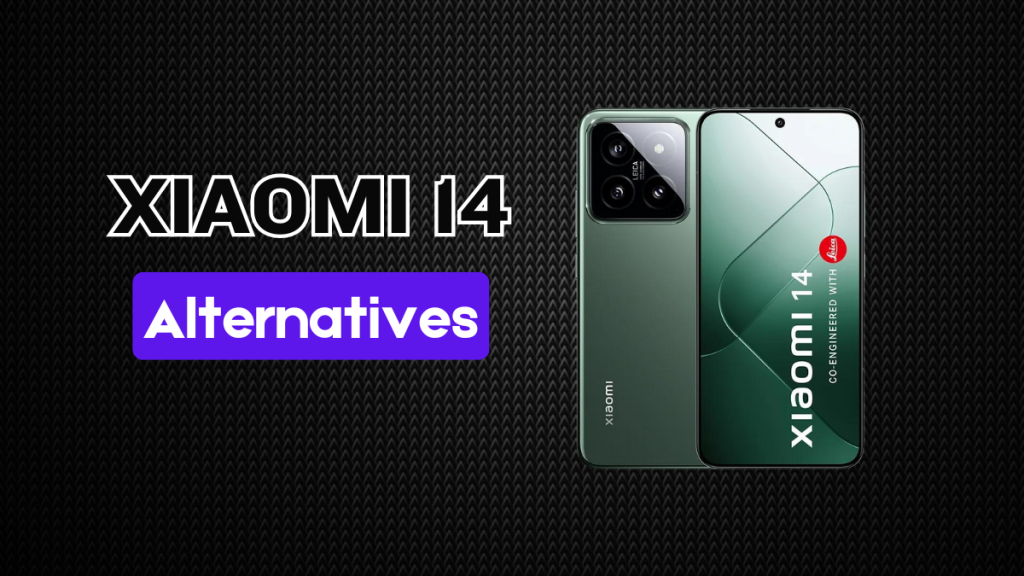
Xiaomi 14 was released in India in March this year. It is one of the best compact flagship phones available on the market. The smartphone boasts a solid set of specifications. However, it lags behind its competitors in some key areas.
If you plan to upgrade to the Xiaomi 14 (full review), don’t forget to check out its best alternatives, which will help you make a better decision. Before we move on to the alternatives, let’s quickly recall the device via the spec sheet below.
| Xiaomi 14 Specs | |
|---|---|
| Body | 152.8 x 71.5 x 8.20mm 193g |
| Display | 6.36″ 120Hz LTPO AMOLED 1200 x 2670 pixels resolution HDR10+, Dolby Vision, 3000nits (peak) |
| Chip | Qualcomm Snapdragon 8 Gen 3 (4nm) Adreno 750 GPU |
| Rear Camera | 50MP (main) – OIS, f/1.6, 1/1.31″ 50MP (telephoto) – OIS, f/2.0, 3.2x optical zoom 50MP (ultrawide) – f/2.2, 115° FOV Video: 8K @ 24fps, 4K @ 24/30/60fps, 1080p @ 30/60fps |
| Front Camera | 32MP – f/2.0, 89.6° FOV Video: 4K/1080p @ 30/60fps, |
| RAM/Storage | 12GB LPDDR5X RAM 256GB/512GB UFS 4.0 storage |
| Battery | 4,610mAh capacity 90W (wired) 50W (wireless) 10W (reverse wireless) |
| Software | Android 14, HyperOS 4 Android upgrades |
| Connectivity | 5G/4G/3G/2G Wi-Fi 7/Wi-Fi 6E/Wi-Fi 6 Bluetooth 5.4 NFC supported |
| Preview | Product | |
|---|---|---|

|
Xiaomi 14 (White, 12GB RAM, 512GB Storage) | 50MP Leica Professional Optics | 120 Hz 1.5K LTPO… | Check Price on Amazon |
Please Note: When you buy something using the links in our articles, we may earn a small commission at no cost to you.
1. Vivo X100
| Vivo X100 Specs | |
|---|---|
| Body | 164.1 x 75.2 x 8.5mm 206g |
| Display | 6.78″ 120Hz LTPO AMOLED 1260 x 2800 pixels resolution 1B colours, 3000nits (peak) |
| Chip | MediaTek Dimensity 9300 (4nm) Immortalis-G720 MC12 GPU |
| Rear Camera | 50MP (main) – OIS, f/1.6, 1/1.49″ 64MP (periscope telephoto) – OIS, f/2.6, 3x optical zoom 50MP (ultrawide) – f/2.0, 119° FOV Video: 4K/1080p @ 30/60fps, 720p @ 30fps |
| Front Camera | 32MP – f/2.0, 89.6° FOV Video: 1080p @ 30/60fps, 720p @ 30fps |
| RAM/Storage | 12GB/16GB LPDDR5X RAM 256GB/512GB UFS 4.0 storage |
| Battery | 5,000mAh capacity 120W (wired) |
| Software | Android 14, Funtouch OS 14 3 Android upgrades |
| Connectivity | 5G/4G/3G/2G Wi-Fi 7/Wi-Fi 6 Bluetooth 5.4 NFC supported |
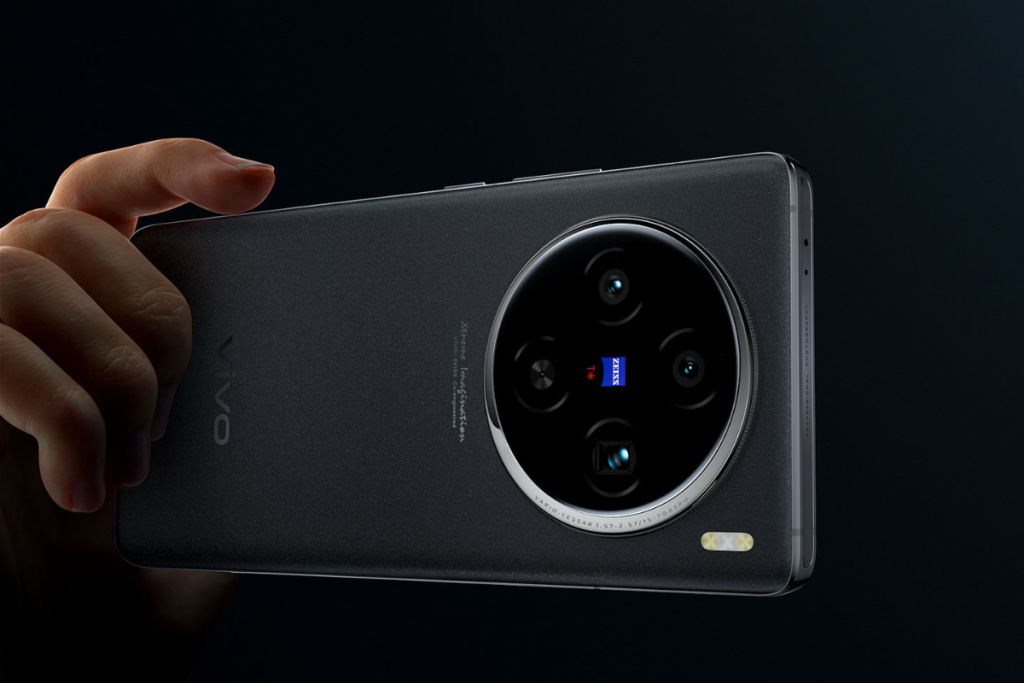
Unlike Xiaomi 14, the Vivo X100 has a curved display that’s around 6.6% bigger in size. The Xiaomi 14 uses an OLED panel, while the rest of the display specifications are almost similar.
Both smartphones are IP68 certified for dust & water resistance. However, the Vivo X100 lacks protection, whereas the Xiaomi 14 uses Corning Gorilla Glass 5.
The Vivo X100 rocks a big circular camera module that’s easily distinguishable from the crowd, whereas the Xiaomi 14 features a rectangular camera module.
Both smartphones have a 50MP primary camera with OIS and a 50MP ultrawide camera (the Vivo X100 has a larger field of view). The periscope telephoto lens on the Vivo phone supports 3x optical zoom, while it is 3.2x on the Xiaomi 14).
Both smartphones take stunning photos and videos using the main camera in varying lighting conditions with fine details, sharpness, and colour accuracy. However, the dynamic range could have been better on the Vivo X100.
The Vivo phone takes good shots with its ultrawide cameras in various lighting conditions. It also takes good macro shots. However, the selfies and videos using the front camera are pretty decent, with some sort of skin smoothing.
Notably, the Vivo X100 supports up to 4K video recording using the rear camera, but only 1080p with its selfie camera. In contrast, the Xiaomi 14 can record up to 8K videos using its rear camera and 4K with its selfie camera.
Both smartphones take excellent photos and videos. However, in most cases, the Xiaomi 14 produces better shots, particularly with its rear camera setup. The Vivo X100 might have an edge when it comes to portrait selfies.
The Vivo X100 is powered by a Dimensity 9300 chip, whereas the Xiaomi 14 uses Snapdragon 8 Gen 3. Both are the fastest mobile CPUs from their respective manufacturers and have similar benchmark results. They deliver excellent performance, but the Snapdragon 8 Gen 3 has slightly better gaming stability. Check out the Snapdragon 8 Gen 3 vs. Dimensity 9300 for more details.
The Xiaomi 14 and Vivo X100 have similar connectivity features, except the former has a faster USB data transfer rate.
The Vivo X100 has a larger battery capacity and supports much faster wired charging compared to Xiaomi 14. This means you’ll benefit from more screen time and quicker battery filling on the Vivo phone. However, the Vivo phone lacks wireless and reverse wireless charging.
| Preview | Product | |
|---|---|---|

|
Vivo X100 5G (Asteroid Black, 12GB RAM, 256GB Storage) MediaTek Dimensity 9300 Processor | AMOLED… | Check Price on Amazon |
Please Note: When you buy something using the links in our articles, we may earn a small commission at no cost to you.
2. Samsung Galaxy S24 (Snapdragon)
| Galaxy S24 Specs | |
|---|---|
| Body | 147.0 x 70.6 x 7.6mm 167g |
| Display | 6.2″ 120Hz Dynamic LTPO AMOLED 2X 1080 x 2340 pixels resolution HDR10+, 2600nits (peak) Corning Gorilla Glass Victus 2 |
| Chip | Qualcomm Snapdragon 8 Gen 3 (4nm) Adreno 750 GPU |
| Rear Camera | 50MP (main) – OIS, f/1.8, 1/1.56″ 10MP (telephoto) – OIS, f/2.4, 3x optical zoom 12MP (ultrawide) – f/2.2, 120° FOV Video: 8K @ 24/30fps, 4K @ 30/60fps, 1080p @ 30/60/240fps |
| Front Camera | 12MP – f/2.2, 89.6° FOV Video: 4K @ 30/60fps, 1080p @ 30fps |
| RAM/Storage | 8GB/12GB RAM 128GB/256GB/512GB storage |
| Battery | 4,000mAh capacity 25W (wired) 15W (wireless) 4.5W (reverse wireless) |
| Software | Android 14, One UI 6.1 7 Android upgrades |
| Connectivity | 5G/4G/3G/2G Wi-Fi 6E Bluetooth 5.3 NFC (supported) USB Type-C 3.2 Gen 1 |
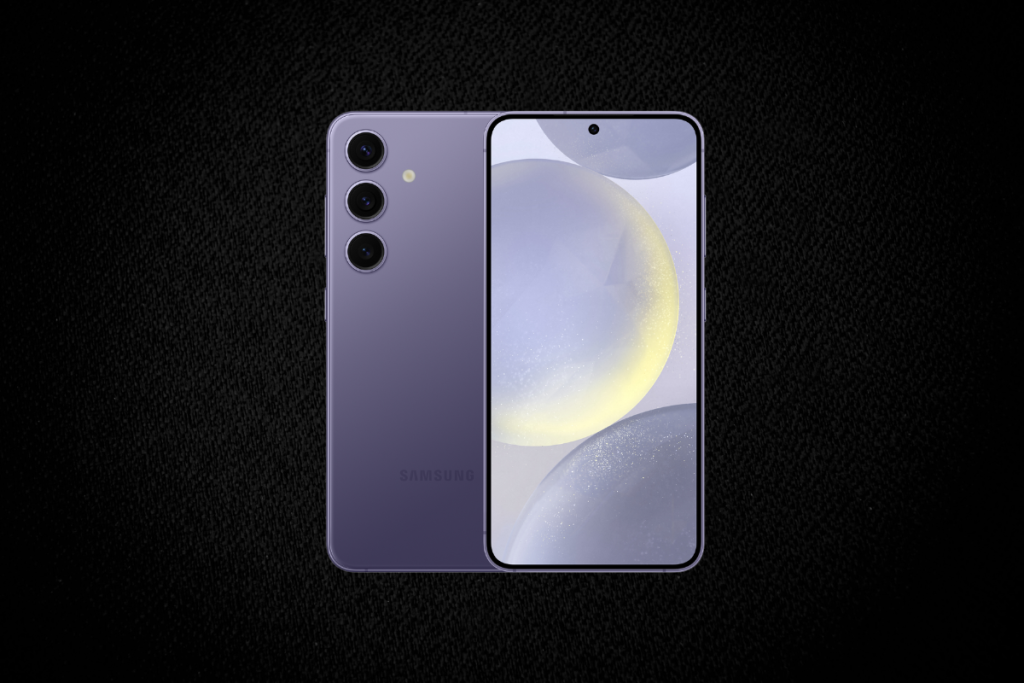
The Galaxy S24 (Snapdragon version) is another good alternative to the Xiaomi 14. It’s more compact and lightweight than the Xiaomi 14 and features a 6.2-inch Dynamic LTPO AMOLED 2X screen — the brightness peaks at 2600nits (slightly lower than Xiaomi 14).
The Galaxy S24 uses the second-generation Gorilla Glass Victus, while the Xiaomi 14 has the first-generation Gorilla Glass Victus protection. Both devices are powered by the same Snapdragon 8 Gen 3 chip. There’s also an Exynos version, but it’s difficult to recommend because of Exynos problems.
While the Xiaomi 14 features a rectangular camera module, the Galaxy S24 has a vertical camera arrangement that looks a lot cleaner. The two phones have similar performance in daylight, but Xiaomi 14 shots are usually more detailed and sharper. However, the opposite is true for the ultrawide camera, where the Galaxy S24 edges out the Xiaomi 14 in daylight shots.
The Xiaomi 14 takes better photos with its telephoto camera, and the low-light images are also better. The Galaxy S24 wins at selfies, while the Xiaomi 14 only manages to produce less contrasty selfies with pale colours.
It isn’t easy to pick one for video recording, as both do an excellent job. For regular videos using the primary camera, the Xiaomi 14 often performs better. However, it’s a different story when using a telephoto or ultrawide camera. In some aspects, the Xiaomi 14 videos look better, while in others, the Galaxy S24 videos look impressive.
The Galaxy S24 packs a lesser battery capacity than the Xiaomi 14, and as you may already know, Samsung is not a fan of superfast charging. Hence, you only get 25W charging support, while the Xiaomi 14 supports 90W fast charging. Both devices support wireless and reverse wireless charging, although they are faster on the Xiaomi phone.
Samsung phones are better known for software updates. The Galaxy S24 is promised seven years of Android and security updates, while the Xiaomi 14 will only get 4 Android updates and five years of security patches.
| Preview | Product | |
|---|---|---|

|
Samsung Galaxy S24 5G AI Smartphone (Amber Yellow, 8GB, 128GB Storage) | Check Price on Amazon |
Please Note: When you buy something using the links in our articles, we may earn a small commission at no cost to you.
3. OnePlus 12
| OnePlus 12 Specs | |
|---|---|
| Body | 164.3 x 75.8 x 9.2mm 220g |
| Display | 6.82″ 120Hz LTPO AMOLED 1440 x 3168 pixels resolution HDR10+, Dolby Vision, 4500nits (peak) Corning Gorilla Glass Victus 2 |
| Chip | Qualcomm Snapdragon 8 Gen 3 (4nm) Adreno 750 GPU |
| Rear Camera | 50MP (main) – OIS, f/1.6, 1/1.4″, 85° FOV 64MP (periscope telephoto) – OIS, f/2.6, 3x optical zoom 48MP (ultrawide) – f/2.2, 114° FOV Video: 8K @ 24fps, 4K/1080p/720p @ 30/60fps |
| Front Camera | 32MP – f/2.4, 90° FOV Video: 4K/1080p/720p @ 30fps |
| RAM/Storage | 12GB/16GB LPDDR5X RAM 256GB/512GB UFS 4.0 storage |
| Battery | 5,400mAh capacity 100W (wired) 50W (wireless) 10W (reverse wireless) |
| Software | Android 14, OxygenOS 14 4 Android upgrades |
| Connectivity | 5G/4G/3G/2G Wi-Fi 7/Wi-Fi 6E Bluetooth 5.4 NFC (supported) USB Type-C 3.2 Gen 1 |
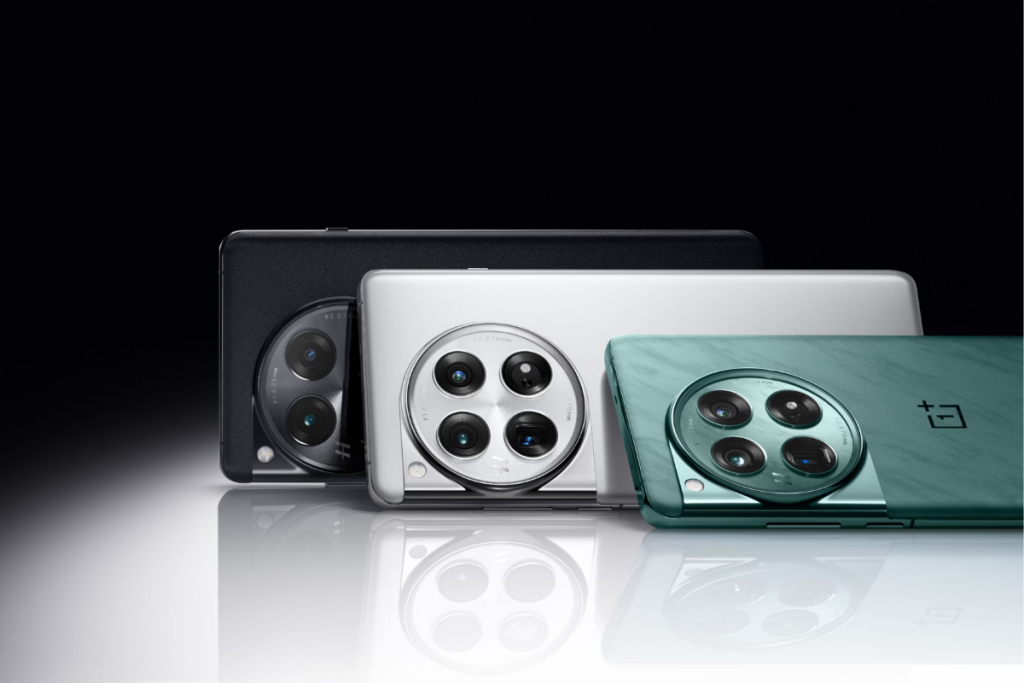
The OnePlus 12 (full review) is another solid alternative to the Xiaomi 14. It’s slightly bigger and bulkier and has an IP65 rating for dust and water resistance. Both smartphones have the same Snapdragon 8 Gen 3 chip, which delivers superior performance.
The OnePlus 12 has a 6.82-inch LTPO AMOLED screen with 120Hz refresh rate, Dolby Vision support, and 4500nits of peak brightness. Compared to Xiaomi 14, it has a bigger display with more pixels and higher peak brightness for better outdoor visibility. Also, it is protected by a Gorilla Glass Victus 2, while the Xiaomi 14 uses first-gen protection.
Both smartphones come with Android 14 out of the box and have been promised four years of Android updates from their respective brands.
The OnePlus 12 boasts a circular camera module featuring a 50MP primary sensor with OIS, a 64MP periscope telephoto lens with OIS, 3x optical zoom, and a 48MP ultrawide lens with 114-degree field of view (FOV). The camera setup is made in collaboration with Hasselblad to achieve better colour accuracy. There’s a 32MP camera for selfies.
Both smartphones capture stunning shots with their primary cameras. However, the Xiaomi 14 produces more natural shots, whereas the OnePlus 12 tends to be slightly more saturated. The Xiaomi 14 also does well with its ultrawide camera.
The OnePlus 12 offers up to 120x zoom, while the Xiaomi 14 only goes up to 60x. Due to high resolution, the OnePlus phone produces sharper images. However, as the zoom level increases, both phones output comparable shots with little to no difference.
When it comes to selfie images, the OnePlus 12 produces more natural shots, whereas Xiaomi 14 appears to enhance the exposure. The Xiaomi phone has skin smoothening turned on by default, which can be disabled for a more natural appearance.
The OnePlus 12 generally produces better videos, while Xiaomi 14 tends to display more contrast, making some videos look underexposed. However, in low-light conditions, Xiaomi does well. Overall, the OnePlus 12 produces better videos than the Xiaomi 14.
The OnePlus 12 has a larger battery capacity of 5,400mAh (vs. 4,610mAh on the Xiaomi 14) and supports faster charging over a USB cable. However, both support the same wireless and reverse wireless charging.

Please Note: When you buy something using the links in our articles, we may earn a small commission at no cost to you.
4. iQOO 12
| iQOO 12 Spec | |
|---|---|
| Body | 163.2 x 75.9 x 8.1mm 198.5g or 203.7g |
| Display | 6.78″ 144Hz LTPO AMOLED 1260 x 2800 pixels resolution HDR10+, 3000nits (peak) |
| Chip | Qualcomm Snapdragon 8 Gen 3 (4nm) Adreno 750 GPU |
| Rear Camera | 50MP (main) – OIS, f/1.7, 1/1.3″ 64MP (periscope telephoto) – OIS, f/2.6, 3x optical zoom 50MP (ultrawide) – f/2.0, 119° FOV Video: 8K @ 30fps, 4K @ 24/30/60fps, 1080p @ 30/60/120/240fps |
| Front Camera | 16MP – f/2.5 Video: 1080p @ 30fps |
| RAM/Storage | 12GB/16GB RAM 256GB/512GB storage |
| Battery | 5,000mAh capacity 120W (wired) |
| Software | Android 14, Funtouch OS 14 3 Android upgrades |
| Connectivity | 5G/4G/3G/2G Wi-Fi 7/Wi-Fi 6 Bluetooth 5.4 NFC (supported) USB Type-C 2.0 |
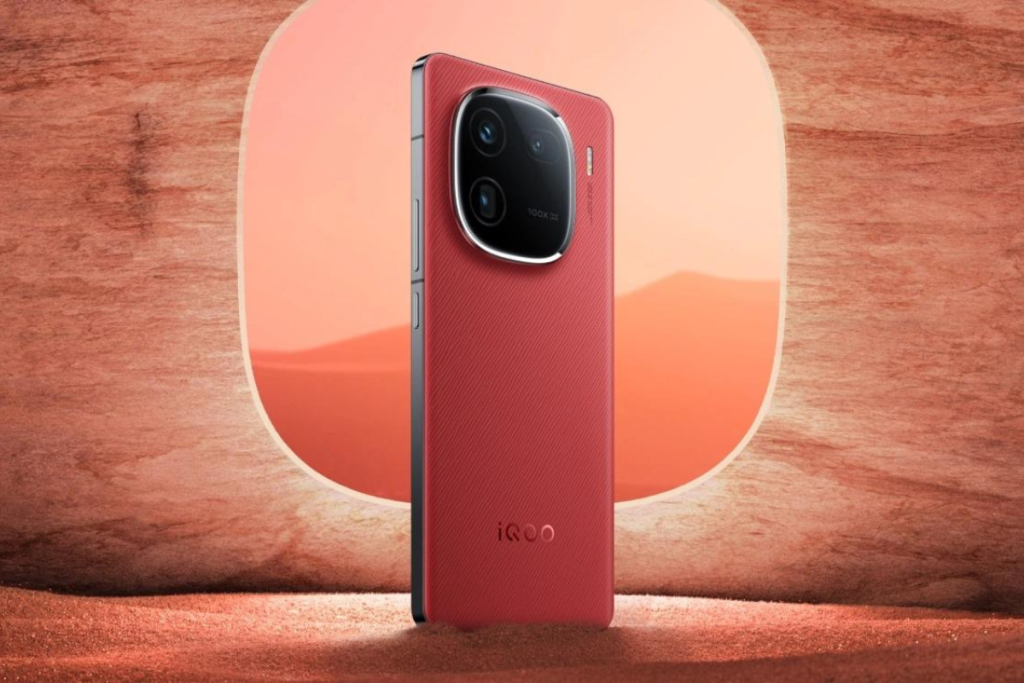
iQOO 12 was released last year with a strong spec sheet. It boasts a slightly larger LTPO AMOLED screen than the Xiaomi 14 with a higher refresh rate and a peak brightness of 3000nits.
The iQOO device is fueled by the Snapdragon 8 Gen 3, the same chip inside the Xiaomi 14. It’s the most powerful chip for Android phones, ensuring superior performance and efficiency.
Let’s get to the cameras. The iQOO 12’s main camera takes detailed, sharp daylight images with excellent dynamic range. The overall image processing is sound, but sometimes, you may observe various imperfections due to weak processing.
The telephoto cameras are excellent, offering great details, colours, right sharpness, and less noise. The dynamic range and overall contrast are also impressive. The 64MP high-res zoomed images are okay(ish) with a good amount of details, accurate colours and good dynamic range, but they are pretty noisy.
With iQOO 12, you can get as close as 5cm from a subject for macro shots, and the output is good. The macro shots from the telephoto camera at 3x zoom are also great. They have natural bokeh, better colour reproduction, and sharpness with a good amount of detail. The smartphone also takes excellent portrait and low-light photos.
All three rear cameras on the iQOO 12 can shoot up to 4K videos, while the main camera also supports 8K recording at 30fps. The 4K video recording using the main camera is average, as the picture looks washed out. Otherwise, it has good colours, contrast, and a wide dynamic range.
The low-light 4K footage is also mediocre. But the 4K 30fps Night Mode video is impressive – it’s bright and detailed with punchy colours and a wide dynamic range. Footage coming from the telephoto camera at 3x zoom is impressive – they have great details, sharpness, accurate colours, high contrast, and wide dynamic range. The device also takes good ultrawide videos in daylight.
The selfie camera isn’t impressive, though. It doesn’t support electronic stabilisation, although the colours are accurate, and the dynamic range is good. However, the end result is average.
The iQOO 12 packs a larger battery, and its charging speed is also better than that of the Xiaomi 14.
| Preview | Product | |
|---|---|---|

|
iQOO 12 5G (Legend, 12GB RAM, 256GB Storage) | India’s 1st Snapdragon® 8 Gen 3 Mobile Platform |… | Check Price on Amazon |
Please Note: When you buy something using the links in our articles, we may earn a small commission at no cost to you.
5. Google Pixel 8
| Pixel 8 Specs | |
|---|---|
| Body | 150.5 x 70.8 x 8.9mm 187g |
| Display | 6.2″ 120Hz OLED 1080 x 2400 pixels resolution HDR10+, 2000nits (peak) Corning Gorilla Glass Victus |
| Chip | Google Tensor G3 (4nm) Immortalis-G715s MC10 GPU |
| Rear Camera | 50MP (main) – OIS, f/1.7, 1/1.31″, 82° FOV 12MP (ultrawide) – f/2.2, 125.8° FOV Video: 4K/1080p @ 24/30/60fps |
| Front Camera | 10.5MP – f/2.2, 95° FOV Video: 4K @ 24/30/60fps |
| RAM/Storage | 8GB LPDDR5X RAM 128GB/256GB UFS 3.1 storage |
| Battery | 4,575mAh capacity 27W (wired) 18W (wireless) reverse wireless |
| Software | Android 14 7 Android upgrades |
| Connectivity | 5G/4G/3G/2G Wi-Fi 6 Bluetooth 5.3 NFC (supported) USB Type-C 3.2 |
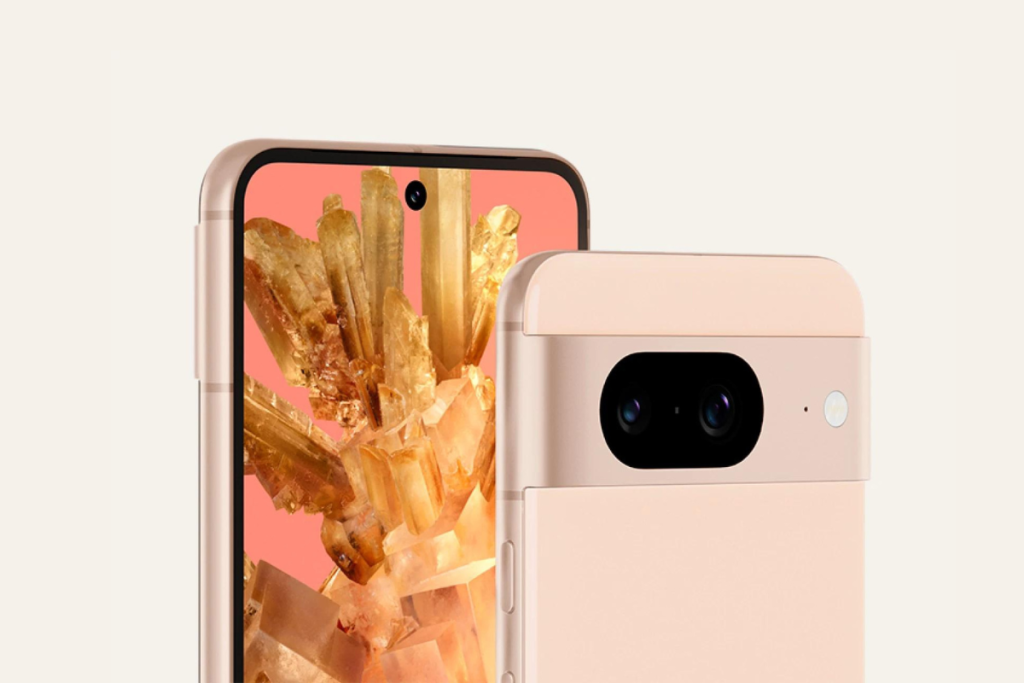
The Pixel 8 has similar pricing to the Xiaomi 14 and offers good value for money. Hence, it is an alternative to the Xiaomi 14 worth exploring.
The Pixel 8 is a compact flagship phone featuring a 6.2-inch OLED screen, although it’s not an LTPO panel and has a lower peak brightness than the Xiaomi 14.
The smartphone is powered by an in-house Tensor G3 chip, which isn’t as powerful as the Snapdragon 8 Gen 3 on the benchmarks. That doesn’t make it a bad choice for high-end phones. The chip can still deliver great performance.
The Pixel 8 has only two camera sensors on the back — a 50MP primary camera with OIS and a 12MP ultrawide camera with a 126-degree FOV. It is also equipped with a 10.5MP camera for selfies.
The smartphone takes good daylight shots with nicer details, consistent white balance, and good saturation. The ultrawide camera also shoots great images. It also has an autofocus that enables both general close-up shots and macro shots.
The Pixel 8 does an impressive job in low-light conditions, all thanks to good image processing. However, the portrait shots are just acceptable. The device takes nice selfies with good details. The video quality of the Pixel 8’s main camera is impressive. The ultrawide camera outputs an average video quality at night but does a fantastic job in daylight.
The Pixel 8 has a slightly lesser battery capacity than the Xiaomi 14, but the difference in changing speeds is big — 27W on the Pixel 8 and 90W on the Xiaomi 14.
The impressive software update policy is one aspect where the Pixel 8 leaves the Xiaomi 14 in the dust. The Pixel 8 will get seven years of Android updates, while the Xiaomi 14 will only get four.
| Preview | Product | |
|---|---|---|

|
Pixel 8 (Obsidian, 128 GB) (8 GB RAM | Check Price on Amazon |
Please Note: When you buy something using the links in our articles, we may earn a small commission at no cost to you.
The Xiaomi 14 is a solid flagship phone. However, these five phones are better than that in one or more key areas. Would you pick Xiaomi 14 or any of these alternatives? Share your thoughts in the comment section below.


Comments