Add GIZMOCHINA as Preferred Source on Google
Amazfit is in the rugged smartwatch market since 2020, and with the recent release of the Amazfit T-Rex 3, the brand continues to innovate. While the T-Rex 2 was an impressive offering in the rugged smartwatch market, the T-Rex 3 builds upon its predecessor with significant upgrades in screen size, battery life, and AI integration. Let’s dive into a detailed comparison of the two models.
1. Design and Display
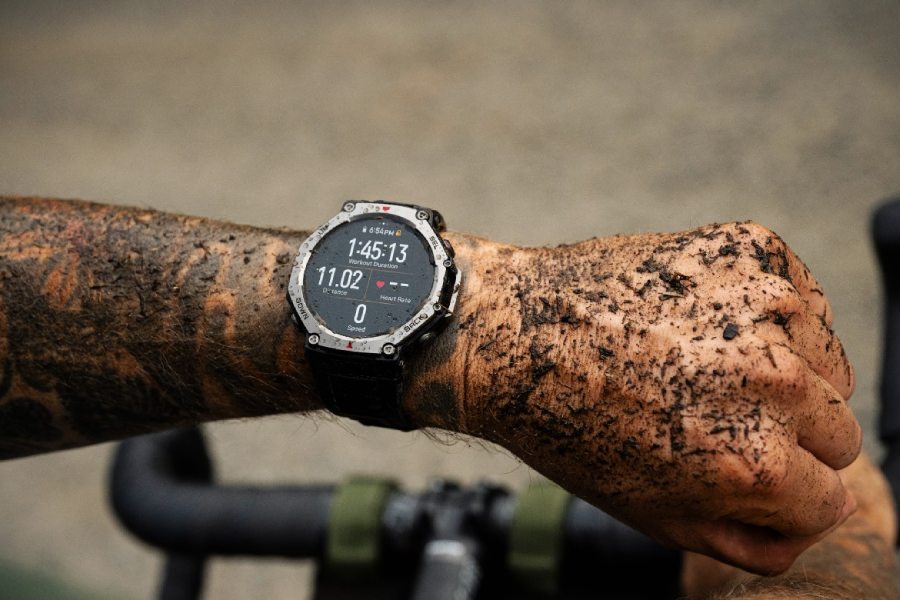
Both watches feature military-grade certifications (MIL-STD-810G) that ensure they can withstand harsh conditions. However, the T-Rex 3 introduces some key improvements. The most notable is the larger 1.5-inch AMOLED display, compared to the 1.39-inch AMOLED screen of the T-Rex 2.
Not only is the T-Rex 3’s screen larger, but it also offers 2,000 nits of peak brightness, a substantial upgrade from the 1,000 nits on the T-Rex 2. This makes the display on the T-Rex 3 much more visible in bright outdoor conditions, a crucial factor for those who rely on their smartwatch for outdoor adventures.
Both smartwatches come with always-on display functionality, and both offer Gorilla Glass protection for durability. However, the larger screen on the T-Rex 3 enhances the user experience, especially when viewing maps, workout data, or notifications.
Additionally, the T-Rex 3 retains a stainless steel bezel, adding to its premium feel, while the T-Rex 2 opts for a polymer middle frame and buttons, which may feel slightly less premium in comparison but keeps the weight lighter.
2. Battery Life
The T-Rex 2 is equipped with a 500mAh battery, which offers up to 24 days of usage in typical scenarios and up to 45 days in battery-saver mode. While these figures are impressive, the T-Rex 3 goes a step further with a 700mAh battery.
This larger battery promises up to 27 days of typical usage and 180 hours in maximum GPS mode, which is particularly useful for long hikes or camping trips. The extra battery life on the T-Rex 3 makes it a more reliable companion for those who spend extended periods away from charging points.
3. Sports Modes and Health Features
Both the T-Rex 2 and T-Rex 3 come with a comprehensive suite of sports and health features, including heart rate monitoring, SpO2 measurement, stress monitoring, and sleep tracking. However, the T-Rex 3 introduces new sports modes that cater to more extreme athletes.
It boasts over 177 sports modes, including Hyrox Race mode, Freediving, and Ultramarathon, as well as an upgraded strength training mode. The T-Rex 2, on the other hand, offers 158 sports modes, which are still impressive but lack some of the newer, more advanced options available on the T-Rex 3.
Both models support 24-hour heart rate and SpO2 monitoring, along with stress and sleep tracking. However, the T-Rex 3 adds a Readiness Score feature and Sleep Heart Rate Variability (HRV) for more detailed analysis of sleep quality and overall fitness.
4. Navigation and GPS
Both the T-Rex 2 and T-Rex 3 come with dual-band GPS and support for multiple satellite systems, ensuring precise tracking. However, the T-Rex 3 goes a step further by offering free offline maps and contour maps with turn directions, a feature not available on the T-Rex 2. This makes the T-Rex 3 a better choice for serious adventurers who need real-time navigation in remote areas.
The T-Rex 3 also offers enhanced privacy features for GPS usage, allowing users to enable or disable GPS tracking as needed, giving more control over how their location data is handled.
5. AI Integration and Voice Control
One of the most exciting new features on the Amazfit T-Rex 3 is the integration of OpenAI’s GPT-4o technology, which powers the Zepp Flow assistant. This AI-based feature allows users to control their watch through voice commands and even send speech-to-text replies. The T-Rex 2 does not offer voice control, making this a clear advantage for the T-Rex 3.
Zepp Flow also provides AI coaching, helping users manage their workouts and daily activities more efficiently. This feature elevates the T-Rex 3 beyond being just a rugged smartwatch, positioning it as a more versatile tool for everyday use.
6. Storage and Music
The T-Rex 3 also comes with 26GB of built-in storage for local music storage, allowing users to leave their phone behind during workouts or outdoor adventures. The T-Rex 2 offers 8GB of local storage and 4GB of RAM.
7. Water Resistance and Durability
Both the T-Rex 2 and T-Rex 3 are designed for extreme conditions, with 10 ATM water resistance that allows them to be submerged up to 100 meters. This makes both models suitable for swimming, snorkeling, and other water sports. However, the T-Rex 3 adds certification for freediving up to 147 feet, making it a better option for serious divers.
Both models can withstand extreme temperatures, but the T-Rex 3 offers better overall durability, handling temperatures ranging from 158°F (70°C) to -22°F (-30°C), making it ideal for adventurers in extreme environments.
8. Pricing
In terms of pricing, the Amazfit T-Rex 2 is currently priced at Rs. 15,999 in India, while the T-Rex 3 is expected to be priced around Rs. 34,999. It is priced at €299 in Europe, $299 in the US, and 1899 yuan in China. The T-Rex 3’s higher price reflects its additional features, including a larger display, more sports modes, longer battery life, and AI integration.
9. Conclusion
Both the Amazfit T-Rex 3 and T-Rex 2 are excellent rugged smartwatches, but the T-Rex 3 offers significant upgrades that make it a more compelling option for outdoor enthusiasts and athletes.
The larger display, improved battery life, advanced AI features, and enhanced sports modes make the T-Rex 3 a clear winner for those who want the latest in smartwatch technology. However, if you’re looking for a more budget-friendly option, the T-Rex 2 still provides excellent value with its solid performance and durability.