
Add GIZMOCHINA as Preferred Source on Google

The Snapdragon 8 Gen 1 was released in October 2021, and two years later, the Snapdragon 8 Gen 3 arrived with more powerful and efficient cores. Both are flagship smartphone chips and are already powering many high-end phones from popular brands such as OnePlus, Samsung, and Xiaomi.
Being a newer chip, the Snapdragon 8 Gen 3 is ahead of its first-gen counterpart in almost every aspect. But the real question is, how big is the difference? Is it worth upgrading, or is the Snapdragon 8 Gen 1 still good enough to stick with? Let’s compare them to see how they stack up against each other.
Let’s begin with the spec sheet:
| SD 8 Gen 3 | SD 8 Gen 1 | |
|---|---|---|
| Release date | October 2023 | November 2021 |
| Process node | 4nm | 4nm |
| Manufacturer | TSMC | Samsung |
| Cores | 8 | 8 |
| CPU architecture | 1 x Cortex-X4 @ 3.3 GHz 3 x Cortex-A720 @ 3.15 GHz 2 x Cortex-A720 @ 2.96 GHz 2 x Cortex-A520 @ 2.27 GHz | 1 x Cortex-X2 @ 3 GHz 3 x Cortex-A710 @ 2.5 GHz 4 x Cortex-A510 @ 1.8 GHz |
| GPU | Adreno 750 770 MHz frequency Snapdragon Elite Gaming Hardware Accelerated Ray Tracing | Adreno 730 Snapdragon Elite Gaming Unreal Engine 5 support |
| NPU | Hexagon NPU | Hexagon NPU |
| Camera | 18-bit Spectra Triple ISP 200MP single camera 108MP camera with ZSL 64MP+36MP dual cameras with ZSL 36MP+36MP+36MP triple cameras with ZSL *ZSL = Zero Shutter Lag | 18-bit Spectra Triple ISP 200MP single camera 108MP camera with ZSL 64MP+36MP dual cameras with ZSL 36MP+36MP+36MP triple cameras with ZSL *ZSL = Zero Shutter Lag |
| Memory | LPDDR5X RAM 4200 MHz frequency | LPDDR5 RAM 3200 MHz frequency |
| Storage | UFS 4.0 | UFS 3.1 |
| Media decode | H.264, H.265, AV1, VP8, VP9 | H.264, H.265, VP8, VP9 |
| Connectivity | Snapdragon X75 5G modem Downlink: 10 Gbps Uplink: 3.5 Gbps Wi-Fi 7, Wi-Fi 6, Wi-Fi 5, Wi-Fi 4 Bluetooth 5.4, LE Galileo, Beidou, NavIC, GPS, GLONASS, QZSS | Snapdragon X65 5G modem Downlink: 10 Gbps Uplink: 3.5 Gbps Wi-Fi 6E, Wi-Fi 4, Wi-Fi 6, Wi-Fi 5 Bluetooth 5.3, LE GLONASS, NavIC, Beidou, GPS, QZSS, Galileo |
Snapdragon 8 Gen 3 vs 8 Gen 1: Benchmarks
(Geekbench 6)
Geekbench is a popular benchmarking platform for measuring the CPU performance of a device. It outputs single-core and multi-core scores. The former shows CPU performance when a single core is at work, and the latter analyzes the CPU strength when all cores are used.
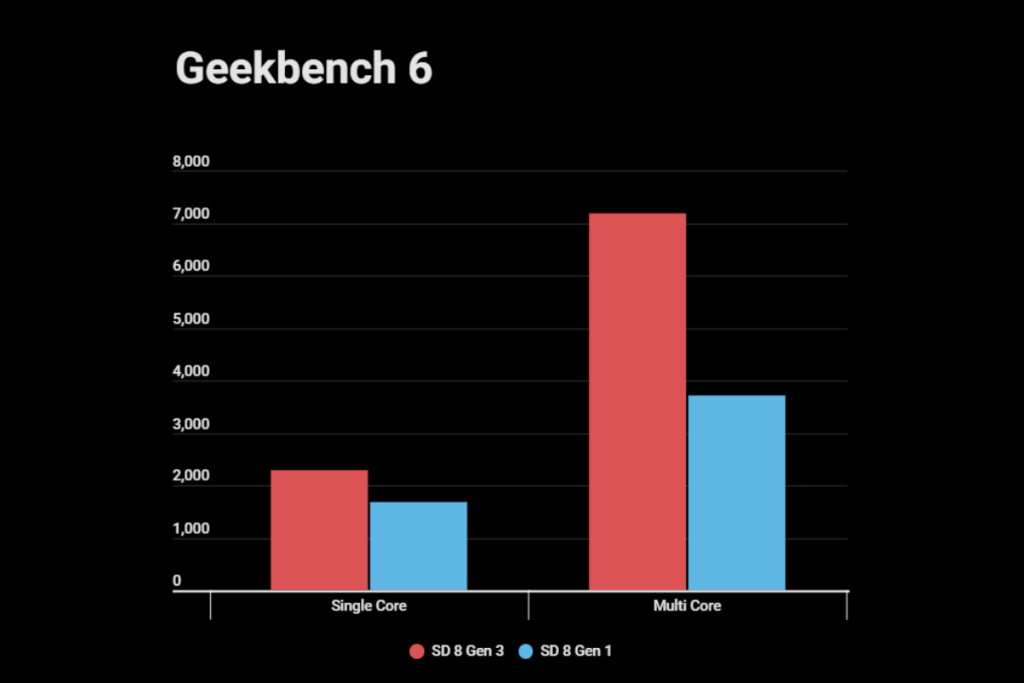
The Snapdragon 8 Gen 3 has scored 30% better in the single-core test, but the difference in the multi-score is significant — it’s almost 2x.
| SD 8 Gen 3 | SD 8 Gen 1 | |
|---|---|---|
| Single Core | 2,288 | 1,681 |
| Multi Core | 7,184 | 3,712 |
(AnTuTu 10)
AnTuTu is another popular benchmarking platform for measuring CPU, GPU, memory, and UX of devices.

AnTuTu 10 also shows a significant performance difference between the Snapdragon 8 Gen 3 and 8 Gen 1 chips. The CPU and GPU of the newer chip have over 50% better AnTuTu scores, whereas the memory score is more than 2x. Overall, the Snapdragon 8 Gen 3 has scored around 65% better than the Snapdragon 8 Gen 1.
The Snapdragon 8 Gen 3 brings major CPU and GPU upgrades, as far as the benchmarking results are concerned. However, as you already know, the benchmarks do not necessarily tell the real-world performance. But having used devices powered by these two chips, I can say the Snapdragon 8 Gen 3 has much better performance and efficiency.
| SD 8 Gen 3 | SD 8 Gen 1 | |
|---|---|---|
| CPU | 436,191 | 285,638 |
| GPU | 709,117 | 417,527 |
| Memory | 363,493 | 175,782 |
| UX | 308,966 | 219,728 |
| Total Score | 18,17,769 | 10,98,675 |
Snapdragon 8 Gen 3 vs 8 Gen 1: Key Differences
Both Snapdragon 8 Gen 3 and 8 Gen 1 are octa-core chips manufactured using a 4nm process node. The newer chip is built by TSMC, which has advanced chip manufacturing technologies that are better than Samsung, which has produced the Snapdragon 8 Gen 1. TSMC’s manufactured chips generally are more efficient than Samsung’s.
Although both are octa-core chips, their cores and core clusters differ. The SD 8 Gen 3 has a Cortex-X4 prime core, which is more powerful and efficient than the Cortex-X2 in SD 8 Gen 1. The five Cortex-A720 performance cores also perform better and are more efficient than the Cortex-A710 in the 8 Gen 1.
The Snapdragon 8 Gen 3’s Cortex-A520 offers 22% better efficiency at the same performance as the Cortex-A510 in the 8 Gen 1.
Highly efficient cores with better performance are one of the primary reasons for the huge performance gap between the two chips.
Not only the CPU but also the GPU is rocking the Snapdragon 8 Gen 3. It’s the Adreno 750, which is probably the best GPU for Android smartphones. It brings notable improvements over its predecessors and introduces new gaming features and improvements that cater to the latest gaming technologies.
Other differences include LPDDR5X support for the Snapdragon 8 Gen 3, whereas the 8 Gen 1 supports LPDDR5 RAM and has a lower peak frequency. The newer chip also supports faster storage—UFS 4.0 (vs. UFS 3.1 on 8 Gen 1). Notably, the SD 8 Gen 3 brings support for Wi-Fi 7 and Bluetooth 5.4, whereas the older chip supports Wi-Fi 6E and Bluetooth 5.3.
Snapdragon 8 Gen 3 vs 8 Gen 1: Final Words
Both the Snapdragon 8 Gen 3 and 8 Gen 1 are flagship smartphones capable of delivering smooth performance. However, the Snapdragon 8 Gen 3 is significantly ahead in terms of raw power and efficiency.
Choosing one of these two chips really depends on your preference. If you’re into high-end gaming, editing, or anything that requires a lot of processing, the Snapdragon 8 Gen 3 is the clear winner.
On the other hand, the Snapdragon 8 Gen 1 still remains a solid choice for everyday tasks and casual gaming. And the fact that Snapdragon 8 Gen 1 phones are now available at a steep discount, it’s still an excellent value for most users.
Popular SoCs Comparisons:
1. Tensor G4 vs Snapdragon 8 Gen 3: How Google Is the Latest Tensor Chip
2. Snapdragon 8+ Gen 1 vs 8 Gen 2: Not the Upgrade We Expected
3. Snapdragon 8 Gen 3 vs 8 Gen 2: Shocking Performance Differences


Comments