
Add GIZMOCHINA on Google:
As an Amazon Associate, Gizmochina earns from qualifying purchases. Links on this page may earn us a commission at no extra cost to you.
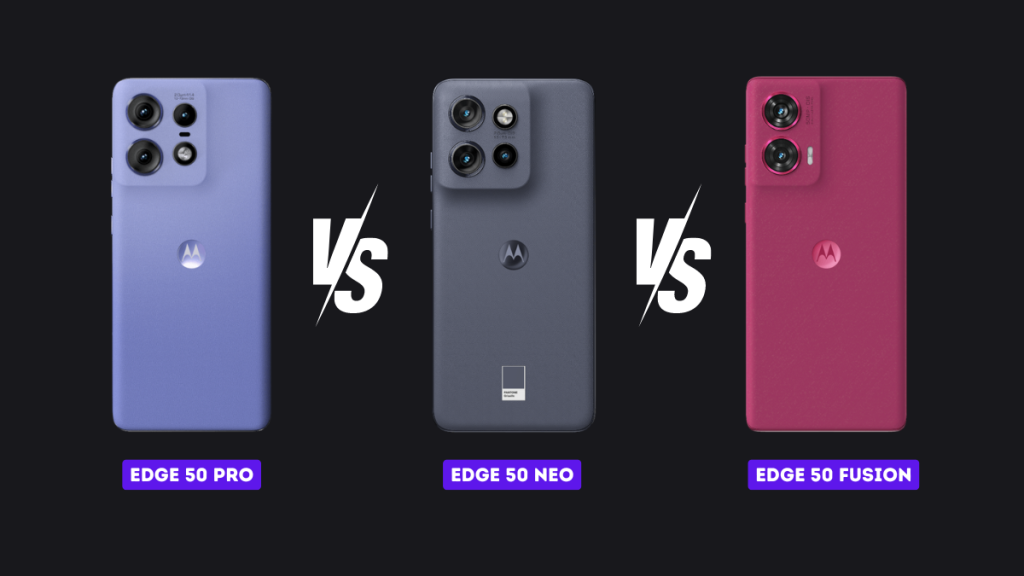
Motorola Edge 50 Pro, Edge 50 Neo, and Edge 50 Fusion are solid mid-range phones, and their competitive pricing makes it difficult to pick the right one. In this post, we’ll compare these three Edge 50 series phones to help you make the right choice based on your needs.
Let’s begin with the spec sheet:
| Edge 50 Pro | Edge 50 Neo | Edge 50 Fusion | |
|---|---|---|---|
| Release Date | April 2024 | September 2024 | May 2024 |
| Body | 161.2 x 72.4 x 8.2 mm 186 g IP68 rating | 154. x 71.2 x 8.1 mm 171 g IP68 rating | 161.9 x 73.1 x 7.9 mm 175 g IP68 rating |
| Display | 6.7″ pOLED display 1220 x 2712 pixels resolution 144Hz refresh rate HDR10+, 2000 nits (peak) Corning Gorilla Glass | 6.4″ LTPO pOLED display 1220 x 2712 pixels resolution 120Hz refresh rate HDR10+, 2800 nits (peak) Corning Gorilla Glass 3 | 6.7″ pOLED display 1080 x 2400 pixels resolution 144Hz refresh rate 1600 nits (peak) Corning Gorilla Glass 5 |
| Chipset | Snapdragon 7 Gen 3(4nm) Adreno 720 GPU | MediaTek Dimensity 7300 (4nm) Mali-G615 MC2 GPU | Snapdragon 7s Gen 2 (4nm) Adreno 710 GPU |
| RAM/Storage | 8GB/12GB LPDDR4X RAM 256GB UFS 2.2 storage | 8GB LPDDR4X RAM 256GB UFS 2.2 storage | 8GB/12GB LPDDR4X RAM 128GB/256GB UFS 2.2 storage |
| Rear Camera | 50MP (main): OIS, f/1.4, 1/1.55″ 10MP (telephoto): OIS, f/2.0, 3x optical zoom 13MP (ultrawide): f/2.2, 120˚ FOV Video: 4K @ 30fps, 1080p @ 30/60fps | 50MP (main): OIS, f/1.8, 1/1.5″ 10MP (telephoto): f/2.0, 3x optical zoom 13MP (ultrawide): f/2.2, 120˚ FOV Video: 4K @ 30fps, 1080p @ 30/60fps | 50MP (main): OIS, f/1.9, 1/1.4″, 85˚ FOV 13MP (ultrawide): f/2.2, 120˚ FOV Video: 4K @ 30fps, 1080p @ 30/60fps |
| Front Camera | 50MP: f/1.9 Video: 4K/1080p @ 30fps | 32MP: f/2.4 Video: 4K/1080p @ 30fps | 32MP: f/2.5 Video: 4K/1080p @ 30fps |
| Battery | 4,500mAh capacity 125W (wired) 50W (wireless) 10W (reverse wireless) | 4,310mAh capacity 68W (wired) 15W (wireless) | 5,000mAh capacity 68W (wired) |
| OS | Android 14 3 Android updates | Android 15 5 Android updates | Android 14 3 Android updates |
| Audio | Stereo speakers | Stereo speakers | Stereo speakers |
| Connectivity | 5G/4G/3G/2G Wi-Fi 802.11 a/b/g/n/ac/6e Bluetooth 5.4 NFC USB Type-C 3.1 | 5G/4G/3G/2G Wi-Fi 802.11 a/b/g/n/ac/6e Bluetooth 5.3 NFC USB Type-C 2.0 | 5G/4G/3G/2G Wi-Fi 802.11 a/b/g/n/ac Bluetooth 5.2 NFC USB Type-C 2.0 |
Design and Build Quality
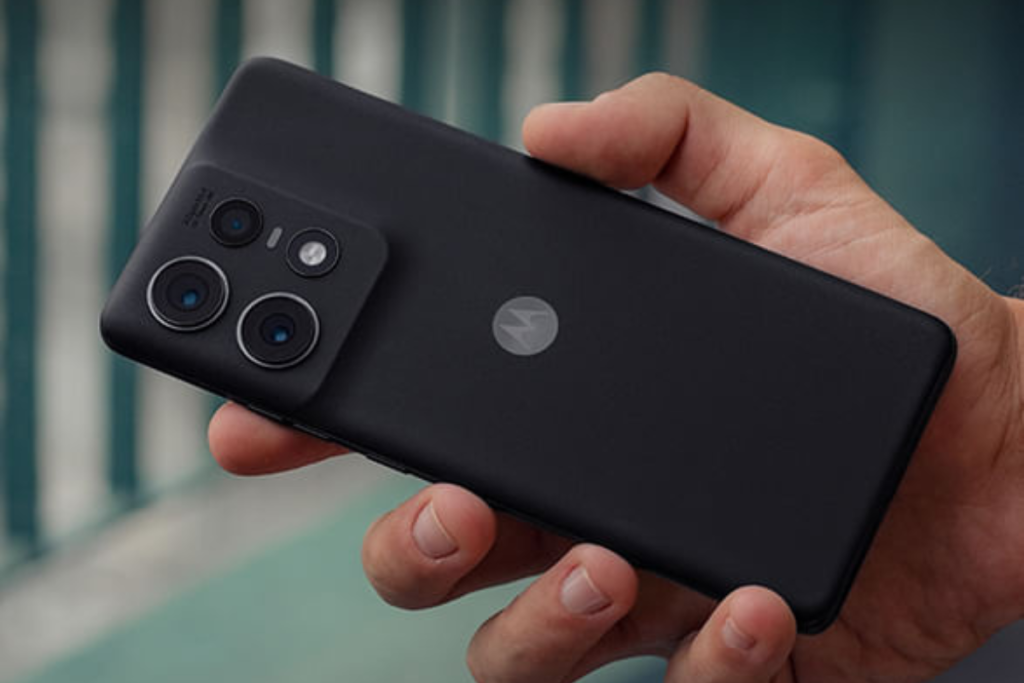
The Edge 50 Pro, Edge 50 Neo, and Edge 50 Fusion have premium designs, but only the Pro model has an aluminium frame. All three have a vegan leather finish for a premium feel.
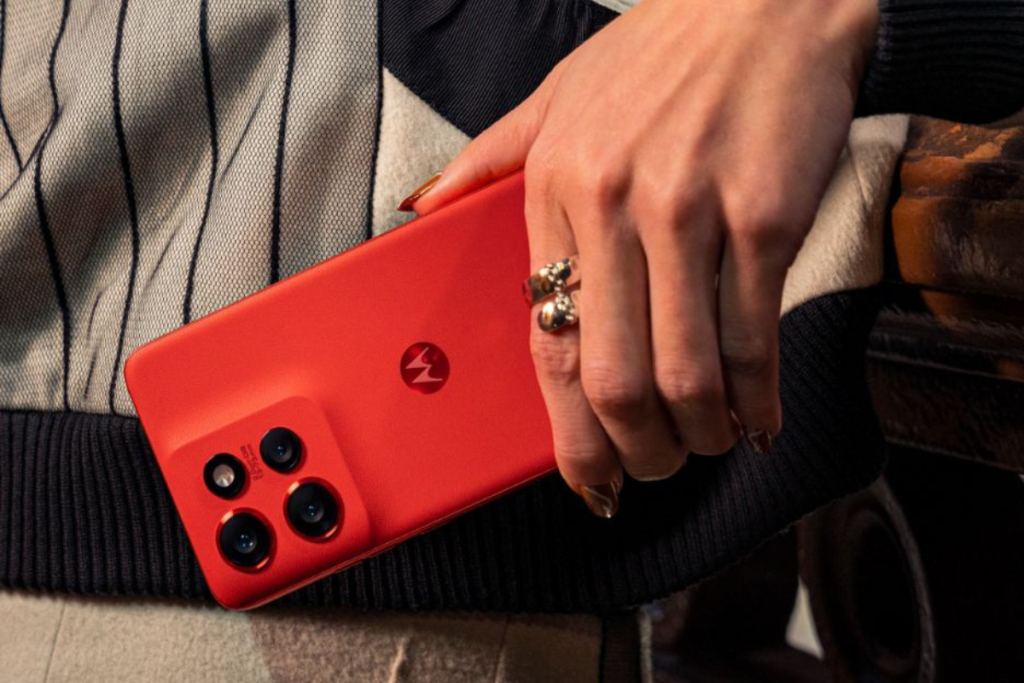
The three Edge 50 series phones have an IP68 rating for better protection against dust and water. In terms of durability, the Edge 50 Neo might have an edge over the other two because it meets military standards for durability.
The Edge 50 Pro and Edge 50 Fusions look similar; the Edge 50 Fusion differs because of a smaller camera module on the rear side, which only has two sensors. In contrast, the other two Edge 50 phones have three sensors on the back.
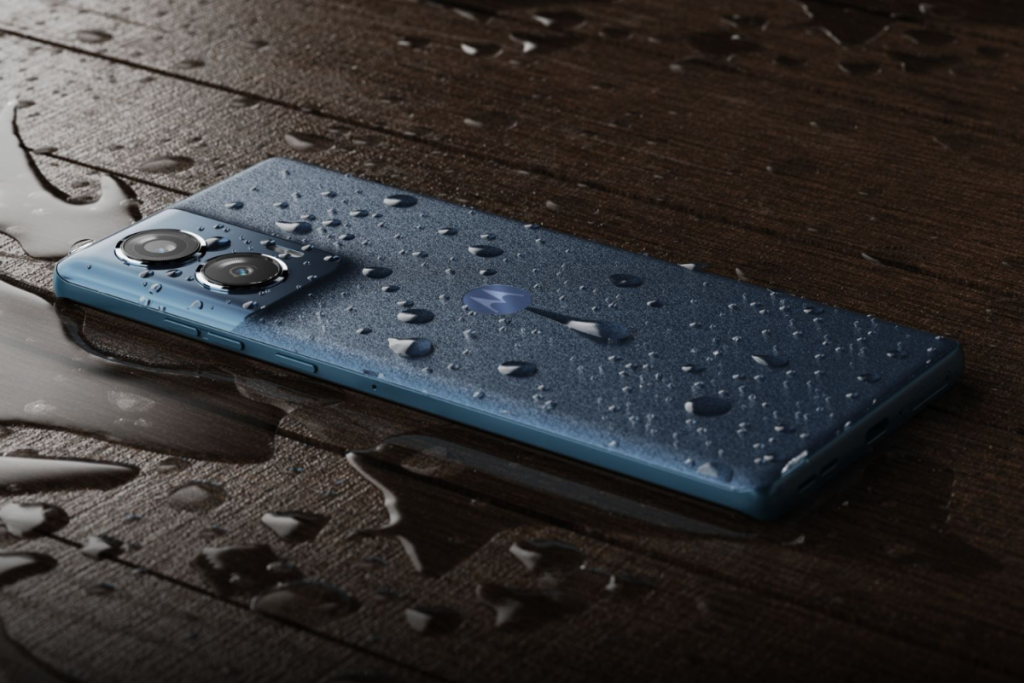
The Edge 50 Neo is slightly more compact and lightweight than the other two. However, the Edge 50 Fusion is the thinnest here.
Design is totally subjective. So, I’ll leave that to you. However, regarding durability, the Edge 50 Neo stands out because of military-grade durability. Among the other two, Edge 50 Pro wins because of its aluminium frame.
Display
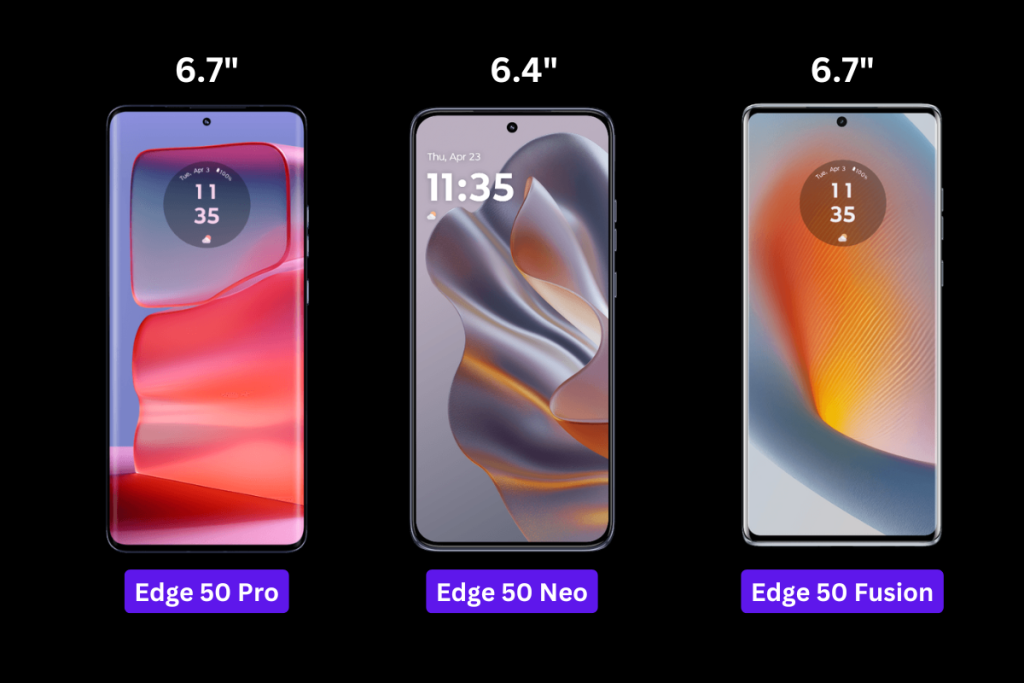
All three Edge 50 models have the same pOLED screen but have different screen sizes and resolutions. The Edge 50 Pro and Edge 50 Fusion have a 6.7-inch screen, whereas the Edge 50 Neo has a smaller 6.4-inch screen. However, the Edge 50 Neo has more pixels per inch, resulting in better details and clarity.
Among the three, the Edge 50 Neo has the highest peak brightness of 2800 nits for better visibility outdoors (vs. 2000 nits on the Edge 50 Pro and 1600 nits on the Edge 50 Fusion). Notably, the Edge 50 Pro and Edge 50 Fusion support a 144Hz refresh rate, which is limited to 120Hz on the Edge 50 Neo. However, the Edge 50 Neo has the advantage of LTPO technology that allows a dynamic refresh rate for better smoothness and power saving.
The Edge 50 Fusion is protected using Gorilla Glass 5, while the Edge 50 Neo has Gorilla Glass 3. The Edge 50 Pro also features Gorilla Glass protection, but Motorola hasn’t specified the version.
Overall, the Motorola Edge 50 Neo has a better display than the other two, but if it’s too compact for you, the Edge 50 Pro might be a better choice.
Camera
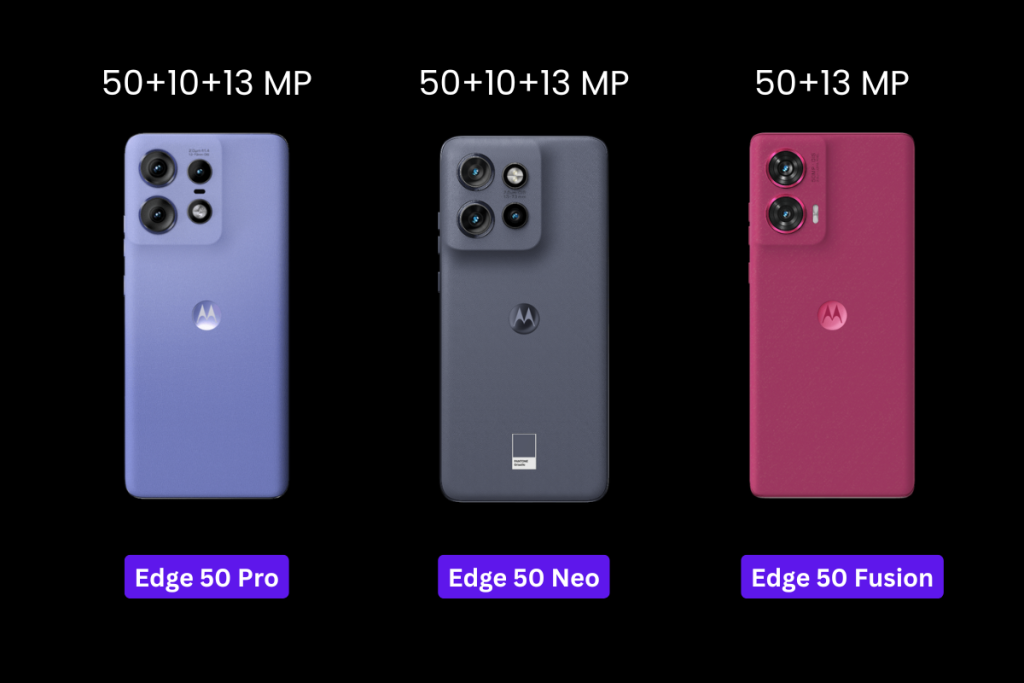
The Motorola Edge 50 Pro and Edge 50 Neo have the same rear camera setup — a 50MP primary sensor, a 10MP telephoto sensor, and a 13MP ultrawide sensor. However, the Edge 50 Pro has a slight edge because of advanced autofocus technology. The Edge 50 Fusion, on the other hand, lacks a telephoto shooter. All three can record up to 4K videos with their rear cameras.
The Edge 50 Pro has a 50MP sensor for selfies and video calling, while the other two have a 32MP sensor. All three can record 4K videos using their selfie cameras, too.
The bottom line is that the Edge 50 Pro has the best camera setup of the three. The Edge 50 Neo is second, and the Edge 50 Fusion is third in terms of camera performance.
Performance

The Edge 50 Pro is powered by a Snapdragon 7 Gen 3 chip, the Edge 50 Neo has Dimensity 7300, and the Edge 50 Fusion has Snapdragon 7s Gen 2.
The Snapdragon 7 Gen 3 inside the Edge 50 Pro outperforms the other two. It has better performance and efficiency, although the difference between the other two isn’t significant.
So, the Edge 50 Pro can handle games better than the Edge 50 Neo and Edge 50 Fusion. However, the other two phones have similar performance.
The Edge 50 Pro is a better choice if you’re really into gaming. However, the other two devices would also work fine for regular day-to-day tasks and light gaming.
Battery & Charging
The Edge 50 Fusion has the highest battery capacity of all three — 5,000mAh (vs. 4,500mAh on the Edge 50 Pro and 4,310mAh on the Edge 50 Neo). But when it comes to charging, the Edge 50 Pro leaves the other two in the dust.
The Edge 50 Pro supports 125W wired charging, 50W wireless charging, and 10W reverse wireless charging. The Edge 50 Neo and Edge 50 Fusion supports 68W wired charging, but the former also supports 15W wireless charging, lacking on the Edge 50 Fusion.
Although the Edge 50 Pro doesn’t have the biggest battery of all three, the charging capabilities make up for it. The device only takes 18 minutes to reach 100% battery capacity, while the other two reach 50% in 15 minutes.
Software
All three Edge 50 models come with Android 14 out of the box. However, the Edge 50 Pro and Edge 50 Fusion will only get three Android upgrades, whereas the Edge 50 Neo will get two additional Android updates. This means the Edge 50 Neo will stay relevant for two more years after the other two become outdated.
Connectivity
Connectivity is another crucial factor that can affect your purchase decision. The Edge 50 Pro and Edge 50 Neo support Wi-Fi 6E, whereas the Edge 50 Fusions support Wi-Fi 5. The newer Wi-Fi standard reduces congestion and offers higher peak download/upload speed.
The Edge 50 Pro has Bluetooth 5.4, Edge 50 Neo has Bluetooth 5.3, and Edge 50 Fusion has Bluetooth 5.2. Only the Edge 50 Pro supports NavIC.
The Edge 50 Neo and Edge 50 Fusion support USB Type-C 2.0, while the Edge 50 Pro has USB Type-C 3.1, offering faster data transfer over a USB connection.
So, the Motorola Edge 50 Pro has the best connectivity features. Then comes the Edge 50 Neo and then the Edge 50 Fusion.
Motorola Edge 50 Pro vs Edge 50 Neo vs Edge 50 Fusion: Which Is the Best?
The Motorola Edge 50 Pro, Edge 50 Neo, and Edge 50 Fusion are solid budget phones, but choosing one really comes down to your priorities.
The Edge 50 Pro sounds better than the other two in most aspects. It has the fastest chip and charging speed and features better connectivity and camera features. If you’re only looking for a camera phone and don’t care about gaming, the Edge 50 Neo will save you some money.


Please Note: When you buy something using the links in our articles, we may earn a small commission at no cost to you.
The Edge 50 Fusion is suitable for light users and those who consume much content, as it packs the largest battery among the three phones.
Which of these three Edge 50 models ticks most of your requirements? Share your thoughts in the comment section below.



Comments