
Add GIZMOCHINA as Preferred Source on Google
As an Amazon Associate, Gizmochina earns from qualifying purchases. Links on this page may earn us a commission at no extra cost to you.
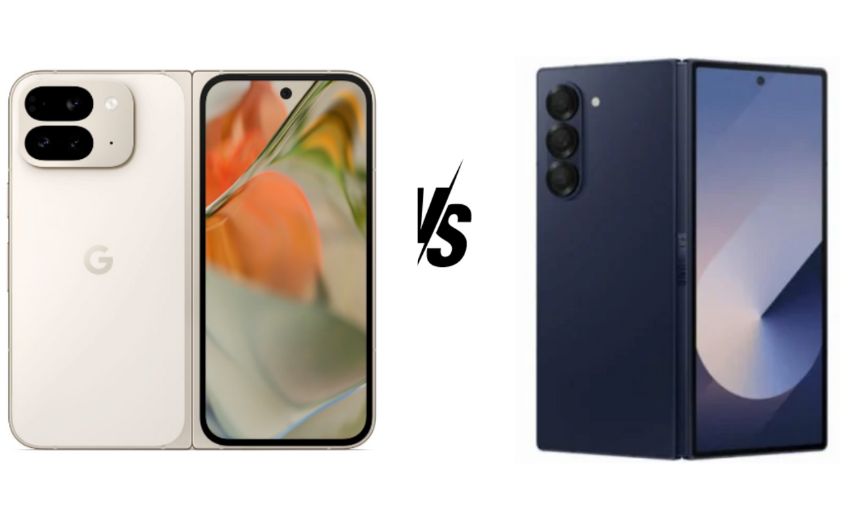
Foldable smartphones are shaping the future of mobile devices, and the competition between Google’s Pixel 9 Pro Fold and Samsung’s Galaxy Z Fold 6 marks a milestone in innovation. Both devices offer cutting-edge technology, but which is the better buy? In this article, we’ll compare these two devices across several key parameters like design, display, performance, cameras, and battery life, to help you make an informed decision.
Design: Build, Durability, and Usability
Features
Both the Pixel 9 Pro Fold and Galaxy Z Fold 6 follow a similar blueprint with foldable form factors, combining Gorilla Glass Victus 2 on the front and back, with an aluminum frame for enhanced durability. These materials ensure the phones can handle everyday use without getting damaged easily. However, Samsung’s Galaxy Z Fold 6 comes with an Enhanced Armor Aluminum frame that promises tougher resistance to drops and scratches, which gives it an edge in durability.
Both devices have IPX8 water resistance, protecting them from submersion in water for short periods. The Pixel 9 Pro Fold has eSIM and Nano-SIM support, while the Galaxy Z Fold 6 offers more flexibility by supporting up to two Nano-SIMs and multi eSIM, which is ideal for frequent travelers.
Similarities
- Foldable design with glass and aluminum build.
- Both are IPX8 water-resistant.
- No support for expandable memory cards.
Differences
- The Pixel 9 Pro Fold lacks stylus support, while the Galaxy Z Fold 6 supports the S Pen, offering more versatility for tasks like note-taking or drawing.
- The Galaxy Z Fold 6 has a slight edge in terms of build robustness, thanks to its Armor Aluminum frame.
Which is Better?
While both phones are premium in terms of design, Samsung’s Galaxy Z Fold 6 offers more durability and versatility (thanks to stylus support and its dual SIM capability). If you’re looking for a foldable phone that you can use for both work and creative tasks, the Z Fold 6 may be more practical.
Display, Media, and Software
Features
When it comes to displays, both phones push boundaries with 120Hz foldable OLED screens. The Pixel 9 Pro Fold features a larger 8.0-inch LTPO OLED main display with a resolution of 2076 x 2152 pixels and a peak brightness of 2700 nits, making it perfect for outdoor visibility and high-quality HDR content. The cover display is also impressive, measuring 6.3 inches with a 1080 x 2424 resolution and similar brightness levels.
The Galaxy Z Fold 6 has a slightly smaller 7.6-inch Dynamic AMOLED 2X main screen, with a resolution of 1856 x 2160 pixels and a peak brightness of 2600 nits. The cover screen is also 6.3 inches, but its resolution is lower at 968 x 2376 pixels. However, the Z Fold 6’s 91% screen-to-body ratio makes the design feel sleeker and more immersive.
On the software front, both devices run Android 14, but Samsung’s One UI 6.1.1 offers extra customization features and a more refined multitasking experience, supported by Samsung’s DeX desktop experience, which turns the phone into a workstation.
Similarities
- Foldable OLED displays with 120Hz refresh rates.
- HDR10+ support for immersive media.
- Both run on Android 14.
Differences
- The Pixel 9 Pro Fold offers a larger main display and higher peak brightness.
- Samsung offers the DeX desktop experience for multitasking and productivity, which Google lacks.
- Pixel 9 Pro Fold provides 7 major Android updates, while the Galaxy Z Fold 6 offers 4 years of updates.
Which is Better?
For sheer display quality, the Pixel 9 Pro Fold takes the lead with its larger and brighter main screen. However, for software features and multitasking, the Galaxy Z Fold 6 is a better choice, particularly for users who need a productivity-oriented device.
Performance and Battery
Features
The Pixel 9 Pro Fold is powered by the Google Tensor G4 chipset with an octa-core CPU and Mali-G715 MC7 GPU. This chipset is optimized for Google’s software, ensuring seamless performance, especially in AI-driven tasks. The phone comes with 16GB of RAM and UFS 3.1 storage, ensuring quick read and write speeds.
The Galaxy Z Fold 6 sports the newer Qualcomm Snapdragon 8 Gen 3 chipset, paired with 12GB of RAM and UFS 4.0 storage. Qualcomm’s Gen 3 processor offers superior performance, especially in graphics-intensive tasks and power efficiency. This means faster processing for gaming, multitasking, and rendering compared to Google’s Tensor G4.
Battery life differs slightly: the Pixel 9 Pro Fold has a 4650 mAh battery with 21W wired charging and 7.5W wireless charging, while the Galaxy Z Fold 6 has a slightly smaller 4400 mAh battery, but faster charging speeds with 25W wired and 15W wireless charging. The Z Fold 6 also supports reverse wireless charging.
Similarities
- Both phones feature octa-core CPUs with high-end performance.
- No expandable memory card support.
Differences
- Galaxy Z Fold 6 has a more advanced Snapdragon 8 Gen 3 processor with superior power efficiency.
- The Pixel 9 Pro Fold offers a larger battery, but the Z Fold 6 has faster charging speeds and reverse wireless charging.
Which is Better?
In terms of performance, the Galaxy Z Fold 6 edges out the Pixel due to its more powerful Snapdragon chipset and faster storage. However, the Pixel 9 Pro Fold offers a slightly longer battery life, making it better for users who prioritize endurance over raw power.
Cameras
Features
The Pixel 9 Pro Fold is equipped with a 48 MP wide lens, a 10.8 MP telephoto lens with 5x optical zoom, and a 10.5 MP ultrawide lens. Google’s camera software has long been a selling point, and the Zoom Enhance and Best Take features ensure that you capture high-quality, AI-optimized images. Video capabilities are strong, with support for 4K@60fps and 10-bit HDR.
The Galaxy Z Fold 6 has a slightly more versatile camera setup: a 50 MP wide lens, a 10 MP telephoto lens with 3x optical zoom, and a 12 MP ultrawide lens. It shines in video recording with support for 8K@30fps video, something the Pixel lacks. The Z Fold 6 also boasts under-display selfie cameras, which help reduce distractions on the large screen.
Similarities
- Triple-camera setups with telephoto, wide, and ultrawide lenses.
- Both support 4K video recording and offer excellent photography features.
Differences
- The Galaxy Z Fold 6 supports 8K video recording, while the Pixel does not.
- Pixel 9 Pro Fold offers better optical zoom (5x vs. 3x).
- Samsung has an under-display selfie camera, which is more innovative but delivers slightly lower-quality images than traditional lenses.
Which is Better?
If zoom and AI-powered photography are important, the Pixel 9 Pro Fold takes the crown. However, if you’re into video recording, the Galaxy Z Fold 6 offers a better experience, especially with its 8K video and under-display camera.
Conclusion: Which is the Better Buy?
Both the Pixel 9 Pro Fold and the Galaxy Z Fold 6 are impressive foldable phones, but they serve slightly different audiences.
- If you prioritize display quality, AI-powered cameras, and software updates, the Pixel 9 Pro Fold is the better choice. It’s ideal for users who are heavily integrated into Google’s ecosystem and value photography features like enhanced zoom and photo optimization.
- On the other hand, if you value performance, multitasking, and flexibility (thanks to the S Pen and DeX features), the Galaxy Z Fold 6 is the better pick. Its superior chipset, better video recording capabilities, and more robust design make it perfect for power users and professionals.
In the end, your choice should depend on your specific needs, whether it’s creativity and photography with the Pixel or productivity and performance with the Galaxy Z Fold 6.


Please Note: When you buy something using the links in our articles, we may earn a small commission at no cost to you.


Comments