
Add GIZMOCHINA as Preferred Source on Google
As an Amazon Associate, Gizmochina earns from qualifying purchases. Links on this page may earn us a commission at no extra cost to you.
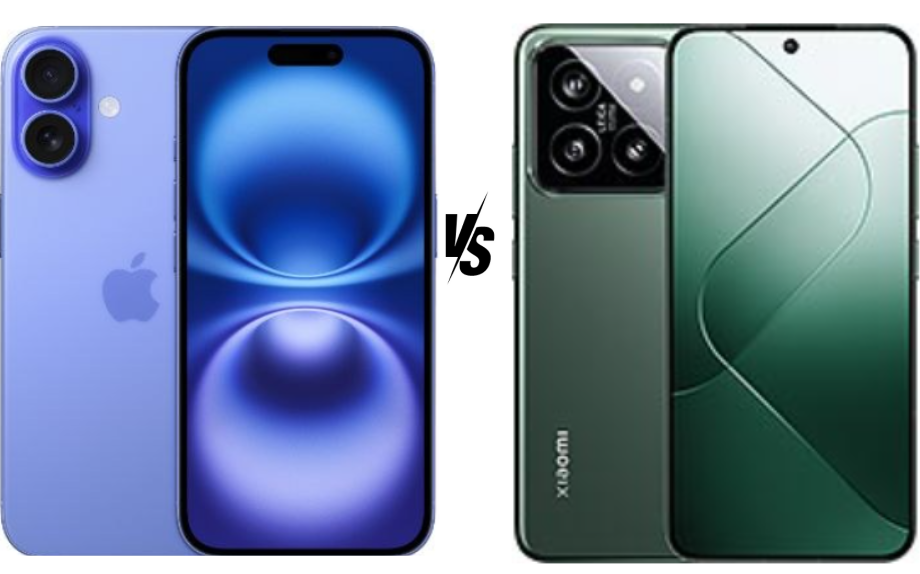
iPhone 16 and Xiaomi 14 are two flagship smartphones that sit at the pinnacle of their respective ecosystems, with Apple bringing refinement and iOS innovation, while Xiaomi pushes the boundaries of Android with its latest technologies. In this comparison, we’ll explore these two phones across various key parameters: design, display, media, software, performance, battery, and cameras. By the end, we’ll determine which is the better buy for different kinds of users.
Design
Features
The Apple iPhone 16 offers a sleek and premium design with a glass front and back (Corning-made glass) alongside an aluminum frame. The phone is IP68 dust and water-resistant (up to 6 meters for 30 minutes), a standard that ensures durability. It comes in multiple SIM configurations, including Nano-SIM, dual eSIM, and dual SIM (for China).
On the other hand, the Xiaomi 14 has a similar build quality with a Gorilla Glass Victus front and a choice between glass or silicone polymer for the back, supported by an aluminum frame. It too is IP68 certified, but with slightly lower water resistance (up to 1.5 meters for 30 minutes).
Similarities
Both phones exhibit premium materials, have similar dust and water resistance, and offer sleek and modern looks. They both lack a 3.5mm headphone jack, continuing the trend toward wireless audio.
Differences
The iPhone 16’s ceramic shield glass adds an extra layer of durability compared to the Xiaomi 14’s Gorilla Glass Victus. However, Xiaomi offers more variety in terms of back materials (silicone polymer option) for a different feel in the hand. Additionally, Xiaomi includes an infrared port, a feature not found in the iPhone 16, which can be handy for controlling home devices.
Advantages
The iPhone 16 may offer a slightly more premium feel due to the Ceramic Shield glass and Apple’s reputation for impeccable craftsmanship. However, Xiaomi’s design includes more flexibility with materials and a useful IR blaster for controlling external devices, making it more versatile in certain scenarios.
Which is Better?
If aesthetics, build quality, and brand appeal are your priorities, the iPhone 16 edges out with its slightly more premium materials and reputation for design consistency. However, for users who appreciate practicality, the Xiaomi 14’s infrared port and material variety might be more compelling.
Display, Media, and Software
Features
The iPhone 16 features a 6.1-inch Super Retina XDR OLED display with a resolution of 1179 x 2556 pixels and a peak brightness of 2000 nits. It supports HDR10, Dolby Vision, and is protected by Ceramic Shield glass. This OLED panel is known for its color accuracy, deep blacks, and consistent brightness.
The Xiaomi 14, meanwhile, offers a slightly larger 6.36-inch LTPO OLED display with a higher resolution of 1200 x 2670 pixels. Its peak brightness reaches an impressive 3000 nits, and it also supports Dolby Vision, HDR10+, and 120Hz refresh rate. Xiaomi uses Corning Gorilla Glass Victus for protection.
Similarities
Both devices support advanced HDR standards (HDR10, Dolby Vision), ensuring high-quality video playback. They also have similar pixel densities (~460 PPI), which means that both phones deliver sharp images and text. Dolby Vision makes both displays fantastic for media consumption.
Differences
The Xiaomi 14’s display is not only larger but also significantly brighter, with a peak brightness of 3000 nits compared to the iPhone’s 2000 nits. This could make a big difference in outdoor visibility and HDR content. Additionally, Xiaomi’s display supports LTPO technology, enabling dynamic refresh rate adjustments from 1Hz to 120Hz, which can conserve battery life during different usage scenarios. The iPhone, on the other hand, uses a fixed refresh rate.
Advantages
In terms of sheer display technology, the Xiaomi 14 pulls ahead with its higher brightness and adaptive refresh rate. This makes it better for users who prioritize a larger screen and smoother visuals, particularly during gaming or media consumption. The iPhone’s display is still excellent but may not be as adaptable in diverse scenarios.
Which is Better?
For users who prioritize display quality for media and gaming, the Xiaomi 14 is the clear winner due to its larger size, higher peak brightness, and dynamic refresh rate.
Performance and Battery
Features
The iPhone 16 is powered by the Apple A18 chipset, built on a 3nm process. It boasts a Hexa-core CPU and 5-core GPU, with configurations of 8GB RAM and storage options up to 512GB. Apple’s iOS 18 software is optimized to work seamlessly with the hardware, ensuring smooth multitasking and app performance.
The Xiaomi 14 runs on Qualcomm’s Snapdragon 8 Gen 3, built on a 4nm process. It features an Octa-core CPU and Adreno 750 GPU, with up to 16GB of RAM and storage options that reach 1TB. Xiaomi’s HyperOS (based on Android 14) provides extensive customization and a unique user experience.
Similarities
Both phones are built on cutting-edge chipsets, ensuring top-tier performance for gaming, multitasking, and day-to-day use. Neither offers expandable storage via a microSD card.
Differences
While both phones are powerful, the Xiaomi 14 offers a wider range of RAM and storage options (up to 16GB RAM and 1TB storage). Xiaomi’s Snapdragon 8 Gen 3 may provide better performance in gaming and AI-driven tasks due to its octa-core configuration. Meanwhile, Apple’s A18 chip is well-known for its superior single-core performance, which can translate into faster app launches and smoother performance in daily tasks.
In terms of battery, Xiaomi has a clear advantage with its 4610 mAh battery and 90W wired charging, reaching 100% in just 31 minutes. It also supports 50W wireless charging and 10W reverse wireless charging. The iPhone 16, on the other hand, offers a smaller, unspecified battery with 25W wireless charging and reverse wired charging capabilities.
Advantages
For users seeking the most performance for gaming, multitasking, and overall heavy use, the Xiaomi 14 takes the lead with its superior battery life, faster charging, and higher RAM capacity. Apple’s software is more refined, but Xiaomi’s raw power and charging speeds are hard to ignore.
Which is Better?
In terms of raw performance and battery management, Xiaomi 14 offers more flexibility with faster charging, larger battery, and higher RAM options, making it better suited for power users.
Cameras
Features
The iPhone 16 sports a dual-camera system with a 48MP wide lens and a 12MP ultrawide lens. It excels in video recording with 4K Dolby Vision HDR and offers stereo sound recording. On the front, it has a 12MP selfie camera with support for 3D facial recognition (SL 3D sensor).
The Xiaomi 14 comes with a more versatile triple-camera setup, including a 50MP wide lens, a 50MP telephoto lens (3.2x optical zoom), and a 50MP ultrawide lens. This Leica-branded system offers an exceptional range of shooting options and supports 8K video recording. The front camera is a 32MP sensor, providing higher resolution selfies compared to the iPhone.
Similarities
Both devices offer high-end camera systems capable of recording in 4K. Their wide and ultrawide cameras are powerful enough for most photography needs, and both phones cater to users who care about HDR and Dolby Vision support.
Differences
The Xiaomi 14’s triple-camera setup provides more versatility with an additional telephoto lens, allowing for optical zoom, a feature the iPhone lacks. Xiaomi’s 8K video recording also offers more future-proofing for high-resolution content. On the selfie front, Xiaomi’s 32MP sensor far outclasses the iPhone’s 12MP in terms of resolution, offering crisper images.
Advantages
Xiaomi’s camera system is more flexible and powerful, especially with its Leica partnership and inclusion of telephoto capabilities, making it better suited for those who prioritize photography. The iPhone 16’s dual-camera system is still excellent but is more geared toward users who rely heavily on the ecosystem for media sharing and social media uploads.
Which is Better?
The Xiaomi 14 is the better option for photography enthusiasts, while the iPhone 16 may still appeal to users who prioritize ease of use and video recording in Apple’s ecosystem.


Please Note: When you buy something using the links in our articles, we may earn a small commission at no cost to you.
Our Opinion
Both the iPhone 16 and Xiaomi 14 are stellar devices, but they cater to different types of users. The iPhone 16 excels in design, software refinement, and integration with Apple’s ecosystem, making it ideal for users who are invested in the Apple ecosystem and value a polished, consistent experience.
However, the Xiaomi 14 pulls ahead in terms of raw performance, camera versatility, battery life, and charging speeds. Its display is also more impressive, with higher brightness and a dynamic refresh rate. Additionally, Xiaomi offers more RAM and storage


Comments