
Add GIZMOCHINA as Preferred Source on Google
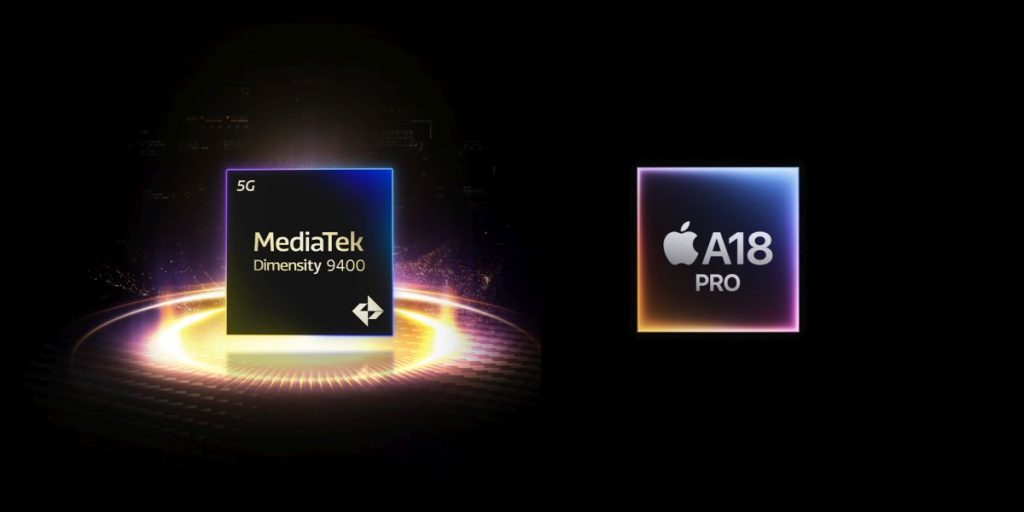
MediaTek recently unveiled the Dimensity 9400 as its most powerful chipset for mobile devices. The upcoming Vivo X200 series and Oppo Find X8 series will feature the D9400 SoC. The chipset has managed to breach the 3 million mark on AnTuTu, showcasing its remarkable performance. How does it fare against the Apple A18 Pro, which powers models like the iPhone 16 Pro and iPhone 16 Pro Max? This post provides a detailed comparison of these two processors, examining their performance, AI capabilities, power efficiency, and overall impact on the smartphone market.
1. Performance and Architecture
The MediaTek Dimensity 9400 is built on TSMC’s second-generation 3nm process, featuring an impressive array of cores: one Arm Cortex-X925 core operating at over 3.62GHz, three Cortex-X4 cores, and four Cortex-A720 cores. This configuration offers a 35 percent increase in single-core performance and a 28 percent boost in multi-core performance compared to its predecessor, the Dimensity 9300.
On the other hand, Apple’s A18 Pro is also manufactured using TSMC’s 3nm technology, with a six-core CPU composed of two performance cores clocked at 4.05GHz and four efficiency cores. Apple’s design focuses on balancing power and efficiency, delivering a processor that is both powerful and energy efficient. Benchmarks tests suggest that the A18 Pro can surpass the Dimensity 9400 in single-core performance. However, in multi-core scenarios, the 8-core design of the Dimensity 9400 might give it an edge.
2. Graphics and Gaming
When it comes to graphics and gaming, both chipsets push the boundaries of mobile GPU performance. The Dimensity 9400 features a 12-core Arm Immortalis-G925 GPU, providing a 40 percent boost in ray tracing performance and a 41% increase in peak performance compared to the Dimensity 9300. It also supports HyperEngine technology for super-resolution and improved picture quality, making it a formidable choice for gaming enthusiasts.
The Apple A18 Pro, with its six-core GPU, is nearly 40 percent faster than the GPU in the iPhone 15 series, enhancing the gaming experience and computational photography capabilities. This significant improvement ensures that the A18 Pro remains competitive against the latest Snapdragon processors. Early benchmarks of the D9400 suggest a significant lead over the A18 Pro’s 6-core GPU, particularly in graphics-intensive tasks and gaming.
3. AI Capabilities
AI and machine learning have become crucial in modern smartphones, and both the Dimensity 9400 and A18 Pro excel in this domain. The Dimensity 9400 is equipped with MediaTek’s 8th generation NPU, which introduces industry-first features like on-device LoRA training and high-quality video generation. It is designed to support agentic AI applications, offering up to 80 percent faster performance in large language model (LLM) prompts and 35 percent greater power efficiency compared to the Dimensity 9300.
Apple’s A18 Pro, with its new 16-core neural engine, can perform 35 trillion operations per second, more than doubling the AI processing power of the A16 Bionic. This enhancement allows for faster and more efficient on-device AI tasks, such as computational photography and voice recognition.
4. Power Efficiency
Power efficiency is a critical factor for mobile processors, impacting battery life and overall device performance. The Dimensity 9400 is up to 40 percent more power-efficient than its predecessor, the Dimensity 9300. This improvement translates to longer battery life, even under heavy use.
The Dimensity 9400 and Apple A18 Pro are built on TSMC’s advanced 3nm process, but with slight variations. The Dimensity 9400 utilizes TSMC’s N3B process, while the A18 Pro is uses the more advanced and power-efficient N3P process. This could give the A18 Pro an edge in power consumption and thermal management.
5. Additional Features
Beyond raw performance, both processors incorporate features that enhance the overall user experience. The Dimensity 9400 supports HDR video recording throughout the entire zoom range, with MediaTek’s Smooth Zoom technology for capturing moving subjects. It also includes Imagiq 1090 for improved image processing. A refreshed 5G modem with up to 7Gbps sub-6GHz performance, Wi-Fi 7 tri-band MLO support, and MediaTek Xtra Range 3.0 for extended Wi-Fi coverage. Additionally, the Dimensity 9400’s dual SIM dual active (DSDA) capabilities offer greater flexibility for users.
Apple’s A18 Pro likely integrates a custom 5G modem with similar capabilities. Additionally, the new chip continues the tradition of integrating advanced technologies seamlessly into the iOS ecosystem. Its 16-core neural engine enhances on-device AI calculations, making tasks like image processing and real-time language translation more efficient. The A18 Pro’s architecture also supports future-proofing for larger AI models, ensuring the chipset remains relevant as AI technology evolves.
6. Final Thoughts
The Dimensity 9400 and Apple A18 Pro represent the pinnacle of mobile chip technology, each with its own strengths and weaknesses. The Dimensity 9400 appears to have a significant advantage in GPU performance, potentially making it a better choice for gamers. Its “all-big-core” CPU design and advanced AI capabilities also make it a strong contender.
Apple’s A18 Pro, while potentially lagging in GPU performance, is likely to excel in single-core CPU performance and power efficiency. Its tightly integrated design and optimization within the Apple ecosystem will continue to be a major advantage. Both chipsets cater to different segments of the market, but they share a common goal: delivering unparalleled performance and efficiency to meet the demands of modern smartphone users.




Comments