
Add GIZMOCHINA as Preferred Source on Google
As an Amazon Associate, Gizmochina earns from qualifying purchases. Links on this page may earn us a commission at no extra cost to you.
In the battle of the Titans, the iPhone 16 Pro Max and Xiaomi 14 Ultra stand out as premium flagship smartphones in 2024. Both devices push boundaries in design, performance, camera technology, and battery life. However, their distinct ecosystems, feature sets, and target audiences make them appealing in different ways. This article provides a detailed comparison of the two phones across several key areas to determine which one might be the better buy for you.
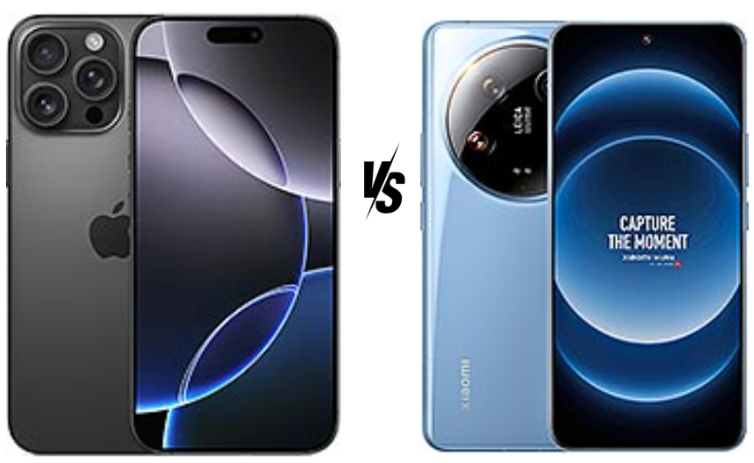
| Category | iPhone 16 Pro Max | Xiaomi 14 Ultra | Best Specs |
| Design | Glass front & back (Corning-made), titanium frame, IP68 (6m for 30 min) | Glass or eco-leather back, titanium/aluminum frame, IP68 (1.5m for 30 min) | iPhone 16 Pro Max (better water resistance, premium build) |
| Display | 6.9″ LTPO Super Retina XDR OLED, 120Hz, 2000 nits (HBM) | 6.73″ LTPO AMOLED, 120Hz, 3000 nits (peak) | Xiaomi 14 Ultra (higher brightness and pixel density) |
| Performance | Apple A18 Pro (3nm), Hexa-core, NVMe storage, 8GB RAM | Snapdragon 8 Gen 3 (4nm), Octa-core, UFS 4.0 storage, up to 16GB RAM | Xiaomi 14 Ultra (more RAM, top-tier Snapdragon chipset) |
| Battery | 4685 mAh, 50W wired, 25W wireless (MagSafe) | 5000 mAh (International) or 5300 mAh (China), 90W wired, 80W wireless | Xiaomi 14 Ultra (larger battery, faster charging) |
| Cameras | Triple: 48MP wide, 12MP telephoto, 48MP ultrawide, LiDAR scanner | Quad: 50MP wide, 50MP telephoto, 50MP periscope, 50MP ultrawide, TOF 3D | Xiaomi 14 Ultra (higher MP and Leica optics) |
| Selfie Camera | 12MP, 4K video, OIS | 32MP, 4K video | Xiaomi 14 Ultra (higher MP, better resolution) |
Design: Premium Materials and Durability
Both the iPhone 16 Pro Max and Xiaomi 14 Ultra boast top-tier build quality, but they approach design from different philosophies.
Features
The iPhone 16 Pro Max is built with a glass front and back, both crafted from Corning-made glass and surrounded by a titanium frame, which enhances durability and gives it a premium feel. It offers IP68 dust and water resistance (up to 6 meters for 30 minutes), ensuring protection in extreme conditions. Xiaomi 14 Ultra, on the other hand, uses either a glass or eco-leather back and a frame made from titanium or aluminum alloy, giving users the option to choose between materials. It also holds an IP68 rating but can only withstand water immersion up to 1.5 meters for 30 minutes.
Similarities
Both phones use premium materials like titanium, enhancing their robustness and resistance to damage. They also share the same IP68 rating, making them highly resistant to dust and water.
Differences
The most significant design difference lies in the material choices. The iPhone offers a sleeker, more refined aesthetic with its all-glass build, while Xiaomi offers customization with either glass or eco-leather. In terms of durability, iPhone’s ceramic shield glass, especially the 2024 generation, is designed to offer superior protection against drops and scratches. Xiaomi’s use of “Xiaomi Shield Glass” or “Longjing Glass” focuses on high durability but lacks the industry recognition of Apple’s Ceramic Shield.
Which is Better?
If you prioritize customization and a more rugged, utilitarian aesthetic, Xiaomi’s eco-leather variant may appeal more. However, for those looking for a polished, premium, and resilient design, the iPhone 16 Pro Max takes the crown, particularly with its advanced glass protection.
Display, Media, and Software: OLED Brilliance vs. AMOLED Power
Features
The iPhone 16 Pro Max features a 6.9-inch LTPO Super Retina XDR OLED display, delivering 120Hz refresh rates, HDR10, Dolby Vision support, and a peak brightness of 2000 nits. This ensures outstanding brightness and contrast, with a near-bezel-free screen achieving a 91.4% screen-to-body ratio. The Xiaomi 14 Ultra, slightly smaller at 6.73 inches, offers an LTPO AMOLED display, supporting 68 billion colors, 120Hz refresh rate, Dolby Vision, and HDR10+. The standout feature here is the peak brightness of 3000 nits, making it one of the brightest displays in the industry.
Similarities
Both displays utilize LTPO technology, enabling adaptive refresh rates up to 120Hz, which balances smoothness with battery efficiency. They also both support Dolby Vision and HDR10+, ensuring immersive media experiences with excellent contrast and color accuracy.
Differences
While iPhone’s screen is larger, Xiaomi offers a higher pixel density of 522 ppi (versus iPhone’s 460 ppi), giving it a slight edge in sharpness. Xiaomi also boasts a significantly higher peak brightness of 3000 nits, making it more suitable for outdoor viewing in direct sunlight compared to iPhone’s 2000 nits.
Which is Better?
If media consumption in bright environments is a priority, Xiaomi’s ultra-bright AMOLED display is hard to beat. However, for those who value a larger screen with Apple’s renowned color accuracy and smoothness, the iPhone 16 Pro Max remains a top choice.
Performance and Battery: Apple’s A18 Pro vs. Snapdragon 8 Gen 3
Features
The iPhone 16 Pro Max is powered by Apple’s cutting-edge A18 Pro chipset, built on a 3 nm architecture, which offers a Hexa-core CPU and a 6-core GPU. This makes the iPhone a powerhouse in terms of speed, efficiency, and graphical performance. Xiaomi 14 Ultra, on the other hand, uses Qualcomm’s Snapdragon 8 Gen 3 chipset, built on a 4 nm process, with an Octa-core CPU and Adreno 750 GPU. The Snapdragon chipset ensures high performance across gaming, multitasking, and AI-driven applications.
In terms of battery, the iPhone houses a 4685 mAh battery, while the Xiaomi comes with a larger 5000 mAh battery for the international model (5300 mAh for China). Xiaomi also leads in charging technology with 90W wired charging and 80W wireless charging, far outpacing Apple’s 50% charge in 30 minutes with its 25W wireless charging.
Similarities
Both phones are built for speed and efficiency with top-tier chipsets that support high-end gaming, multitasking, and advanced AI features.
Differences
Xiaomi’s battery is significantly larger, offering superior longevity on a single charge. Additionally, its ultra-fast charging capabilities (90W wired and 80W wireless) make it more convenient for users who prioritize quick recharges, compared to the iPhone’s slower charging rates.
Which is Better?
For raw performance, Apple’s A18 Pro likely edges out Qualcomm’s Snapdragon 8 Gen 3 in efficiency and real-world application performance, especially with iOS 18’s deep optimization. However, Xiaomi takes the lead in battery life and fast charging, making it a better choice for users who want longer-lasting battery performance and quicker recharges.
Cameras: Apple’s Triple-Lens vs. Xiaomi’s Quad-Lens Leica System
Features
The iPhone 16 Pro Max sports a triple-lens system with a 48 MP wide, 12 MP periscope telephoto, and 48 MP ultrawide sensor. Apple’s sensors are designed for excellent low-light performance, with features like sensor-shift OIS and 5x optical zoom. It also integrates a TOF 3D LiDAR scanner for depth-sensing, making it a strong choice for AR and portrait shots.
Xiaomi 14 Ultra, on the other hand, features a Leica-engineered quad-camera setup, headlined by a 50 MP wide sensor with variable aperture (f/1.6 to f/4.0), a 50 MP telephoto lens, a 50 MP periscope lens with 5x optical zoom, and a 50 MP ultrawide sensor. The Leica lenses provide unmatched versatility, especially with the variable aperture that adapts to different lighting conditions.
Similarities
Both phones offer cutting-edge camera systems with high megapixel counts, optical zoom capabilities, and advanced stabilization technologies. Both can shoot in Dolby Vision HDR and offer ProRes recording (Apple) and 8K video recording (Xiaomi).
Differences
Xiaomi’s Leica partnership offers more professional-grade versatility, particularly with its variable aperture and multiple 50 MP lenses across all camera types. Apple’s advantage lies in software processing, where its computational photography often results in more consistent image quality across different scenarios.
Which is Better?
For users seeking ultimate camera flexibility and creativity, especially with manual controls, the Xiaomi 14 Ultra’s Leica system stands out. However, for those who prefer ease of use with consistently stunning results, the iPhone 16 Pro Max’s camera system is hard to beat, thanks to Apple’s advanced software optimization.
Which is Better?
The decision between the iPhone 16 Pro Max and Xiaomi 14 Ultra ultimately comes down to personal priorities.
- For Apple loyalists and those entrenched in the iOS ecosystem, the iPhone 16 Pro Max offers seamless integration with other Apple devices, superb build quality, and a powerful yet easy-to-use camera system. Its display and overall performance, while not vastly superior to Xiaomi’s, are incredibly refined, making it the ideal choice for a user looking for a polished, all-around excellent phone.
- For power users and photography enthusiasts, the Xiaomi 14 Ultra is the more versatile device. With its superior camera flexibility, faster charging capabilities, and customizable options in materials and finish, Xiaomi provides more bang for your buck, especially for those who want a more creative smartphone experience.


Please Note: When you buy something using the links in our articles, we may earn a small commission at no cost to you.
In the end, Xiaomi 14 Ultra edges out the iPhone 16 Pro Max in terms of sheer value, offering more features, a better camera system, and a significantly faster charging experience. However, if you value the Apple ecosystem, superior software experience, and refined simplicity, the iPhone 16 Pro Max remains a fantastic choice.




Comments