
Add GIZMOCHINA as Preferred Source on Google
MediaTek recently announced Dimensity 9400, promising significant upgrades over its predecessor. And to a large extent, MediaTek’s claims are true (see our Dimensity 9400 vs 9300 comparison for more details). Its predecessor, Dimensity 9300, fell short of Snapdragon 8 Gen 3 in our benchmarking tests. However, the Dimensity 9400 is a strong contender.
It will be interesting to see how the latest Dimensity 9400 chip stacks up against the Snapdragon 8 Gen 3. In this post, we’ll look at the benchmark data of these two chips and their key differences.
Let’s begin our comparison with the spec sheet:
| Dimensity 9400 | Snapdragon 8 Gen 3 | |
|---|---|---|
| Announced | October 2024 | October 2023 |
| Model number | MT6991 | SM8650-AB, SM8650-AC |
| Process node | 3nm | 4nm |
| Manufacturer | TSMC | TSMC |
| CPU | 1 x Cortex-X925 — 3.63GHz 3 x Cortex-X4 — 3.3GHz 4 x Cortex-A720 — 2.4GHz | 1 x Cortex-X4 — 3.3GHz 3 x Cortex-A720 — 3.15GHz 2 x Cortex-A720 — 2.96GHz 2 x Cortex-A520 — 2.27GHz |
| GPU | Arm Immortalis-G925 MC12 MediaTek Adaptive Gaming Technology 3.0 Global illumination MediaTek Frame Rate Converter HyperEngine’s Super Resolution Ray tracing support | Adreno 750 GPU Support for Unreal Engine 5.2 Lumen Snapdragon Game Super Resolution Adreno Frame Motion Engine 2.0 Global illumination Ray tracing support |
| NPU | MediaTek NPU 890 | Qualcomm Hexagon NPU |
| Camera | MediaTek Imagiq 1090 ISP Up to 320MP single camera Up to 8K/60fp video recording Gen-AI Super Resolution Gen-AI Super Zoom | Qualcomm Spectra Cognitive Triple 18-bit ISP Up to 200MP single camera 8K/30fps or 4K/120fps video recording 720p/960fps slow-mo video recording |
| Memory | LPDDR5X at 10667Mbps Up to 24GB RAM | LPDDR5x at 4.8GHz Up to 24GB RAM |
| Storage | UFS 4.0 + MCQ | UFS 4.0 |
| Connectivity | Downlink: 7.3Gbps Wi-Fi 7 Bluetooth 5.4 standard | Downlink: 7Gbps Wi-Fi 7 Bluetooth 5.4 standard |
Dimensity 9400 vs Snapdragon 8 Gen 3: Benchmarks
[Note: We’ve tested Vivo X200 Pro (powered by Dimensity 9400) and Red Magic 9S Pro (powered by Snapdragon 8 Gen 3) for benchmark results.]Geekbench comparison
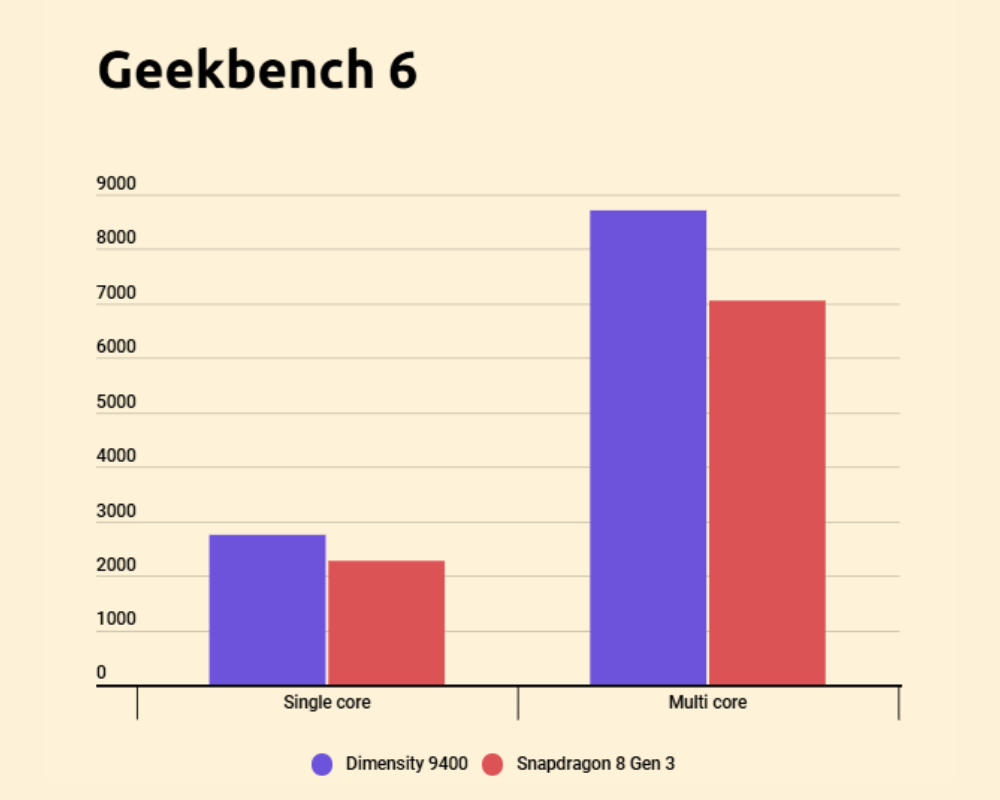
Geekbench is a popular benchmarking platform for testing the CPU capabilities of a device. On this platform, the Dimensity 9400 has completely outshined the Snapdragon 8 Gen 3 with over 20% better single-core and multi-core scores.
| Dimensity 9400 | SD 8 Gen 3 | |
|---|---|---|
| Single core | 2,751 | 2,273 |
| Multi core | 8,712 | 7,054 |
AnTuTu comparison
AnTuTu is a more popular benchmarking tool that measures the overall strength of a device. The Dimensity 9400 is leading here as well, with over 35% better AnTuTu score than Snapdragon 8 Gen 3.
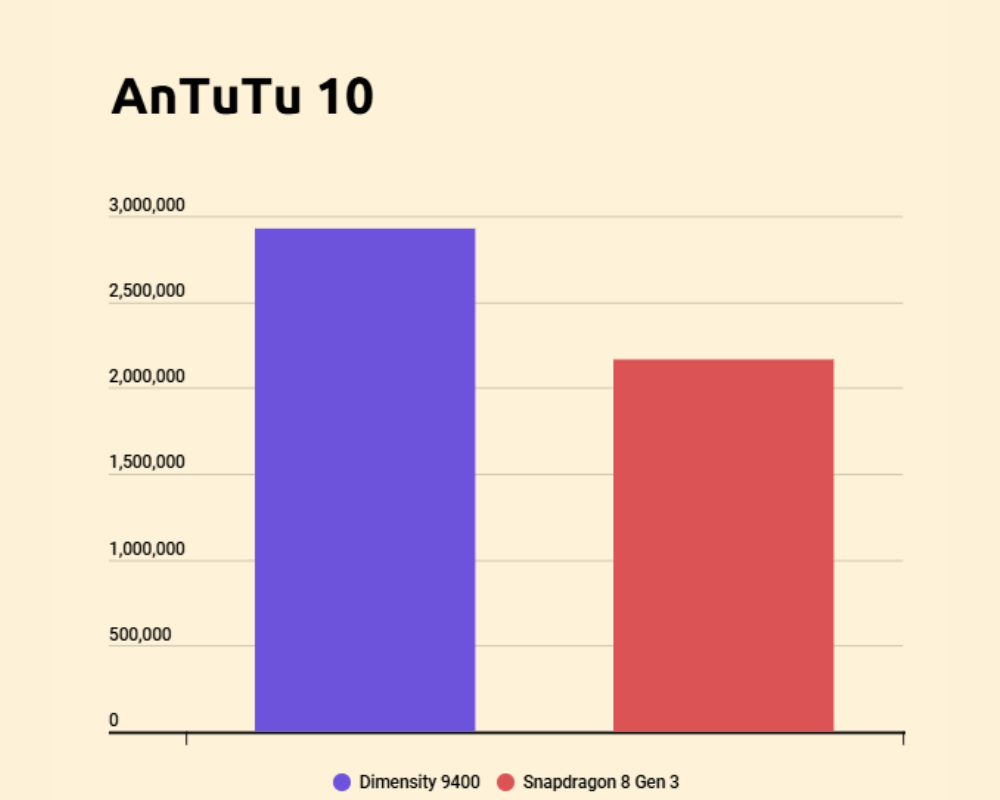
Here’s a more detailed look at AnTuTu scores:
| Dimensity 9400 | SD 8 Gen 3 | |
|---|---|---|
| AnTuTu score | 2,927,565 | 2,165,760 |
| CPU | 634,512 | 470,836 |
| GPU | 1,287,272 | 946,221 |
| Memory | 507,889 | 392,652 |
| UX | 497,892 | 356,051 |
MediaTek Dimensity 9400 is way ahead of Snapdragon 8 Gen 3 on these benchmarks. But how has MediaTek been able to achieve this big leap? Let’s look at the core differences between them below.
Dimensity 9400 vs Snapdragon 8 Gen 3: Key Differences
TSMC has manufactured both the Dimensity 9400 and Snapdragon 8 Gen 3, although the process nodes are different. The former is fabricated using a 3nm node, offering better performance and power efficiency than the 4nm node used for the latter chip.
The Dimensity 9400 features all big cores design; there are no small cores for efficiency. In contrast, the Snapdragon 8 Gen 3 has two efficiency cores. The former chip has one Cortex-X925 core with up to 3.63GHz peak frequency, three Cortex-X4 cores running at 3.3GHz, and four Cortex-A720 cores at 2.4GHz.
The Snapdragon 8 Gen 3, on the other hand, has just one Cortex-X4 prime core with the same clock speed, five Cortex-A720 performance cores (two of them run at 3.15GHz and two at 2.96GHz), and two Cortex-A520 efficiency cores at 2.27GHz. Because of the Cortex-X925 super large core and all-big-core design, the Dimensity 9400 offers significantly better performance than the Snapdragon 8 Gen 3.
Since the Dimensity 9400 is primarily tuned for high performance, one would expect high battery consumption, but that’s not actually true. When tested with Genshin Impact, the Dimensity 9400-powered Vivo X200 Pro resulted in less power consumption than the Snapdragon 8 Gen 3-powered Xiaomi 14 Ultra.
The Dimensity chip has a new Imagiq 1090 ISP, which enables HDR video capture throughout the entire zoom range, the first on any flagship chip. It also has AI-enabled camera features such as Gen-AI Super Resolution and Gen-AI Super Zoom for better outputs. The latter AI technology can achieve up to 100x magnification in photos with clear details.
MediaTek has also increased the maximum camera resolution to 320MP (vs. 200MP on the Snapdragon 8 Gen 3). It now natively supports 8K recording at 60fps, while the Snapdragon chip is limited to 8K/30fps recording. In terms of connectivity, the Dimensity chip offers a higher peak download speed, while the rest of the connectivity features are almost similar.
Dimensity 9400 vs Snapdragon 8 Gen 3: Verdict
MediaTek has done an excellent job with Dimensity 9400. In fact, it’s the best Dimensity chip upgrade in recent years and is certainly better than the Snapdragon 8 Gen 3 in almost all aspects. However, that doesn’t make Snapdragon 8 Gen 3 a bad choice all of a sudden.
Snapdragon 8 Gen 3 is still one of the best smartphone chips. Whether you opt for Dimensity 9400 or Snapdragon 8 Gen 3, you’ll get a great mobile gaming experience. Both chips offer a suite of gaming-focused features tailored to enhance the experience. The MediaTek chip has better power efficiency, though.
If I had to pick from these two, I would go with Dimensity 9400. However, a great deal on Snapdragon 8 Gen 3 phones would be difficult to ignore.


Comments