
Add GIZMOCHINA as Preferred Source on Google
The Dimensity 8400 Ultra is MediaTek’s latest and greatest offering for mid-range smartphones. And thanks to its all big CPU core design, it can compete with flagship chips as well. Recently, we compared it against the Snapdragon 8s Gen 3, and the results were surprising. But how does it fare against the Snapdragon 8 Gen 2?
Both Dimensity 8400 Ultra and Snapdragon 8 Gen 2 are built using TSMC’s 4nm highly-efficient process node. Each chip has eight CPU cores, although their configurations are different. There are also many other crucial differences that we’ll be looking at in this comparison. So, let’s begin.
Dimensity 8400 Ultra vs Snapdragon 8 Gen 2: Benchmarks
[Note: For benchmark results, we performed these tests on Poco X7 Pro (powered by Dimensity 8400 Ultra) and Poco F6 Pro (powered by Snapdragon 8 Gen 2).]AnTuTu comparison
AnTuTu is a popular benchmarking tool for measuring different aspects of a device, such as CPU, GPU, memory, and UX performance. The AnTuTu score represents the overall strength.
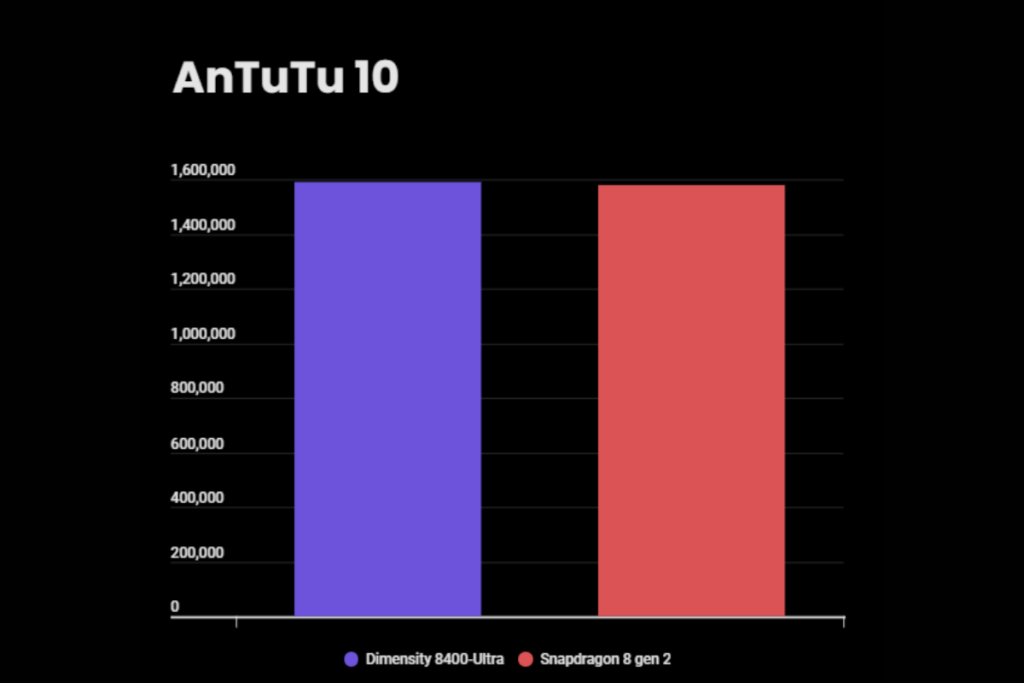
The Dimensity 8400 and Snapdragon 8 Gen 2 have similar AnTuTu scores. Some differences might occur due to software optimizations and heat management.
The AnTuTu breakdown below reveals that the CPU performance is similar on both chips. However, the Snapdragon chip leads the GPU column by some margin.
| D-8400 Ultra | SD 8 Gen 2 | |
|---|---|---|
| AnTuTu score | 1,590,202 | 1,579,204 |
| CPU | 370,994 | 368,149 |
| GPU | 567,384 | 621,953 |
| Memory | 329,331 | 314,451 |
| UX | 322,493 | 274,651 |
Geekbench comparison
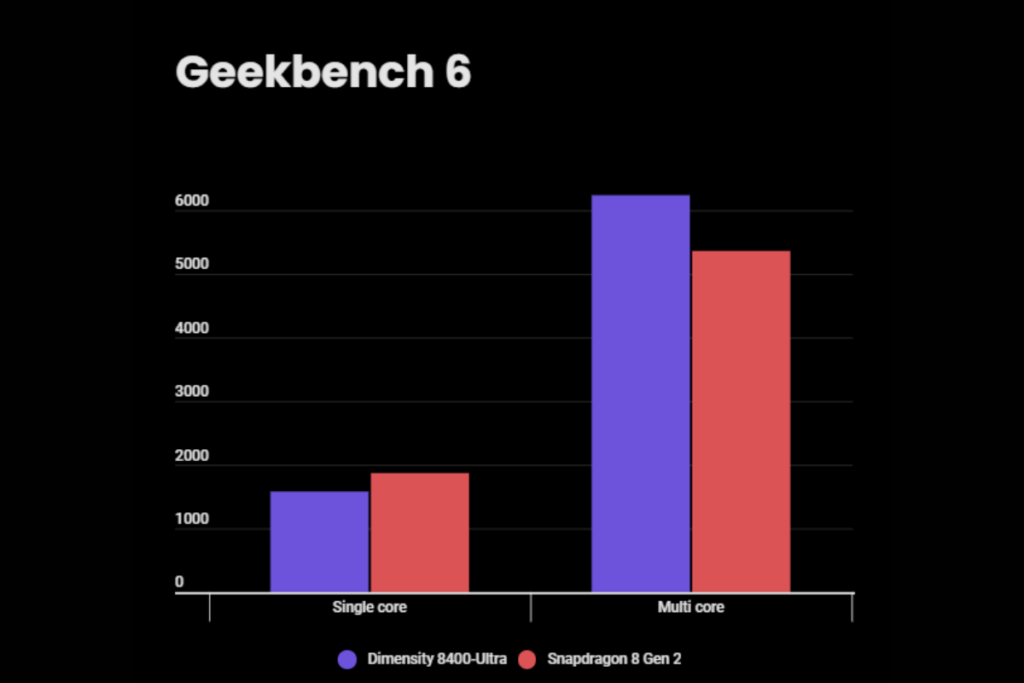
Geekbench is a popular benchmarking tool for measuring the CPU capabilities of devices. On this platform, the Snapdragon 8 Gen 2 gets a higher single-core score. However, the Dimensity 8400 Ultra has a clear advantage when all cores are at work, thanks to all big CPU cores. That’s what the multi-core scores depict.
| D-8400 Ultra | SD 8 Gen 2 | |
|---|---|---|
| Single core | 1,579 | 1,870 |
| Multi core | 6,238 | 5,362 |
Dimensity 8400 Ultra vs Snapdragon 8 Gen 2: Key differences
The two chips take entirely different approaches to CPU architecture. The Dimensity 8400 Ultra has all Cortex-A725 big CPU cores, while the Snapdragon 8 Gen 2 adopts a heterogeneous CPU architecture. The latter has one Cortex-X3 core, two Cortex-A715 cores, two Cortex-A710 cores, and three Cortex-A510 cores.
GPUs also bring a significant difference between the two. The Dimensity chip has a Mali-G720 MP7 GPU, which falls short of the Adreno 740 inside the Snapdragon chip in terms of performance. The latter also brings support for hardware ray tracing for enhanced gameplay.
As for the cameras, the Dimensity chip supports up to 320MP single camera, while the Snapdragon 8 Gen 2 can go up to 200MP. However, the latter supports 8K video recording, which is limited up to 4K on the Dimensity 8400 Ultra.
Both chips have integrated 5G modems. The Dimensity 8400 Ultra has a 5.1 Gbps peak download speed, whereas the Snapdragon chip peaks at 10 Gbps. The latter also supports a newer Wi-Fi 7 standard (vs. Wi-Fi 6E on D-8400 Ultra). The Dimensity chip, however, has a newer Bluetooth 5.4 standard.
Dimensity 8400 Ultra vs Snapdragon 8 Gen 2: Conclusion
Both Dimensity 8400 Ultra and Snapdragon 8 Gen 2 are excellent chips. For everyday tasks such as browsing and social media, both chips would offer a smooth experience. However, the difference is visible while gaming.
The Snapdragon chip has better and sustained gaming performance. And the support for ray tracking makes it an even better choice for gaming. That doesn’t make Dimensity 8400 Ultra a dull choice for gaming. It’s, in fact, better than most mid-range chips.
The Snapdragon 8 Gen 2 also has higher video recording quality and better connectivity. Both chips have LPDDR5X and UFS 4.0 support and high-performance NPUs for on-device AI tasks.
| Dimensity 8400 Ultra | Snapdragon 8 Gen 2 | |
|---|---|---|
| Announced | December 2024 | December 2022 |
| Process node | 4nm | 4nm |
| Manufacturer | TSMC | TSMC |
| Cores | 8 | 8 |
| CPU architecture | 1 x Cortex-A725 @ 3.25 GHz 3 x Cortex-A725 @ 3.0 GHz 4 x Cortex-A725 @ 2.1 GHz | 1 x Cortex-X3 @ 3.2 GHz 2 x Cortex-A715 @ 2.8 GHz 2 x Cortex-A710 @ 2.8 GHz 3 x Cortex-A510 @ 2.0 GHz |
| GPU | Mali-G720 MP7 MediaTek HyperEnging 3.0 Gaming MediaTek Frame Rate Converter | Adreno 740 Snapdragon Elite Gaming Ray tracing support |
| NPU | MediaTek NPU 880 | Hexagon NPU |
| Camera | Imagiq 1080 ISP Up to 320MP single camera 4K-60FPS video recording | Spectra 18-bit triple ISPs Up to 200MP single camera 8K-30FPS video recording |
| RAM Storage | LPDDR5X — 4200 MHz UFS 4.0 | LPDDR5X RAM — 4266 MHz UFS 4.0 |
| Connectivity | MediaTek 5G modem Downlink: 5.1 Gbps Wi-Fi 6E Bluetooth 5.4 | Snapdragon X70 5G modem Downlink: 10 Gbps Wi-Fi 7 Bluetooth 5.3 |



Comments