
Add GIZMOCHINA as Preferred Source on Google
The Snapdragon 7+ Gen 3 may sound like just a slight upgrade over the Snapdragon 7 Gen 3, but it’s actually a significant leap. It’s, in fact, so powerful that it even outperforms some Snapdragon 8-series flagship chipsets on benchmarks. In this comparison, we’ll dive into benchmark scores and key differences to see how much of an upgrade the Snapdragon 7+ Gen 3 really is over its predecessor.
Both the Snapdragon 7+ Gen 3 and 7 Gen 3 are manufactured by TSMC using their 4nm process node. Both chipsets have eight CPU cores, although the core configurations are different. The Plus model has superior CPU and GPU which also reflects on the benchmark results below.
Let’s go through the spec sheet first.
| SD 7+ Gen 3 | SD 7 Gen 3 | |
|---|---|---|
| Announced | March 2024 | November 2023 |
| Process node | 4nm | 4nm |
| Manufacturer | TSMC | TSMC |
| CPU | 1 x 2.8GHz — Cortex-X4 4 x 2.6GHz — Cortex-A720 3 x 1.9GHz — Cortex-A520 | 1 x 2.63 GHz — Cortex-A715 3 x 2.4 GHz — Cortex-A715 4 x 1.8 GHz — Cortex-A510 |
| GPU | Adreno 732 GPU Snapdragon Elite Gaming features | Adreno 720 GPU Snapdragon Elite Gaming features |
| NPU | Qualcomm Hexagon NPU | Qualcomm Hexagon NPU |
| Memory | LPDDR5X, up to 4.2GHz | LPDDR5, up to 3.2GHz |
| Storage | UFS 4.0 | UFS 2.2, UFS 3.1 |
| USB | USB Type-C version 3.1 Gen 2 | USB Type-C version 3.1 Gen 2 |
| Camera | Spectra triple 18-bit ISPs Up to 200MP single camera Up to 108MP single camera with zero shutter lag Up to 64+36MP dual cameras with zero shutter lag Up to 36MP triple cameras with zero shutter lag Up to 4K video recording | Spectra triple 12-bit ISPs Up to 200MP single camera Up to 64MP single camera with zero shutter lag Up to 32+21MP dual cameras with zero shutter lag Up to 21MP triple cameras with zero shutter lag Up to 4K video recording |
| Connectivity | Snapdragon X63 5G modem Downlink: 5 Gbps Uplink: 3.5 Gbps Qualcomm FastConnect 7800 Wi-Fi 7 (peak speed: 5.8Gbps) Bluetooth 5.3 | Snapdragon X63 5G modem Downlink: 5Gbps Uplink: 3.5 Gbps Qualcomm FastConnect 6700 Wi-Fi 6E (peak speed: 2.9Gbps) Bluetooth 5.4 |
Snapdragon 7+ Gen 3 vs 7 Gen 3: Benchmarks
[Note: The following benchmark tests have been conducted on the Realme GT 6T (powered by Snapdragon 7+ Gen 3) and OnePlus Nord CE 4 5G (powered by Snapdragon 7 Gen 3).]
AnTuTu benchmark:
AnTuTu is a widely used benchmarking tool that measures a device’s CPU, GPU, memory, and user experience (UX) performance through a series of tests. It evaluates processing power, graphics rendering, multitasking efficiency, and overall system responsiveness. The final AnTuTu score represents the overall performance of a device.
Here’s AnTuTu comparison of the Snapdragon 7+ Gen 3 and 7 Gen 3:
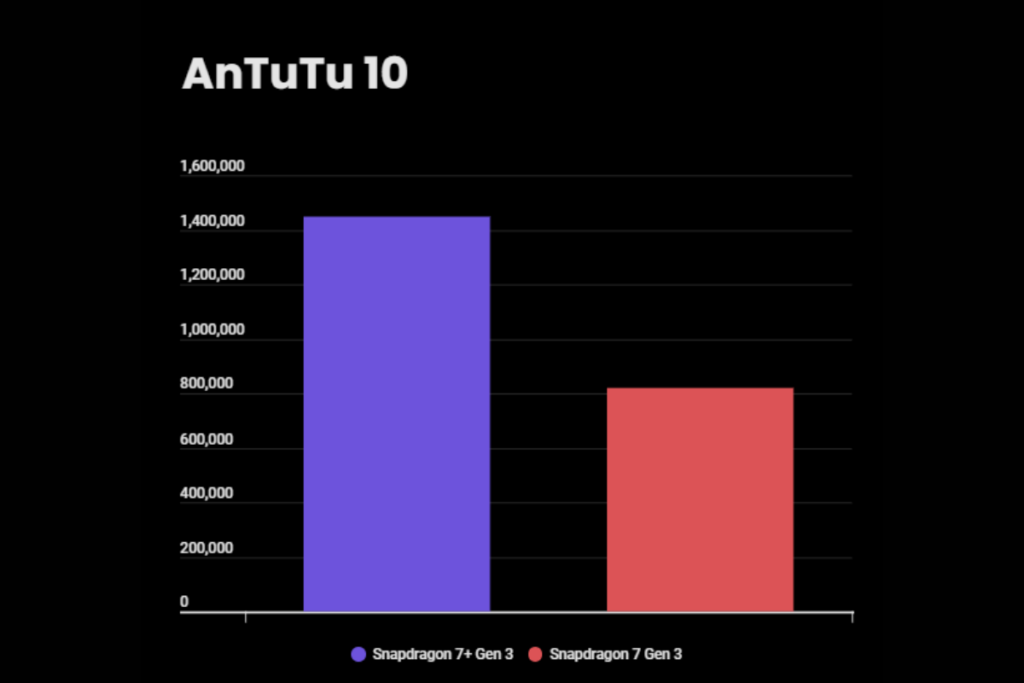
On AnTuTu v10, the Snapdragon 7+ Gen 3-powered Realme GT 6T has scored over 1.4 million AnTuTu points, while the Snapdragon 7 Gen 3-powered OnePlus Nord CE 4 could only manage to get past the 800,000 mark.
Here’s a detailed look at AnTuTu scores:
| SD 7+ Gen 3 | SD 7 Gen 3 | |
|---|---|---|
| AnTuTu score | 1,448,293 | 819,655 |
| CPU | 376,122 | 269,334 |
| GPU | 488,799 | 256,584 |
| Memory | 334,990 | 129,961 |
| UX | 248,382 | 163,776 |
Geekbench benchmark:
Geekbench evaluates CPU performance by running a series of tasks and outputs single-core and multi-core scores. The single-core score reflects the performance of a single CPU core, while the multi-core score measures the performance when all cores work together.
Here’s the comparison of Snapdragon 7+ Gen 3 and 7 Gen 3:
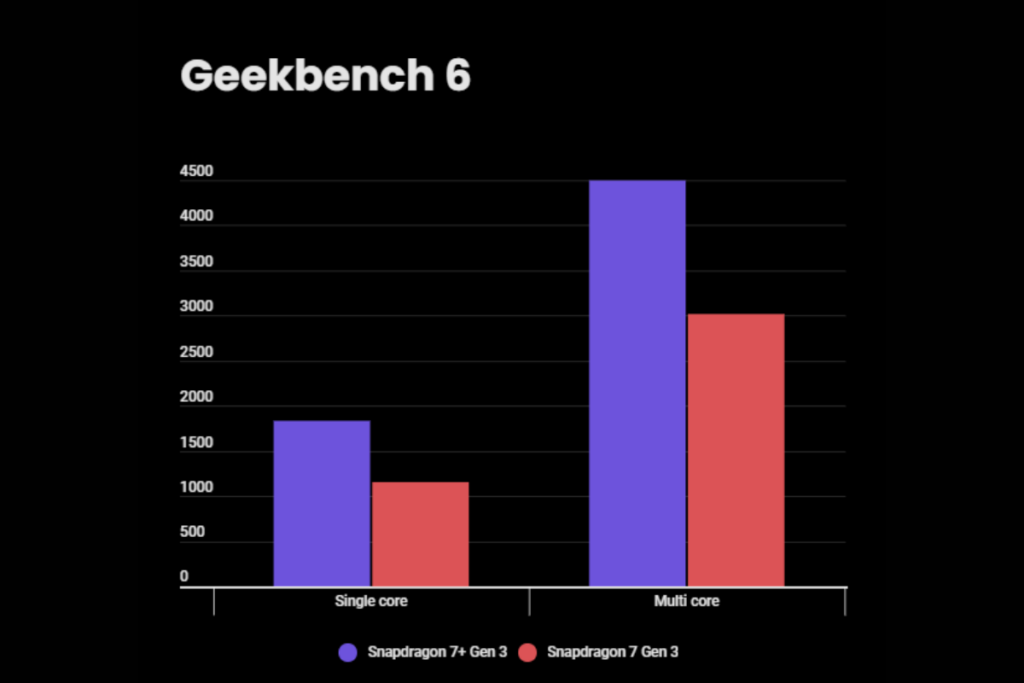
On Geekbench v6, the Snapdragon 7+ Gen 3-powered Realme GT 6T has scored 1,834 single-core points and 4,498 multi-core points. The Nord CE 4, powered by 7 Gen 3, has scored 1,154 points and 3,018 points in the single-core and multi-core tests, respectively.
| SD 7+ Gen 3 | SD 7 Gen 3 | |
| Single core | 1,834 | 1,154 |
| Multi core | 4,498 | 3,018 |
Snapdragon 7+ Gen 3 vs 7 Gen 3: Key differences
CPU:
Both chips have been manufactured by TSMC using its 4nm process node, although their CPU configurations differ. The Plus version has a more powerful and efficient Cortex-X3 prime core clocked at 2.8GHz, four Cortex-A720 performance cores at 2.6GHz, and three power-efficiency Cortex-A520 cores at 1.9GHz.
The 7 Gen 3’s CPU, on the other hand, has one Cortex-A715 performance core clocked at 2.63GHz, three Cortex-A715 performance cores at 2.4GHz, and four Cortex-A510 power-efficiency cores at 1.8GHz. So, the Snapdragon 7+ Gen 3 not only has a higher CPU peak frequency but also more powerful and efficient cores.
Qualcomm says the Snapdragon 7+ Gen 3 has 15% better CPU performance and 5% better power efficiency than its predecessor.
GPU:
The Snapdragon 7+ Gen 3 packs Adreno 732 GPU, while the 7 Gen 3 gets Adreno 720. This is the biggest upgrade to the former chip, promising over 45% improvements over the 7 Gen 3.
Both chips also get the Snapdragon Elite Gaming feature for enhanced gaming features. The Plus variant, though, also brings a Game Post Processing Accelerator for better visual effects.
Camera:
The Snapdragon 7 Gen 3 has triple 12-bit ISPs, while the 7+ Gen 3 has triple 18-bit ISPs. The latter’s increased bit depth provides a substantial upgrade in dynamic range, color depth, and processing capabilities.
The Plus chip also benefits from multi-frame noise reduction (MFNR) and zero shutter lag (ZSL) at higher megapixels. Both Snapdragon 7-series chips can record up to 4K videos. However, the 7+ Gen 3 can do slow-mo video recording at a higher frame rate (FPS).
Connectivity:
Both Qualcomm chips have the same Snapdragon X63 5G modem with a 5Gbps peak download and 3.5Gbps peak upload speeds. However, they differ in terms of mobile connectivity systems. The 7 Gen 3 has a Qualcomm FastConnect 6700 with a peak speed of 2.9Gbps, while the 7+ Gen 3 has an improved FastConnect 7800 with 2x peak speed. The only plus point of the Snapdragon 7 Gen 3 here is that it supports a newer standard of Bluetooth connectivity.
Snapdragon 7+ Gen 3 vs 7 Gen 3: Conclusion
The Snapdragon 7+ Gen 3 is a major step up from the 7 Gen 3, bringing significant improvements in CPU, GPU, and camera performance. With a more-powerful Cortex-X3 and other performance cores, the 7+ Gen 3 is able to achieve 15% better CPU performance, and the GPU upgrade is even more impressive — a 45% performance jump.
Performance-wise, it rivals the flagship Snapdragon 8 Gen 1 chipset (read the comparison here). The Snapdragon 7+ Gen 3 also has better camera capabilities and faster connectivity than its predecessor, the Snapdragon 7 Gen 3.
If you’re looking for a chipset that delivers flagship-like performance without being heavy on the pocket, the Snapdragon 7+ Gen 3 is clearly the better choice over the 7 Gen 3.
Snapdragon 7+ Gen 3 phones:
Snapdragon 7 Gen 3 phones:



Comments