Add GIZMOCHINA as Preferred Source on Google
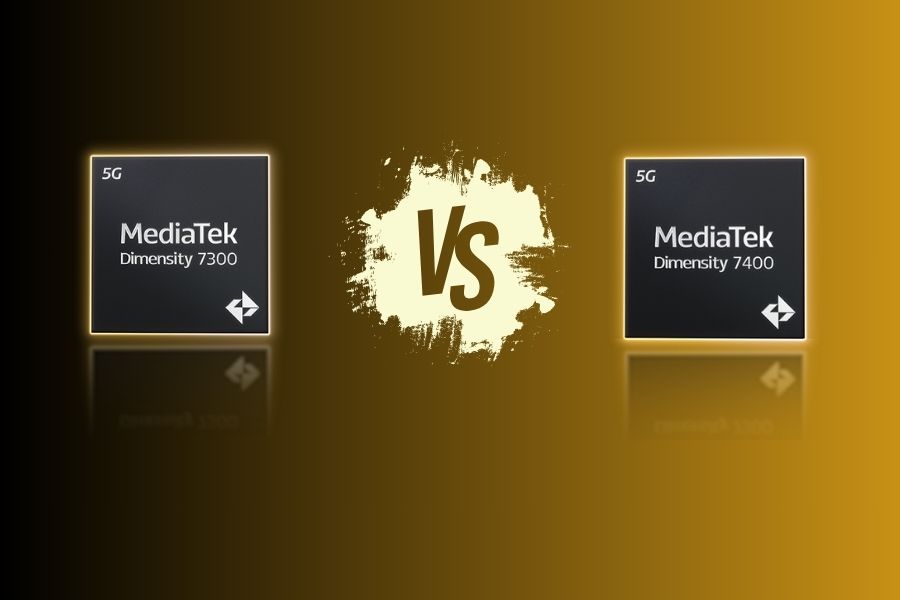
MediaTek’s new Dimensity 7400 is here and it takes over the Dimensity 7300 as the brand’s latest mid-range chipset. But if you’re wondering whether it’s actually an upgrade or just a minor refresh, you’re not alone.
MediaTek tends to release iterative updates in its mid-range lineup, and the difference between generations isn’t always obvious at first glance. So, what’s changed this time? And does the Dimensity 7400 actually offer anything meaningful over the 7300? Let’s break it down.
1. Core Configuration
The Dimensity 7400 and 7300 are eerily similar. Both pack an octa-core CPU with four Cortex-A78 cores and four Cortex-A55 cores. The only difference is that the A78 cores in the 7400 now clock up to 2.6GHz, a 100MHz increase from the 7300’s 2.5GHz. That will hardly make a noticeable difference in real-world usage unless you’re benchmarking every little detail.
Memory and storage support remain unchanged too — both chips support LPDDR4x and LPDDR5 RAM at up to 6400Mbps, and both work with UFS 3.1 storage.
2. Connectivity and Network
Both the Dimensity 7400 and 7300 support the exact same cellular technologies, including SA and NSA 5G, 3CC carrier aggregation, and peak downlink speeds of 3.27 Gbps. Wi-Fi 6E and Bluetooth 5.4 are present as well.
In other words, if you use a phone powered by either of these chips, you will get the same network experience.
3. Camera and Imaging
The camera setup tells a similar story. Both chips have Imagiq 950 ISP with 12-bit HDR and 200MP sensor support and can record 4K HDR videos at 30fps. The Dimensity 7400 does add “hardware-assisted autofocus” (AF) as a dedicated feature, but that’s hardly a game-changer when the 7300 already supports all-pixel AF and dual simultaneous video capture.
Unless MediaTek has made some under-the-hood optimizations, users aren’t likely to see any major improvements in photography or videography performance.
4. GPU, AI
For graphics, MediaTek is keeping the same Arm Mali-G615 MC2 GPU on the Dimensity 7400 as its predecessor. The maximum supported display refresh rates remain at WFHD+ 120Hz or Full HD+ 144Hz—again, no differences.
Since both the chips have the same GPU, you can expect identical gaming performance on the two chips.
AI is a big trend even in 2025, and it’s largely thanks to the NPUs in processors that handle the workload, allowing AI tasks to run efficiently on phones. Given the increasing number of AI-driven capabilities, it would’ve made sense for MediaTek to boost AI performance on the Dimensity 7400. But again, it’s sad to say that there’s nothing new here compared to the 7300.
Both chips feature the same NPU 655, meaning AI tasks—like scene recognition in photography or background noise cancellation in calls—will perform exactly as they did on last year’s model.
5. So, Why Does the Dimensity 7400 Exist?
Given how similar these chips are, it’s hard not to wonder why MediaTek even bothered rebranding the Dimensity 7300 as the 7400. The 100MHz CPU boost is barely worth mentioning, and there’s no real upgrade in GPU, connectivity, storage, or AI performance.
The only plausible reason we could think of is marketing. A new number definitely sounds better, especially for smartphone manufacturers looking to refresh their device lineup without investing in major hardware changes. It also allows MediaTek to keep its branding fresh without actually having to roll out a meaningful upgrade.
6. Final Verdict
So if you were expecting MediaTek’s latest mid-range chipset to bring significant improvements, you might want to dial back your expectations. The Dimensity 7400 is essentially a repackaged Dimensity 7300 with a slight CPU clock bump and a few barely noticeable tweaks. And that’s it.
So if you ever come across stances on choosing between a phone with the 7400 and one with the 7300, the decision should come down to other factors—like battery life, camera sensors, or software—because the chip itself isn’t going to be the defining difference.