
Add GIZMOCHINA on Google:
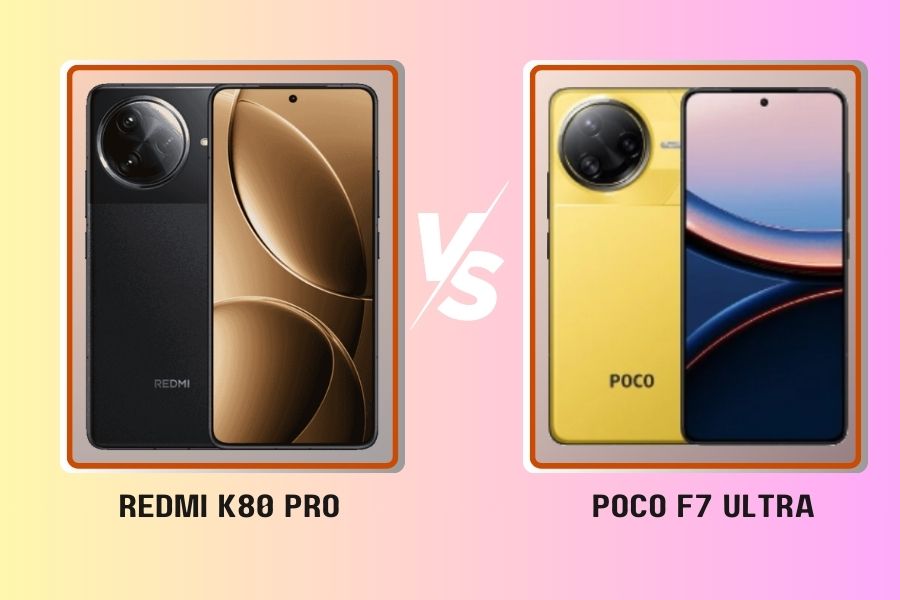
The Poco F7 Ultra and Redmi K80 Pro are, at their core, siblings under Xiaomi’s umbrella. But as usual with Xiaomi’s strategy, they’re targeted at slightly different audiences and priced differently across markets.
On paper, both these phones appear nearly identical, to the point where you’d wonder if there’s any real difference beyond the logos stamped on their backs. But when you dig deeper, the small differences can matter. Let’s break it down.
1. Design and Build
When you hold either phone, you won’t feel much of a difference. Both phones share the exact same dimensions — 160.3 x 75 x 8.4 mm — and both weigh around 212 grams (the K80 Pro has a slightly heavier variant at 217g depending on configuration). Their frames are aluminum which keeps both the front and back glass panels in pace. And the phones are IP68 water and dust resistance making them capable of surviving in up to 2.5 meters of water for 30 minutes.
However, the glass protection is where the two differ. The Poco F7 Ultra uses Poco Shield Glass, while the Redmi K80 Pro relies on Longjing Glass 2. On paper, both are designed to resist scratches and cracks, but we can not say for sure which offer better protection here.
2. Display
In the display department, you’re essentially looking at the same panel. Both phones feature a 6.67-inch AMOLED with support for 68 billion colors, Dolby Vision, HDR10+, and a 120Hz refresh rate. Peak brightness hits a blinding 3200 nits, which is more than enough to stay visible even under harsh sunlight.
Resolution is flagship-grade too — 1440 x 3200 pixels, translating to a sharp 526 ppi pixel density. Both phones use an under-display ultrasonic fingerprint sensor, a more reliable and faster tech than optical sensors.
So if display quality is your deciding factor, there’s no real winner here. Both phones deliver equally well.
3. Performance
Under the hood, both phones are powered by Qualcomm’s Snapdragon 8 Elite chipset, built on a 3nm process. The CPU layout is the same: 2x Cortex Oryon V2 Phoenix L at 4.32 GHz and 6x Oryon V2 Phoenix M at 3.53 GHz, with the Adreno 830 GPU handling graphics.
Both phones ship with Android 15 layered with HyperOS 2. In real-world use, this chipset is more powerful than most users will need. Whether you’re multitasking, gaming, or editing videos, you won’t notice much lag or stutter.
The phones are available in slightly different memory configurations. The Poco F7 Ultra starts with a 12GB RAM base paired with 256GB storage while the top-tier model has 16GB RAM and 512GB storage. Memory is LPDDR5X while the storage is UFS 4.1.
The Redmi K80 Pro also starts at 12/256GB base but the highest configured model has 16GB RAM and 1TB storage. However, it’s worth noting that it uses UFS 4.0, slightly slower than Poco’s UFS 4.1.
In practice, the difference between UFS 4.0 and 4.1 is negligible for day-to-day tasks. But if you’re particular about having the fastest storage or need a 1TB option, the K80 Pro has a clear edge.
4. Cameras
The rear camera setup is identical on both phones:
- 50MP main camera (f/1.6, OIS, 1/1.55” sensor)
- 50MP telephoto with 2.5x optical zoom and OIS
- 32MP ultrawide with a 120° field of view
Both phones can shoot up to 8K at 24fps and support advanced stabilization and high frame rate modes — including 4K at 60fps and even slow-motion at 1920fps in 720p.
Where the difference appears is on the front camera. The Poco F7 Ultra uses a 32MP selfie camera, while the Redmi K80 Pro opts for a 20MP shooter. In good lighting, you might not notice much difference, but for those who rely heavily on front cameras — whether for video calls, content creation, or social media — Poco’s higher resolution sensor has the upper hand, at least on paper.
That said, the K80 Pro supports gyro-EIS on the front camera for smoother videos, a feature missing in the spec sheet of the F7 Ultra.
5. Battery and Others
Battery capacity is one area where these phones go in different directions.
The Poco F7 Ultra packs a 5300mAh battery, while the Redmi K80 Pro uses a larger 6000mAh silicon-carbon battery. Both phones support 120W wired charging and 50W wireless charging.
As for the audio, both have stereo speakers but you don’t get a headphone jack support. Connectivity options include Wi-Fi 7, Bluetooth 6.0, NFC, and an Infrared blaster. And the positioning systems are also identical with support for NavIC, GPS (L1+L5), GLONASS, BDS, Galileo, and QZSS.
The under-display ultrasonic fingerprint scanner and a full suite of sensors (accelerometer, gyroscope, compass, proximity) are also common to both.
6. So, Which One Should You Buy?
Now as you can tell, both phones are strikingly similar. The Redmi K80 Pro has a few key advantages over Poco as it packs a massive 6,000mAh battery for longer endurance and offers up to 1TB of storage. While the F7 Ultra has a higher-res selfie camera.
These differences are minor, but price could be a major deciding factor for users. And fortunately, you can get the Redmi K80 Pro for $100 less at starting than the Poco F7 Ultra. It starts at $549 for the 12GB RAM, 256GB storage model, while the Poco F7 Ultra costs $649 for the same configuration. If you’re looking to grab the K80 Pro at that price, it’s available on Giztop.
For more daily updates, please visit our News Section.
Stay ahead in tech! Join our Telegram community and sign up for our daily newsletter of top stories!