
Add GIZMOCHINA as Preferred Source on Google
MediaTek has introduced its latest processor, the Kompanio Ultra 910, designed to enhance Chromebook performance. The new chipset focuses on AI capabilities, improved power efficiency, and high-speed connectivity. It brings advanced computing features aimed at productivity, creativity, and immersive multimedia experiences. Here’s a closer look at what the Kompanio Ultra 910 has to offer.
MediaTek Kompanio Ultra 910 specifications and features
Built on TSMC’s 2nd-gen 3nm process, the MediaTek Kompanio Ultra 910 chip delivers exceptional power efficiency, allowing Chromebooks to maintain all-day battery life while offering significant performance gains. At its core, the Kompanio Ultra 910 features an 8-core CPU architecture, including a powerful Arm Cortex-X925 core clocked up to 3.62GHz, three Cortex-X4 cores, and four Cortex-A720 cores.
This combination, coupled with 12MB of L3 cache and 10MB of system-level cache (SLC), ensures seamless handling of single-threaded and multi-threaded workloads. For graphics, the processor includes the 11-core Immortalis-G925 MC11 GPU, which is ray tracing-capable, enhancing gaming and graphics-intensive applications.
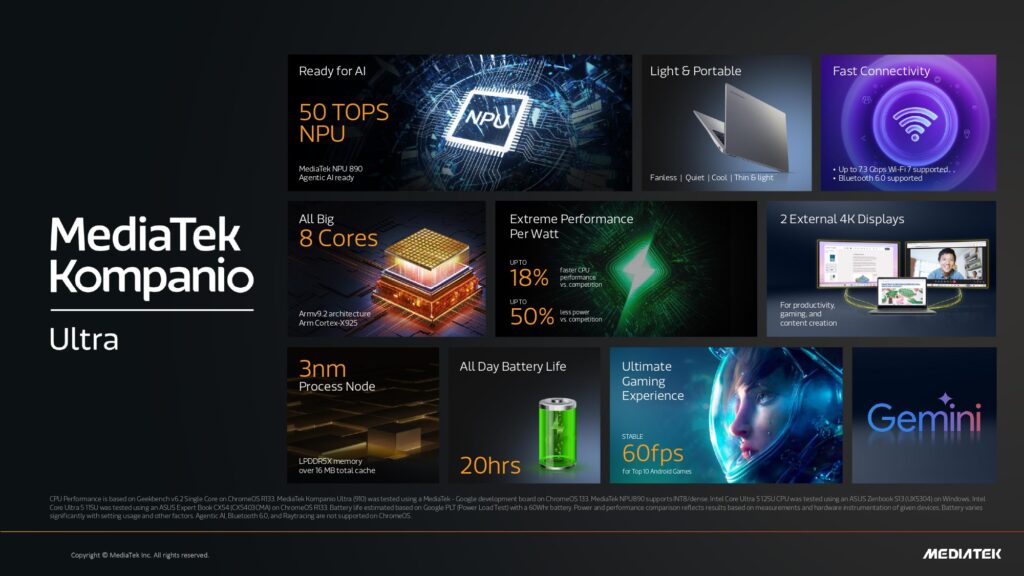
To complement its processing power, the Kompanio Ultra 910 supports LPDDR5X memory (8533Mbps), ensuring that the CPU, GPU, and NPU receive data without delays. Benchmarks indicate impressive results, with a Geekbench 6 single-core score of 2600 and a multi-core score of 8000.
One of the major highlights of the Kompanio Ultra 910 is its 8th-generation NPU, which significantly boosts on-device AI performance, making it capable of real-time AI image and video generation. The NPU can handle up to 50 TOPS AI performance, making it a leader in ETHZ v6 AI benchmarks, particularly in Generative AI tasks. The AI acceleration also enhances power efficiency by offloading workloads from the CPU and GPU.
In terms of connectivity, the Kompanio Ultra 910 is designed for fast wireless connections, supporting Wi-Fi 7 with speeds up to 7.3Gbps and Bluetooth 6.0 with a dual Bluetooth engine for improved signal range and stability.
For multimedia experiences, the processor can drive up to three 4K displays simultaneously—one on-device and two external. It supports 4K 10-bit video decoding and encoding in formats like HEVC, AVC, VP9, and AV1, ensuring smooth video playback and streaming. Additionally, dedicated Hi-Fi Audio DSPs enhance sound effects and low-power keyword detection, making it ideal for voice-assisted applications.
For more daily updates, please visit our News Section.
Stay ahead in tech! Join our Telegram community and sign up for our daily newsletter of top stories!


Comments