
Add GIZMOCHINA as Preferred Source on Google
The X200 Ultra is Vivo’s most ambitious camera phone yet. One company exec even dubbed it “a pocket camera that can make calls.”
Vivo has been teasing the phone’s imaging chops in bits and pieces over the past few weeks, but today, it finally dropped the full spec sheet (via a series of posters on its official Weibo account). There’s a lot to unpack, but here’s a quick breakdown of what you need to know.
Vivo X200 Ultra camera prowess
At the heart of the X200 Ultra’s camera system is a new 35mm main camera built around the Sony LYT-818 sensor. It’s a 1/1.28” sensor paired with a Zeiss T*-coated lens which notably is the world’s first GLC 2.0 ultra-low dispersion glass.
The lens is optically stabilized with CIPA 5.0-level OIS. Vivo is also pushing its third-generation VCS bionic spectral imaging tech here. Whereas, the lens has sub-0.1% visible light reflection thanks to improved anti-glare coatings.
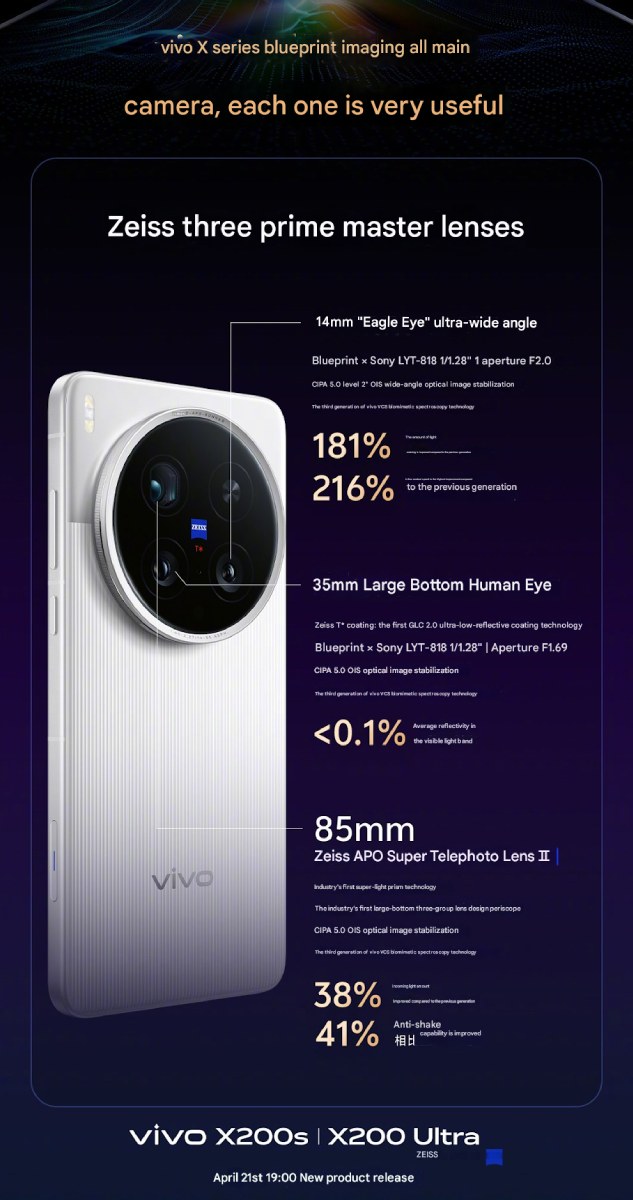

The ultra-wide camera continues the premium sensor approach. It uses another Sony LYT-818. But here, it’s been customized jointly with Zeiss. It’s a 14mm “Hawk Eye” lens promising an 181% jump in light intake and a 216% faster shutter speed than its predecessor. There’s also dual-axis optical image stabilization.
Then there’s the 85mm telephoto. It’s a 200MP Samsung HP9 sensor behind what Vivo calls the first APO-grade telephoto setup in mobile. It has a six-element design with improved clarity and 5.0-level OIS. Compared to the last-gen module, Vivo claims it delivers 38% better light performance and 41% more stable results.
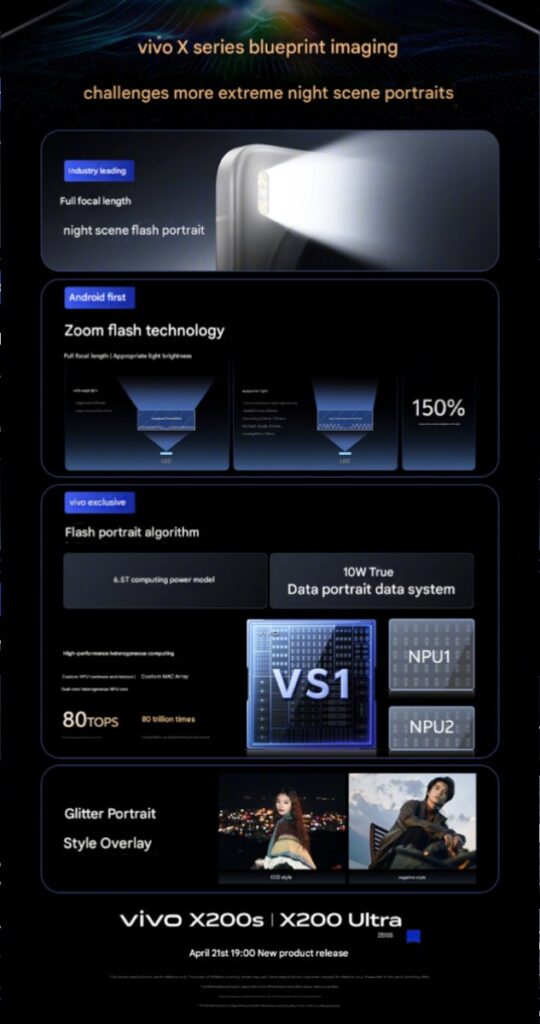
Underpinning this entire system is the new VS1 chip. This is Vivo’s first AI ISP (image signal processor) with 80 TOPS of computing power and industry-leading energy efficiency (16 TOPS/W). It’s built to handle everything from real-time bokeh rendering to HDR processing and complex multi-frame image stacking.
Portraits and low-light photography
Portraits, of course, are a big part of X200 Ultra. The phone can shoot from 24mm to 100mm backed by AI-powered skin rendering, lighting control, and million-level 3D ray tracing for bokeh. There’s even a “Humanistic Street Photography” mode which focuses on quick-launch, 35mm framing, and a simulated film-style aesthetic.
The X200 Ultra can also shoot 4K portrait videos at all focal lengths with skin color optimization via the HSV algorithm, and near-zero shutter delay thanks to the new VS1 chip.

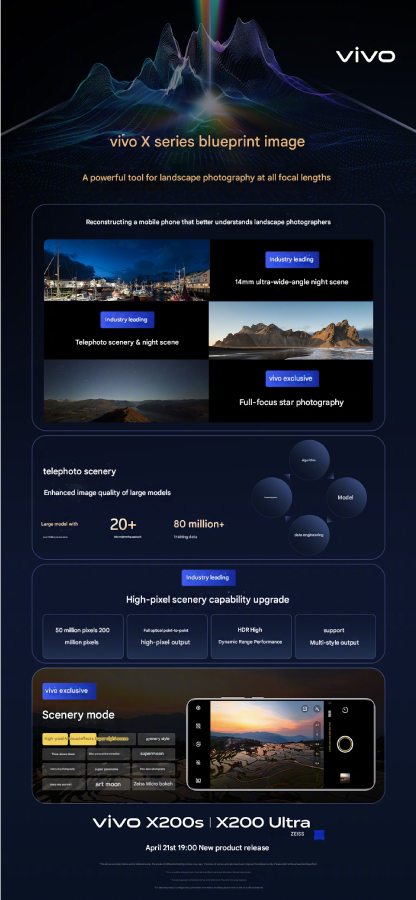
There’s equal emphasis on low-light photography. You can shoot from (14mm) ultrawide to long-range telephoto night shots. And there are a handful of modes like Supermoon, Zeiss Micro Bokeh, and Starry Sky to capture nuance details of the sky.
For scene recognition and visual fidelity, Vivo says it uses models trained on over 80 million samples, including large-scale image sets and data-engineered photo simulations.
The Vivo X200 Ultra is set to be officially unveiled on April 21st.
For more daily updates, please visit our News Section.
Stay ahead in tech! Join our Telegram community and sign up for our daily newsletter of top stories!
(Source)



Comments