
Add GIZMOCHINA as Preferred Source on Google
Snapdragon 7+ Gen 3 is a popular mid-range chipset announced in March 2025. It features a high-performance octa-core CPU with up to 2.8GHz clock speed and the Adreno 732 GPU, which provides a lag-free gaming experience. The Snapdragon 7+ Gen 3 is one of the best mid-range chips, even outperforming the flagship Snapdragon 8 Gen 1 on various benchmarks.
The Snapdragon 870, on the other hand, is a relatively older chip, announced back in January 2021. However, it hasn’t bitten the dust yet. It was one of the best smartphone chips when released and still has a decent popularity among smartphone enthusiasts. The chip has a higher peak CPU frequency. However, the cores may not be as strong and efficient as the 7+ Gen 3. We’ll find that out in the benchmark comparison below.
Snapdragon 7+ Gen 3 vs Snapdragon 870: Benchmark comparison
[Note: The tests were conducted on the Realme GT 6T (powered by Snapdragon 7+ Gen 3) and Poco F4 (powered by Snapdragon 870).]
AnTuTu (v10) comparison
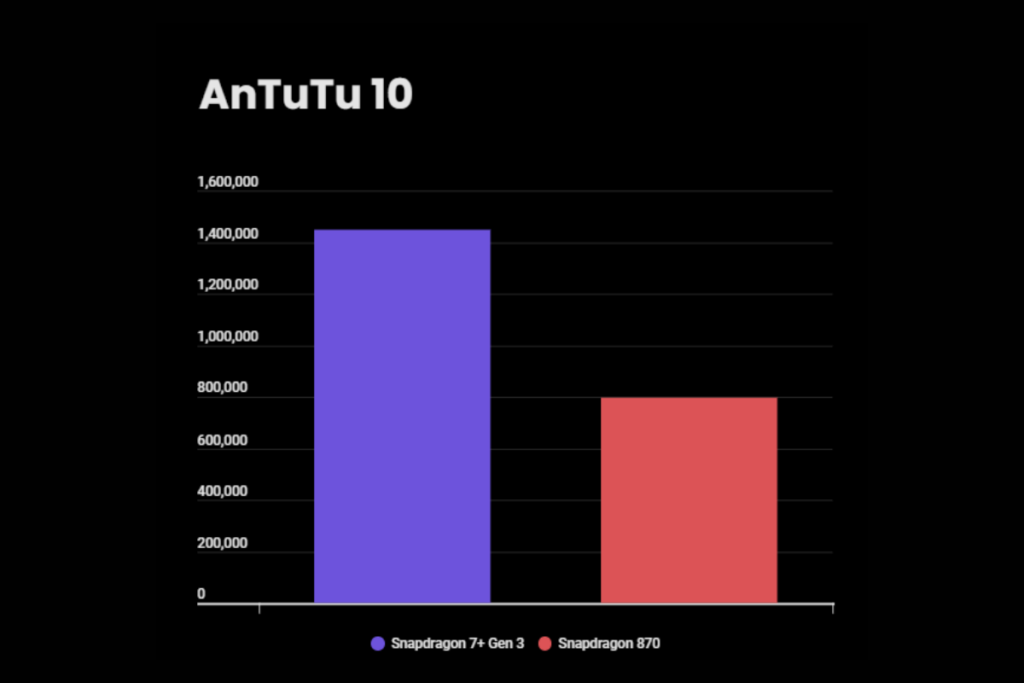
The Snapdragon 7+ Gen 3 absolutely crushes the older Snapdragon 870 across every category in the AnTuTu benchmark. It delivers an overall score that’s nearly 82% higher, showcasing a massive leap in performance. The CPU score sees a 55% boost, GPU performance more than doubles with a 120% jump, memory speeds are up by 132%, and even the user experience (UX) score improves by over 30%.
| SD 7+ Gen 3 | SD 870 | |
|---|---|---|
| AnTuTu score | 1,448,293 | 796,504 |
| CPU | 376,122 | 241,986 |
| GPU | 488,799 | 219,756 |
| Memory | 334,990 | 144,545 |
| UX | 248,382 | 190,218 |
Geekbench (v10) comparison
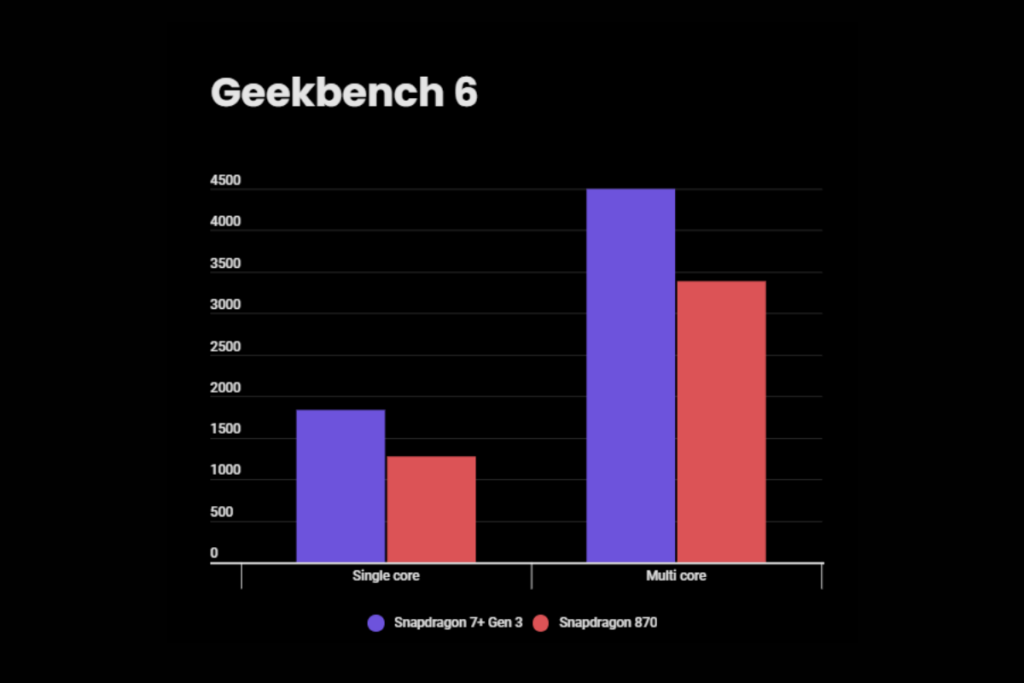
The Snapdragon 7+ Gen 3 also dominates the Geekbench results, all thanks to its powerful CPU cores. The chip delivers 44% higher performance in the single-core test and around 33% uplift in the multi-core test. This means you’ll enjoy a noticeably faster and smoother experience on devices powered by the Snapdragon 7+ Gen 3 compared to those using the older Snapdragon 870.
| SD 7+ Gen 3 | SD 870 | |
| Single core | 1,834 | 1,274 |
| Multi core | 4,498 | 3,386 |
Snapdragon 7+ Gen 3 vs Snapdragon 870: What makes the newer chip so much better?
Here, we’ll discuss key differences in CPU, GPU, connectivity, and other important areas that are absolutely critical for a meaningful comparison.
CPU
Although both are octa-core CPUs, they greatly differ in terms of CPU architectures and manufacturing processes. The Snapdragon 7+ Gen 3, for instance, uses the latest ARMv9.2-A architecture, with a Cortex-X4 prime core, four Cortex-A720 performance cores, and three Cortex-A520 efficiency cores.
On the other hand, the Snapdragon 870 uses the older ARMv8.2-A architecture, with four Cortex-A77 performance cores and four Cortex-A55 efficiency cores. However, the older chip has a higher peak CPU frequency. Despite that, it couldn’t reach near the Snapdragon 7+ Gen 3 in CPU benchmarks because the other chip has powerful and more efficient cores.
The use of TSMC’s 4nm advanced process further improves the power efficiency, whereas the Snapdragon 870 is built using an older TSMC’s 7nm process.
GPU
- Snapdragon 7+ Gen 3: Adreno 732
- Snapdragon 870: Adreno 650
The Adreno 732 in the Snapdragon 7+ Gen 3 is a substantial upgrade over the Adreno 650 in the Snapdragon 870. It is built on a newer architecture and has significantly higher shading units, total shaders, and FLOPS (floating point operations per second) that deliver smoother and better gaming performance than Adreno 650.
Additionally, the Snapdragon 7+ Gen 3 supports newer graphics APIs, enabling better compatibility with the latest games and graphic features. In gaming benchmarks such as 3DMark, the newer chip achieves over 100% better scores with better stability and higher fps.
Connectivity
The Snapdragon 7+ Gen 3 uses the newer X63 5G modem, with a peak download speed of up to 5Gbps and an upload speed of up to 3.5Gbps. It has the FastConnect 7800 mobile connectivity system with Wi-Fi 7 support and a peak speed of up to 5.8Gbps.
The Snapdragon 870 actually has a higher peak download speed of 7.5Gbps despite using an older X55 5G modem. The upload speed, however, is slightly higher on the newer chip. The Snapdragon 870 also lacks Wi-Fi 7 support, and has a lower peak speed on a Wi-Fi connection. It also has a slighly older Bluetooth standard — v5.2 (vs v5.3 on the 7+ Gen 1).
Snapdragon 7+ Gen 3 vs Snapdragon 870: Conclusion
The Snapdragon 7+ Gen 3 is a major leap forward compared to the Snapdragon 870. It outperforms the older chip in every benchmark category, brings a much more efficient CPU and GPU architecture, and supports the latest connectivity standards like Wi-Fi 7. While the Snapdragon 870 still holds up well for casual use, the 7+ Gen 3 is clearly the better choice for those who want faster performance, smoother gaming, and future-ready features.
| SD 7+ Gen 3 | SD 870 | |
|---|---|---|
| Announced | March 2024 | January 2021 |
| Process node | 4nm | 7nm |
| Manufacturer | TSMC | TSMC |
| CPU | 1 x 2.8 GHz — Cortex-X4 4 x 2.6 GHz — Cortex-A720 3 x 1.9 GHz — Cortex-A520 | 1 x 3.2 GHz — Cortex-A77 3 x 2.42 GHz — Cortex-A77 4 x 1.8 GHz — Cortex-A55 |
| GPU | Adreno 732 GPU | Adreno 650 |
| NPU | Qualcomm Hexagon NPU | Qualcomm Hexagon 698 |
| Memory | LPDDR5, up to 4.2GHz | LPDDR5, 2.7GHz |
| Camera | Real-time semantic segmentation (max 12 layers) Up to 200MP single camera Up to 108MP single camera with zero shutter lag Up to 64MP+36MP dual camera with zero shutter lag Up to 36MP triple camera with zero shutter lag Up to 4K/60fps video recording | Up to 200MP camera Up to 64MP single camera with zero shutter lag Up to 25MP dual camera with zero shutter lag Up to 8K/30fps video recording |
| Connectivity | Snapdragon X63 5G modem Downlink: 5Gbps Uplink: 3.5Gbps Qualcomm FastConnect 7800 Wi-Fi 7 (peak speed: 5.8Gbps) Bluetooth 5.3 | Snapdragon X55 5G modem Downlink: 7.5Gbps Uplink: 3Gbps Qualcomm FastConnect 6800 Wi-Fi 6 (peak speed: 1.774Gbps) Bluetooth 5.2 |
Popular Snapdragon 7+ Gen 3 phones:
OnePlus Nord 4
Realme GT 6T
Realme GT Neo6 SE
OnePlus Ace 3V
Popular Snapdragon 870 phones:



Comments