
Add GIZMOCHINA as Preferred Source on Google
The Snapdragon 7+ Gen 3 is a mid-range smartphone chipset, featuring high-performance octa-core CPU with up to 2.8GHz maximum clock speed and a capable Adreno 732 GPU that delivers smooth gaming performance. It’s one of the best mid-range chips and even goes head-to-head with the Snapdragon 8 Gen 1 flagship chip (more on that here).
The 7+ Gen 3 was announced in March 2024, and a few months later, Qualcomm announced a more budget-friendly alternative — Snapdragon 7s Gen 3. It also boasts strong performance without breaking the brand. This also has an octa-core CPU but with a slightly lower peak speed. To find out how big the performance gap is, we tested them through multiple benchmarks, and here are the results.
Snapdragon 7+ Gen 3 vs 7s Gen 3: Benchmark comparison
[Note: The tests were conducted on the Realme GT 6T (Snapdragon 7+ Gen 3) and Nothing Phone 3a Pro (Snapdragon 7s Gen 3).]
AnTuTu comparison
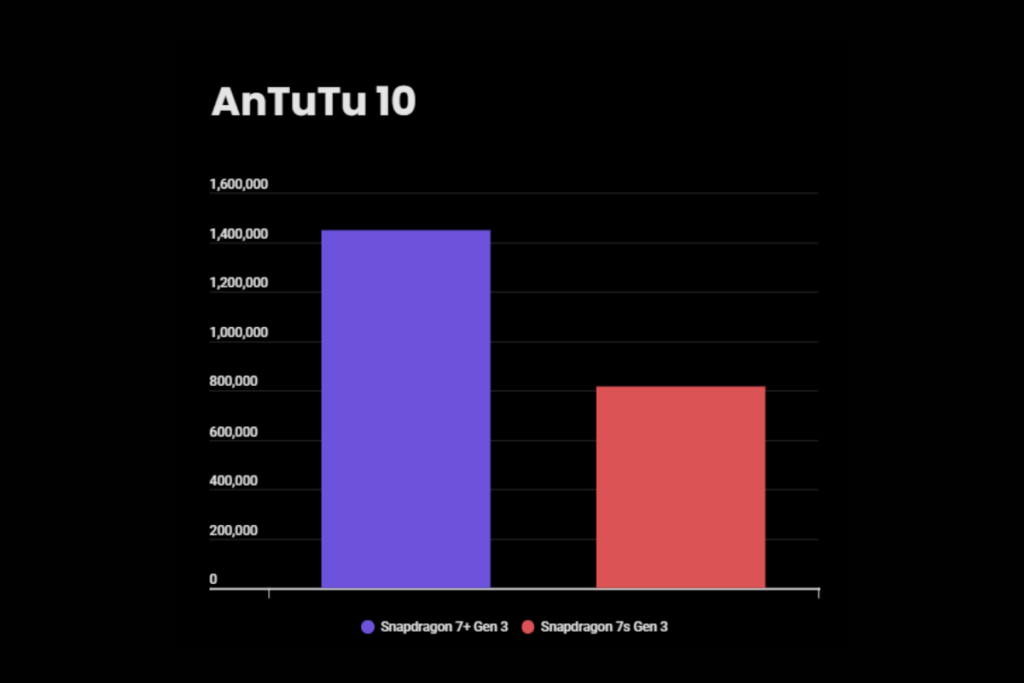
The Snapdragon 7+ Gen 3 absolutely outclasses the Snapdragon 7s Gen 3 across every category in the AnTuTu benchmark. It delivers a total score that’s nearly 78% higher. Coming to individual scores, the CPU score is about 36% higher, but the real difference shows up in the GPU scores—where the 7+ Gen 3 offers a massive 144% boost in graphics performance. Memory performance is also up by 92%, while the UX score sees a 50% improvement.
| SD 7+ Gen 3 | SD 7s Gen 3 | |
|---|---|---|
| AnTuTu score | 1,448,293 | 815,716 |
| CPU | 376,122 | 275,699 |
| GPU | 488,799 | 200,564 |
| Memory | 334,990 | 174,454 |
| UX | 248,382 | 164,998 |
Geekbench comparison
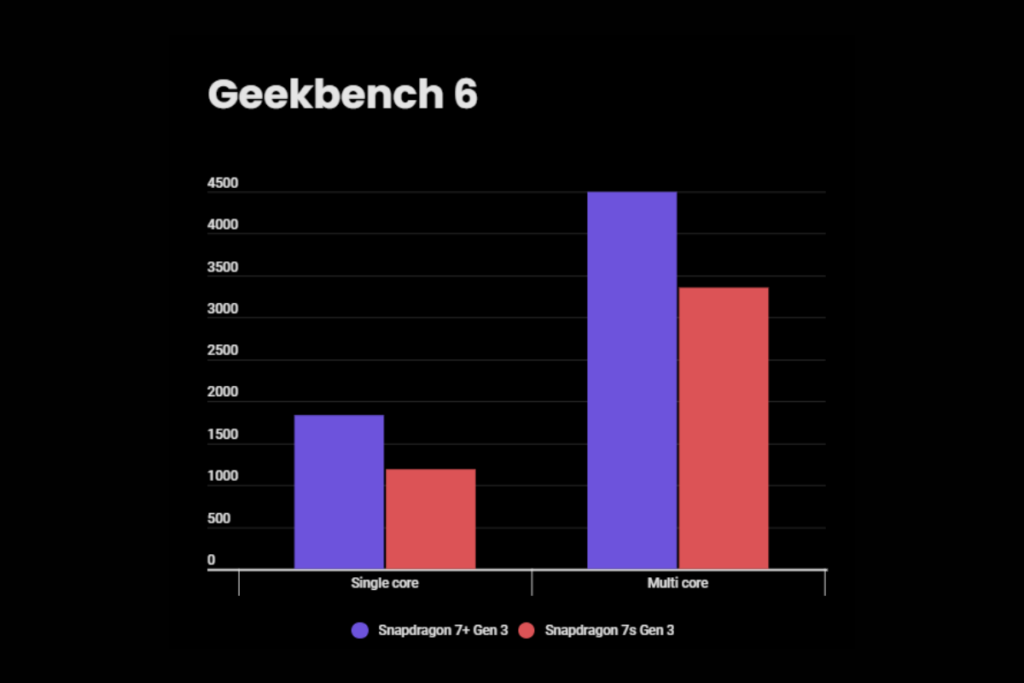
The Snapdragon 7+ Gen 3 also leads comfortably in Geekbench tests. It delivers around 54% higher single-core performance and a 34% boost in multi-core results compared to the Snapdragon 7s Gen 3. This means better speed in everyday tasks and noticeably faster performance in demanding, multi-threaded workloads like gaming or multitasking.
| SD 7+ Gen 3 | SD 7s Gen 3 | |
| Single core | 1,834 | 1,189 |
| Multi core | 4,498 | 3,356 |
3DMark comparison
In the 3DMark Wild Life Stress Test, the Snapdragon 7+ Gen 3 delivers nearly 3x higher peak performance than the Snapdragon 7s Gen 3, with a best loop score of 11,256 versus 3,992. However, that power comes at the cost of stability — its 54.6% stability indicates significant thermal throttling under sustained load. In contrast, the 7s Gen 3 remains incredibly consistent with 99.2% stability, though its performance ceiling is much lower.
| SD 7+ Gen 3 | SD 7s Gen 3 | |
| Best loop score | 11,256 | 3,992 |
| Lowest loop score | 6,074 | 3,961 |
| Stability | 54.6% | 99.2% |
Snapdragon 7+ Gen 3 vs 7s Gen 3: Key differences that matter
Now that we’ve seen benchmark results, let’s break down the differences to understand the reason behind a significant gap in performance and other differences that really matter.
CPU
Both are octa-core processors built using TSMC’s 4nm process, yet they differ in terms of architecture and core setup. The 7+ Gen 3, for instance, uses 1+4+3 core configuration, featuring one high-performance Cortex-X4 core, four Cortex-A720 performance cores, and three Cortex-A520 efficiency cores.
On the other hand, the Snapdragon 7s Gen 3 uses 1+3+4, sacrificing one performance core over an efficiency core. It has one high-performance Cortex-A720 core, three Cortex-A720 performance cores, and four Cortex-A520 efficiency cores.
The Cortex-X4 in the Snapdragon 7+ Gen 3 is a flagship-class core with superior performance and power efficiency than Cortex-A720. It also runs at a higher speed, making it suitable for demanding applications.
GPU
The Snapdragon 7+ Gen 3 has an Adreno 732 GPU, while the 7s Gen 3 brings an Adreno 810. At first glance, it may seem like the latter has a powerful GPU, but the reality is just the opposite. The Adreno 732 has higher shading units, total shaders, floating point operations per second (FLOPS), memory bandwidth, and pipelines, which translates to superior graphics capabilities. That means the Snapdragon 7+ Gen 3 devices will have significantly better gaming performance as compared to Snapdragon 7s Gen 3 devices.
Connectivity
The two also have notable differences in connectivity. The Snapdragon 7+ Gen 3, for instance, has an X63 5G modem that offers up to 5 Gbps download speed and up to 3 Gbps upload speed, whereas the 7s Gen 3’s modem (Qualcomm has not revealed its name) has a much lower peak download speed of 2.9 Gbps.
The same goes for a Wi-Fi connection, which offers up to 5.8 Gbps speed on the 7+ Gen 3 but is limited up to 2.9 Gbps on the 7s Gen 3. Additionally, the 7+ Gen 3 chip also supports Wi-Fi 7, offering lower latency and better performance in crowded areas.
The only thing that favours Snapdragon 7s Gen 3 is a newer Bluetooth v5.4 standard versus v5.3 on the other chip.
Snapdragon 7+ Gen 3 vs 7s Gen 3: Verdict
The Snapdragon 7+ Gen 3 clearly wins all cards over the Snapdragon 7s Gen 3, with a big margin. It has a superior CPU and GPU that crushes the other chip on multiple benchmarks. Plus, the chip supports Wi-Fi 7 and allows significantly higher download and upload speeds for reliable connectivity, even in crowded environments.
The Snapdragon 7+ Gen 3 is clearly a no-brainer pick over the 7s Gen 3. However, the Snapdragon 7s Gen 3 still holds its own for budget-conscious buyers. It delivers respectable day-to-day performance and shines in sustained workloads with excellent thermal stability. So, If you’re after the best performance without jumping to a flagship chip, the 7+ Gen 3 is the obvious winner. But for casual users who prioritize efficiency and value, the 7s Gen 3 still makes a solid case.
| SD 7+ Gen 3 | SD 7s Gen 3 | |
|---|---|---|
| Announced | March 2024 | August 2024 |
| Process node | 4nm | 4nm |
| Manufacturer | TSMC | TSMC |
| CPU | 1x 2.8 GHz — Cortex-X4 4x 2.6 GHz — Cortex-A720 3x 1.9 GHz — Cortex-A520 | 1x 2.5 GHz — Cortex-A720 3x 2.4 GHz — Cortex-A720 4x 1.8 GHz — Cortex-A520 |
| GPU | Adreno 732 GPU | Adreno 810 |
| NPU | Qualcomm Hexagon NPU | Qualcomm Hexagon NPU |
| Memory | LPDDR5, up to 4.2GHz | LPDDR5, up to 3.2GHz |
| Camera | Real-time semantic segmentation (max 12 layers) Up to 200MP single camera Up to 108MP single camera with zero shutter lag Up to 64MP+36MP dual camera with zero shutter lag Up to 36MP triple camera with zero shutter lag Up to 4K/60fps video recording | Up to 200MP camera Up to 64MP single camera with zero shutter lag Up to 32+21MP dual cameras with zero shutter lag Up to 21+21+21MP triple cameras with zero shutter lag Up to 4K/30fps video recording |
| Connectivity | Snapdragon X63 5G modem Downlink: 5Gbps Uplink: 3.5Gbps Qualcomm FastConnect 7800 Wi-Fi 7 (peak speed: 5.8Gbps) Bluetooth 5.3 | Snapdragon 5G modem Downlink: 2.9Gbps Qualcomm FastConnect Wi-Fi 6E (peak speed: 2.9Gbps) Bluetooth 5.4 |
Snapdragon 7+ Gen 3 phones:
Snapdragon 7s Gen 3 phones:



Comments