
Add GIZMOCHINA as Preferred Source on Google
The Dimensity 7300 and Snapdragon 7s Gen 2 are popular mid-range smartphone chips that power many phones from different brands, including Nothing, Motorola, Realme, and Xiaomi. Both octa-core chips from Qualcomm and MediaTek use the same CPU cores, yet they have many differences that really matter.
In this detailed comparison, we’ll examine the benchmark data to see which one delivers superior raw performance and then go through the key differences across various aspects, including camera, connectivity, CPU, and GPU, that will help you pick the right one for your needs.
Dimensity 7300 vs Snapdragon 7s Gen 2: Benchmark comparison
Note: The tests were conducted on the Nothing CMF Phone 1 (MediaTek Dimensity 7300) and Poco X6 (Snapdragon 7s Gen 2).
AnTuTu benchmark (v10)
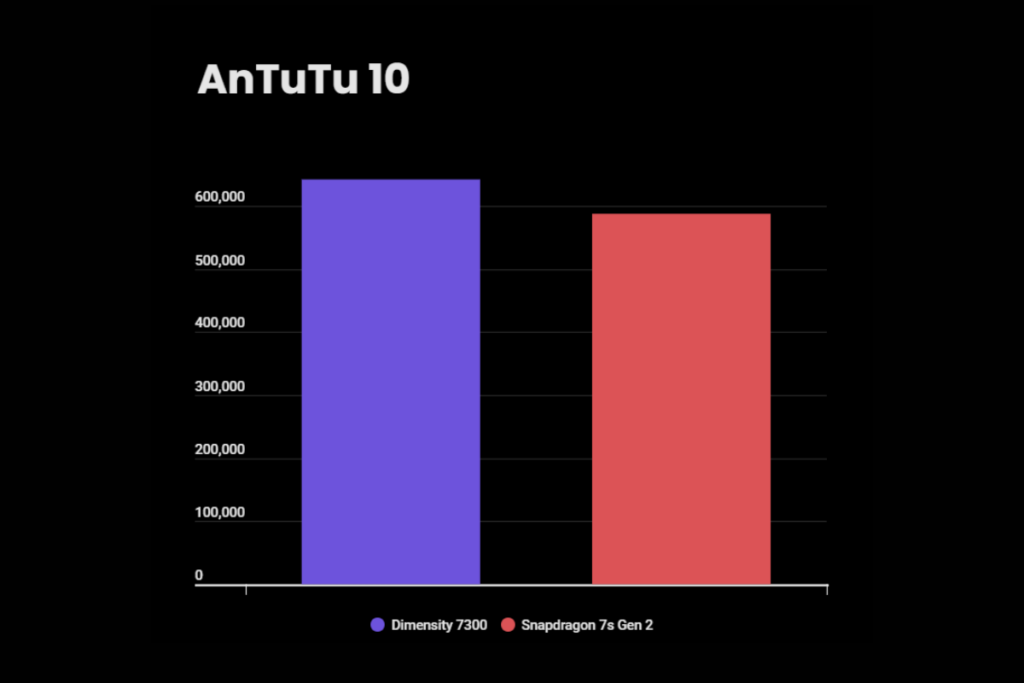
| Dimensity 7300 | SD 7s Gen 2 | |
|---|---|---|
| AnTuTu score | 641,755 | 587,323 |
| CPU | 184,894 | 201,218 |
| GPU | 146,819 | 117,853 |
| Memory | 145,073 | 122,989 |
| UX | 164,969 | 145,263 |
The Dimensity 7300 outperforms the Snapdragon 7s Gen 2 in overall AnTuTu score, racking up 641,755 points compared to 587,323. This reflects a solid leap in overall performance.
While the Snapdragon 7s Gen 2 edges out in CPU performance (201,218 vs. 184,894), the Dimensity 7300 makes up for it with a much stronger GPU score (146,819 vs. 117,853), which means it should offer a better graphics rendering and gaming experience.
The Dimensity chip also pulls ahead in memory (145,073 vs. 122,989) and UX (164,969 vs. 145,263) benchmarks, suggesting smoother multitasking, faster app load times, and a generally more responsive user experience.
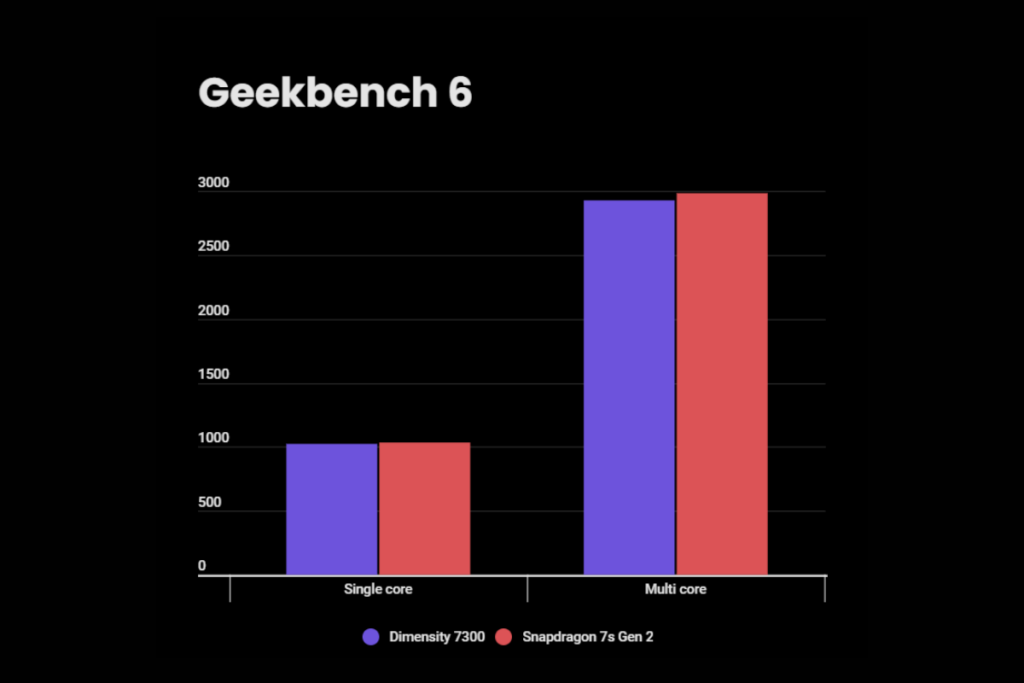
Geekbench benchmark (v6)
| Dimensity 7300 | SD 7s Gen 2 | |
| Single core | 1,023 | 1,034 |
| Multi core | 2,926 | 2,982 |
In Geekbench tests, the Snapdragon 7s Gen 2 takes a slight lead over the Dimensity 7300, scoring 1,034 in single-core and 2,982 in multi-core performance, compared to 1,023 and 2,926, respectively. So, both chips offer similar CPU capabilities, making them evenly matched in everyday tasks like web browsing, app launching, and multitasking.
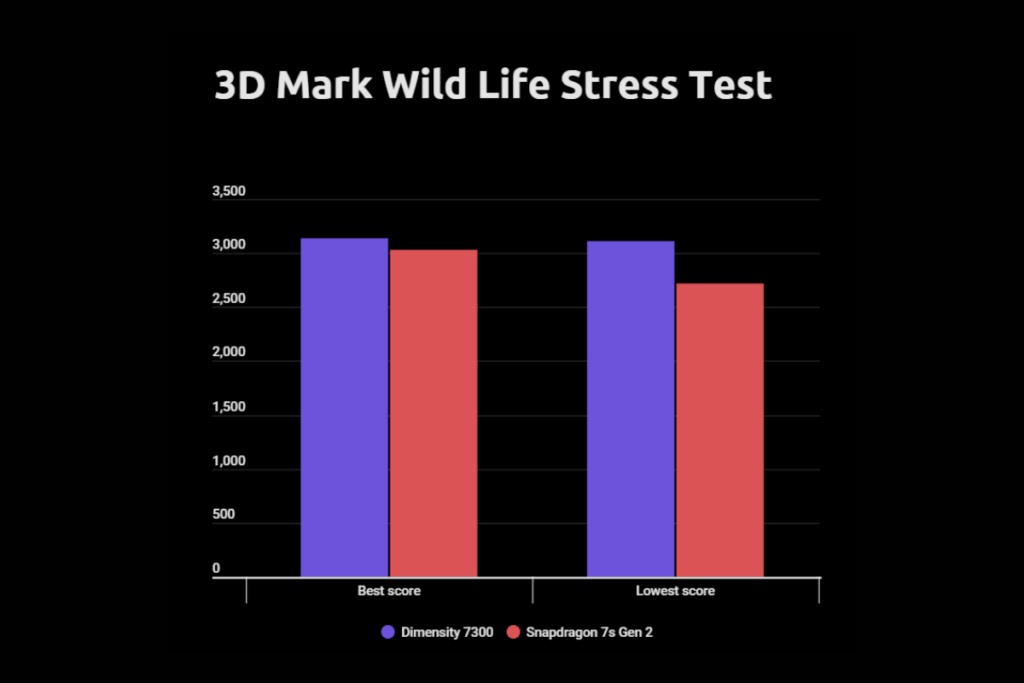
3DMark Wild Life Stress Test
| Dimensity 7300 | SD 7s Gen 2 | |
| Best loop score | 3,138 | 3,031 |
| Lowest loop score | 3,111 | 2,719 |
| Stability | 99.1% | 89.7% |
In the 3DMark Wild Life Stress Test, the Dimensity 7300 showcases impressive sustained performance. It recorded a best loop score of 3,138 and a lowest loop score of 3,111, resulting in a stability rating of 99.1% — a strong indicator of excellent thermal management and consistent GPU performance during extended workloads.
The Snapdragon 7s Gen 2, while not far behind in peak performance with a best score of 3,031, drops to 2,719 at its lowest, yielding a stability of 89.7%. This suggests more noticeable throttling under continuous stress.
Overall, the Dimensity 7300 delivers not only higher peak GPU performance but also far better stability, making it a more reliable option for gaming and heavy graphical tasks over longer durations.
Dimensity 7300 vs Snapdragon 7s Gen 2: What really sets them apart?
1. CPU, GPU, and NPU
Both have octa-core CPUs featuring four Cortex-A78 cores and four Cortex-A55 cores. However, those in the Dimensity 8400 run at a slightly higher speed, giving a little boost in the peak performance.
Both chips are built on advanced 4nm nodes, but the Dimensity 7300 uses TSMC’s, while the Snapdragon 7s Gen 2 uses Samsung’s. The difference here is that TSMC’s manufacturing process is regarded as more power-efficient than Samsung’s.
Coming to the GPU, the Dimensity 7300 features Mali-G615 MP2, while the Snapdragon 7s Gen 2 has an Adreno 710 to fulfill the graphics needs. The former runs at a higher frequency and has higher floating point operations per second (FLOPS), resulting in better GPU performance. The benchmark numbers also confirm this.
The chips also show a large stability difference on the 3DMark test, with the Dimensity chip getting higher stability. One strong reason is TSMC’s manufacturing, which is more efficient at managing power and heat than Samsung.
Both chips have NPUs that enable AI enhancements to various aspects of the chip. The Dimensity 7300 has MediaTek’s 6th-gen NPU 655, which enhances visuals, power efficiency, and performance, says MediaTek. The NPU also helps improve auto-exposure, auto-white balance, and auto-focus.
On the other hand, the Snapdragon 7s Gen 2 features a hexagon NPU that enables faster execution of tasks such as image recognition, voice processing, and camera enhancements. The AI engine also helps improve a range of tasks, including real-time image & video enhancements, smart camera features, low-light scenes, and natural language processing.
2. Camera and Imaging
The MediaTek 7300 has an Imagiq 950 12-bit ISP, with support for up to 200MP single camera. It offers multiple camera features, including face detection, multi-frame noise reduction, EIS for video stabilization, and AI-based auto-exposure, auto-white balance, and auto-focus. The chip also allows video recording from two different cameras at the same time.
On the other hand, the Snapdragon 7s Gen 2 has a 12-bit Spectra triple ISP, with up to 200MP single camera. It allows zero shutter lag at up to 48MP (single camera), 32MP + 16MP (dual cameras), and 16MP+16MP+16MP (triple cameras).
The Snapdragon chip also brings a range of camera features, such as multi-frame noise reduction, AI-based de-noising, deep learning face detection, HDR, staggered HDR, and more. Both chips, however, cap video recording at 4K/30fps.
3. Connectivity
The Dimensity 7300 and Snapdragon 7s Gen 2 have integrated 5G modems, but they have different download speeds. The Dimensity chip allows a maximum download speed of 3.27Gbps, while the Snapdragon chip is capped at 2.9Gbps.
Both chips support Wi-Fi 6E, but the Dimensity chip brings a higher Bluetooth 5.4 standard (versus Bluetooth 5.2) for improved efficiency and seamless connectivity.
4. Audio, Display, and Storage
Both chipsets fully support mainstream audio formats. The Dimensity 7300 leads with the newer Bluetooth 5.4 standard and supports Dual-Link TWS for simultaneous connection to two wireless audio devices. On the other hand, the Snapdragon 7s Gen 2 excels in wireless audio with the Snapdragon Sound suite, aptX codecs, and robust Bluetooth audio features.
The display differences aren’t significant. Both chips support FullHD+ resolution screens at up to 144Hz refresh rate. The two chips do not have many differences in storage, either — they support UFS 3.1 storage and LPDDR5 RAM.
Dimensity 7300 vs Snapdragon 7s Gen 2: Conclusion
Both the Dimensity 7300 and Snapdragon 7s Gen 2 are capable mid-range chips, but they cater to slightly different needs. If you’re looking for better gaming performance, excellent thermal stability, and superior power efficiency, the Dimensity 7300 is the clear winner. It delivers stronger GPU results, better overall AnTuTu scores, and outstanding consistency in stress testing.
The Snapdragon 7s Gen 2, on the other hand, holds a slight edge in CPU performance and includes powerful camera capabilities through its triple ISP and Snapdragon Sound features, which may appeal to users who prioritize photography and multimedia.
Ultimately, if you want a well-balanced performer with a focus on gaming and sustained performance, go with the Dimensity 7300. But if your priorities lean more towards image processing, wireless audio, and raw CPU strength, the Snapdragon 7s Gen 2 won’t disappoint.
| Dimensity 7300 | Snapdragon 7s Gen 2 | |
|---|---|---|
| Announced | June 2024 | September 2023 |
| Manufacturing | 4nm (TSMC) | 4nm (Samsung) |
| CPU | 4 x 2.5GHz — Cortex-A78 4 x 2GHz — Cortex-A55 | 4 x 2.4GHz — Cortex-A78 4 x 1.95GHz — Cortex-A55 |
| GPU | Mali-G615 MP2 | Adreno 710 |
| NPU | MediaTek APU 655 | Hexagon NPU |
| Memory | LPDDR5, up to 3.2GHz | LPDDR5, up to 3.2GHz |
| Storage | UFS 3.1 | UFS 3.1 |
| Camera | Imagiq 950 ISP (12-bit) Up to 200MP single camera Up to 4K/30fps video recording | Spectra triple ISP (12-bit) Up to 200MP single camera Up to 4K/30fps video recording |
| Connectivity | Integrated 5G modem Downlink: 3.27Gbps Wi-Fi 6E Bluetooth 5.2 | Snapdragon X62 5G modem Downlink: 2.9Gbps Qualcomm FastConnect 6700 Wi-Fi 6E Bluetooth 5.4 |
Popular Dimensity 7300 devices:
Popular Snapdragon 7s Gen 2 devices:



Comments