
Add GIZMOCHINA as Preferred Source on Google
The headphones we’re going to talk about today, may change the way you think about open headphones – it’s the Huawei FreeArc, Huawei’s brand new take on open headphones, that not only breaks through stereotypes in terms of sound quality, but also brings a lot of surprises in terms of the wearing experience. I’ve reviewed many similar products before, but the FreeArc’s performance really surprised me. Next, I will bring you a comprehensive review of these headphones from the design, sound quality, features, and also the actual experience.
Design
As the latest addition to Huawei’s audio lineup, the FreeArc opts for the more revered on-ear design. The main part hangs on the outside of the ear and is secured to the ear by an S-shaped memory alloy. The memory alloy is wrapped in ultra-lightweight liquid silicone, which provides excellent comfort for long periods of wearing. The memory metal also conforms the headphones to the ear over time. Ensure that the headphones can be firmly ‘hooked’ to the ear, they won’t come off even with intense exercise.

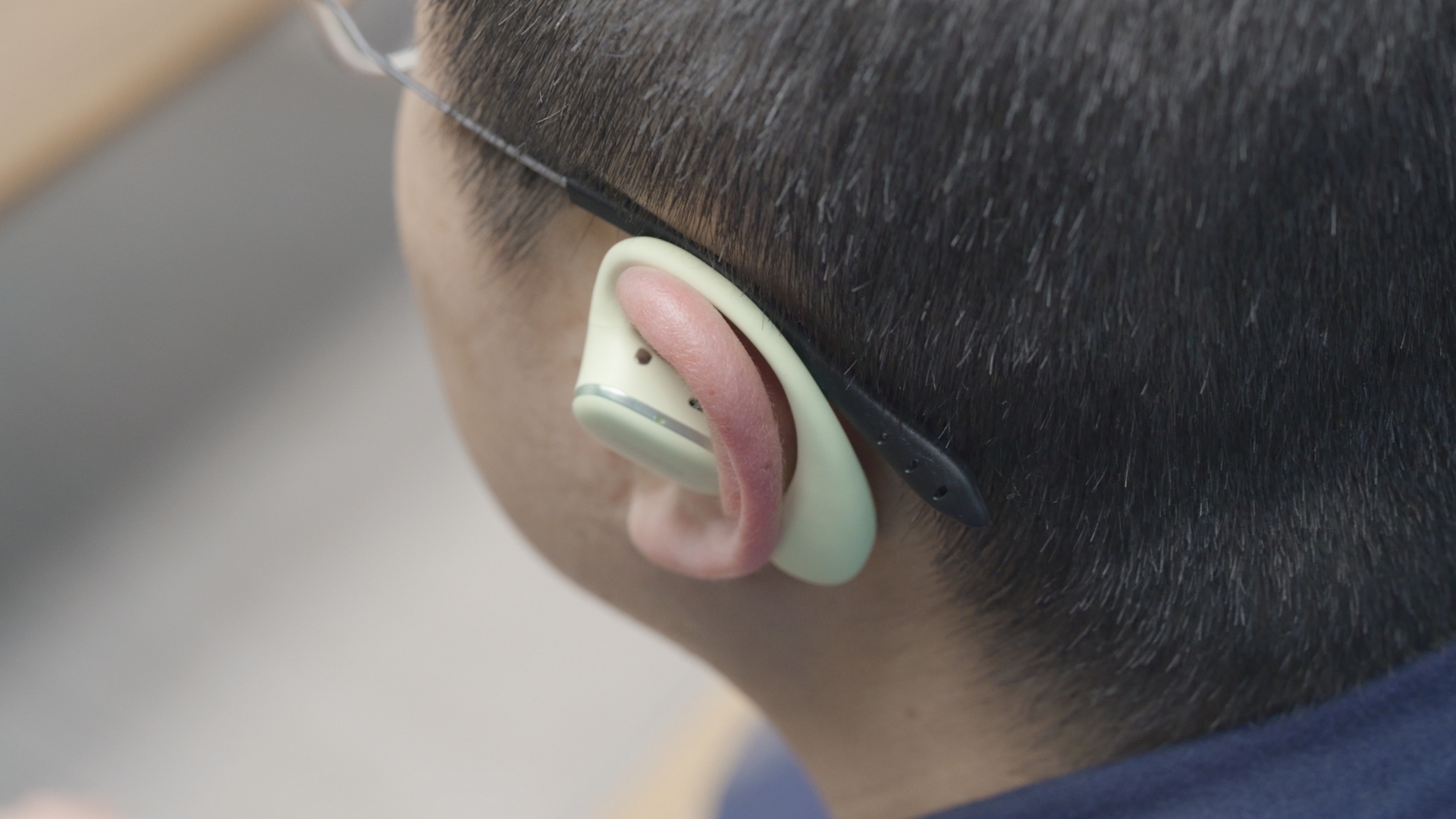
The fit is very good, neither pressing on the ear canal like in-ear headphones, nor creating a pinching like ear clip type of headphones. It claims to fit 99% of ear shapes, with our tests, it shows that both users with larger and smaller ears can find a stable wearing angle. I got the Green, it’s a light green color that gives a fresh and quiet look, suitable for users who are looking for individuality. If you want something a little more understated, you can also choose Ceramic White or Obsidian Black.


The FreeArc is also Huawei’s first headphones to support IP57-rated dust and water resistance, meaning they can withstand rain and sweat. So here I put them inside a glass of water for half an hour, after taking them out and drying them off, they still worked fine. However, it should be noted that the charging case is not waterproof, so remember to dry your headphones after exercise before putting them back in the case.


Sound Quality
This time Huawei has included a huge speaker on the FreeArc, they are over 200 square millimeters, that’s even bigger than some cell phone speakers, which enables the headphones to give better low-frequency response as well as dynamic range. But it’s not without any drawbacks, the headphone does get a bit bulkier and heavier. So next, let’s put on the headphones to hear how these performs.


Overall, the FreeArc is very well balanced, with a low-frequency dive that comes close to what you’d hear on some in-ear headphones. The overall performance is more consistent with the frequency response curve we tested. The better low-frequency response makes them suitable for music that requires a strong sense of rhythm and deep bass, such as electronic music, dance music and rock. The mid-range frequencies reproduce vocals and most instruments well, making it suitable for pop, folk, and jazz music, which is dominated by vocals and instruments. High frequency performance is more natural, suitable for listening to music that requires clear high-frequency details, such as classical music and instrumental solos.

Of course, these sound quality reviews are only for the default EQ settings. You also have the option of switching to Voices, to make the headphones accentuate vocals, and make podcast vocals stand out more. Or switch to Treble boost to hear more detail in the high frequencies of classical music. The Elevate allows the headphones to produce a deeper, more powerful and richer low frequency response. Those times when listening to electronic music, dance music, rock while doing workout.

Sound Leakage Test
Open headphones have been basically criticized for sound leakage. But this time, Huawei’s, seems to have solved this problem. They introduced the Reverse Sound Wave system in FreeArc, to minimize sound leakage and enhance the listening experience. This directional sound transmission technology directs audio to the ear canal, while eliminating external sound waves to ensure clear and private listening. So we put this feature to the test. Please put on your headphones and let’s experience how powerful this technology really is.


Through the test, we found that if you listen to ASMR while taking the subway or elevator, and the sound is as loud as the test just now, or even louder, the people next to you is likely to hear the weird “chewing sound” or “whispering sound”. But if you turn the sound down to maybe below 40%, they won’t hear anything. Or if people are 1 meter away, they can hear nothing. But of course, if you are in a noisy metro, you have to turn the volume up, to mask the ambient noise.


Endurance
It claims to support 7 hours of playtime on a single charge, 28 hours with the charging case, and it supports 10w fast charging. We played lossless streaming music in AAC connection mode, with 50% volume setting. After 2 hours of continuous use, it only consumed 33% of the battery. That’s actually about 6 hours of battery life, which is pretty close to the 7 hours claimed. If you really use them until it’s completely dead, in time of making a cup of coffee, the FreeArc will get 2-3 hours of battery life from fast charging. However, the charging case only supports USB-C wired charging, and it’s a slight pity that wireless charging is not included.


Stable connection is always Huawei’s strong point. the FreeArc comes with a self-developed Bluetooth 5.3 chip, that supports multi-device switching for super terminals. For those who have Huawei’s family bucket, the headphones can connect to both cell phones and tablets, and automatically switch the audio source when an incoming call comes in, which is very practical in both office and entertainment scenarios.

This time, there are also some changes in touch operation. Compared to the common double-click, long-press, they also support a slide to adjust the volume. Fingers need to slide precisely along the groove on the outside of the earhook, it takes time to get used to it, but later on you will know that it’s better than physical buttons. Unfortunately, the headphones do not support wear detection, I hope that the a firmware update can enable such feature.

Conclusion
So honestly, the Huawei FreeArc isn’t perfect – it lacks wear detection and there’s still room for improvement in high-frequency resolution. But these do not take the fact away that they are one of the best open headphones available. Huawei has found a good balance between sound quality, wearing comfort, and sports compatibility. So I think the test results answers the question at the beginning.




Comments