
Add GIZMOCHINA as Preferred Source on Google
Snapdragon’s 7 Plus series includes two of the best-performing chipsets in the mid-range space — the Snapdragon 7 Plus Gen 2 and the newer 7 Plus Gen 3. While it’s pretty obvious that the Snapdragon 7 Plus 3 is superior here, the real question is — how significant an upgrade it is over its predecessor, the 7 Plus Gen 2. Is it a true next-gen upgrade or just a modest refresh with a new label?
In this comparison, we’ll break down the specs, run key benchmarks, and explore real-world differences to see just how much of an upgrade the Gen 3 truly is over its predecessor. Let’s start with the spec sheet:
| Snapdragon 7+ Gen 3 | Snapdragon 7+ Gen 2 | |
|---|---|---|
| Announced | March 2024 | March 2023 |
| Process node | 4nm | 4nm |
| Manufacturer | TSMC | TSMC |
| CPU | 1x 2.8 GHz — Cortex-X4 4x 2.6 GHz — Cortex-A720 3x 1.9 GHz — Cortex-A520 | 1x 2.91 GHz — Cortex-X2 3x 2.49 GHz — Cortex-A710 4x 1.8 GHz — Cortex-A510 |
| GPU | Adreno 732 | Adreno 725 |
| NPU | Qualcomm Hexagon NPU | Qualcomm Hexagon NPU |
| Storage | UFS 4.0 | UFS 3.1 |
| Memory | LPDDR5x, up to 4.2GHz | LPDDR5, up to 3.2GHz |
| Camera | 18-bit Qualcomm Spectra triple ISP Up to 200MP single camera Up to 4K video recording Semantic segmentation support | 18-bit Qualcomm Spectra triple ISP Up to 200MP single camera Up to 4K video recording |
| Connectivity | Snapdragon X63 5G modem Downlink: 5Gbps Qualcomm FastConnect 7800 Wi-Fi 7 (peak speed: 5.8Gbps) Bluetooth 5.3 | Snapdragon X62 5G modem Downlink: 4.4Gbps Qualcomm FastConnect 6900 Wi-Fi 6E (peak speed: 3.6Gbps) Bluetooth 5.3 |
| Display | QHD+ @ 144Hz, 4K Ultra HD @ 60Hz HDR10, HDR10+, HDR Vivid 10-bit color depth | QHD+ @ 120Hz HDR10+ 10-bit color depth |
Snapdragon 7 Plus Gen 3 vs 7 Plus Gen 2: Benchmark comparison
Note: The tests were conducted on the Realme GT 6T (Snapdragon 7+ Gen 3) and POCO F5 (Snapdragon 7+ Gen 2).
AnTuTu performance
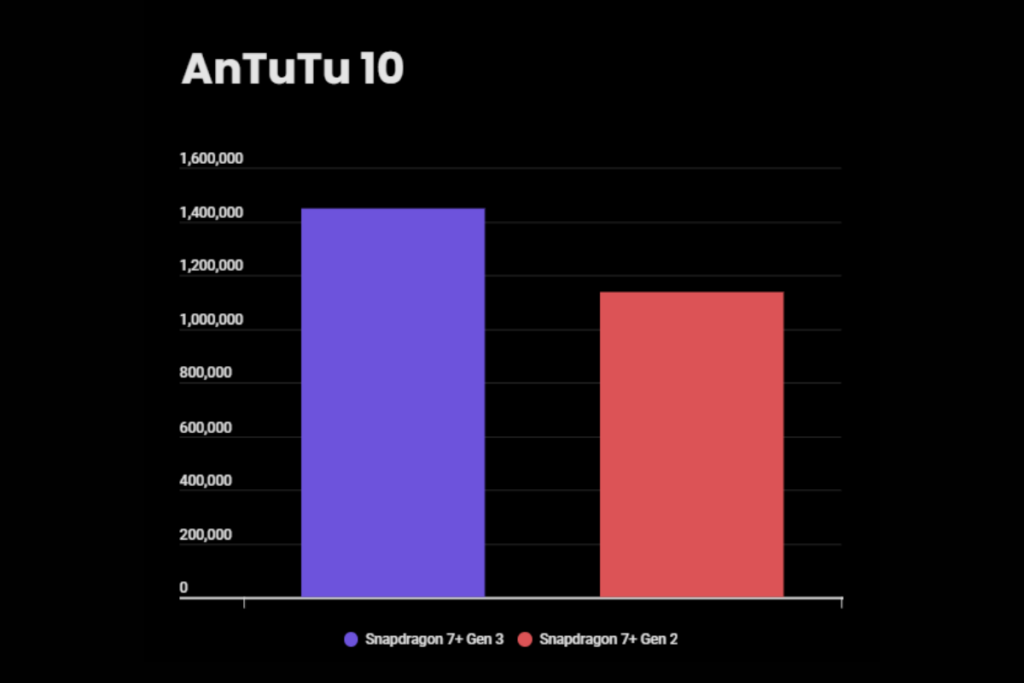
The Snapdragon 7 Plus Gen 3 shows a solid leap in performance over its predecessor in the AnTuTu benchmark. It achieved a total score of 1,448,293, which is around 27.4% higher than the 7 Plus Gen 2’s 1,136,824. The improvements span across all major categories, with the CPU score showing an 11% jump.
The biggest upgrade comes in the GPU department. The 7 Plus Gen 3 delivers about 42% higher graphics score on the benchmark. Memory performance is also up by almost 60%, while the UX score remains largely the same.
| SD 7+ Gen 3 | SD 7+ Gen 2 | |
|---|---|---|
| AnTuTu score | 1,448,293 | 1,136,824 |
| CPU | 376,122 | 339,177 |
| GPU | 488,799 | 344,408 |
| Memory | 334,990 | 209,481 |
| UX | 248,382 | 243,758 |
Geekbench performance
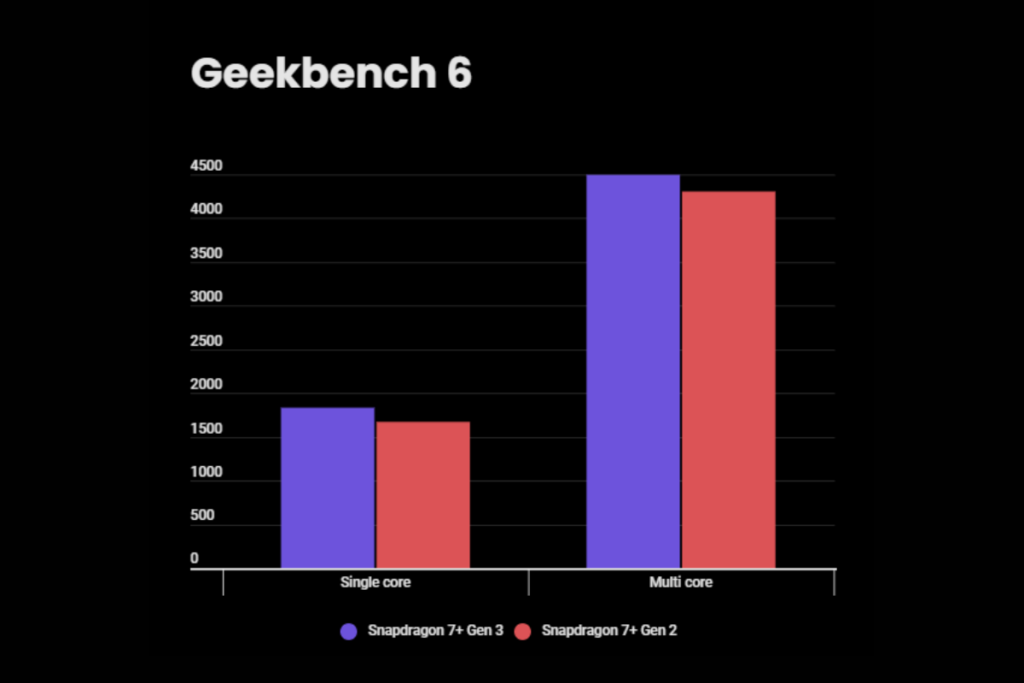
On Geekbench, the Snapdragon 7 Plus Gen 3 once again takes the lead with noticeable improvements in both single-core and multi-core scores. It recorded 1,834 in the single-core test and 4,498 in multi-core, compared to 1,671 and 4,307, respectively, for the Snapdragon 7 Plus Gen 2. That translates to about a 9.7% gain in single-core performance and roughly 4.4% in multi-core.
| SD 7+ Gen 3 | SD 7+ Gen 2 | |
| Single core | 1,834 | 1,671 |
| Multi core | 4,498 | 4,307 |
The benchmark scores provide a good idea of the raw performance, but they don’t tell the complete picture. So, let’s dive further into the key differences to see real-world changes.
Snapdragon 7 Plus Gen 3 vs 7 Plus Gen 2: Key differences that matter
CPU, GPU, and NPU
Both Qualcomm chipsets utilize TSMC’s 4nm manufacturing facility, but they feature different sets of CPU cores. The Snapdragon 7 Plus Gen 3, for instance, features one Cortex-X4 prime core, four Cortex-A720 performance cores, and three Cortex-A520 efficiency cores, whereas the Gen 2 has one Cortex-X2, three Cortex-A510, and four Cortex-A510 cores.
The third-generation chip benefits from newer ARM cores, which unlock higher performance and better power efficiency. It also excels in visual rendering, thanks to its higher peak speed, increased pipelines, and higher floating-point operations per second (FLOPS). AI capabilities are largely the same across both, powered by Qualcomm’s Hexagon NPU.
Camera
Both Snapdragon 7-series chips have the same camera capabilities except for one thing, which makes a meaningful difference. The Snapdragon 7 Plus Gen 3 also has a Cognitive ISP, which uses AI to interpret and enhance images and videos in real-time. The ISP can recognize and differentiate between elements in a scene in real-time and apply detailed optimizations to improve clarity, detail, and color accuracy.
Connectivity and others
The connectivity has also received several meaningful upgrades. The newer X63 5G modem in the Snapdragon 7 Plus Gen 3 offers up to 5Gbps download speed (vs. 4.4Gbps on the 7 Plus Gen 2 with X62 modem). The Gen 3 chip also gets Wi-Fi 7 support with a peak speed of 5.8Gbps versus Wi-Fi 6E (3.6Gbps) on 7 Plus Gen 2.
The 7 Plus Gen 3 also features faster memory (LPDDR5x at 4.2GHz vs. LPDDR5 at 3.2GHz) and storage (UFS 4.0 vs. UFS 3.1), as well as faster USB data transfer. Additionally, it brings support for 4K display resolution and a higher refresh rate for a QHD+ display.
Snapdragon 7 Plus Gen 3 vs 7 Plus Gen 2: Conclusion
The Snapdragon 7 Plus Gen 3 brings meaningful upgrades over its predecessor, the 7 Plus Gen 2, despite both being built on the same efficient 4nm TSMC process. The Gen 3 chip brings newer, more powerful, and efficient CPU cores, along with a superior GPU, providing a notable performance boost. On AnTuTu, it achieves around 28% higher scores, and a noticeable gain is also observed on Geekbench.
The addition of a Cognitive ISP sets the 7 Plus Gen 3 apart, enabling smarter, context-aware image and video enhancements powered by on-device AI. Connectivity is more advanced too, bringing faster 5G and Wi-Fi 7 support. The memory, storage, and display also get meaningful upgrades.
While both are excellent chipsets, the refinements in the 7 Plus Gen 3 platform make it a clear choice for users seeking the premium performance, camera capabilities, and next–generation connectivity in the mid-range segment.



Comments