
Add GIZMOCHINA as Preferred Source on Google
The Snapdragon 8 Elite, announced late last year, was a major step from Qualcomm, marking the arrival of Oryon cores on a smartphone chip. The chip promises huge performance and efficiency improvements over its predecessors, and as a result, the 8 Elite quickly became a top choice among flagship phones.
Its biggest rival, MediaTek, has also introduced several excellent mobile chipsets in the meantime, promising excellent upgrades. The Dimensity 9300 Plus is one of MediaTek’s high-performance chipsets, which we will test against the Snapdragon 8 Gen 3 to find out how the two chips stack up against each other.
Here’s a quick spec sheet to begin with:
| Snapdragon 8 Elite | Dimensity 9300+ | |
|---|---|---|
| Announced | October 2024 | May 2024 |
| Manufacturing | TSMC (3nm) | TSMC (4nm) |
| CPU | 2 x 4.32GHz — Oryon 6 x 3.53GHz — Oryon | 1x 3.4 GHz — Cortex-X4 3x 2.85 GHz — Cortex-X4 4x 2 GHz — Cortex-A720 |
| GPU | Adreno 830 Ray tacing support Snapdragon Elite Gaming features | Mali-G720 Immortalis MP12 Ray tracing support MediaTek Adaptive Gaming Technology |
| NPU | Qualcomm Hexagon NPU | MediaTek NPU 790 |
| Memory | LPDDR5x, up to 5.3GHz | LPDDR5T, up to 4.8GHz |
| Storage | UFS 4.0 | UFS 4.0 |
| Camera | Spectra triple AI ISP (18-bit) Up to 320MP single camera Limitless real-time semantic segmentation Up to 8K video recording | Imagiq 990 ISP (18-bit) Up to 320MP single camera Real-time semantic segmentation Up to 8K video recording |
| Connectivity | Download speed: 10Gbps (peak) Wi-Fi 7 (peak speed: 5.8Gbps) Bluetooth 6.0 Ultra Wideband (UWB) support | Download speed: 7Gbps (peak) Wi-Fi 7 (peak speed: 6.5Gbps) Bluetooth 5.4 |
Snapdragon 8 Elite vs Dimensity 9300 Plus — Benchmark comparison
Note: The tests were conducted on the iQOO 13 (Snapdragon 8 Elite) and Vivo X200 FE (Dimensity 9300 Plus).
AnTuTu comparison
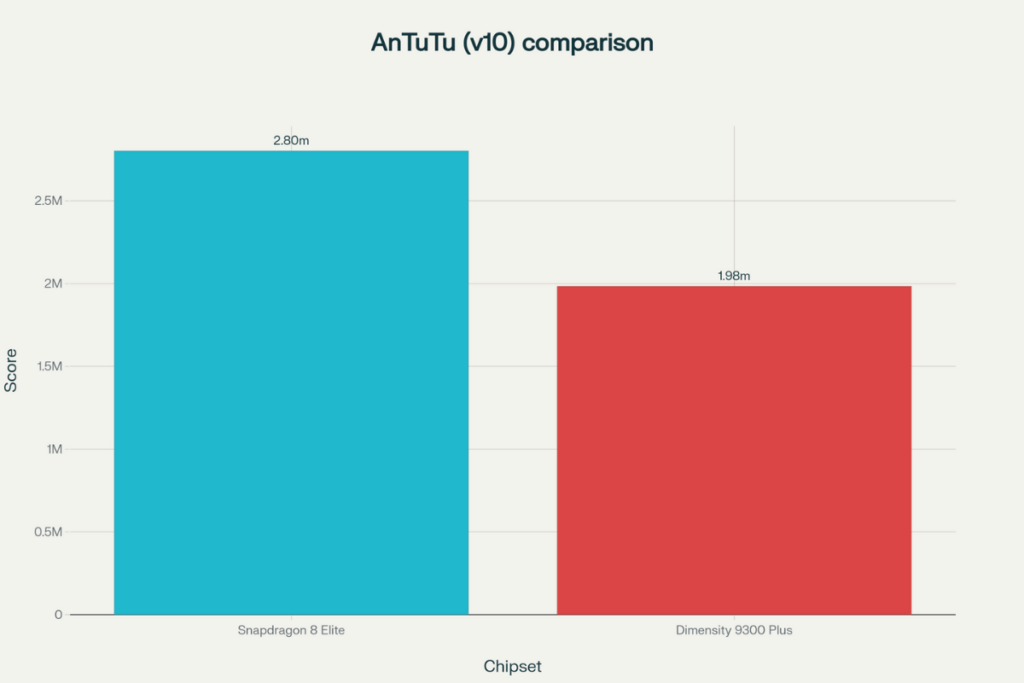
The Snapdragon 8 Elite dominates the AnTuTu benchmark with an impressive 2,802,747 points, putting it far ahead of the Dimensity 9300 Plus, which scores 1,984,562 — a gap of over 41% in total performance.
Breaking it down, Qualcomm’s chip delivers a 34.6% higher CPU score (631,482 vs 469,277) and an even bigger leap in GPU performance, where it posts 1,208,815 points compared to MediaTek’s 810,295 — a massive 49% advantage that directly translates into smoother gaming, faster rendering, and better sustained graphics performance.
The Snapdragon 8 Elite also leads in memory (505,708 vs. 341,139) and UX (456,742 vs. 363,851), resulting in faster data handling, improved multitasking, and a more responsive day-to-day experience. Overall, the numbers make it clear — Snapdragon’s latest flagship isn’t just ahead, it’s in an entirely different performance class.
| Snapdragon 8 Elite | Dimensity 9300+ | |
|---|---|---|
| AnTuTu score | 2,802,747 | 1,984,562 |
| CPU | 631,482 | 469,277 |
| GPU | 1,208,815 | 810,295 |
| Memory | 505,708 | 341,139 |
| UX | 456,742 | 363,851 |
Geekbench comparison
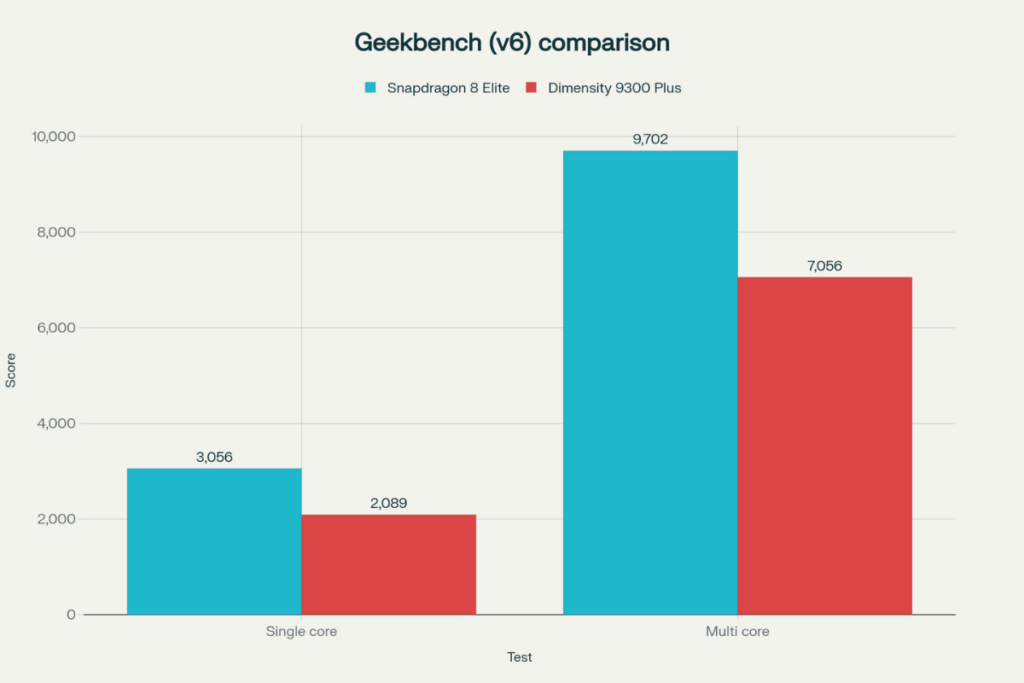
On Geekbench, the Snapdragon 8 Elite delivers a commanding lead in both single-core and multi-core performance. It scores 3,056 in single-core, which is about 46% higher than the Dimensity 9300 Plus’s 2,089, giving it a clear edge in tasks that rely on burst speed, like app launches and quick UI interactions.
In multi-core performance, the gap remains significant — 9,702 vs 7,056 — a 37.6% advantage for the Snapdragon chip. This means better handling of heavy multitasking, demanding productivity apps, and sustained workloads.
| Snapdragon 8 Elite | Dimensity 9300+ | |
| Single core | 3,056 | 2,089 |
| Multi core | 9,702 | 7,056 |
Although benchmarks are helpful, they do not tell the complete picture. It lacks key elements, such as camera capabilities and connectivity features, which we’ll cover in the following section.
Snapdragon 8 Gen 3 vs Dimensity 9300 Plus — Key differences that really matter
Manufacturing
Both the Snapdragon 8 Elite and Dimensity 9300 Plus have been manufactured by TSMC, but using different process nodes that make a real difference. The Snapdragon chip uses a 3nm process, which is more advanced and power-efficient than the 4nm node used for the Dimensity chip.
CPU
The CPU makes a significant difference, as the two chips differ in core selection and core architecture. For instance, the Snapdragon 8 Elite features eight Oryon cores (2 x 4.32 GHz and 6 x 3.52 GHz).
On the other hand, the Dimensity 9300 Plus features four Cortex-X4 performance cores (1 x 3.4 GHz and 3 x 2.85 GHz) and four Cortex-A720 efficiency cores operating at up to 2 GHz speed.
Not only does the Snapdragon chip have a higher peak speed, but Oryon cores are more powerful and power-efficient than the Dimensity chip’s cores. In addition, the more advanced manufacturing also provides the 8 Elite with a noticeable boost in performance and efficiency.
GPU
The Snapdragon 8 Elite is equipped with Adreno 830 for graphics rendering. It’s the first chip to use Qualcomm’s new “sliced architecture,” which benefits both performance and efficiency. Besides powerful hardware, the chip offers a comprehensive suite of Snapdragon Elite Gaming Features, including Qualcomm Adaptive Performance Engine 4.0, Real-Time Hardware-Accelerated Ray Tracing, Snapdragon Game Super Resolution 2.0, and Adreno Frame Motion Engine 2.0, all designed to enhance the gaming experience.
The Dimensity 9300 Plus, on the other hand, features Mali-G720 Immortalis MP12 (12-core) GPU with higher peak speed and more pipelines. Despite this, it can’t outperform the Snapdragon 8 Elite’s GPU performance due to multiple factors, including a new sliced architecture, advanced manufacturing technology, architectural efficiency improvements, and highly optimized drivers.
AI & NPU
The Snapdragon 8 Elite features a hexagon NPU, which is 45% faster and offers 45% better performance per watt compared to the previous generation. It supports popular large language models (LLMs) and on-device generative AI capabilities. On the other hand, the Dimensity 9300 Plus features a MediaTek NPU 780 with generative AI capabilities across text, images, music, and more domains. The on-device intelligence also helps in image optimizations, performance improvements, and more areas.
Camera
The Snapdragon chip features an 18-bit Spectra AI ISP with support for up to 320MP camera and up to 8K video recording. Additionally, it offers a range of camera optimizations, including real-time semantic segmentation, video object eraser, real-time skin/sky adjustments, Truepic photo capture, and more.
The Dimensity 9300+ also supports 320MP resolution and 8K video resolution. However, it lacks a robust set of camera optimizations as present on the Snapdragon 8 Elite. It supports semantic segmentation, though.
Connectivity
The Snapdragon 8 Elite offers faster download speed on a 5G connection (10Gbps vs 7Gbps). The upload speed peaks at 3.5Gbps. MediaTek hasn’t published this detail on its official website. On the plus side, the Dimensity 9300 Plus offers higher speeds on Wi-Fi connection (6.5Gbps vs 5.8Gbps).
Qualcomm says the Snapdragon 8 Elite features 30% better accurate location positioning and 40% more efficient mobile connectivity system. It’s Qualcomm’s first chip to integrate Wi-Fi ranging, Bluetooth wireless technology, and UWB proximity for hyper-accurate location accuracy and seamless device tracking.
The Dimensity 9300 Plus also brings several connectivity enhancements, including MediaTek Xtra Range 2.0 and MediaTek Wi-Fi UltraSave, which provide extended reach and improved efficiency.
Snapdragon 8 Elite vs Dimensity 9300 Plus: Conclusion
The Snapdragon 8 Elite and Dimensity 9300 Plus are both flagship-level chipsets with impressive specs, but in head-to-head testing, Qualcomm’s offering consistently comes out on top. It not only delivers far higher benchmark scores — with over a 40% lead in AnTuTu and up to 46% in Geekbench — but also shows real-world advantages in gaming, efficiency, and feature support.
Qualcomm’s use of Oryon cores, a more advanced 3nm manufacturing process, and the new Adreno 830 GPU with sliced architecture allows the 8 Elite to push performance boundaries while maintaining strong thermal efficiency. It also benefits from a richer set of gaming and camera features, along with faster 5G connectivity and enhanced location capabilities.
The Dimensity 9300 Plus still offers strong performance and faster Wi-Fi speeds, making it a capable choice for high-end devices. However, when you factor in overall performance, gaming stability, AI efficiency, and ecosystem maturity, the Snapdragon 8 Elite holds a comfortable lead, making it the better all-around flagship chip for 2025.



Comments