Add GIZMOCHINA as Preferred Source on Google
Google and Samsung are the two names that come up first when you think of the best Android phones. And with Google’s brand-new Pixel 10 Pro XL now official, it’s only natural to wonder, is it the better buy over Samsung’s current best Galaxy S25 Ultra?
Both devices are the very best each company has to offer. On Google’s side, the Pixel 10 Pro XL makes a strong case with meaningful upgrades, faster wired and wireless charging, a more efficient Tensor G5 chip built for AI, and the largest battery ever put in a Pixel.
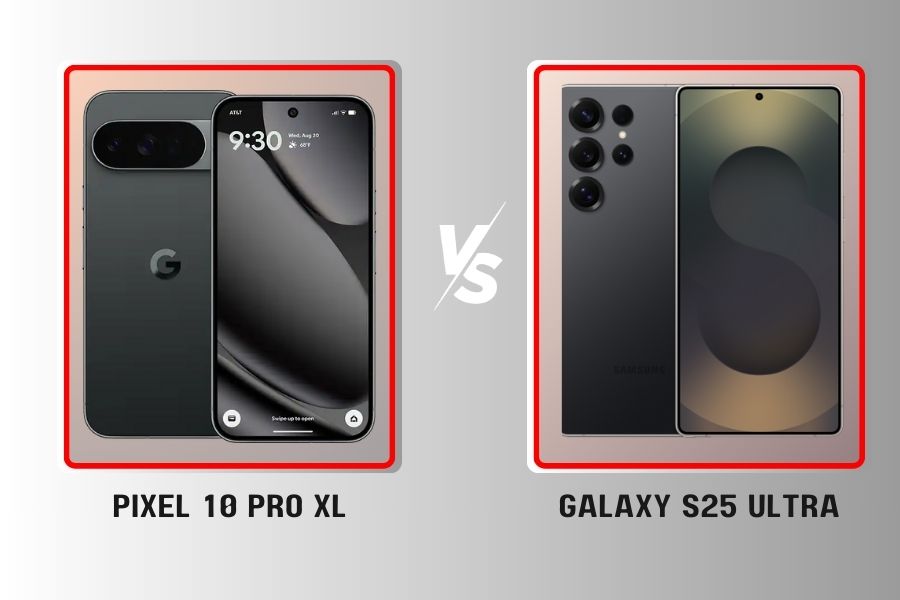
On the other side, Samsung’s Galaxy S25 Ultra has been out for half a year but still feels like the benchmark to beat. Samsung packed it with the best display in the business, a versatile camera system, and a durable build.
So here we are: Google’s newest challenger versus Samsung’s proven workhorse. If you’re standing at the crossroads of these two phones, which one actually makes more sense to buy? Let’s dive in.
1. Design and durability
The Pixel 10 Pro XL sticks to the design language Google has used for years: glass front, glass back, and an aluminum frame. It feels premium but also bulky at 232 grams. The Galaxy S25 Ultra, meanwhile, comes in slightly lighter at 218 grams despite being bigger, thanks to its use of a titanium frame.
Samsung also uses Corning Gorilla Armor 2 on the front, which is rated harder than Gorilla Glass Victus 2 and adds a DX anti-reflective coating for better visibility outdoors.
| Preview | Product | |
|---|---|---|

|
Google Pixel 10 Pro XL – Unlocked Android Smartphone – Gemini AI Assistant, Triple Rear Camera… | Check Price on Amazon |
Please Note: When you buy something using the links in our articles, we may earn a small commission at no cost to you.
| Preview | Product | |
|---|---|---|

|
Samsung Galaxy S25 Ultra 5G Smartphone with Galaxy AI (Titanium Silverblue, 12GB RAM, 256GB… | Check Price on Amazon |
Please Note: When you buy something using the links in our articles, we may earn a small commission at no cost to you.
2. Display quality
Google gave the Pixel 10 Pro XL a strong 6.8-inch LTPO OLED panel that reaches up to 3300 nits of peak brightness. That makes it one of the brightest displays on any phone. The resolution is sharp at 1344 x 2992 pixels with HDR10+ support.
Samsung counters with a slightly larger 6.9-inch Dynamic LTPO AMOLED 2X panel at 1440 x 3120 pixels. Peak brightness is lower on paper at 2600 nits, but Samsung balances this with an anti-reflective coating and better outdoor visibility. More importantly, the S25 Ultra stretches the display to a 92.5% screen-to-body ratio, meaning less bezel and more immersive viewing.
The Pixel looks great indoors, but Samsung’s combination of panel tech, anti-reflective layer, and higher resolution means it’s simply easier to use in real-world conditions.
3. Performance and hardware
Performance is where Samsung pulls ahead most clearly. The Pixel 10 Pro XL uses Google’s Tensor G5, a chip built on 3nm but optimized mainly for AI workloads and photography. It’s suitable for daily use, but historically, Tensor chips have lagged behind Qualcomm’s top-tier processors in terms of raw performance and efficiency.
The Galaxy S25 Ultra ships with the Snapdragon 8 Elite, Qualcomm’s most powerful chipset yet. Its Oryon V2 CPU and Adreno 830 GPU deliver not only higher benchmarks but also better sustained performance for gaming, video editing, and multitasking.
For anyone planning to keep their phone for several years, Samsung’s hardware advantage makes a difference in long-term performance and battery efficiency.
4. Camera systems
Google has done an incredible job using AI to squeeze more out of its camera hardware. The Pixel 10 Pro XL can take some of the best still photos on the market.
It now even supports 100X Pro Res Zoom, which leverages its 48MP telephoto lens and Tensor G5’s AI compute to fill in the lost details. Besides this, it comes with a 50MP main sensor and a 48MP ultrawide.
Samsung, on the other hand, is betting more on the hardware. The S25 Ultra has four rear lenses, including a 200-megapixel main sensor, a dedicated 3x telephoto, a 5x periscope zoom, and a 50MP ultrawide. That variety means you can shoot in almost any situation without relying entirely on software correction.
The Pixel’s AI tricks work well, but Samsung’s setup offers more flexibility in real-world shooting. For someone who uses their phone as their only camera, the S25 Ultra’s quad system is the safer bet.
5. Software and features
Both phones promise seven years of Android updates, which puts them at the top of the industry for longevity. The Pixel 10 Pro XL launches with Android 16, while Samsung ships the S25 Ultra with Android 15 and One UI 7.
Google keeps its software clean and emphasizes AI tools like Circle to Search, Best Take, and skin temperature monitoring. Samsung includes most of the same AI features but pairs them with extras like Samsung DeX (a desktop mode via wired or wireless display), better multitasking tools, and deeper customization.
The S25 Ultra also comes with an S Pen stylus, which adds note-taking, precise editing, and remote shutter functions. It’s niche, but for anyone who values productivity, it’s something the Pixel simply doesn’t offer.
6. Connectivity and extras
Both phones have 5G, Wi-Fi 7, and UWB (Ultra Wideband) support. But Samsung goes further with Bluetooth 5.4 versus Google’s older Bluetooth 6.0 implementation. The Galaxy also supports DisplayPort 1.2 output over USB-C, meaning you can connect it directly to monitors for DeX or media playback.
On the audio side, Samsung tunes its speakers with AKG and supports 32-bit/384kHz audio, while the Pixel sticks with standard stereo speakers. Neither has a headphone jack, but Samsung’s audio stack is aimed at people who still care about wired quality through DACs.
7. Battery and charging
Google gives the Pixel 10 Pro XL a 5200 mAh battery with 45W wired charging, 25W wireless charging, and reverse wireless charging. It even supports bypass charging to reduce heat during gaming.
The Galaxy S25 Ultra uses a slightly smaller 5000 mAh battery, but thanks to the Snapdragon chip and Samsung’s optimization, efficiency is typically better. It also supports 45W wired charging (65% in 30 minutes) and 15W wireless charging.
8. To sum it up
The easiest way to sum up the choice is this: the Pixel 10 Pro XL is a phone built around AI. Google’s strategy is to let software do the heavy lifting, whether that’s through computational photography or predictive features in Android. It’s a focused vision, but it leaves gaps in hardware versatility.
The Galaxy S25 Ultra is a phone built to cover every base. It’s not just fast; it’s durable, versatile, and also comes with its own suite of Galaxy AI features that just as good as Google’s, if not better.
So really, the choice comes down to what you value most. If you want AI front and center, the Pixel makes sense. But if you want a phone that leaves no box unchecked, the Ultra still feels like the safer bet.
For more daily updates, please visit our News Section.
Stay ahead in tech! Join our Telegram community and sign up for our daily newsletter of top stories.