
Add GIZMOCHINA as Preferred Source on Google
For years, Qualcomm Snapdragon chips have been the go-to choice for top performance and efficiency on Android devices over MediaTek. However, recent MediaTek Dimensity chips have been closing in on the gap, and as a result, the competition between the two chipmakers is now fiercer than ever before.
In September, both chipmakers announced their most powerful mobile chipsets, Snapdragon 8 Elite Gen 5 and Dimensity 9500, promising significant improvements to performance and power efficiency. But how do they stack up against each other? Let’s look at benchmark figures and key differences to find out the answer.
Snapdragon 8 Elite Gen 5 vs Dimensity 9500: Benchmark Score
Note: The benchmark scores were obtained from the listings of the Honor Magic 8 (powered by Snapdragon 8 Elite Gen 5) and Vivo X300/Pro (powered by Dimensity 9500) spotted on benchmark websites.
Geekbench Score
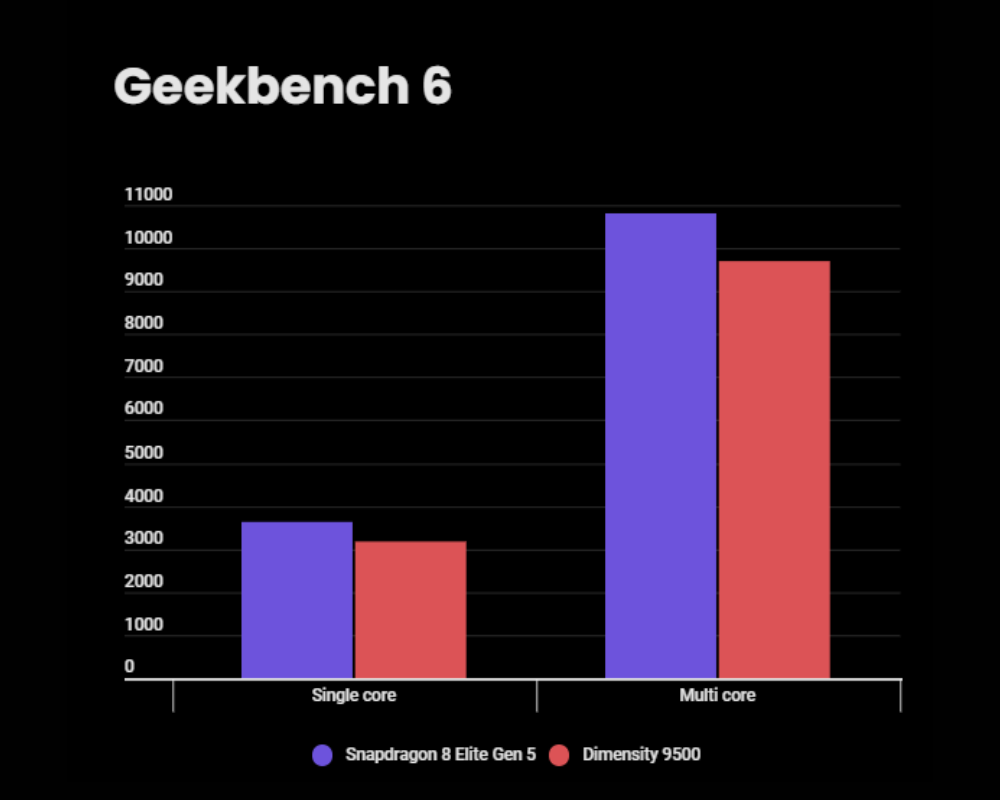
The Snapdragon 8 Elite Gen 5 posts 3,364 points in single-core, which is about 15% higher than Dimensity 9500. The multi-core performance also tells the same story, getting about 12% higher score than the Dimensity chip.
The Snapdragon chip, featuring a robust Oryon CPU, dominates Geekbench with higher single-core and multi-core scores. In other words, the 8 Elite Gen 5 should offer better performance than the Dimensity 9500 in tasks that require a single core, as well as in multi-core tasks such as multitasking, running heavy apps, and managing background apps.
| Geekbench 6 | Snapdragon 8 Elite Gen 5 | Dimensity 9500 |
|---|---|---|
| Single core | 3,634 | 3,177 |
| Multi core | 10,813 | 9,701 |
AnTuTu Score
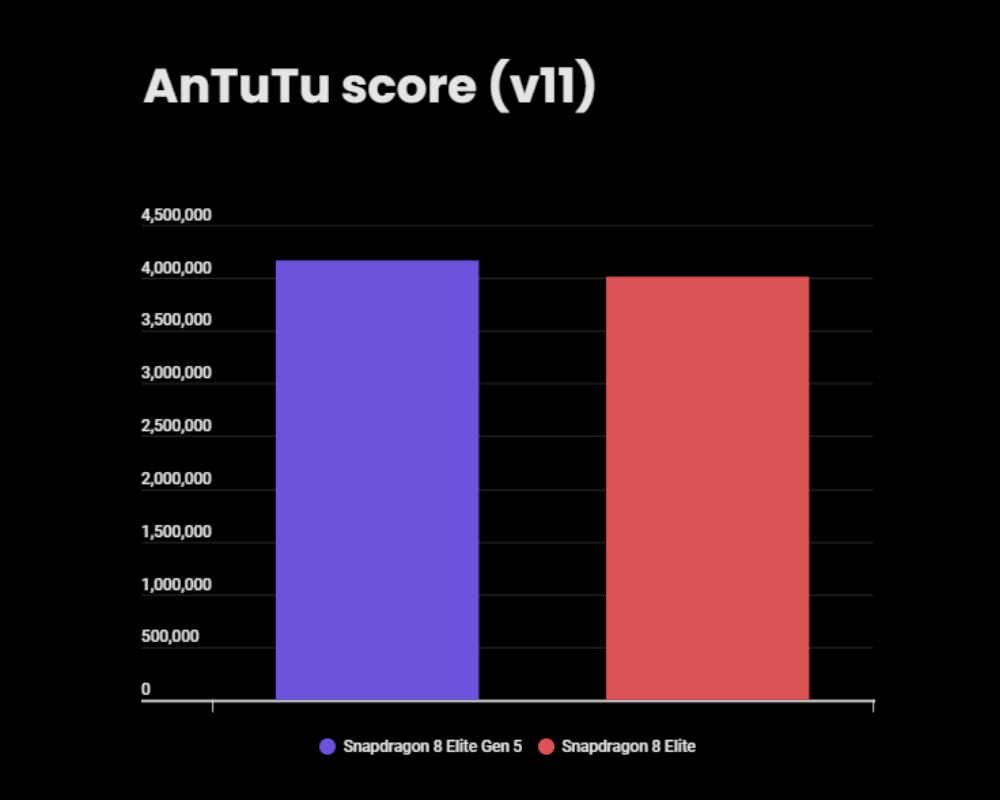
Both Snapdragon 8 Elite Gen 5 and Dimensity 9500 have managed to cross the 4 million mark on AnTuTu, becoming the first mobile chipsets to achieve this feat. The Snapdragon chip comes at the top, posting a total score of 4,166,339 (vs. 4,011,932). The difference here is just 4%, but it gets wider as you look at the breakdown.
The Snapdragon 8 Elite Gen 5 achieves a 16% higher CPU score (1,213,845 vs. 1,043,247). The GPU score, however, favors the Dimensity 9500 (1,510,982 vs. 1,468,351), but the difference is small — just 3%. It also gets a higher memory score, but the Snapdragon chip bounces back with a higher UX score.
| Snapdragon 8 Elite Gen 5 | Dimensity 9500 | |
|---|---|---|
| AnTuTu score | 4,166,339 | 4,011,932 |
| CPU | 1,213,845 | 1,043,247 |
| GPU | 1,468,351 | 1,510,982 |
| Memory | 570,553 | 667,254 |
| UX | 913,590 | 790,449 |
Snapdragon 8 Elite Gen 5 vs Dimensity 9500: Specs and Key Differences
| Snapdragon 8 Elite Gen 5 | Dimensity 9500 | |
|---|---|---|
| Announced | September 2025 | September 2025 |
| Process node | 3nm (TSMC) | 3nm (TSMC) |
| CPU cores | 8-core | 8-core |
| CPU cores | 2 x 4.61 GHz — Oryon (3rd gen) 6 x 3.63 GHz — Oryon (3rd gen) | 1 x 4.21 GHz — C1-Ultra 3 x 3.5 GHz —C1-Premium 4 x 2.7 GHz — C1-Pro |
| GPU | Adreno 840 Ray tracing support Snapdragon Elite Gaming features | Mali-G1 Ultra MP12 Ray tacing support MediaTek HyperEngine Gaming Technology |
| NPU | Qualcomm Hexagon NPU | MediaTek NPU 990 |
| Memory | LPDDR5X, up to 5.3 GHz | LPDDR5X, up to 5.3 GHz |
| Storage | UFS 4.1 | UFS 4.1 |
| Camera | Qualcomm Spectra Triple ISP (20-bit) Up to 320MP single camera Up to 8K video recording Supports real-time semantic segmentation | MediaTek Imagiq 1190 ISP Up to 320MP single camera Up to 8K video recording Supports real-time semantic segmentation |
| Connectivity | Snapdragon X85 5G modem Download speed: 12.5 Gbps (peak) Upload speed: 3.7 Gbps (peak) Wi-Fi 7 (peak speed: 5.8 Gbps) Bluetooth 6.0 | 3GPP Release-17 5G modem Maximum speed: 7.4 Gbps Wi-Fi 7 (peak speed: 7.3 Gbps) Bluetooth 6.0 |
Both flagship chipsets utilize TSMC’s 3nm (N3P), shifting from the N3E process used in their predecessors, for improved power efficiency and performance density. The key difference lies in the CPU architecture, where Qualcomm maintains its proven “2+6” core configuration, featuring two prime cores at 4.6GHz and six performance cores at 3.62GHz. MediaTek, on the other hand, continues with its “All Big Core” design, featuring one C1-Ultra core at 4.21 GHz, three C1-Premium cores at 3.5 GHz, and four C1-Pro cores at 2.7 GHz.
The GPU also gets notable upgrades on both chips. The Snapdragon 8 Elite Gen 5 introduces a new Adreno 840 GPU clocked at up to 1.2 GHz, paired with Qualcomm’s gaming technologies, which offer exceptional gaming performance. The Dimensity 9500 chip features an Arm Mali-G1 Ultra GPU, which delivers significant improvements in ray-tracing capabilities and power efficiency.
Coming to the NPU, the improved Hexagon NPU inside the 8 Elite Gen 5 is 37% faster and 16% more power-efficient than its predecessor. It supports advanced “agentic AI” capabilities. The Dimensity 9500 has a MediaTek NPU 990, which is 2x faster and offers a 56% reduction in peak power consumption compared to its predecessor.
Both chipsets offer excellent connectivity features, albeit with some differences. The Snapdragon 8 Elite Gen 5 supports a maximum speed of 12.5 Gbps over a 5G connection, while the Dimensity 9500 can go up to 7.4 Gbps. However, it’s a different story with Wi-Fi speed, as the Snapdragon chip peaks at 5.8 Gbps, but the Dimensity 9500 can reach 7.3 Gbps.
The camera has also received notable upgrades, including a 20-bit triple ISP (upgraded from 18-bit) for the Snapdragon 8 Elite Gen 5, which offers nearly four times the dynamic range. Additionally, it supports Advanced Professional Video (APV), making it the first mobile chipset to offer near-lossless video recording quality. The Dimensity 9500 features the Imagiq 1190 ISP, which includes an NPU-assisted focusing tracking engine and powerful AI denoise technology.
Also Read:
1. Snapdragon 8 Elite Gen 5 tops Apple A19 Pro and Dimensity 9500 in early benchmarks
2. Snapdragon 8 Elite Gen 5 vs Snapdragon 8 Elite: here are all the major upgrades
3. Upcoming smartphones powered by the Snapdragon 8 Elite Gen 5
Don’t miss a thing! Join our Telegram community for instant updates and grab our free daily newsletter for the best tech stories!



Comments