
Add GIZMOCHINA as Preferred Source on Google
The Dimensity 9500 is the latest and greatest mobile chipset from MediaTek, promising a significant boost to performance and power efficiency across CPU and GPU. The NPU, camera, and connectivity have also received notable upgrades, making it a well-rounded option for high-end devices.
Built on TSMC’s 3nm (N3P) process node, the latest Dimensity chip adopts a third-generation “All Big Core” CPU design featuring ARM’s latest C1-series processors, which promises a significant boost to performance and power efficiency. The new 12-core Mali-G1 Ultra GPU also delivers notable performance gains and enhancements for ray tracing.
The Dimensity 9500 looks excellent on paper, but how big of an upgrade is it over last year’s Dimensity 9400? Let’s look at the benchmark scores to find out.
Dimensity 9500 vs Dimensity 9400: benchmark score
Note: The benchmark scores were obtained from leaked listings of Vivo X300 Pro (Dimensity 9500). For Dimensity 9400, we used the Vivo X200 Pro.
Geekbench score
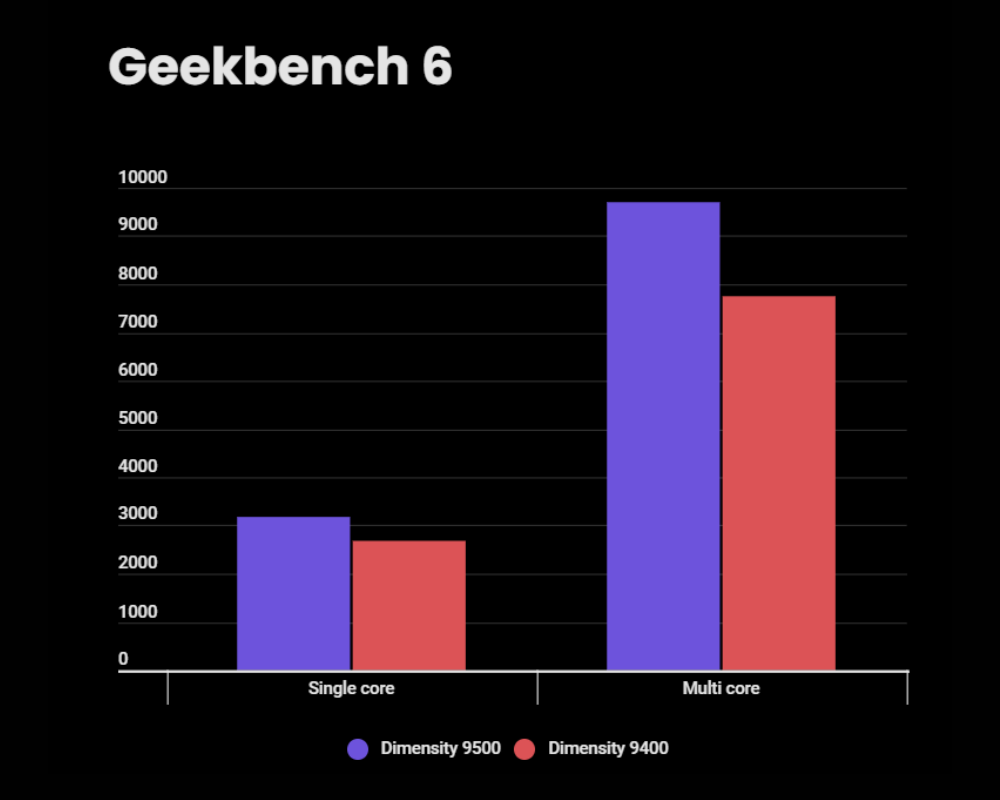
On the Geekbench 6 platform, the Dimensity 9500 gets 3,177 in single core, which is about 18% higher than the Dimensity 9400. The gap widens further in multi-core, where the Dimensity chip has posted a total score of 9,701, while its predecessor couldn’t cross the 8,000 mark. That’s a solid 25% gain in multi-core score for the newer chip.
| Geekbench 6 | Dimensity 9500 | Dimensity 9400 |
|---|---|---|
| Single core | 3,177 | 2,681 |
| Multi core | 9,701 | 7,752 |
AnTuTu score
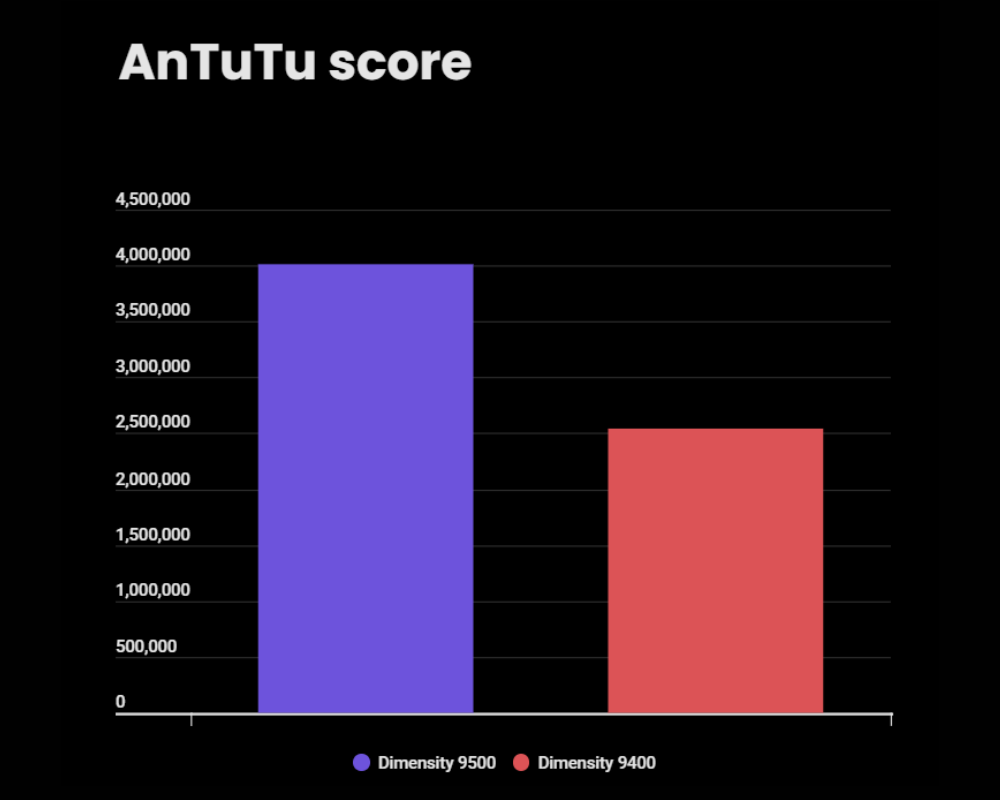
On the AnTuTu benchmarking platform, the Dimensity 9500’s total score crosses the 4 million mark, which is a big achievement in itself. This is about 57% higher than Dimensity 9400.
The breakdown reveals that the Dimensity 9500’s CPU achieves a significantly higher CPU score (1,043,247 vs 591,239). That’s a solid 76% increase. The GPU gets a 32% higher score (1,510,982 vs 1,144,638). The memory (667,254 vs. 411,334) and the UX (790,449 vs. 394,544) have also gained about 62% and 100% higher scores, respectively.
The latest advancements to the Dimensity 9500 are the driving factors behind this significant gap, but this is also partly due to differences in AnTuTu versions. The AnTuTu score for the Vivo X200 Pro (powered by Dimensity 9400) is from AnTuTu v10, while the X300 Pro (powered by Dimensity 9500) is tested on a newer version, v11. So, we’ll update the score for Dimensity 9400 after benchmarking on the same AnTuTu version for a fair comparison.
| Dimensity 9500 | Dimensity 9400 | |
|---|---|---|
| AnTuTu score | 4,011,932 | 2,541,756 |
| CPU | 1,043,247 | 591,239 |
| GPU | 1,510,982 | 1,144,638 |
| Memory | 667,254 | 411,334 |
| UX | 790,449 | 394,544 |
Dimensity 9500 vs Dimensity 9400: spec sheet
| Dimensity 9500 | Dimensity 9400 | |
|---|---|---|
| Announced | September 2024 | October 2024 |
| Process node | TSMC’s 3nm (N3P) | TSMC’s 3nm (N3E) |
| CPU cores | 8-core | 8-core |
| CPU cores | 1 x 4.21 GHz — C1-Ultra 3 x 3.5 GHz —C1-Premium 4 x 2.7 GHz — C1-Pro | 1 x 3.62 GHz — Cortex-X925 3 x 3.3 GHz — Cortex-X4 4 x 2.4 GHz — Cortex-A720 |
| GPU | Mali-G1 Ultra MP12 120 FPS ray traced mobile gaming MediaTek HyperEngine Gaming Technology MRFC 3.0 technology Vulkan Ray Tracing Pipeline support MegaLights, Nanite support in Unreal Engine | Mali-G925 Immortalis MP12 Ray tracing support MediaTek HyperEngine Gaming Technology |
| NPU | MediaTek NPU 990 | MediaTek NPU 890 |
| Memory | LPDDR5X, up to 5.3 GHz | LPDDR5X, up to 5.3 GHz |
| Storage | 4-lane UFS 4.1 | UFS 4.0 |
| Camera | MediaTek Imagiq 1190 ISP Up to 320MP single camera Up to 8K video recording 4K/120fps video recording (EIS) 4K/60fps cinematic video capture Supports real-time semantic segmentation | MediaTek Imagiq 1090 ISP Up to 320MP single camera Up to 8K video recording Supports real-time semantic segmentation |
| Connectivity | 3GPP Release-17 5G modem Maximum speed: 7.4 Gbps Wi-Fi 7 (peak speed: 7.3 Gbps) Bluetooth 6.0 | 3GPP Release-17 5G modem Maximum speed: 7 Gbps Wi-Fi 7 (peak speed: 7.3 Gbps) Bluetooth 6.0 |
Key upgrades to Dimensity 9500
The Dimensity 9500 brings comprehensive upgrades across all major components. It’s built on TSMC’s 3nm (N3P) process node, which offers better performance and power efficiency over the N3E node used for Dimensity 9400.
CPU, GPU, and NPU
The latest Dimensity chip adopts MediaTek’s third-generation “All Big Core” CPU design, featuring ARM’s latest C1-series processors. The chipmaker claims a 32% uplift in single core performance and a modest 17% jump in multi-core performance. Remarkably, the Ultra core achieves 55% lower power consumption at peak performance, while there’s a 37% reduction in power consumption at peak CPU usage. The overall chip is 30% more power efficient during multitasking in gaming and social audio applications.
The Dimensity 9500 also brings significant upgrades to graphics capabilities and gaming experience. The new 12-core ARM Mali-G1 Ultra GPU, combined with MediaTek HyperEngine Gaming Technology, offers 33% faster GPU performance and 42% improved power efficiency at peak performance. Furthermore, the Dimensity 9500 claims a 119% boost to raytracing performance.
The chip introduces MRFC 3.0 technology to upgrade 60fps titles to 120fps. In fact, it’s the first mobile chipset to support 120FPS raytraced mobile gaming. Furthermore, the Dimensity 9500 debuts two first-to-market features: support for the Vulkan Raytracing Pipeline and native Unreal Engine 5.5+ integration, further enhancing the gaming experience. The GPU also supports advanced gaming technologies, including MegaLights and Nanite, enabling console-class rendering and lighting effects on mobile devices.
The Dimensity 9500 introduces the ninth-generation MediaTek NPU 990, paired with Generative AI Engine 2.0 doubles the computer power for seamless and immediate AI execution. Furthermore, it offers 100% faster 3 billion parameter LLM output, 128K token long text processing, and 4K ultra-high-definition image generation on-device. On top of this, the peak power consumption has reduced by 56%.
Storage, Camera, and Connectivity
The storage read/write speed has doubled compared to UFS 4.0 in the Dimensity 9400. This also helps in 40% faster loading of AI models. There’s no change to memory, though — still LPDDR5X at 10667 Mbps.
The Dimensity 9500 still supports up to 320MP camera, but it introduces a new Imagiq 1190 ISP with higher bandwidth and lower latency, and brings support for RAW-domain pre-processing for cleaner detail and color fidelity. It introduces a powerful AI denoise technology, which works with up to 200MP camera capture. The video capture capabilities have also improved, with the inclusion of support for 4K/120fps video capture with EIS and 4K/60fps cinematic video capture. In contrast, the Dimensity 9400 only supports 4K/60fps video capture.
The connectivity part has also received several upgrades, including a 10% reduction in power consumption for 5G, a 20% reduction in power consumption for Wi-Fi, and a 50% reduction in latency, thanks to AI-assisted technologies. The AI also helps to achieve 20% higher signal accuracy. The peak connection speed on a 5G network has increased to 7.4Gbps (up from 7Gbps), while the peak Wi-Fi speed remains unchanged at 7.3Gbps.


Comments